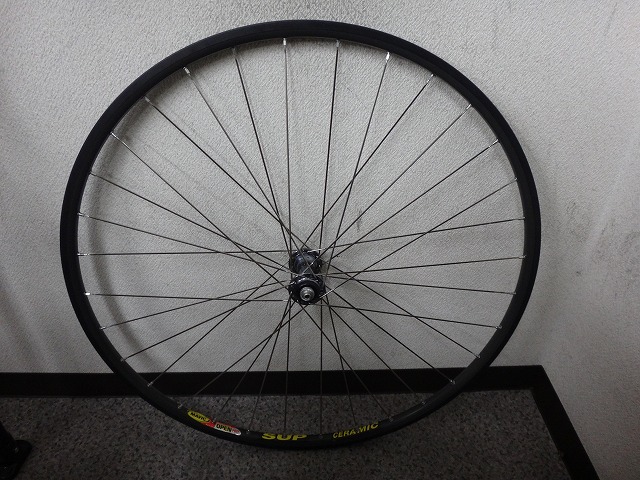
A customer brought in an Open Pro front wheel for me to work on.
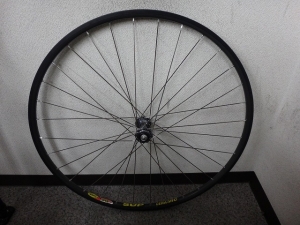
This was one I'd built myself back in the day.
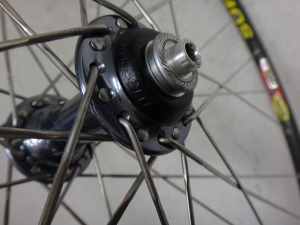
It had a Centaur Century hub, but the customer wanted the hub swapped out.
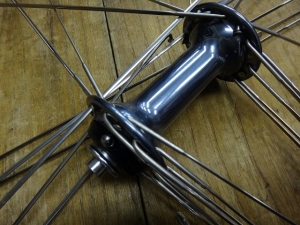
Broke it down.
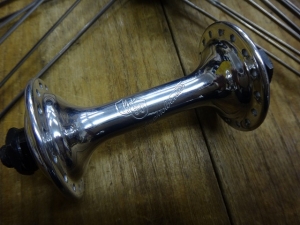
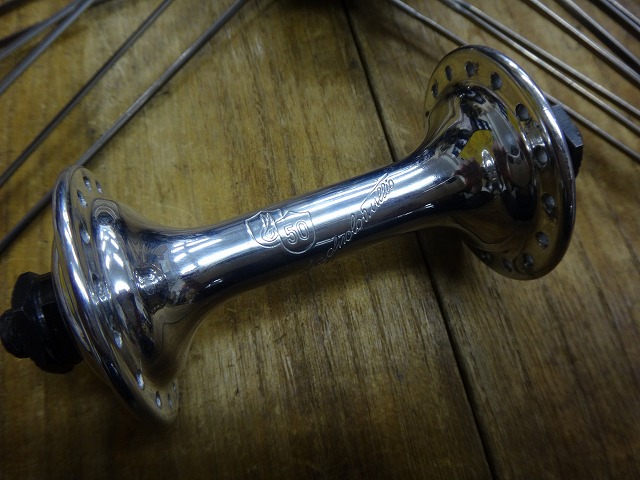
The replacement hub is
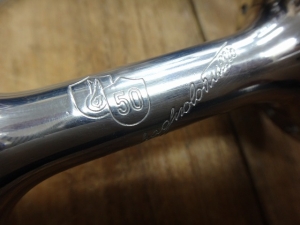
a Campagnolo 50th Anniversary front hub.
It's a 50th Anniversary Super Record, and the right crank has a serial number stamped on the back. It was originally supposed to be limited to 5,000 sets, but in reality about 15,000 sets were produced. The earlier serial number batches have relatively clean machining on the back of the crank, but later batches got rougher—sort of like the ridged finish you'd see on a nail file built into nail clippers. The value gets subdivided by serial number freshness and whether the original box is present, and as an even finer detail point, whether the diamond-shaped stamp-like "1933–1983 SEAL" is still there matters a lot. I've got the name of that seal rote-memorized as "ichi-kyuu-san-san ichi-kyuu-hachi-san seal," so I never forget Campagnolo's founding year. Plus there's a special postcard that came with it to send to Campagnolo's Italian headquarters confirming you bought a 50th Anniversary set, and if you send that in, they send you a little commemorative memento.
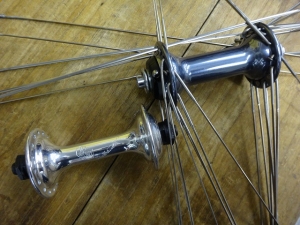
Anyway, on to the rebuild.
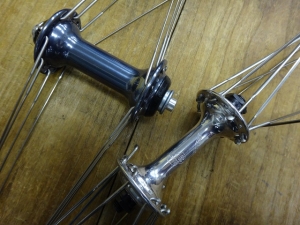
The bending marks that form just below the spoke head differ between inpokes and outpokes, so I think it reduces the risk of spoke neck failure if you thread inpokes as inpokes and outpokes as outpokes. The image above shows the stage where I'd only transferred the inpokes.
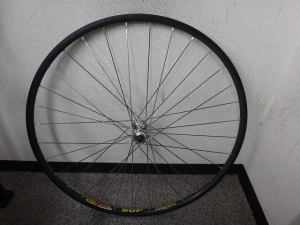
Got it built up. The spoke lengths were almost identical, so I reused the spokes. The nipples—I *could* have reused them, but I swapped them all out for new ones.
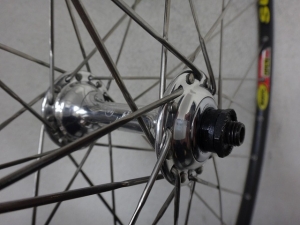
32H CX-RAY laced six-cross Italian style. The flange got pulled and the hub bearing adjustment loosened, creating radial play that wasn't there when the hub was alone. On the flip side, the Centaur Century hub's rotation got slightly stiffer once it came out of its isolated state.
This happens all the time, so you shouldn't adjust hub bearings when the hub is sitting by itself.
On a separate note: Shimano Saint and similar through-axle rear hubs actually have deliberate play built in—quite a bit of it when you look at the hub alone—but once you build it into a wheel and clamp it to the frame, it works out just right. If you don't know this and tighten out all the play, the rotation will become abnormally heavy when the frame locks it down, so watch out.
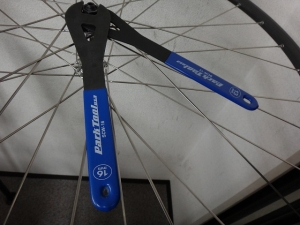
So I adjusted the bearing preload, and the cone locknut grip width came out to 16mm. That's a rare size.
This was one I'd built myself back in the day.

It had a Centaur Century hub, but the customer wanted the hub swapped out.

Broke it down.
The replacement hub is
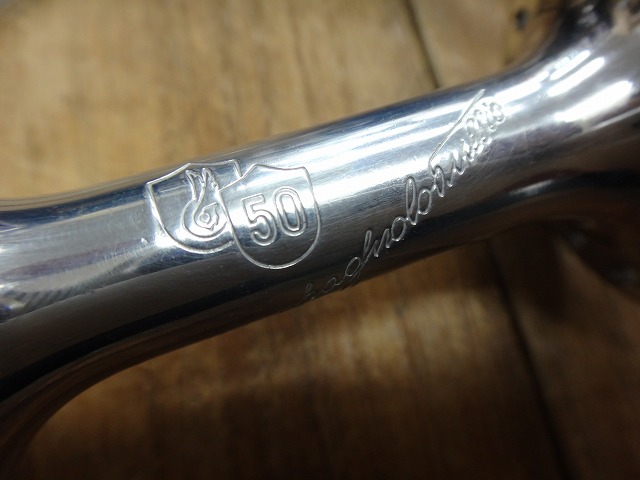
a Campagnolo 50th Anniversary front hub.
It's a 50th Anniversary Super Record, and the right crank has a serial number stamped on the back. It was originally supposed to be limited to 5,000 sets, but in reality about 15,000 sets were produced. The earlier serial number batches have relatively clean machining on the back of the crank, but later batches got rougher—sort of like the ridged finish you'd see on a nail file built into nail clippers. The value gets subdivided by serial number freshness and whether the original box is present, and as an even finer detail point, whether the diamond-shaped stamp-like "1933–1983 SEAL" is still there matters a lot. I've got the name of that seal rote-memorized as "ichi-kyuu-san-san ichi-kyuu-hachi-san seal," so I never forget Campagnolo's founding year. Plus there's a special postcard that came with it to send to Campagnolo's Italian headquarters confirming you bought a 50th Anniversary set, and if you send that in, they send you a little commemorative memento.
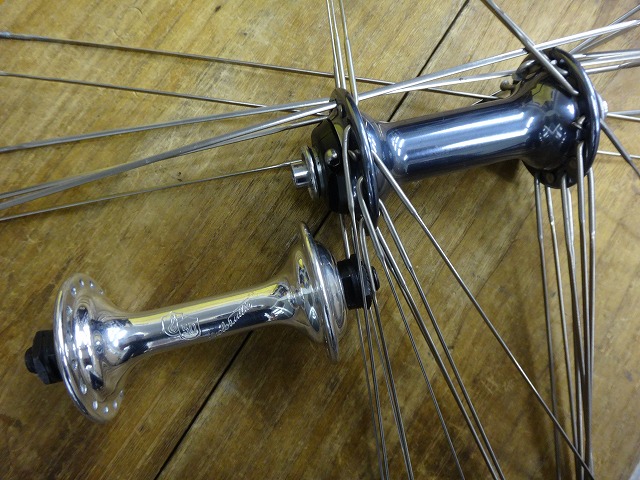
Anyway, on to the rebuild.

The bending marks that form just below the spoke head differ between inpokes and outpokes, so I think it reduces the risk of spoke neck failure if you thread inpokes as inpokes and outpokes as outpokes. The image above shows the stage where I'd only transferred the inpokes.

Got it built up. The spoke lengths were almost identical, so I reused the spokes. The nipples—I *could* have reused them, but I swapped them all out for new ones.
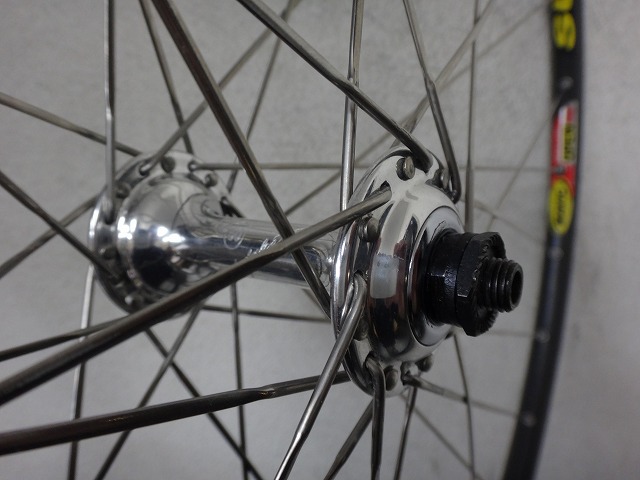
32H CX-RAY laced six-cross Italian style. The flange got pulled and the hub bearing adjustment loosened, creating radial play that wasn't there when the hub was alone. On the flip side, the Centaur Century hub's rotation got slightly stiffer once it came out of its isolated state.
This happens all the time, so you shouldn't adjust hub bearings when the hub is sitting by itself.
On a separate note: Shimano Saint and similar through-axle rear hubs actually have deliberate play built in—quite a bit of it when you look at the hub alone—but once you build it into a wheel and clamp it to the frame, it works out just right. If you don't know this and tighten out all the play, the rotation will become abnormally heavy when the frame locks it down, so watch out.

So I adjusted the bearing preload, and the cone locknut grip width came out to 16mm. That's a rare size.