In my previous post, I mentioned that if you send the postcard included with the Campagnolo 50th anniversary component set to their headquarters,
you'll receive a "gift,"
but I received a comment saying that since "gift" is a humble expression,
something like "commemorative item" would be more appropriate.
That's true, isn't it.
It does sound like the receiver is writing "Here's something rather trivial..."
Let me correct that.
Thank you for the comment.
So, about that commemorative item—but first, a bit of context.
In Europe, when releasing anniversary models, companies often mark milestones not just at every ten years,
but also at every twenty-five years.
(In the case of the 50th anniversary, both conditions apply)
So Dura-Ace anniversary models also come in 25-year editions,
and for Campagnolo, it's the 50th and 75th anniversaries.
Now that I think about it, the old Sugino 75 component set
was also released as a Sugino company 75th anniversary edition.
The Sugino 75 also came with a postcard for return to the factory, and
if you sent it in, your name as a Sugino 75 purchaser would be engraved
forever on a relief sculpture at Sugino's headquarters,
but since Sugino later dishonored checks and went bankrupt,
I have no idea what happened to that relief.
Today's Sugino (Sugino Engineering) continues the historical lineage,
but it's a rebuilt company.
Regarding Campagnolo's components, the rear brake comes in
two specs: dual-pivot type and single-pivot type.
The single-pivot type is sometimes called a skeleton brake or D-skeleton,
where the "D" in D-skeleton stands for "differential" (difference),
and according to Campagnolo, since the braking force ratio is 7:3 between front and rear,
they made the single-pivot brake available as an option to reduce stopping power in the rear to prevent locking,
while also achieving weight reduction.
I just wrote "made the single-pivot brake available as an option," but
phrasing it that way means the D-skeleton brake is merely optional,
and the standard spec for the rear brake is actually the dual-pivot type.
The fact that lower-tier component groups only have dual-pivot rear brakes
seems to support this,
though cost considerations may also play a role.
(Simply changing the length of the mounting shaft creates the front/rear distinction)
However, with most distributors in Japan,
if you order components without specifying the brake type,
the rear brake will be D-skeleton.
(I don't know if this is still the case, but one distributor in Nara Prefecture
always used dual-pivot brakes)
This reflects the distributors' consideration that "most users probably prefer D-skeleton,"
but for Campagnolo, the D-skeleton remains
treated as an option only.
...One piece of evidence supporting this theory is the 75th anniversary component set.
The 75th anniversary rear brake comes only in dual-pivot spec,
so it proves that Campagnolo's standard spec is the dual-pivot type.
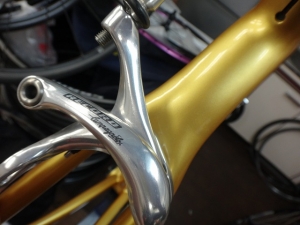
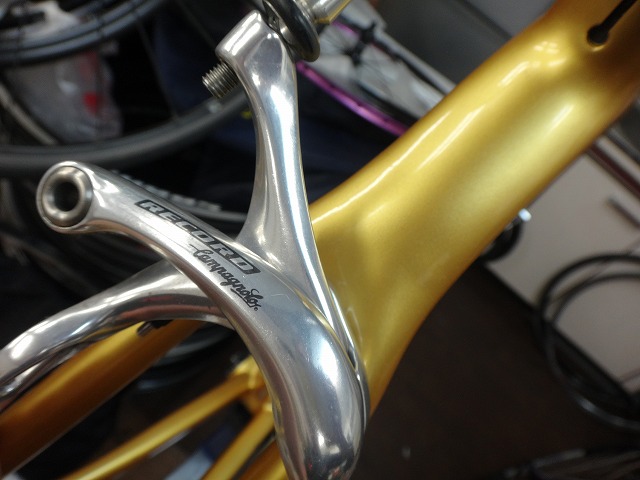
With Campagnolo's dual-pivot brake,
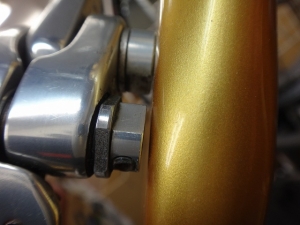
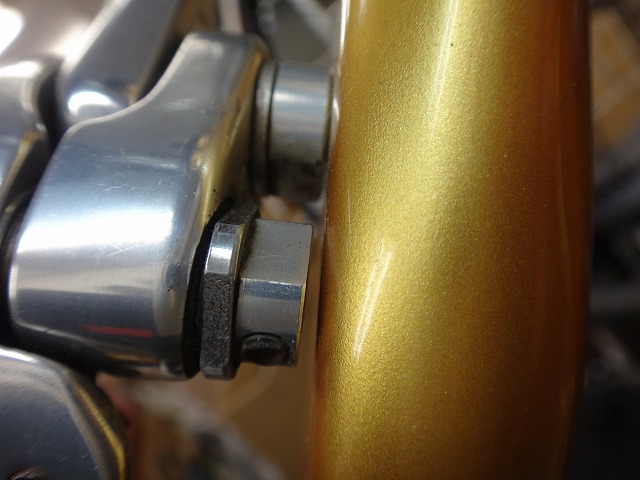
the mounting bolt between the part connecting the Y-arm and C-arm
and the C-arm itself is quite long,
and on some frames it causes interference.
In practice, from the state shown in the image you'd insert
one or more serrated washers onto the brake mounting shaft,
so there should be more clearance than this, but even with that,
there have been actual cases where the 75th anniversary rear brake couldn't be installed.
With the brake in the image,
play is taken up with two square nuts plus a fixing Allen key,
but with earlier Record models, it was a single nut type.
Back in the day, Banesto team bikes had the nut here
replaced with a titanium version about two-thirds the thickness,
but that's because Banesto director Manolo Saiz was a real gear geek.
Even the original Giant frames back then didn't have interference issues,
so apart from weight reduction, there was no reason to swap in a thinner nut.
Speaking of Manolo Saiz, he'd put hollowed-out Record aluminum cranks on
Laurent Jalabert's Banesto-era bike,
but he also made non-weight-related modifications like painting the "Record" lettering gold
on Joseba Beloki's bike and painting the Campagnolo component lettering blue
on the BH that came with Liberti Segurós,
so he's definitely more of a gear geek than a weight weenie.
He was arrested after his athlete doping scheme was exposed.
Okay, that was all just preamble.
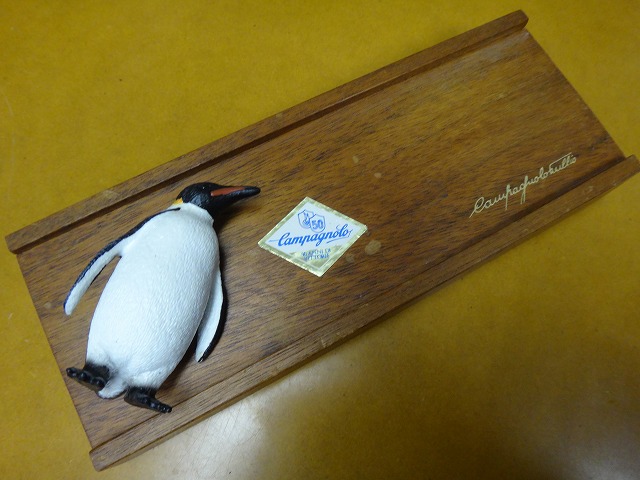
As for the commemorative item you get when you send the postcard included with the 50th anniversary set to headquarters,
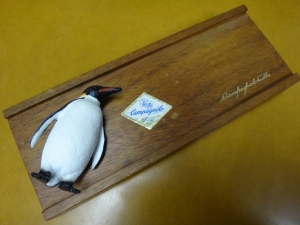
↑This is it.
I grabbed this image from something floating around online,
so I don't actually own one myself.
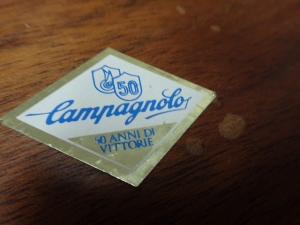
50th Anniversary
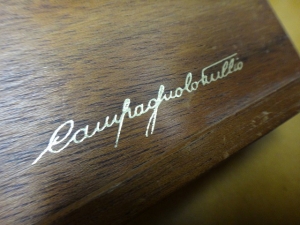
The signature "Campagnolo Tulio" of Tulio Campagnolo is
printed on the box, and it's the same as the engraving on the components.
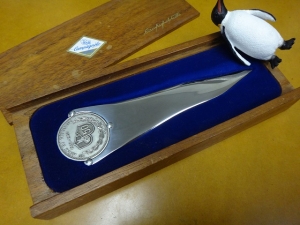
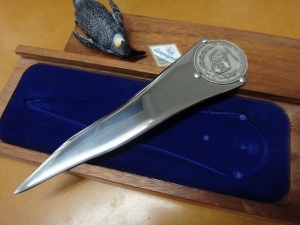
Inside is a letter opener.
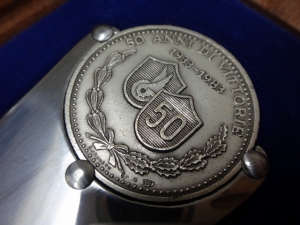
A medal engraved with the 50th anniversary mark is riveted on,
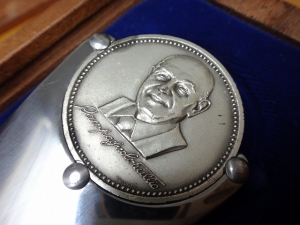
and the reverse side features a portrait of Tulio Campagnolo.
・Attack Power +30
・Occasionally attacks twice
Tulio's face seems to shimmer on the velvet lining the case
like a Holy Shroud,
but pay no attention to that.
you'll receive a "gift,"
but I received a comment saying that since "gift" is a humble expression,
something like "commemorative item" would be more appropriate.
That's true, isn't it.
It does sound like the receiver is writing "Here's something rather trivial..."
Let me correct that.
Thank you for the comment.
So, about that commemorative item—but first, a bit of context.
In Europe, when releasing anniversary models, companies often mark milestones not just at every ten years,
but also at every twenty-five years.
(In the case of the 50th anniversary, both conditions apply)
So Dura-Ace anniversary models also come in 25-year editions,
and for Campagnolo, it's the 50th and 75th anniversaries.
Now that I think about it, the old Sugino 75 component set
was also released as a Sugino company 75th anniversary edition.
The Sugino 75 also came with a postcard for return to the factory, and
if you sent it in, your name as a Sugino 75 purchaser would be engraved
forever on a relief sculpture at Sugino's headquarters,
but since Sugino later dishonored checks and went bankrupt,
I have no idea what happened to that relief.
Today's Sugino (Sugino Engineering) continues the historical lineage,
but it's a rebuilt company.
Regarding Campagnolo's components, the rear brake comes in
two specs: dual-pivot type and single-pivot type.
The single-pivot type is sometimes called a skeleton brake or D-skeleton,
where the "D" in D-skeleton stands for "differential" (difference),
and according to Campagnolo, since the braking force ratio is 7:3 between front and rear,
they made the single-pivot brake available as an option to reduce stopping power in the rear to prevent locking,
while also achieving weight reduction.
I just wrote "made the single-pivot brake available as an option," but
phrasing it that way means the D-skeleton brake is merely optional,
and the standard spec for the rear brake is actually the dual-pivot type.
The fact that lower-tier component groups only have dual-pivot rear brakes
seems to support this,
though cost considerations may also play a role.
(Simply changing the length of the mounting shaft creates the front/rear distinction)
However, with most distributors in Japan,
if you order components without specifying the brake type,
the rear brake will be D-skeleton.
(I don't know if this is still the case, but one distributor in Nara Prefecture
always used dual-pivot brakes)
This reflects the distributors' consideration that "most users probably prefer D-skeleton,"
but for Campagnolo, the D-skeleton remains
treated as an option only.
...One piece of evidence supporting this theory is the 75th anniversary component set.
The 75th anniversary rear brake comes only in dual-pivot spec,
so it proves that Campagnolo's standard spec is the dual-pivot type.
With Campagnolo's dual-pivot brake,
the mounting bolt between the part connecting the Y-arm and C-arm
and the C-arm itself is quite long,
and on some frames it causes interference.
In practice, from the state shown in the image you'd insert
one or more serrated washers onto the brake mounting shaft,
so there should be more clearance than this, but even with that,
there have been actual cases where the 75th anniversary rear brake couldn't be installed.
With the brake in the image,
play is taken up with two square nuts plus a fixing Allen key,
but with earlier Record models, it was a single nut type.
Back in the day, Banesto team bikes had the nut here
replaced with a titanium version about two-thirds the thickness,
but that's because Banesto director Manolo Saiz was a real gear geek.
Even the original Giant frames back then didn't have interference issues,
so apart from weight reduction, there was no reason to swap in a thinner nut.
Speaking of Manolo Saiz, he'd put hollowed-out Record aluminum cranks on
Laurent Jalabert's Banesto-era bike,
but he also made non-weight-related modifications like painting the "Record" lettering gold
on Joseba Beloki's bike and painting the Campagnolo component lettering blue
on the BH that came with Liberti Segurós,
so he's definitely more of a gear geek than a weight weenie.
Okay, that was all just preamble.
As for the commemorative item you get when you send the postcard included with the 50th anniversary set to headquarters,
↑This is it.
I grabbed this image from something floating around online,
so I don't actually own one myself.
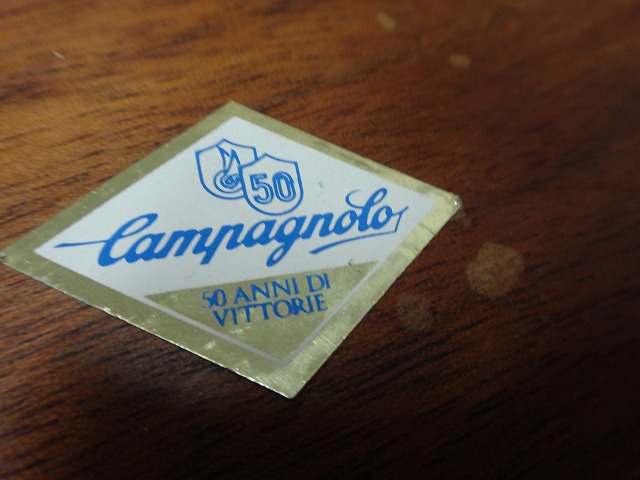
50th Anniversary
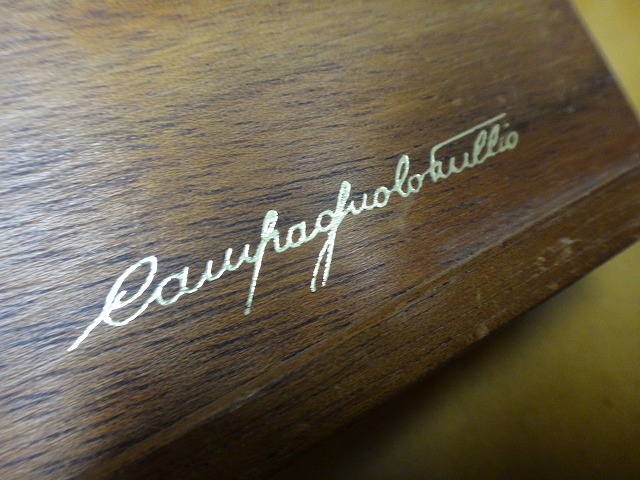
The signature "Campagnolo Tulio" of Tulio Campagnolo is
printed on the box, and it's the same as the engraving on the components.
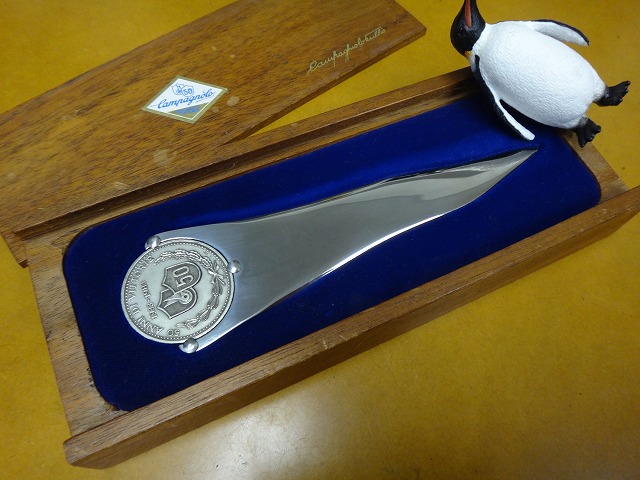
Inside is a letter opener.

A medal engraved with the 50th anniversary mark is riveted on,
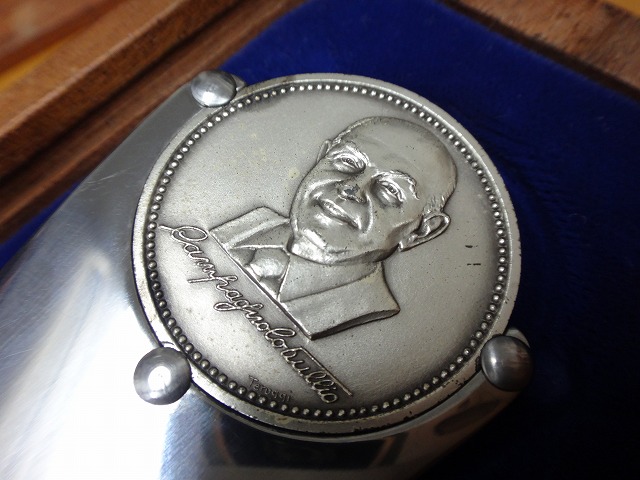
and the reverse side features a portrait of Tulio Campagnolo.

・Attack Power +30
・Occasionally attacks twice
Tulio's face seems to shimmer on the velvet lining the case
like a Holy Shroud,
but pay no attention to that.