I bought the Cat Eye HL-EL1010.

The pet name VOLT1600 seems to be more commonly used.
In the image above, the left one is the VOLT1200 I've been using until now,
so I'll be calling them the 1200 and 1600 respectively from here on.

When I first saw the photos, the 1600 looked slimmer,
but that was just because the body is longer.
The distance from the battery-to-body junction to the control button is the same,
so it's the part beyond that which is extended.

The 1600 is brighter than the 1200.
The 1200 is already quite bright, but I was surprised at how much brighter the 1600 is.
I'd like to end my impressions here,
but the usability has changed somewhat, so let me write about that.

↑First, here are the official rated continuous run times.
From my actual usage, it seems to last a bit longer than advertised,
but that's probably the humble way Japanese companies present their specs.
The names of the lighting modes have changed,
but the 1600 mode names are clearer, so there's no issue.
One of these modes is called Hyper Constant,
which is a mode where the light flashes periodically while remaining lit.
As I've mentioned before, because of this feature where it's lit with periodic flashes,
there's no moment when it's off, so it technically meets the legal requirement of a front headlight being on,
while at the same time being able to draw more attention than normal continuous lighting...
but honestly, I don't see the point of it.
Since the flash is quite bright, if you use Hyper Constant on a roadside where cars are driving,
it looks like you're flashing them aggressively,
and I think it's blinding and dangerous for the driver (and risky for both of us).
On the other hand, if you use it on dark roads or mountain roads without street lights,
the bumps and unevenness in the ground are harder to distinguish than with normal continuous lighting,
so you're less likely to notice sudden potholes or obstacles,
which makes it actually more dangerous as a headlight.
I'm sure some of you might say, "Actually, Hyper Constant is extremely useful for brevets,
and it's the mode I use most!"
If that's the case, please forgive my lack of knowledge on the subject.

First, how I use the 1200.
Long press turns on/off, short press switches modes.
For my usage, I only need to switch between Dynamic and All Night,
but to get from All Night to Dynamic,
I have to go through Hyper Constant.
In situations where this might bother drivers around me,
I cover the light with my hand while pressing the button
to skip past Hyper Constant.
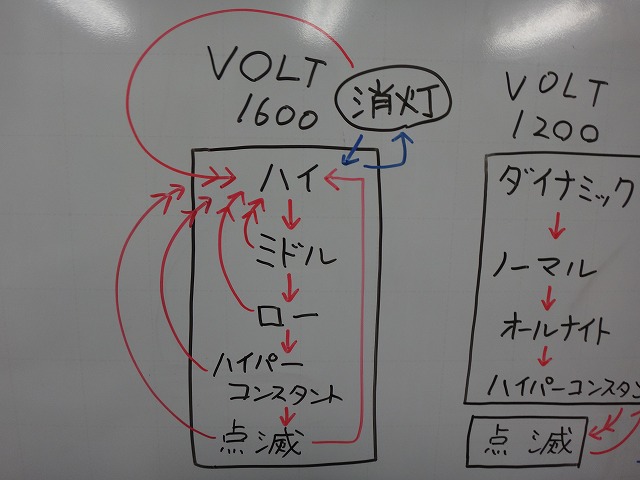
The diagram above doesn't show an arrow to switch to flashing, but

you can switch to flashing by double-clicking from the normal cycling mode.
To return from flashing, you short press. Double-clicking doesn't do anything.
So with the 1200, flashing mode never activates
unless you intentionally double-click.

It's written in the manual but not widely known:
if you double-click the 1200 from the off state, it starts in flashing mode.

Now for the 1600.
Since flashing is now part of the cycling modes,
the operation procedure is simpler.
But this is the tricky part for me—
to switch from Low to High, I have to go through both Hyper Constant
and flashing.
I thought this was really annoying, but then
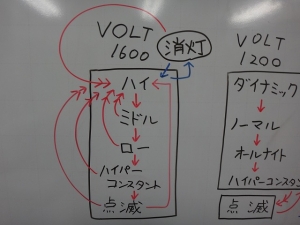
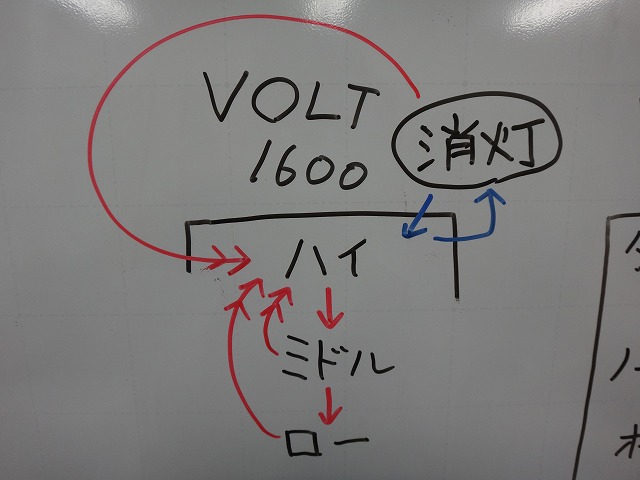
with the 1600, double-clicking from any state except High (including from off) switches directly to High,
and once you know this,

for my usage, I only need these modes for switching.
Once I figured this out, the usability became much better.
(For both 1200 and 1600, if you long-press to turn on,
they light up in the mode you were in when you last turned them off)
Edit: There's a correction post (→here)
One more request or gripe:
since it uses USB charging rather than an AC adapter,
theoretically you should be able to download dedicated software, connect to the unit, and customize the functionality.
For example, being able to skip unused modes,
or with the 1600, being able to set High, Middle, and Low to any brightness you want in 200 lumen increments up to 1600 lumens,
or being able to see the number of charge-discharge cycles.
Speaking of charge-discharge cycles, electric-assist bicycles have batteries
where you can generally check this with a button operation—
it's not widely known, kind of like a secret mode.
Both the 1200 and 1600 are rated to drop to 70% of nominal capacity after 300 cycles,
but currently my 1200 is around that cycle count and
the continuous run time is just slightly shorter than the new unit's rated time,
which I'm very satisfied with.

I'm giving the 1200 to someone I've been indebted to,
so I'll replace the battery with a new one first.
Unlike the Volt 300-type light, replacement requires tools,
but this cockroach-egg system (worst name ever)
is actually very well designed.
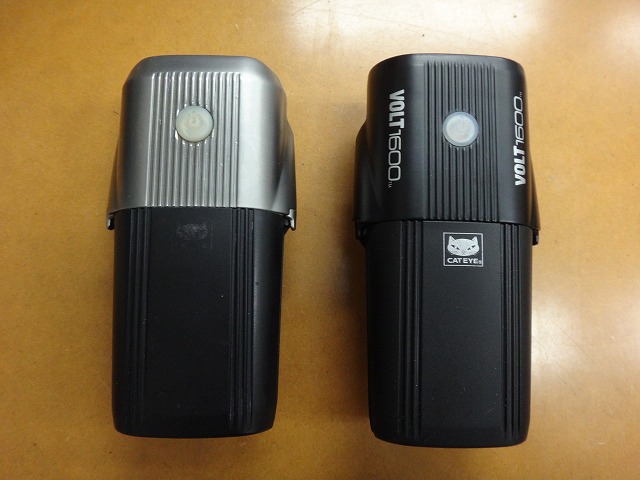
The pet name VOLT1600 seems to be more commonly used.
In the image above, the left one is the VOLT1200 I've been using until now,
so I'll be calling them the 1200 and 1600 respectively from here on.
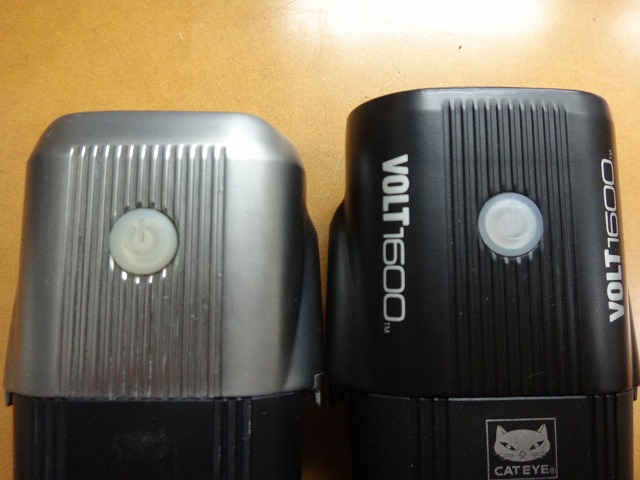
When I first saw the photos, the 1600 looked slimmer,
but that was just because the body is longer.
The distance from the battery-to-body junction to the control button is the same,
so it's the part beyond that which is extended.
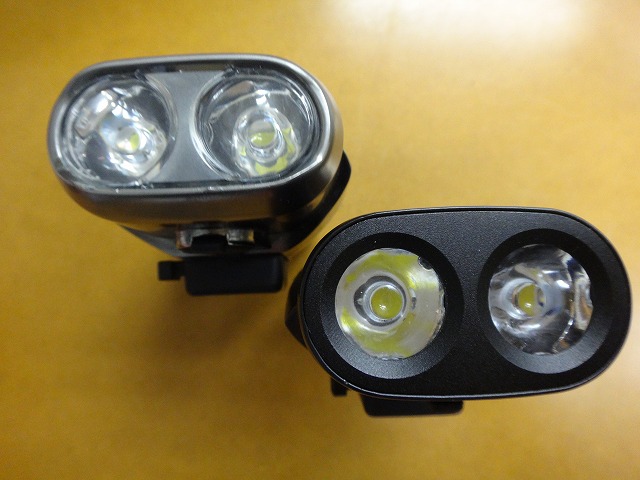
The 1600 is brighter than the 1200.
The 1200 is already quite bright, but I was surprised at how much brighter the 1600 is.
I'd like to end my impressions here,
but the usability has changed somewhat, so let me write about that.
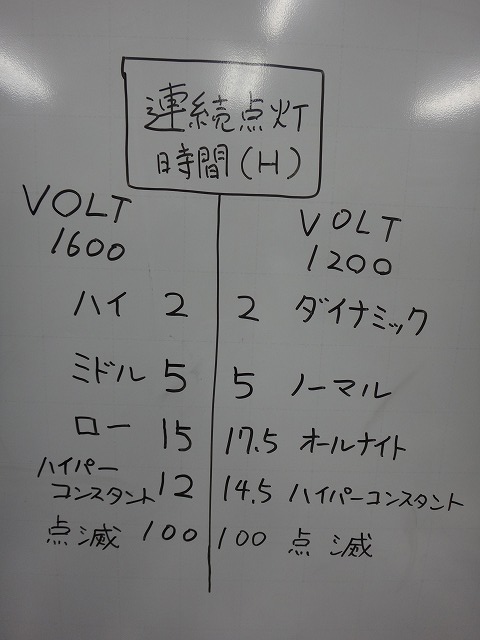
↑First, here are the official rated continuous run times.
From my actual usage, it seems to last a bit longer than advertised,
but that's probably the humble way Japanese companies present their specs.
The names of the lighting modes have changed,
but the 1600 mode names are clearer, so there's no issue.
One of these modes is called Hyper Constant,
which is a mode where the light flashes periodically while remaining lit.
As I've mentioned before, because of this feature where it's lit with periodic flashes,
there's no moment when it's off, so it technically meets the legal requirement of a front headlight being on,
while at the same time being able to draw more attention than normal continuous lighting...
but honestly, I don't see the point of it.
Since the flash is quite bright, if you use Hyper Constant on a roadside where cars are driving,
it looks like you're flashing them aggressively,
and I think it's blinding and dangerous for the driver (and risky for both of us).
On the other hand, if you use it on dark roads or mountain roads without street lights,
the bumps and unevenness in the ground are harder to distinguish than with normal continuous lighting,
so you're less likely to notice sudden potholes or obstacles,
which makes it actually more dangerous as a headlight.
I'm sure some of you might say, "Actually, Hyper Constant is extremely useful for brevets,
and it's the mode I use most!"
If that's the case, please forgive my lack of knowledge on the subject.
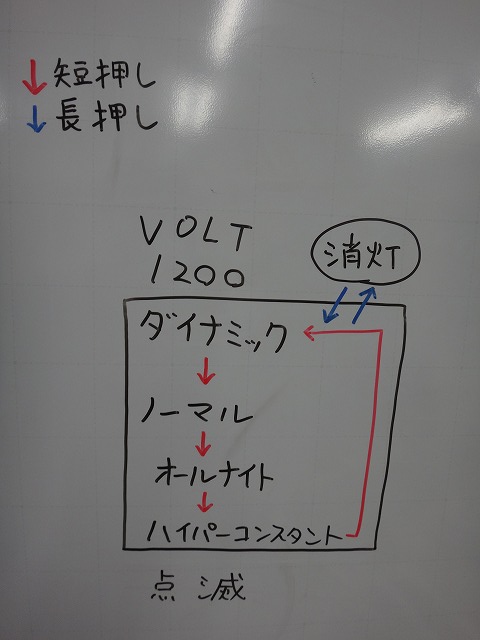
First, how I use the 1200.
Long press turns on/off, short press switches modes.
For my usage, I only need to switch between Dynamic and All Night,
but to get from All Night to Dynamic,
I have to go through Hyper Constant.
In situations where this might bother drivers around me,
I cover the light with my hand while pressing the button
to skip past Hyper Constant.
The diagram above doesn't show an arrow to switch to flashing, but
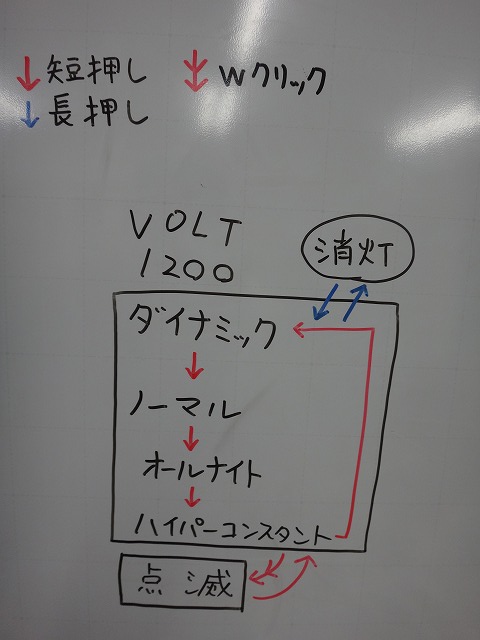
you can switch to flashing by double-clicking from the normal cycling mode.
To return from flashing, you short press. Double-clicking doesn't do anything.
So with the 1200, flashing mode never activates
unless you intentionally double-click.
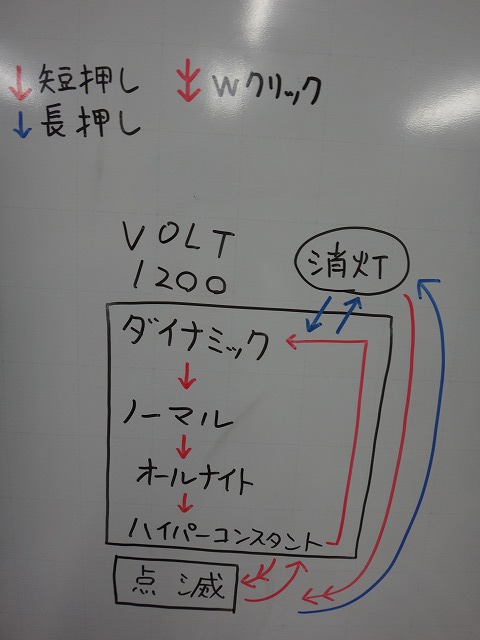
It's written in the manual but not widely known:
if you double-click the 1200 from the off state, it starts in flashing mode.

Now for the 1600.
Since flashing is now part of the cycling modes,
the operation procedure is simpler.
But this is the tricky part for me—
to switch from Low to High, I have to go through both Hyper Constant
and flashing.
I thought this was really annoying, but then
with the 1600, double-clicking from any state except High (including from off) switches directly to High,
and once you know this,
for my usage, I only need these modes for switching.
Once I figured this out, the usability became much better.
(For both 1200 and 1600, if you long-press to turn on,
they light up in the mode you were in when you last turned them off)
Edit: There's a correction post (→here)
One more request or gripe:
since it uses USB charging rather than an AC adapter,
theoretically you should be able to download dedicated software, connect to the unit, and customize the functionality.
For example, being able to skip unused modes,
or with the 1600, being able to set High, Middle, and Low to any brightness you want in 200 lumen increments up to 1600 lumens,
or being able to see the number of charge-discharge cycles.
Speaking of charge-discharge cycles, electric-assist bicycles have batteries
where you can generally check this with a button operation—
it's not widely known, kind of like a secret mode.
Both the 1200 and 1600 are rated to drop to 70% of nominal capacity after 300 cycles,
but currently my 1200 is around that cycle count and
the continuous run time is just slightly shorter than the new unit's rated time,
which I'm very satisfied with.

I'm giving the 1200 to someone I've been indebted to,
so I'll replace the battery with a new one first.
Unlike the Volt 300-type light, replacement requires tools,
but this cockroach-egg system (worst name ever)
is actually very well designed.