From WolfTooth, famous for single-chainring rings,

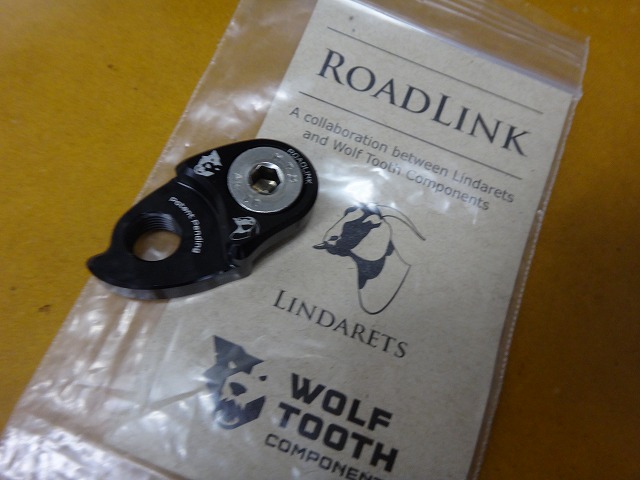
there's a part called RoadLink.
WolfTooth's DropStop (™) chainrings for single-speeds
have tooth profiles alternating to match both the outer and inner links of the chain,
which makes it almost impossible for the chain to drop off.
(The structure inevitably results in an even number of teeth)
I suspect that's where the name came from—wolf teeth—since that was probably their founding product,
but lately they've been making all kinds of niche component parts.
One of them is a part called GoatLink,
which attaches to the pivot section of Shimano MTB rear derailleurs.
The name's probably a play on the wolf branding—they went with a goat.
And in the same spirit, but for road bikes,
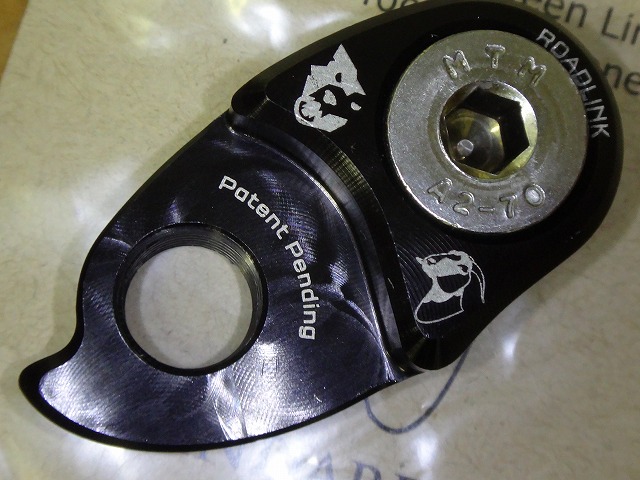
there's the RoadLink—that's the part in the image above.

↑Like this
Shimano road bike rear derailleurs
usually support a maximum sprocket size of 28T or 30T,
but by lowering the derailleur position with a RoadLink,
it becomes compatible with MTB sprockets,
allowing you to support up to 40T maximum.

↑Image from the manufacturer's website.
It doesn't support triple chainrings.
The front chainring must be either single or double.
About maximum sprocket sizes with 10-speed cassettes:
11–32T → no RoadLink needed; just use a mid-cage derailleur and you're good
11–34T or 36T → compatible with single or double
11–40T → compatible with single or double,
but the chainring tooth difference must be 14T max (e.g., 48–34T)
11–42T → not compatible
About maximum sprocket sizes with 11-speed cassettes:
11–32T → no RoadLink needed; just use a mid-cage derailleur and you're good
11–36T → compatible with single or double
11–40T → compatible with single or double,
but the chainring tooth difference must be 14T max (e.g., 48–34T)
11–42T → not compatible
10–42T → not compatible
That's how it breaks down.
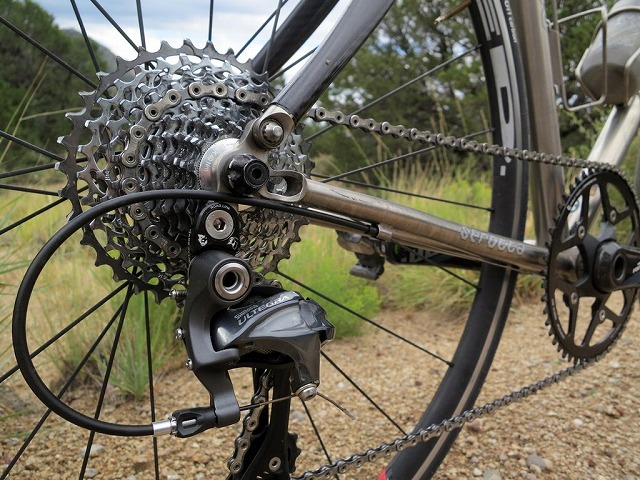
The intended use case is more like running a front single-speed cyclocross bike
the way you'd run a front single-speed MTB.
The image above is exactly that kind of setup.

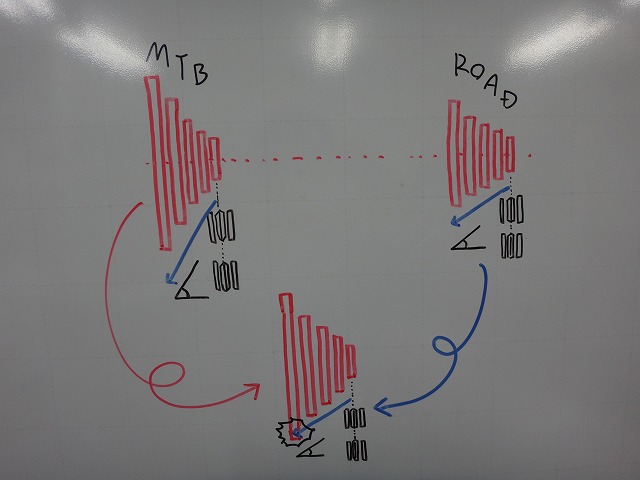
Road bike and MTB rear derailleurs
have different angles (slant angles) at which the parallelogram moves toward the low gear.
The slant angle is designed so that the spacing between the sprocket teeth and upper pulley
stays roughly equal across all gears,
but when you combine an MTB sprocket with a road bike derailleur,
as you shift toward the low gear, the gap between the teeth and pulley gets tighter,
and at the low gear or the gear before it, the sprocket and pulley interfere.
Obvious point: the RoadLink can't change the slant angle.
It just increases the spacing between the low gear and pulley.
So on the top gear side, the gap between sprocket and pulley becomes much larger
than Shimano intended, and shifting performance definitely drops.

Component manufacturers set specific rear-end dimension requirements
that they ask frame makers to follow.
If a frame deviates from this, the original shifting performance isn't guaranteed.
(Honestly, quite a few frames are out of spec,
but the bigger issue is that aero bikes often have
rear centers (chainstay length) of 405mm or less)
With a RoadLink, the measured length increases by 22mm,
so shifting performance definitely gets worse.
Unless you absolutely need a massive low gear
on a road bike or cyclocross bike, I wouldn't recommend it.
Since this RoadLink wasn't purchased as merchandise for the shop,
I'm writing pretty freely here.

I mounted an 11–36T on the opposite side of the dual freebody that has 14–25T.
Both are 10-speed cassettes.

I installed a RoadLink.
I installed a RoadLink.
I installed a RoadLink.
I installed a RoadLink.

Hmm?


Gallian Sword
When you stack RoadLinks, the rear end repeats,
so I figured it'd mostly extend straight down,

but when you actually jam it all the way back and lock it down,

you get this,

and the arc ends up tighter than I expected.

Since shifting performance drops pretty noticeably,
you should stick to using just one RoadLink.
The manufacturer's site had no warnings about using two or more
(naturally).

I adjusted the virtual length to roughly match what it'd be with a real chain.

The Poop-Hair Gauge X (→here) is a really useful tool.

↑Without the RoadLink
The pulley and sprocket are interfering heavily.

↑With the RoadLink (just one, by the way)
There is definitely a gap now. With a max gear of 36T,
you can't manage it with just the B-tension adjustment bolt.

I hooked up the chain for real.

Pretty similar to before.
Actually, I could tighten it up another link (2 links total),
but I prefer a bit of slack in the chain tension when on the low gear,
so I'm leaving it a link long.

And then I shifted to the top gear.
There's quite a bit of space between the pulley and sprocket.

Earlier I said the RoadLink adds 22mm in length,
but the line from the rear hub axle to the derailleur mounting hole
doesn't extend straight—
it bends to roughly the angle of Orion's three stars.
The 22mm is pretty extreme, so whether the three points are collinear
is kind of a minor detail.
To make chain drops less likely,
this cyclocross bike's chainring uses thin track cog teeth.
Thick teeth just won't pull in 10-speed chain.
With a Suntour Superb Pro 144mm PCD track crank
and a 45T Dura-Ace track thin ring,
the low gear 45×36T is roughly equivalent to 39×31T or 34T×27T,
and the top gear 45×11T is roughly equivalent to 53×13T or 50×12T.
It's set up so you get the upper and lower gear-ratio limits
of a typical compact 50–34T crank paired with a 12–27T cassette,
but naturally the spacing between each shift gets pretty coarse.
To belabor the point: shifting performance is definitely compromised,
so unless you can find some other benefit—separate from that—
you might give the RoadLink a try.
there's a part called RoadLink.
WolfTooth's DropStop (™) chainrings for single-speeds
have tooth profiles alternating to match both the outer and inner links of the chain,
which makes it almost impossible for the chain to drop off.
(The structure inevitably results in an even number of teeth)
I suspect that's where the name came from—wolf teeth—since that was probably their founding product,
but lately they've been making all kinds of niche component parts.
One of them is a part called GoatLink,
which attaches to the pivot section of Shimano MTB rear derailleurs.
The name's probably a play on the wolf branding—they went with a goat.
And in the same spirit, but for road bikes,
there's the RoadLink—that's the part in the image above.
↑Like this
Shimano road bike rear derailleurs
usually support a maximum sprocket size of 28T or 30T,
but by lowering the derailleur position with a RoadLink,
it becomes compatible with MTB sprockets,
allowing you to support up to 40T maximum.
↑Image from the manufacturer's website.
It doesn't support triple chainrings.
The front chainring must be either single or double.
About maximum sprocket sizes with 10-speed cassettes:
11–32T → no RoadLink needed; just use a mid-cage derailleur and you're good
11–34T or 36T → compatible with single or double
11–40T → compatible with single or double,
but the chainring tooth difference must be 14T max (e.g., 48–34T)
11–42T → not compatible
About maximum sprocket sizes with 11-speed cassettes:
11–32T → no RoadLink needed; just use a mid-cage derailleur and you're good
11–36T → compatible with single or double
11–40T → compatible with single or double,
but the chainring tooth difference must be 14T max (e.g., 48–34T)
11–42T → not compatible
10–42T → not compatible
That's how it breaks down.
The intended use case is more like running a front single-speed cyclocross bike
the way you'd run a front single-speed MTB.
The image above is exactly that kind of setup.
Road bike and MTB rear derailleurs
have different angles (slant angles) at which the parallelogram moves toward the low gear.
The slant angle is designed so that the spacing between the sprocket teeth and upper pulley
stays roughly equal across all gears,
but when you combine an MTB sprocket with a road bike derailleur,
as you shift toward the low gear, the gap between the teeth and pulley gets tighter,
and at the low gear or the gear before it, the sprocket and pulley interfere.
Obvious point: the RoadLink can't change the slant angle.
It just increases the spacing between the low gear and pulley.
So on the top gear side, the gap between sprocket and pulley becomes much larger
than Shimano intended, and shifting performance definitely drops.

Component manufacturers set specific rear-end dimension requirements
that they ask frame makers to follow.
If a frame deviates from this, the original shifting performance isn't guaranteed.
(Honestly, quite a few frames are out of spec,
but the bigger issue is that aero bikes often have
rear centers (chainstay length) of 405mm or less)
With a RoadLink, the measured length increases by 22mm,
so shifting performance definitely gets worse.
Unless you absolutely need a massive low gear
on a road bike or cyclocross bike, I wouldn't recommend it.
Since this RoadLink wasn't purchased as merchandise for the shop,
I'm writing pretty freely here.
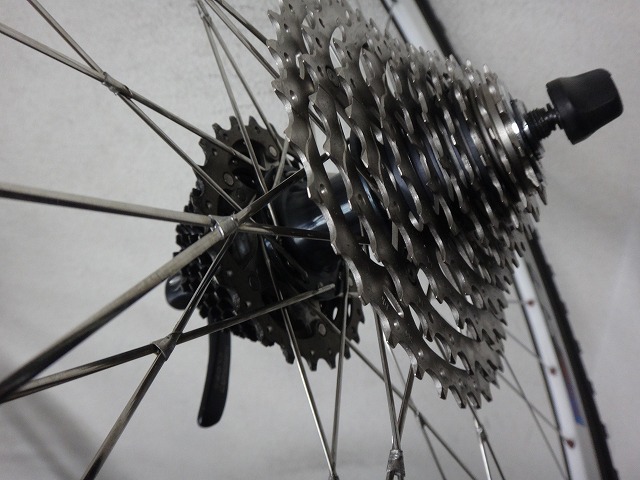
I mounted an 11–36T on the opposite side of the dual freebody that has 14–25T.
Both are 10-speed cassettes.

I installed a RoadLink.
I installed a RoadLink.
I installed a RoadLink.
I installed a RoadLink.
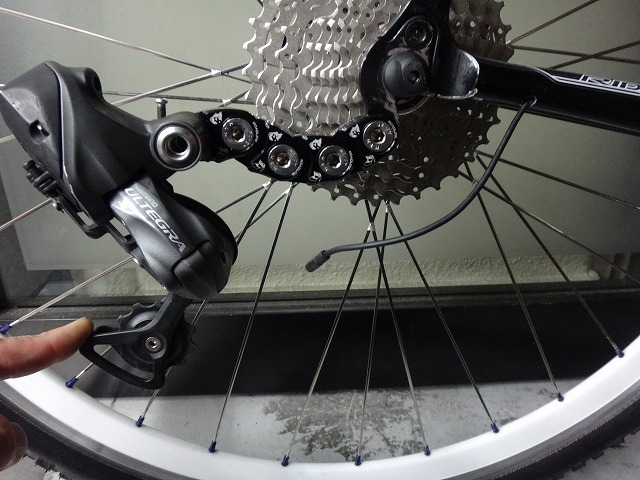
Hmm?

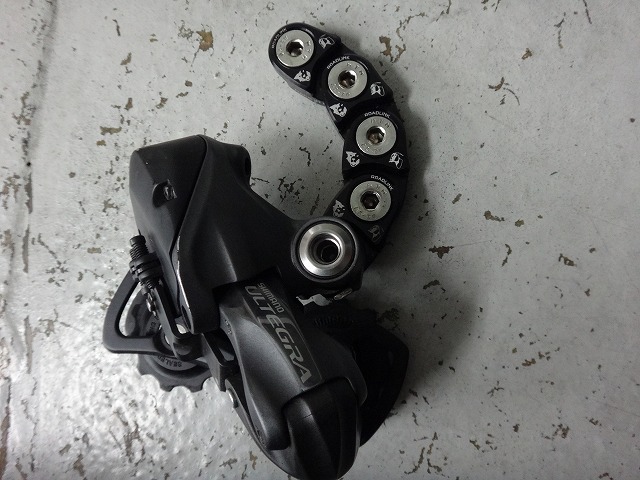
When you stack RoadLinks, the rear end repeats,
so I figured it'd mostly extend straight down,

but when you actually jam it all the way back and lock it down,
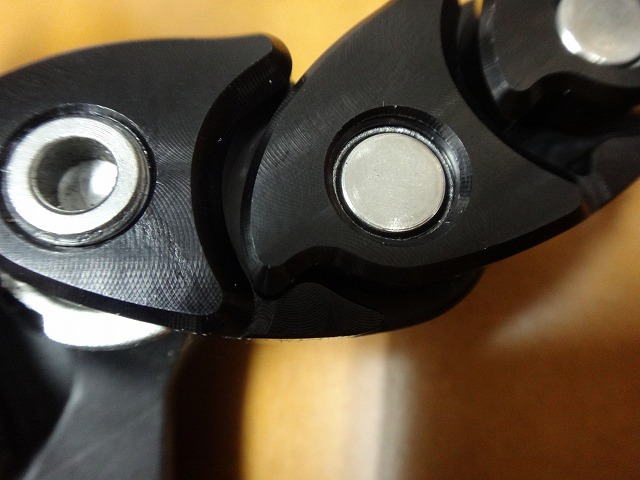
you get this,
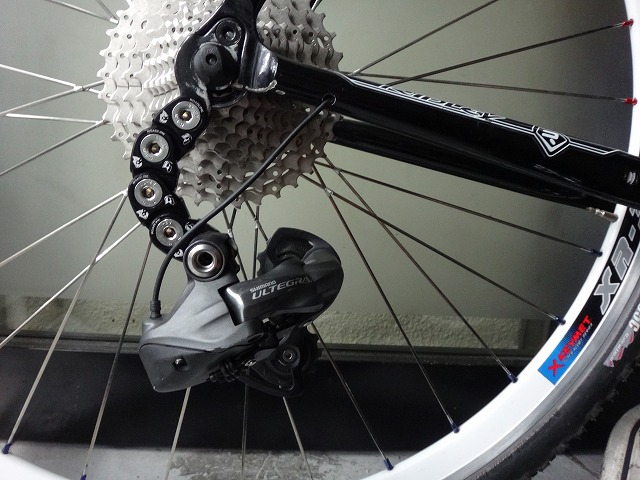
and the arc ends up tighter than I expected.
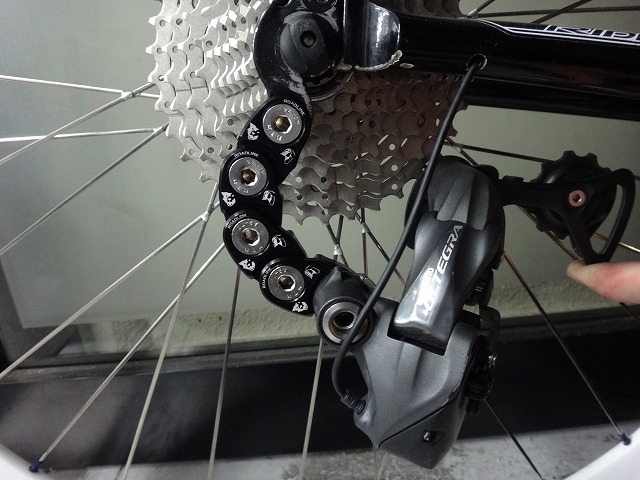
Since shifting performance drops pretty noticeably,
you should stick to using just one RoadLink.
The manufacturer's site had no warnings about using two or more
(naturally).
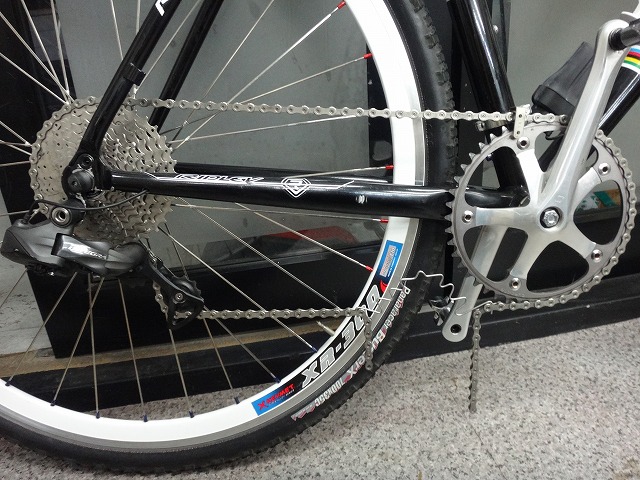
I adjusted the virtual length to roughly match what it'd be with a real chain.
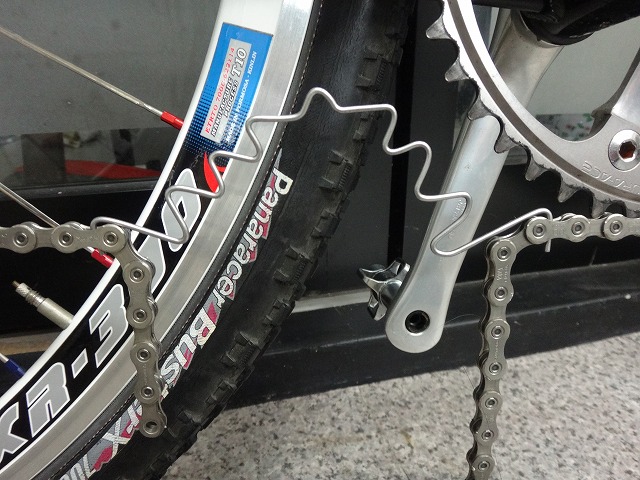
The Poop-Hair Gauge X (→here) is a really useful tool.
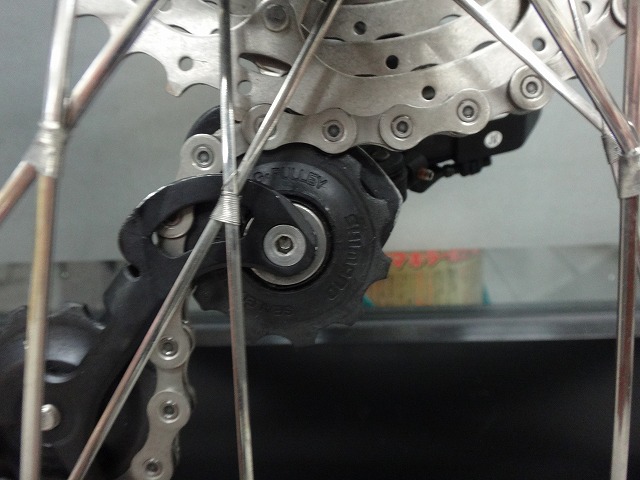
↑Without the RoadLink
The pulley and sprocket are interfering heavily.
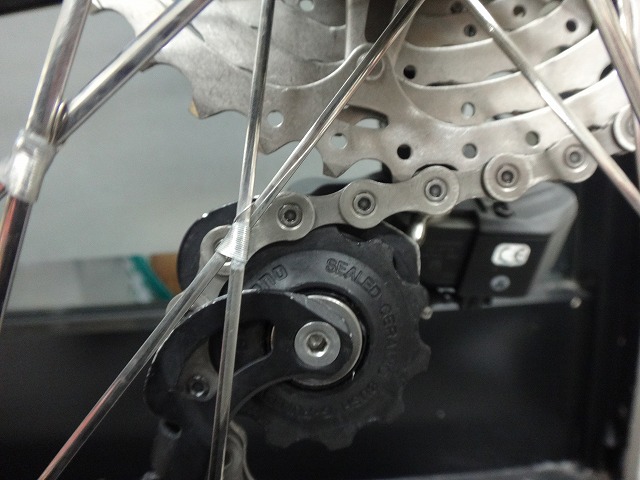
↑With the RoadLink (just one, by the way)
There is definitely a gap now. With a max gear of 36T,
you can't manage it with just the B-tension adjustment bolt.
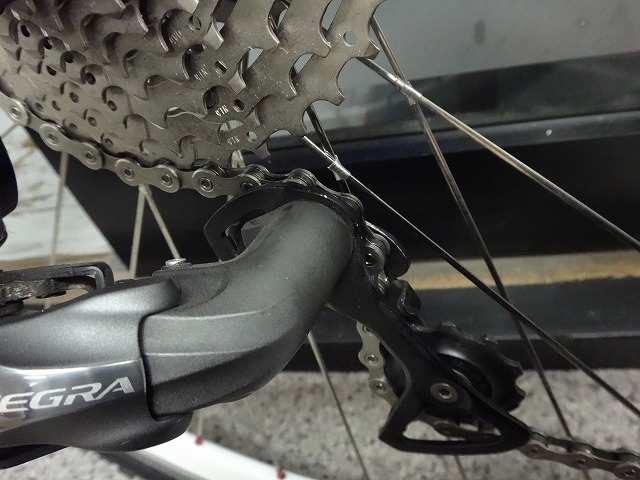
I hooked up the chain for real.
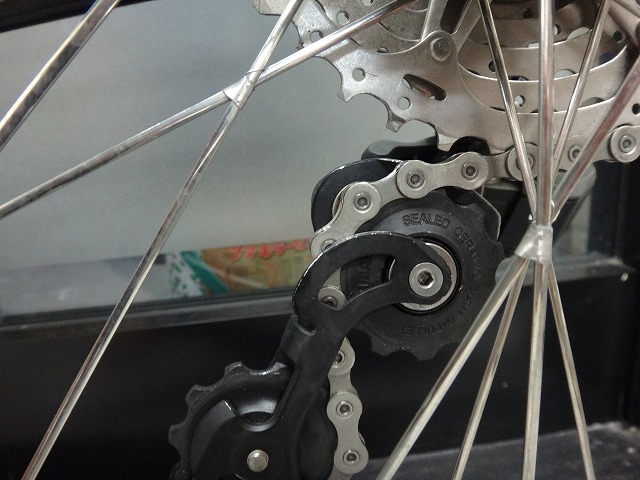
Pretty similar to before.
Actually, I could tighten it up another link (2 links total),
but I prefer a bit of slack in the chain tension when on the low gear,
so I'm leaving it a link long.

And then I shifted to the top gear.
There's quite a bit of space between the pulley and sprocket.
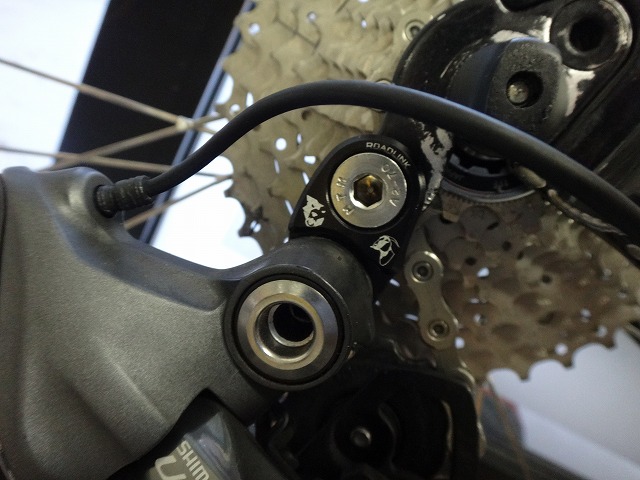
Earlier I said the RoadLink adds 22mm in length,
but the line from the rear hub axle to the derailleur mounting hole
doesn't extend straight—
it bends to roughly the angle of Orion's three stars.
The 22mm is pretty extreme, so whether the three points are collinear
is kind of a minor detail.
To make chain drops less likely,
this cyclocross bike's chainring uses thin track cog teeth.
Thick teeth just won't pull in 10-speed chain.
With a Suntour Superb Pro 144mm PCD track crank
and a 45T Dura-Ace track thin ring,
the low gear 45×36T is roughly equivalent to 39×31T or 34T×27T,
and the top gear 45×11T is roughly equivalent to 53×13T or 50×12T.
It's set up so you get the upper and lower gear-ratio limits
of a typical compact 50–34T crank paired with a 12–27T cassette,
but naturally the spacing between each shift gets pretty coarse.
To belabor the point: shifting performance is definitely compromised,
so unless you can find some other benefit—separate from that—
you might give the RoadLink a try.