I picked up a chain for Campagnolo's new Potenza 11 grade.
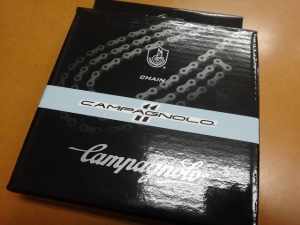
Normally the center band should have the grade name on it,
but this one has CAMPAGNOLO written on it instead.
Even though it's labeled as a Potenza 11 chain,
it seems it's technically an out-of-grade part.
You see similar examples with 165mm cranks and such.
Campagnolo's 11-speed components come in four grades:
Super Record, Record, Chorus, and Athena.
Of these, only Record and Chorus have chains in their lineup.
So Super Record and Athena end up borrowing their chains
from Record and Chorus respectively.
Potenza 11, based on price and catalog hierarchy, sits between Chorus and Athena,
but it does have its own chain in the lineup.
The reason I bought this one comes down to a personal preference of mine:
"I buy the cheapest chain available for whatever speed I need."
If, say, Dura-Ace came out new and was the only group at the highest speed count at that moment,
there'd be no compatible chain except the Dura-Ace one.
But eventually when Ultegra and 105 catch up in speed,
you can get compatible chains more cheaply.
Of course, sometimes higher-end chains have weight savings
with material removed, creating a noticeable weight difference,
but even then I almost never buy the expensive chain.
The only exception is when building a super-lightweight bike.
For Campagnolo, this meant Chorus was the only option until now,
but thanks to Potenza 11 now having its own chain,
I've got a cheaper genuine alternative.
For reference, the official list prices are:
Record at ¥7,800, Chorus at ¥6,400,
and Potenza 11 at ¥4,700 (before tax).
By the way, you might have noticed that I've been writing
"Potenza 11" rather than just "Potenza" throughout this article.
That's because Potenza 11 is the official name.
On the manufacturer's site it lists:
Super Record
Record
Chorus
Potenza 11
Athena
Veloce
This is probably to avoid trademark issues with POTENZA,
the tire brand from Bridgestone (the tire company).
The fact that Bridgestone Cycle's tire brand is EXTENZA
is also because they couldn't get permission to use the Potenza name from Bridgestone Tires,
so they likely had a hard time going with just Potenza here too.
Back in the day, Campagnolo's Daytona
was only produced for two years (2000-2001),
and was later renamed to Centaur,
which had been used in their old MTB components—
this was due to trademark issues in America.
I guess ROLEX watches are okay though.
Speaking of the Potenza 11 chain,
there's another point worth mentioning:
this chain is actually lighter than the Chorus chain.
The Record chain has
outer plates with no material removed plus hollow pins,
while Chorus has no weight reduction on either.

But Potenza 11 comes with
lightened plates plus solid pins—a different approach.
If you combined Record's pins with these plates you'd have a lightweight chain,
but the work involved makes that impractical of course.
If you want a chain like that, go with KMC.
Or maybe this is groundwork for releasing a Super Record chain in the future
with both lightened plates and hollow pins.
If I'm right, I can claim I predicted it, so I'll put it out there.
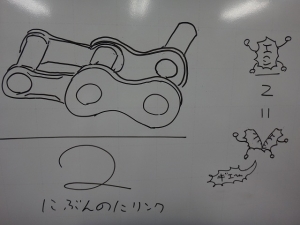
Campagnolo's site lists the published weight per chain link.
To save myself the trouble of looking this up later, I'll note it here:
Record: 2.10g
Chorus: 2.24g
Potenza 11: 2.22g
Of course, outer and inner links have different weights,
so they've divided the weight of one complete link (two pieces)
in half to get a virtual single-link weight.
The "2 links" shown in the diagram would equal one real link's weight,
which is the average of outer and inner links—
a theoretical value that doesn't actually exist.
If you use it in stock condition (without a missing link or similar),
the link count will be an even number like 108 or 110,
so calculating chain weight as virtual link weight × link count works fine.
By actual measurement, straight out of the bag in that sticky lubed state,
114 links weighed 248g. The virtual single link comes to 2.175g.
I say "sticky lubed" specifically because
degreasing definitely makes it lighter.
Not that I do that.
Some people degrease new chains and apply "better" oil,
but the holding power of the lubricant inside the rollers
and the corrosion resistance of the whole chain almost never exceed
what Campagnolo puts on it from the factory.
Sure, most chain oils are superior at reducing sliding friction,
but unless you're really passionate about that,
I think using it as-is from the start is the way to go.

Normally the center band should have the grade name on it,
but this one has CAMPAGNOLO written on it instead.
Even though it's labeled as a Potenza 11 chain,
it seems it's technically an out-of-grade part.
You see similar examples with 165mm cranks and such.
Campagnolo's 11-speed components come in four grades:
Super Record, Record, Chorus, and Athena.
Of these, only Record and Chorus have chains in their lineup.
So Super Record and Athena end up borrowing their chains
from Record and Chorus respectively.
Potenza 11, based on price and catalog hierarchy, sits between Chorus and Athena,
but it does have its own chain in the lineup.
The reason I bought this one comes down to a personal preference of mine:
"I buy the cheapest chain available for whatever speed I need."
If, say, Dura-Ace came out new and was the only group at the highest speed count at that moment,
there'd be no compatible chain except the Dura-Ace one.
But eventually when Ultegra and 105 catch up in speed,
you can get compatible chains more cheaply.
Of course, sometimes higher-end chains have weight savings
with material removed, creating a noticeable weight difference,
but even then I almost never buy the expensive chain.
The only exception is when building a super-lightweight bike.
For Campagnolo, this meant Chorus was the only option until now,
but thanks to Potenza 11 now having its own chain,
I've got a cheaper genuine alternative.
For reference, the official list prices are:
Record at ¥7,800, Chorus at ¥6,400,
and Potenza 11 at ¥4,700 (before tax).
By the way, you might have noticed that I've been writing
"Potenza 11" rather than just "Potenza" throughout this article.
That's because Potenza 11 is the official name.
On the manufacturer's site it lists:
Super Record
Record
Chorus
Potenza 11
Athena
Veloce
This is probably to avoid trademark issues with POTENZA,
the tire brand from Bridgestone (the tire company).
The fact that Bridgestone Cycle's tire brand is EXTENZA
is also because they couldn't get permission to use the Potenza name from Bridgestone Tires,
so they likely had a hard time going with just Potenza here too.
Back in the day, Campagnolo's Daytona
was only produced for two years (2000-2001),
and was later renamed to Centaur,
which had been used in their old MTB components—
this was due to trademark issues in America.
Speaking of the Potenza 11 chain,
there's another point worth mentioning:
this chain is actually lighter than the Chorus chain.
The Record chain has
outer plates with no material removed plus hollow pins,
while Chorus has no weight reduction on either.

But Potenza 11 comes with
lightened plates plus solid pins—a different approach.
If you combined Record's pins with these plates you'd have a lightweight chain,
but the work involved makes that impractical of course.
If you want a chain like that, go with KMC.
Or maybe this is groundwork for releasing a Super Record chain in the future
with both lightened plates and hollow pins.
If I'm right, I can claim I predicted it, so I'll put it out there.
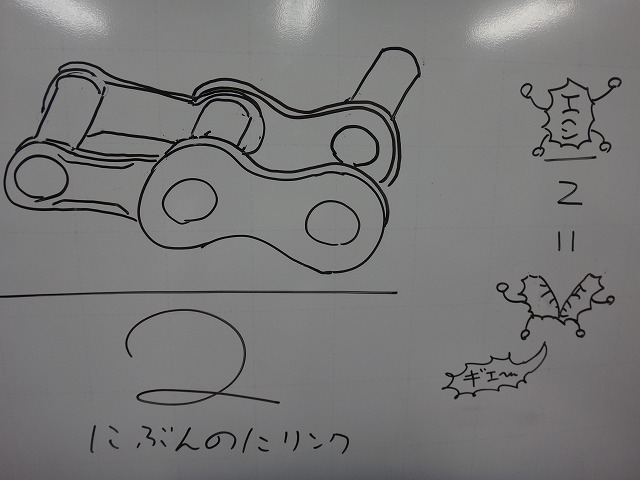
Campagnolo's site lists the published weight per chain link.
To save myself the trouble of looking this up later, I'll note it here:
Record: 2.10g
Chorus: 2.24g
Potenza 11: 2.22g
Of course, outer and inner links have different weights,
so they've divided the weight of one complete link (two pieces)
in half to get a virtual single-link weight.
The "2 links" shown in the diagram would equal one real link's weight,
which is the average of outer and inner links—
a theoretical value that doesn't actually exist.
If you use it in stock condition (without a missing link or similar),
the link count will be an even number like 108 or 110,
so calculating chain weight as virtual link weight × link count works fine.
By actual measurement, straight out of the bag in that sticky lubed state,
114 links weighed 248g. The virtual single link comes to 2.175g.
I say "sticky lubed" specifically because
degreasing definitely makes it lighter.
Not that I do that.
Some people degrease new chains and apply "better" oil,
but the holding power of the lubricant inside the rollers
and the corrosion resistance of the whole chain almost never exceed
what Campagnolo puts on it from the factory.
Sure, most chain oils are superior at reducing sliding friction,
but unless you're really passionate about that,
I think using it as-is from the start is the way to go.