A customer brought in an Assault rear wheel for repair.
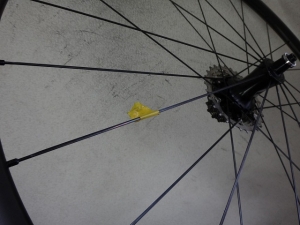
There's yellow tape on one of the non-freewheel side spokes,
and this particular spoke has low tension, which shows up in how the bike feels while riding.
When I touch it directly, it flexes noticeably more than the other non-freewheel side spokes.
One cause was that the nipple was starting to loosen.
Radial lacing on both front and rear wheels tends to develop nipple looseness.
Once loosening starts, vibrations from riding gradually loosen it further,
and when the nipple's neck no longer catches in the rim hole (effectively zero tension),
the loosening accelerates even more, and the fully loosened nipple can
even fall into the rim interior.
This wheel was in the early stages of that condition, so retightening will solve the problem.
I loosened it once to where the threads were visible, applied threadlocker compound,
and then retightened it, so there should be virtually no chance of this spot loosening again in the future.
The other cause was centering error.
The rim is sitting quite far toward the freewheel side.
Since I can do one-sided retightening on the non-freewheel side,
it's actually fortunate in terms of conditions,
but for a Reynolds rim, the amount of offset is fairly large, so
I asked the customer about the wheel's truing history.
Apparently it's been in the original condition from the shop and has never been touched.
As I've mentioned before, the nipples had oddly rounded inner gripping surfaces with no tool marks,
so it definitely appears to be in original condition.
While doing the centering and truing, I tensioned it as much as possible,
and it's clearly tighter than when it came in,
but compared to the other spokes, the low tension remained.
I believe this is caused by individual variations in spoke flattening
and non-uniformity in rim inner diameter (the rim's own roundness and thickness variation in the rim holes).
Of course, in cases with severe radial hop,
the spoke tension becomes lower on the side hopping outward,
but in this case after adjustment there's almost no radial hop, so that's not relevant.
If the lowest-tension spoke among the non-freewheel side spokes is tensioned above the threshold
where it won't loosen from vibration,
then even with some variation in tension, it won't loosen.
Achieving that with non-freewheel side radial lacing is
difficult even with a rim that can take considerable freewheel-side tension, which is
one reason I dislike non-freewheel side radial lacing.
Changing subjects, the reason old aluminum rims had eyelets installed was
to hide the non-uniformity in rim hole thickness,
but describing it as "for rim reinforcement"
also obscures the true reason (or at least the primary one).
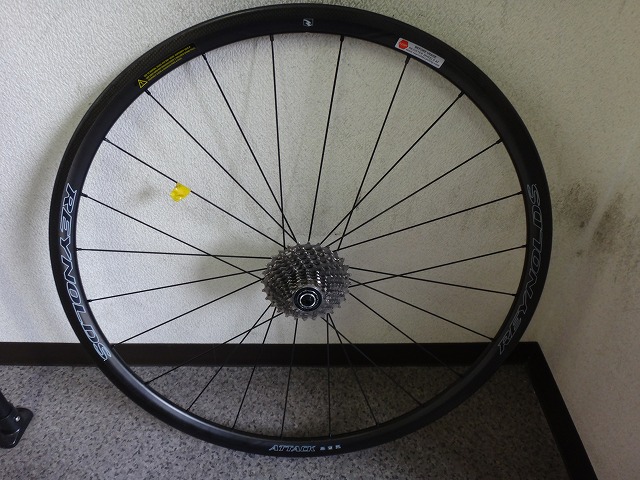
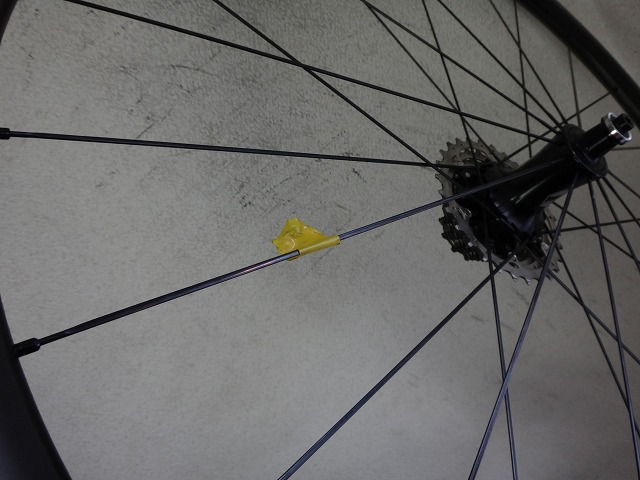
There's yellow tape on one of the non-freewheel side spokes,
and this particular spoke has low tension, which shows up in how the bike feels while riding.
When I touch it directly, it flexes noticeably more than the other non-freewheel side spokes.
One cause was that the nipple was starting to loosen.
Radial lacing on both front and rear wheels tends to develop nipple looseness.
Once loosening starts, vibrations from riding gradually loosen it further,
and when the nipple's neck no longer catches in the rim hole (effectively zero tension),
the loosening accelerates even more, and the fully loosened nipple can
even fall into the rim interior.
This wheel was in the early stages of that condition, so retightening will solve the problem.
I loosened it once to where the threads were visible, applied threadlocker compound,
and then retightened it, so there should be virtually no chance of this spot loosening again in the future.
The other cause was centering error.
The rim is sitting quite far toward the freewheel side.
Since I can do one-sided retightening on the non-freewheel side,
it's actually fortunate in terms of conditions,
but for a Reynolds rim, the amount of offset is fairly large, so
I asked the customer about the wheel's truing history.
Apparently it's been in the original condition from the shop and has never been touched.
As I've mentioned before, the nipples had oddly rounded inner gripping surfaces with no tool marks,
so it definitely appears to be in original condition.
While doing the centering and truing, I tensioned it as much as possible,
and it's clearly tighter than when it came in,
but compared to the other spokes, the low tension remained.
I believe this is caused by individual variations in spoke flattening
and non-uniformity in rim inner diameter (the rim's own roundness and thickness variation in the rim holes).
Of course, in cases with severe radial hop,
the spoke tension becomes lower on the side hopping outward,
but in this case after adjustment there's almost no radial hop, so that's not relevant.
If the lowest-tension spoke among the non-freewheel side spokes is tensioned above the threshold
where it won't loosen from vibration,
then even with some variation in tension, it won't loosen.
Achieving that with non-freewheel side radial lacing is
difficult even with a rim that can take considerable freewheel-side tension, which is
one reason I dislike non-freewheel side radial lacing.
Changing subjects, the reason old aluminum rims had eyelets installed was
to hide the non-uniformity in rim hole thickness,
but describing it as "for rim reinforcement"
also obscures the true reason (or at least the primary one).