Another wheel day (abbreviated hereafter).

Continuing from yesterday.
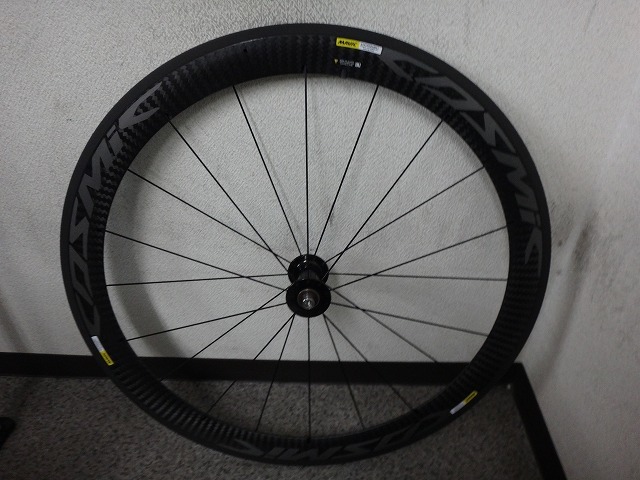
Managed to get it built without incident.
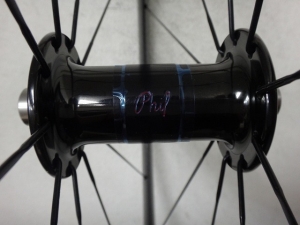
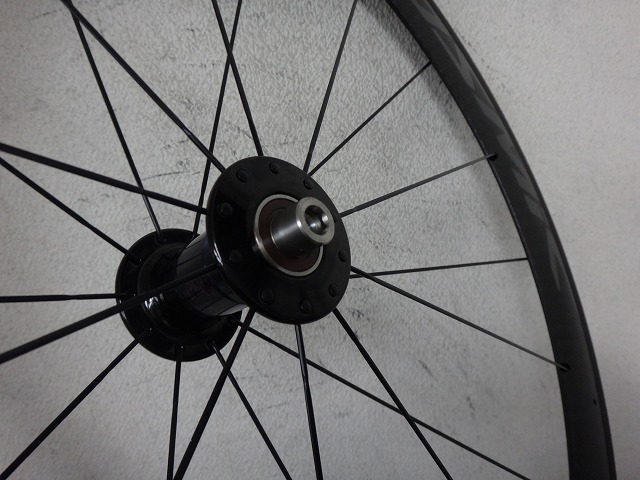
Fillwood fixed gear hub, 20H, black, CX-RAY outpoke radial build.
This hub has an over-locknut dimension of 100mm, so while it's not impossible to use on a road bike, the front wheel requires tools for installation (it's not quick-release), so it's for fixed gear use.

This is originally a rear rim, but
depending on the direction of the eyelets, the spoke incident angle on the left side is designed for radial lacing,
while the right side is designed for tangential lacing.
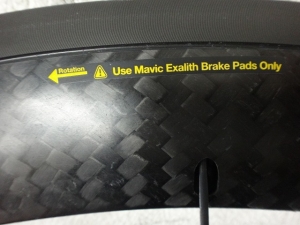
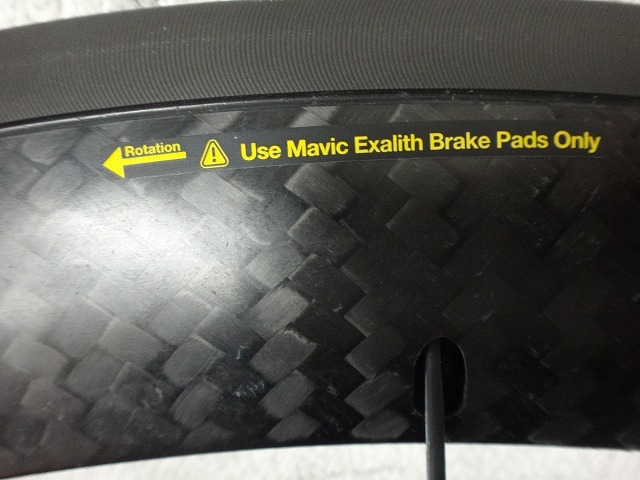
Starting with the left side,
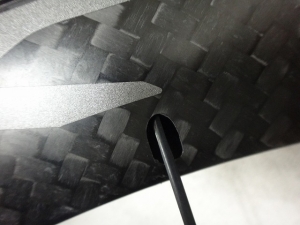

Using the radial lacing holes for a radial build,
there are no holes where the spokes contact the carbon hood.
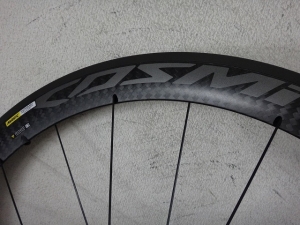
Moving on to the right side,


Contact is happening in the opposite direction from yesterday.
Yesterday was "tangential lacing in radial-designed holes,"
but today it's "radial lacing in tangential-designed holes."
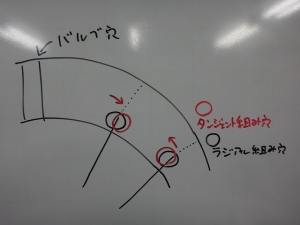
↑Like this
Beyond this, what I was concerned about was
whether this rim, being designed for the rear,
might actually be an offset rim. If the weakness of non-drive-side radial lacing is mitigated by offset rim design, there could be a problem using it on the front wheel.
The 2005 Cosmic Carbon SL rim, compared to the earlier Cosmic Carbon SSC, was lightened by changing from dual eyelets to single eyelets and adding cutouts between rim holes—essentially processing similar to Ksyrium. And Ksyrium rear rims do have offset designs.
If the Cosmic Carbon rim were offset, then when both sides use the same spokes and same lacing pattern, spoke tension would differ between left and right. If the build is locked into radial lacing (which it is, per the customer's request), you can't address this difference with different spoke counts on each side. But we also don't have spoke options fine-grained enough to adjust tension percentages—say, 65% on one side and 68% on the other.
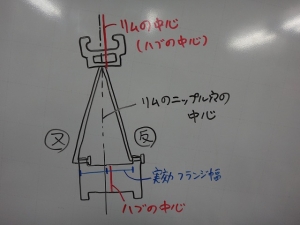
If it were offset, I considered building one side inpoke radial and the other side outpoke radial to shift the effective flange center closer to the rim's offset. But that's overthinking it—the aesthetics look bad. Even if it theoretically balanced things out perfectly, I wouldn't do it. If this became a real problem, the dish on a disc brake front hub would be far worse.
Following similar logic,
when building a front wheel with a disc front hub and an offset rim,
you can aim to reduce hub dish by offsetting the rim's nipple holes toward the anti-rotor side (wheel right side)—the opposite direction from how rear wheels are offset. An old colleague once built both front and rear 26-inch disc wheels using offset Bontrager rims (back when it was Keith Bontrager's own brand, before Trek acquired it), and he built the front rim apex biased left. I thought he was just memorizing "offset rim apex biases left" without understanding the actual reasoning—a bit sad. But then one time he said he'd make a custom ultra-thin washer for an International Standard disc brake mount, so he bought a thin aluminum sheet. Rather than drilling the hole first and then cutting the washer shape, he was cutting out the washer shape first and then drilling the hole afterward. I saw several thin aluminum discs, maybe 1cm in diameter, already lying around, and trying to drill a 6mm hole through the center of something that small would be extremely difficult.
Anyway, back to whether the Cosmic Carbon rear rim is offset—
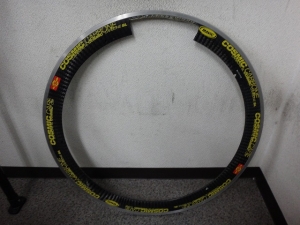
you can check it.
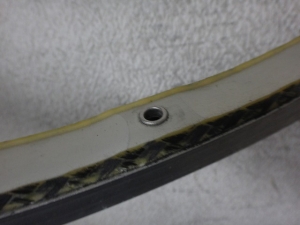
On the inside of the rim wall, inboard of the braking zone, there's a stepped adhesive land for bonding the carbon hood.
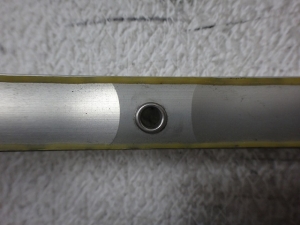
It's not an offset rim.
The eyelet isn't centered

—it's the standard hole spacing for low-profile rims.
You can visually confirm offset from the outer perimeter as well (setting aside hole positioning), but if you get a chance to look from the inner side, that's more definitive.
Continuing from yesterday.
Managed to get it built without incident.

Fillwood fixed gear hub, 20H, black, CX-RAY outpoke radial build.
This hub has an over-locknut dimension of 100mm, so while it's not impossible to use on a road bike, the front wheel requires tools for installation (it's not quick-release), so it's for fixed gear use.
This is originally a rear rim, but
depending on the direction of the eyelets, the spoke incident angle on the left side is designed for radial lacing,
while the right side is designed for tangential lacing.
Starting with the left side,
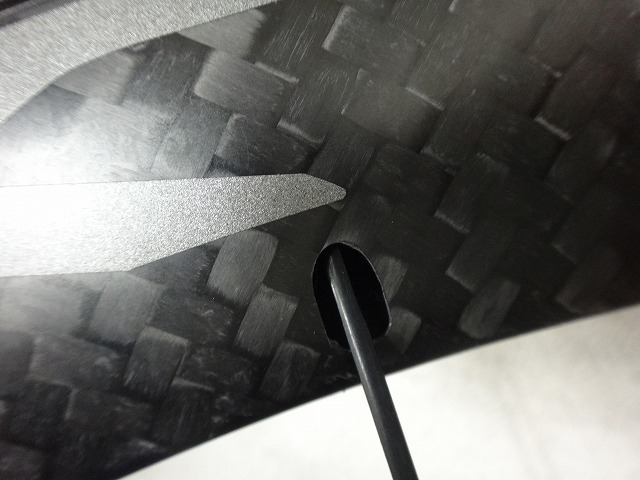

Using the radial lacing holes for a radial build,
there are no holes where the spokes contact the carbon hood.
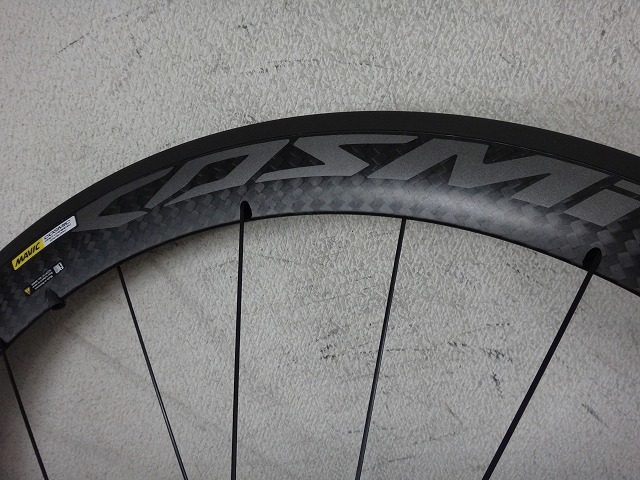
Moving on to the right side,
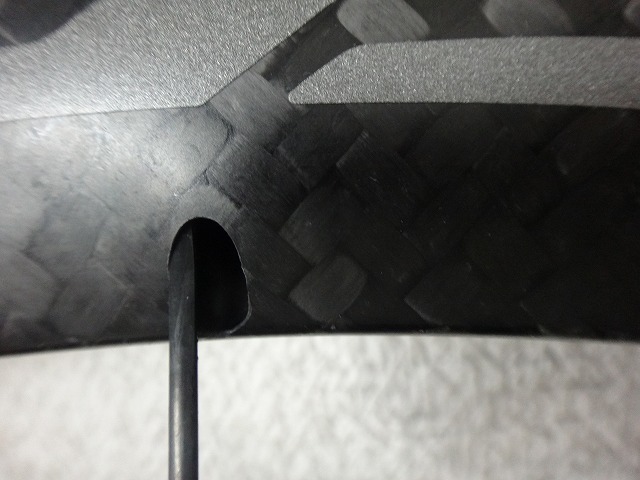
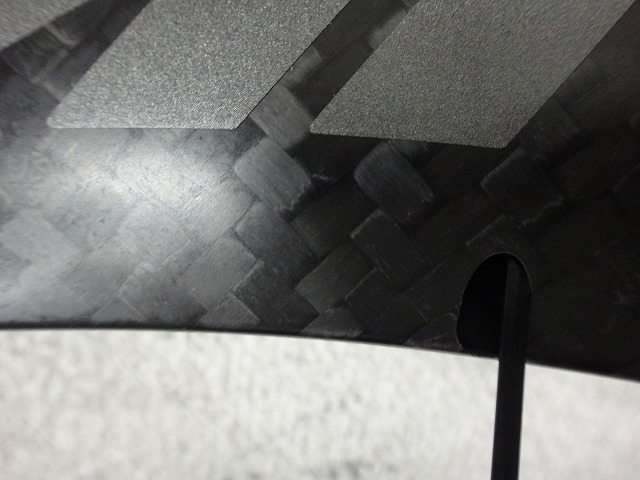
Contact is happening in the opposite direction from yesterday.
Yesterday was "tangential lacing in radial-designed holes,"
but today it's "radial lacing in tangential-designed holes."

↑Like this
Beyond this, what I was concerned about was
whether this rim, being designed for the rear,
might actually be an offset rim. If the weakness of non-drive-side radial lacing is mitigated by offset rim design, there could be a problem using it on the front wheel.
The 2005 Cosmic Carbon SL rim, compared to the earlier Cosmic Carbon SSC, was lightened by changing from dual eyelets to single eyelets and adding cutouts between rim holes—essentially processing similar to Ksyrium. And Ksyrium rear rims do have offset designs.
If the Cosmic Carbon rim were offset, then when both sides use the same spokes and same lacing pattern, spoke tension would differ between left and right. If the build is locked into radial lacing (which it is, per the customer's request), you can't address this difference with different spoke counts on each side. But we also don't have spoke options fine-grained enough to adjust tension percentages—say, 65% on one side and 68% on the other.

If it were offset, I considered building one side inpoke radial and the other side outpoke radial to shift the effective flange center closer to the rim's offset. But that's overthinking it—the aesthetics look bad. Even if it theoretically balanced things out perfectly, I wouldn't do it. If this became a real problem, the dish on a disc brake front hub would be far worse.
Following similar logic,
when building a front wheel with a disc front hub and an offset rim,
you can aim to reduce hub dish by offsetting the rim's nipple holes toward the anti-rotor side (wheel right side)—the opposite direction from how rear wheels are offset. An old colleague once built both front and rear 26-inch disc wheels using offset Bontrager rims (back when it was Keith Bontrager's own brand, before Trek acquired it), and he built the front rim apex biased left. I thought he was just memorizing "offset rim apex biases left" without understanding the actual reasoning—a bit sad. But then one time he said he'd make a custom ultra-thin washer for an International Standard disc brake mount, so he bought a thin aluminum sheet. Rather than drilling the hole first and then cutting the washer shape, he was cutting out the washer shape first and then drilling the hole afterward. I saw several thin aluminum discs, maybe 1cm in diameter, already lying around, and trying to drill a 6mm hole through the center of something that small would be extremely difficult.
Anyway, back to whether the Cosmic Carbon rear rim is offset—
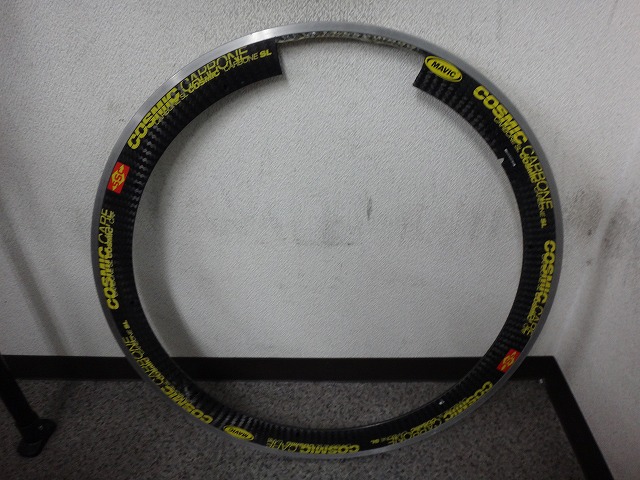
you can check it.

On the inside of the rim wall, inboard of the braking zone, there's a stepped adhesive land for bonding the carbon hood.
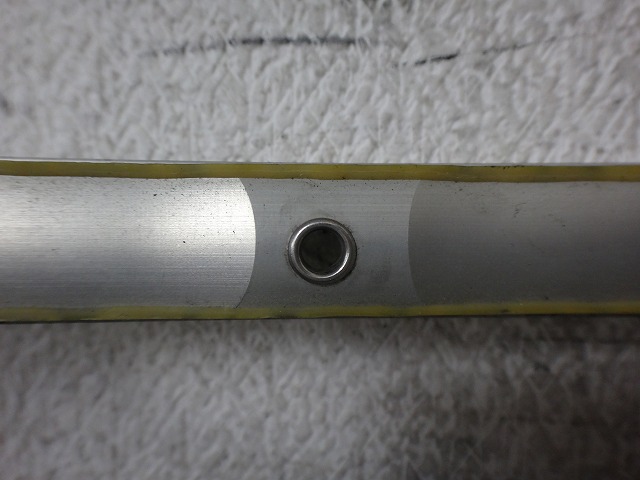
It's not an offset rim.
The eyelet isn't centered
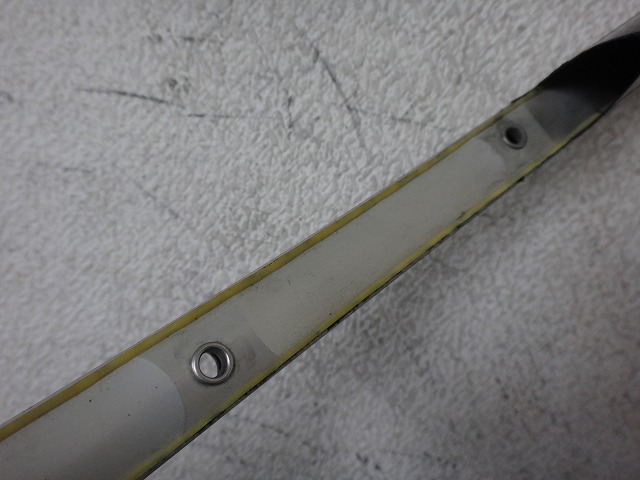
—it's the standard hole spacing for low-profile rims.
You can visually confirm offset from the outer perimeter as well (setting aside hole positioning), but if you get a chance to look from the inner side, that's more definitive.