I've received a comment from someone using hand-built wheels.
「Spoke tension-wise, it should be the easiest,
yet the inpoke spokes on the non-drive side of Italian lacing
keep breaking at the nipple. Strange.」
That's what they said.
Well, it's just coincidence.
Though I'd probably get yelled at if I just left it at that, so let me dig a bit deeper.
The non-drive side isn't absolutely immune to spoke nipple breakage,
so of course it happens.
From my own statistical gut feeling, I'd say
nipple breakage occurs more on the drive side than the non-drive side,
but the left-right difference isn't that dramatic.
It's not 5:5, but nowhere near 6:4 either—
just slightly more on the drive side.
As for the risk difference in nipple breakage between inpoke and outpoke mentioned in the comment,
theoretically there should be a difference, but in practice it seems pretty similar.
What's really surprising is that this blog's neologism "inpoke"
is gradually becoming a semi-general term (laughs).
That said, actually there are certain conditions on the drive side where
inpoke spokes break more easily.
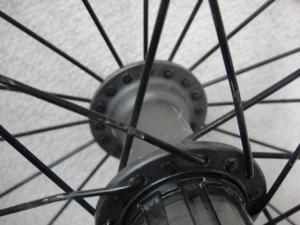
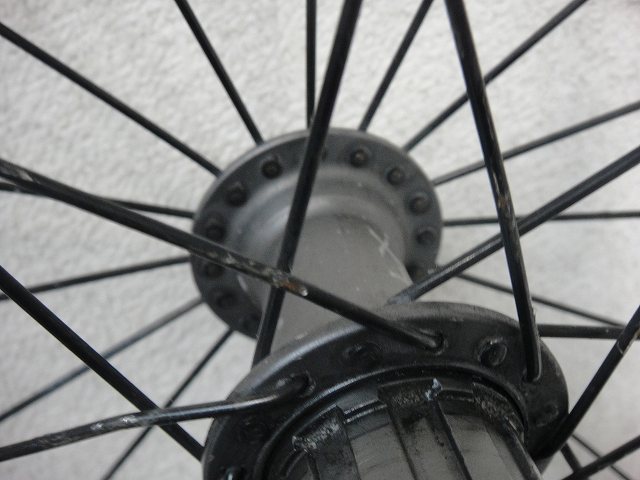
↑This wheel, I built it. It's unusual for me to have
the non-drive side in radial lacing, but that's because they're all inpokes.
Not many people do something like this, I'd say.
Anyway, that aside—as evidence of dropping the chain inside the low gear,
scratches appear only on the inpoke spokes.
When this gets really bad, the spokes can actually break mid-shaft rather than at the nipple.
If a nipple breakage occurs in this state, it's hard to completely deny
any causal relationship with the spoke damage.
Even if there's enough left-right difference for me to feel that
「drive-side spokes break more easily」,
I haven't kept precise statistics on how many of those drive-side nipple breaks
have a chain-drop history.
But I suspect this contributes to the higher drive-side breakage count
(though limited to inpoke spokes).
Of course, the idea that the drive side experiences twisting stress from the freewheel body more directly,
and therefore spokes break more easily there, is also correct thinking.
Also, the comment continues with:
「Since inpoke has inner-out head orientation, there's some slack at the nipple section.
If I did double-cross, that slack would disappear and
maybe it wouldn't break as easily?
Though honestly, double-cross on 32H seems pretty impossible.」
Let me answer that.
In tangent lacing, we express spoke crossing as "○-cross" lacing,
but there's also another expression: "○-cross."
This refers to how many times a single spoke intersects with other spokes
as it travels from hub to rim.
2-cross lacing has spokes crossing just once, so it's 1-cross.
Similarly,
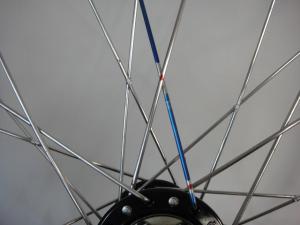
4-cross lacing has two crossings, so it's 2-cross.
(In the image above, the red parts on the blue spoke show the crossing points)
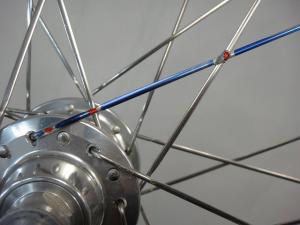
6-cross lacing is 3-cross.
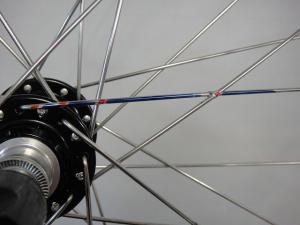
8-cross lacing is 4-cross.
In other words, "○-cross lacing" can also be called "○/2-cross" lacing.
Making the crossing points contact each other is called "weaving,"
and with 3-cross (6-cross) or higher, you can weave the penultimate crossing as well.
I call this double-cross (though this isn't my original coinage).
Double-crossing on 3-cross is pretty tough, as the comment mentions.
It gets even more impractical the larger the flange.
Realistically, you could say it's the exclusive domain of 4-cross.
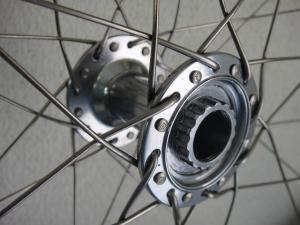
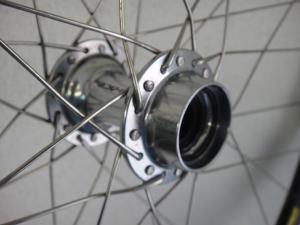
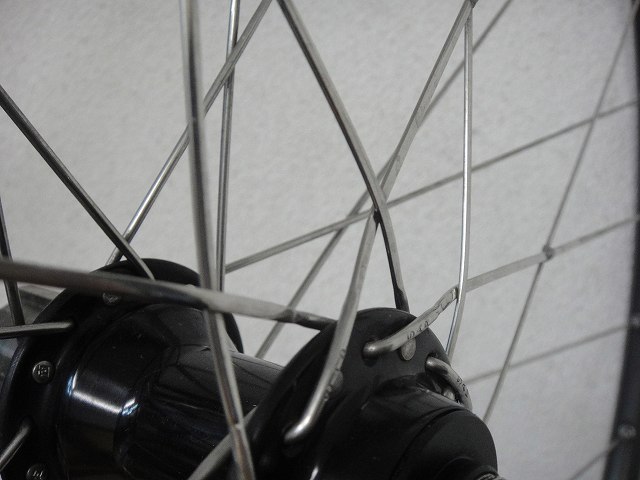
↑This is also a wheel I built, currently undergoing overhaul.
This one is 3-cross double-crossed.
As you can see, the spokes look all bendy and flexible, which is what happens with round spokes.
As the comment suggests, spoke slack or deformation would decrease, I think,
but my current thinking is that nipple breakage risk actually increases.
Solder-bridging kills the slack in the final crossing,
while double-cross mainly reduces spoke deformation on the hub side of the final crossing.
Whether this affects overall wheel rigidity on a noticeable level is…
honestly, I do feel like it becomes 「stronger sideways」and「less prone to runout」.
However (the truth is unclear), I believe nipple breakage risk increases,
so I don't offer it as a standard menu item.
But I'm at the level of "I won't refuse if asked."
If you'd like it, just let me know.
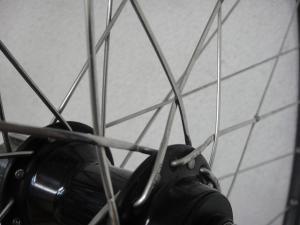
↑My rear wheel, which has appeared many times before, but with aero spokes,
double-cross doesn't get quite so bendy.
One more thing.
I received a comment saying:
「There are actually people out there who say the exact opposite of nomulab—
『the non-drive side should be radial, that's correct』」
On this, I need a bit more time.
To give you the conclusion upfront: No way.
I plan to write about why that doesn't work
and what conditions might just barely allow non-drive-side radial lacing.
「Spoke tension-wise, it should be the easiest,
yet the inpoke spokes on the non-drive side of Italian lacing
keep breaking at the nipple. Strange.」
That's what they said.
Well, it's just coincidence.
Though I'd probably get yelled at if I just left it at that, so let me dig a bit deeper.
The non-drive side isn't absolutely immune to spoke nipple breakage,
so of course it happens.
From my own statistical gut feeling, I'd say
nipple breakage occurs more on the drive side than the non-drive side,
but the left-right difference isn't that dramatic.
It's not 5:5, but nowhere near 6:4 either—
just slightly more on the drive side.
As for the risk difference in nipple breakage between inpoke and outpoke mentioned in the comment,
theoretically there should be a difference, but in practice it seems pretty similar.
What's really surprising is that this blog's neologism "inpoke"
is gradually becoming a semi-general term (laughs).
That said, actually there are certain conditions on the drive side where
inpoke spokes break more easily.
↑This wheel, I built it. It's unusual for me to have
the non-drive side in radial lacing, but that's because they're all inpokes.
Not many people do something like this, I'd say.
Anyway, that aside—as evidence of dropping the chain inside the low gear,
scratches appear only on the inpoke spokes.
When this gets really bad, the spokes can actually break mid-shaft rather than at the nipple.
If a nipple breakage occurs in this state, it's hard to completely deny
any causal relationship with the spoke damage.
Even if there's enough left-right difference for me to feel that
「drive-side spokes break more easily」,
I haven't kept precise statistics on how many of those drive-side nipple breaks
have a chain-drop history.
But I suspect this contributes to the higher drive-side breakage count
(though limited to inpoke spokes).
Of course, the idea that the drive side experiences twisting stress from the freewheel body more directly,
and therefore spokes break more easily there, is also correct thinking.
Also, the comment continues with:
「Since inpoke has inner-out head orientation, there's some slack at the nipple section.
If I did double-cross, that slack would disappear and
maybe it wouldn't break as easily?
Though honestly, double-cross on 32H seems pretty impossible.」
Let me answer that.
In tangent lacing, we express spoke crossing as "○-cross" lacing,
but there's also another expression: "○-cross."
This refers to how many times a single spoke intersects with other spokes
as it travels from hub to rim.
2-cross lacing has spokes crossing just once, so it's 1-cross.
Similarly,
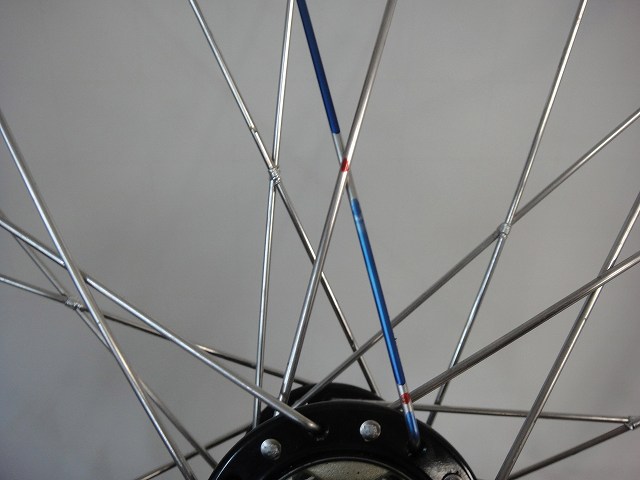
4-cross lacing has two crossings, so it's 2-cross.
(In the image above, the red parts on the blue spoke show the crossing points)
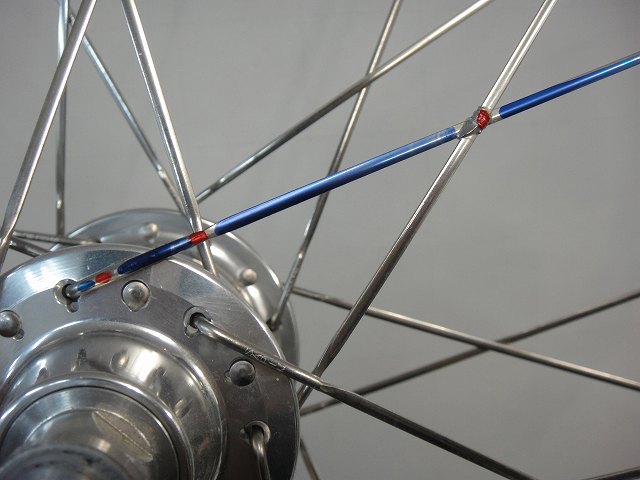
6-cross lacing is 3-cross.

8-cross lacing is 4-cross.
In other words, "○-cross lacing" can also be called "○/2-cross" lacing.
Making the crossing points contact each other is called "weaving,"
and with 3-cross (6-cross) or higher, you can weave the penultimate crossing as well.
I call this double-cross (though this isn't my original coinage).
Double-crossing on 3-cross is pretty tough, as the comment mentions.
It gets even more impractical the larger the flange.
Realistically, you could say it's the exclusive domain of 4-cross.
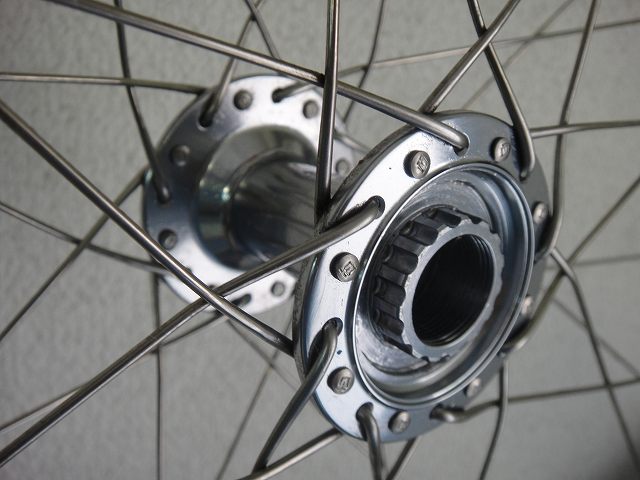
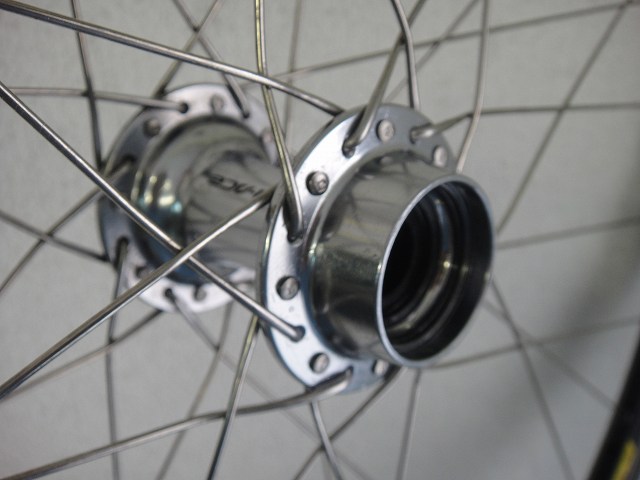
↑This is also a wheel I built, currently undergoing overhaul.
This one is 3-cross double-crossed.
As you can see, the spokes look all bendy and flexible, which is what happens with round spokes.
As the comment suggests, spoke slack or deformation would decrease, I think,
but my current thinking is that nipple breakage risk actually increases.
Solder-bridging kills the slack in the final crossing,
while double-cross mainly reduces spoke deformation on the hub side of the final crossing.
Whether this affects overall wheel rigidity on a noticeable level is…
honestly, I do feel like it becomes 「stronger sideways」and「less prone to runout」.
However (the truth is unclear), I believe nipple breakage risk increases,
so I don't offer it as a standard menu item.
But I'm at the level of "I won't refuse if asked."
If you'd like it, just let me know.
↑My rear wheel, which has appeared many times before, but with aero spokes,
double-cross doesn't get quite so bendy.
One more thing.
I received a comment saying:
「There are actually people out there who say the exact opposite of nomulab—
『the non-drive side should be radial, that's correct』」
On this, I need a bit more time.
To give you the conclusion upfront: No way.
I plan to write about why that doesn't work
and what conditions might just barely allow non-drive-side radial lacing.