I received a 9000-C35 from a customer.
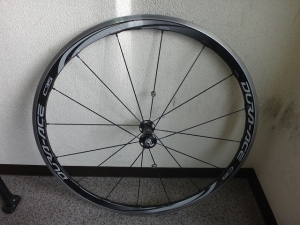
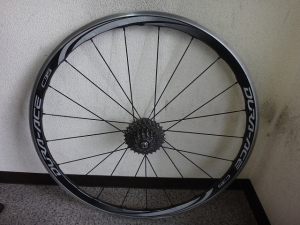
The front wheel has Shimano C24 and C35 carbon laminate rims, and
due to spoke tension, the rim apex deforms left and right alternately...
but with only 16 holes and high tension, the deformation
even appears in the brake zone.
This happens with new wheels too.
With Kinlin's XR200, which is lighter than the C24 rim,
deformation that noticeable doesn't occur even with C24-level tension,
and similar deformation occurs on the C35, so
I suspect the soft material properties of the rim are the main cause.
I haven't verified this, but if you ordered a 16-hole XR200 rim
and tensioned it to C24 levels, the brake zone might ripple
at eight points left and right.
However, since the rippling is occurring even on the C35—where there's considerable distance
from the rim apex to the brake zone and it can't really be called an ultra-lightweight rim—
the main cause is the rim's softness, not the spoke count.
What I'm trying to say is,
if you're truing to a compromise point like what you can achieve with an Open Pro,
this front wheel will never finish truing, period.
As a result, I mistook the rippling for lateral runout, chased it too far,
and ended up creating a center offset of about one sheet of paper thickness, left and right,
which took considerably longer than it should have for what's not really a problematic wheel.
The rear wheel had a spoke that was faintly deformed,
but I handled it with truing alone without replacing it.
It was directly under the only noticeable lateral runout present,
so in cases like that I check the spokes carefully,
but if there had been no runout, I probably wouldn't have noticed the deformation.
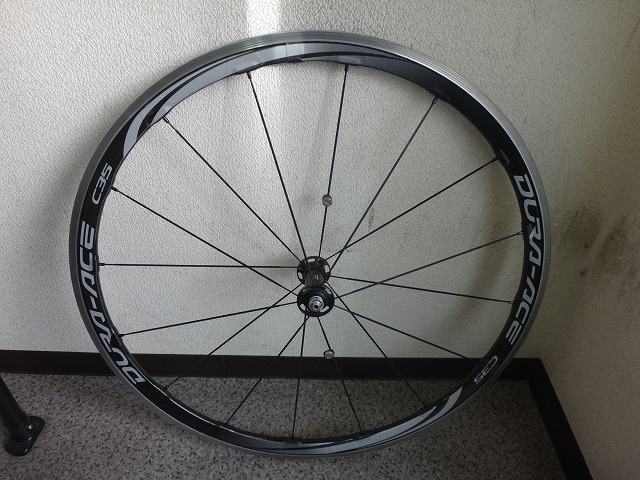
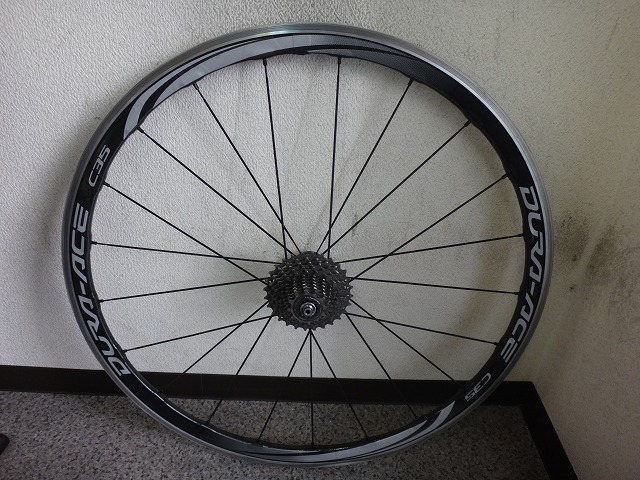
The front wheel has Shimano C24 and C35 carbon laminate rims, and
due to spoke tension, the rim apex deforms left and right alternately...
but with only 16 holes and high tension, the deformation
even appears in the brake zone.
This happens with new wheels too.
With Kinlin's XR200, which is lighter than the C24 rim,
deformation that noticeable doesn't occur even with C24-level tension,
and similar deformation occurs on the C35, so
I suspect the soft material properties of the rim are the main cause.
I haven't verified this, but if you ordered a 16-hole XR200 rim
and tensioned it to C24 levels, the brake zone might ripple
at eight points left and right.
However, since the rippling is occurring even on the C35—where there's considerable distance
from the rim apex to the brake zone and it can't really be called an ultra-lightweight rim—
the main cause is the rim's softness, not the spoke count.
What I'm trying to say is,
if you're truing to a compromise point like what you can achieve with an Open Pro,
this front wheel will never finish truing, period.
As a result, I mistook the rippling for lateral runout, chased it too far,
and ended up creating a center offset of about one sheet of paper thickness, left and right,
which took considerably longer than it should have for what's not really a problematic wheel.
The rear wheel had a spoke that was faintly deformed,
but I handled it with truing alone without replacing it.
It was directly under the only noticeable lateral runout present,
so in cases like that I check the spokes carefully,
but if there had been no runout, I probably wouldn't have noticed the deformation.