Today it's wheels again (and so on).
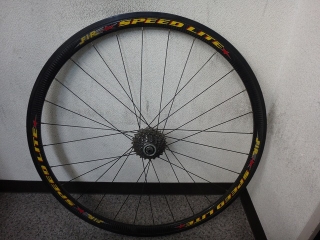
Building the rear wheel to match the front wheel I assembled the other day. But first, let me explain something.
When I previously rebuilt the rear wheel with a Planet X 82mm-high rim
with a Leaf hub (→here),
I thought the original hub was a special narrow-flange version made specifically for deep rims,
but it turned out to have exactly the same dimensions as an Evo hub.
So the Evo hub is also considered narrow-flange.
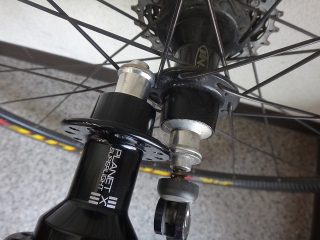
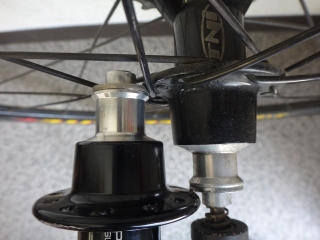
↑Photos I took before returning the hub to the customer and noticed the difference
The difference in diameter of the thin left axle end is because
the Planet X hub is equivalent to the Evo Hub II (aluminum shaft version).
As I'll mention later, being equivalent to Evo Hub II, the freewheel body has a set screw.

I disassembled the rear wheel and cleaned the rear hub.
The hub at the top of the image is the Evo hub (steel shaft, so Evo Hub I),
and the bottom is the brand new Evo Lite hub.
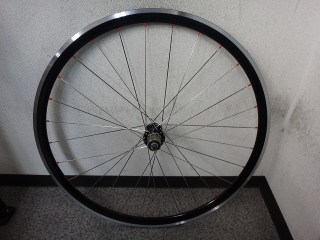
Built it up.
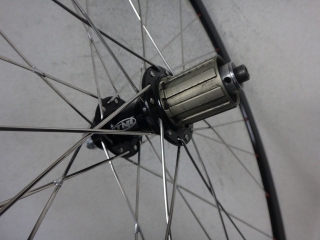
Because the left end cap is aluminum, it's easy to miss that it has a steel shaft.
With the tap-fit right end cap secured by set screw after installation,
there's no set screw on the freewheel body's spline.
It seems the bearing race at the inner side of the freewheel body is held in place there as well.
It's similar to a PowerTap hub with the same tap-fit, just differing in whether
the set screw is on the freewheel body or on the right end cap.
I built the Evo Hub 28H in semi-comp 1-cross lacing with spoke connections.
You can clearly see that the left and right spoke tensions are very close to each other.
This is simply because the dimensions are closer to the front wheel than when building with the Evo Lite hub,
but small difference in left-right spoke tension doesn't necessarily mean higher lateral stiffness.
In either case, with the rim centered and the freewheel-side spoke tension equal
(of course the spoke gauge and lacing pattern are also the same),
when compared to the rear wheel built with the Evo Lite hub,
the non-freewheel-side tension is higher on the Evo hub,
but the lateral stiffness is definitely still higher on the Evo Lite hub.
With the same freewheel-side spoke tension
(I keep repeating this, but with the condition that the rim is centered),
there are other means to achieve higher non-freewheel-side spoke tension,
so I think a wide-flange rear hub + lacing with different left-right diameters +
different spoke counts left and right within what the hub allows is optimal...
This time I reused the rear hub due to budget constraints.
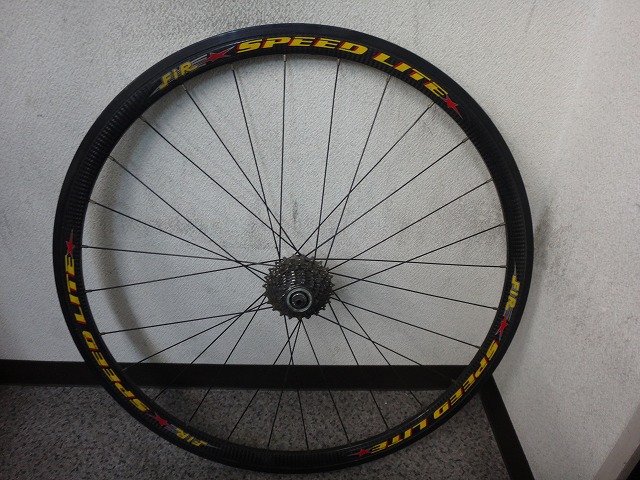
Building the rear wheel to match the front wheel I assembled the other day. But first, let me explain something.
When I previously rebuilt the rear wheel with a Planet X 82mm-high rim
with a Leaf hub (→here),
I thought the original hub was a special narrow-flange version made specifically for deep rims,
but it turned out to have exactly the same dimensions as an Evo hub.
So the Evo hub is also considered narrow-flange.
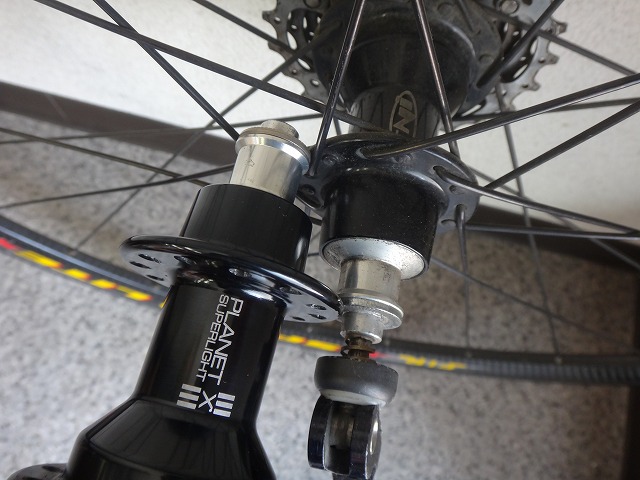
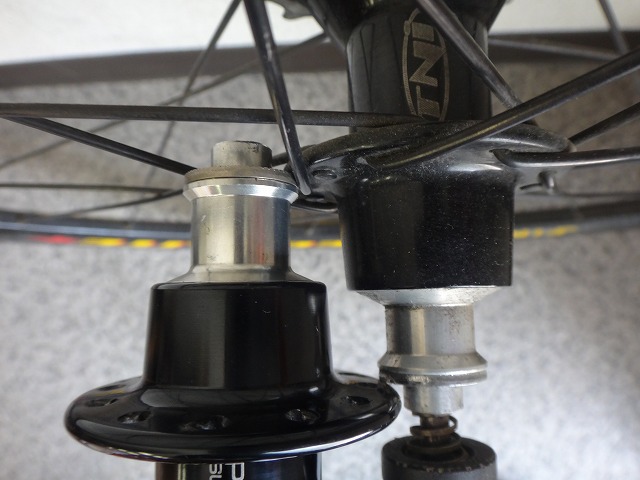
↑Photos I took before returning the hub to the customer and noticed the difference
The difference in diameter of the thin left axle end is because
the Planet X hub is equivalent to the Evo Hub II (aluminum shaft version).
As I'll mention later, being equivalent to Evo Hub II, the freewheel body has a set screw.

I disassembled the rear wheel and cleaned the rear hub.
The hub at the top of the image is the Evo hub (steel shaft, so Evo Hub I),
and the bottom is the brand new Evo Lite hub.
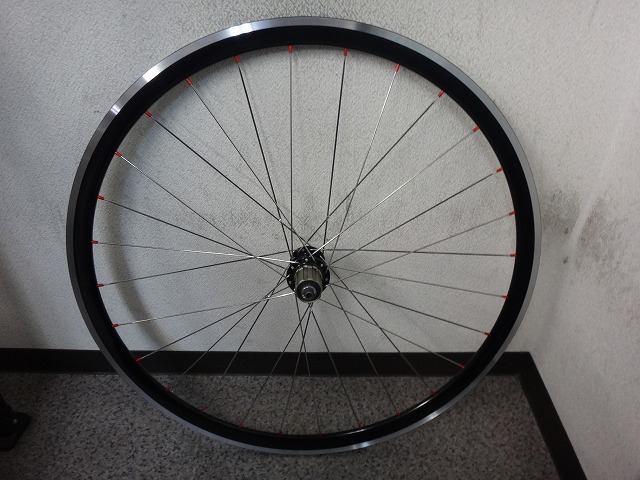
Built it up.

Because the left end cap is aluminum, it's easy to miss that it has a steel shaft.
With the tap-fit right end cap secured by set screw after installation,
there's no set screw on the freewheel body's spline.
It seems the bearing race at the inner side of the freewheel body is held in place there as well.
It's similar to a PowerTap hub with the same tap-fit, just differing in whether
the set screw is on the freewheel body or on the right end cap.
I built the Evo Hub 28H in semi-comp 1-cross lacing with spoke connections.
You can clearly see that the left and right spoke tensions are very close to each other.
This is simply because the dimensions are closer to the front wheel than when building with the Evo Lite hub,
but small difference in left-right spoke tension doesn't necessarily mean higher lateral stiffness.
In either case, with the rim centered and the freewheel-side spoke tension equal
(of course the spoke gauge and lacing pattern are also the same),
when compared to the rear wheel built with the Evo Lite hub,
the non-freewheel-side tension is higher on the Evo hub,
but the lateral stiffness is definitely still higher on the Evo Lite hub.
With the same freewheel-side spoke tension
(I keep repeating this, but with the condition that the rim is centered),
there are other means to achieve higher non-freewheel-side spoke tension,
so I think a wide-flange rear hub + lacing with different left-right diameters +
different spoke counts left and right within what the hub allows is optimal...
This time I reused the rear hub due to budget constraints.