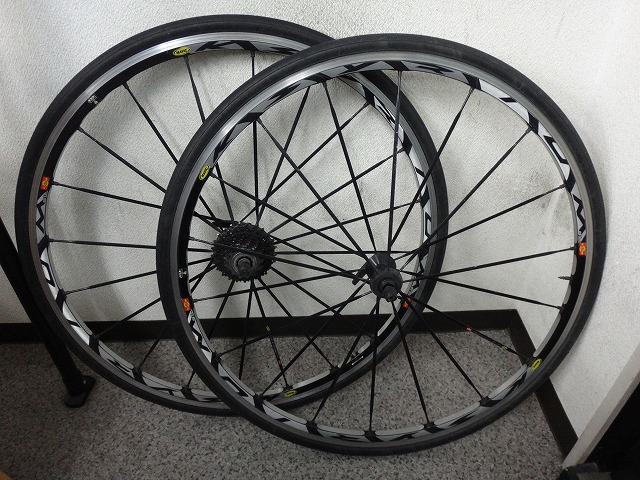
I received a Ksyrium Pro Exalith (high-end Mavic wheelset) from a customer.
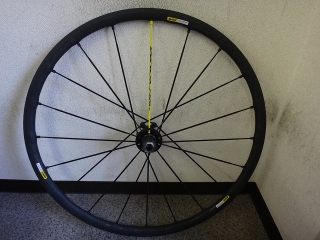
However, the title of this article is not
"Ksyrium Pro Exalith."
Let me start with the relevant work first.
The rear wheel rim was significantly shifted toward the non-drive side.
I forget which Swiss wheelbuilder made it, but apparently it was purchased through overseas online shopping.
The front wheel also had some centering issues, though not as severe as the rear,
and since it was brand new and unused, there was no need to suspect rim warping or spoke bending,
so the work itself wasn't particularly time-consuming.
By the way, when I asked the customer why they bought this Ksyrium, they said:
"Because somewhere online there was a blog post that said,
'When you buy a high-end Ksyrium model without really understanding the differences,
the rear wheel comes with something called R-SYS,
but the rear wheel with full aluminum spokes is the real deal—it uses radial lacing on the drive side (isopulse design),
continuing the legacy of the original Ksyrium and representing the true successor.'
After reading that post (acting clueless), apparently they decided to buy it.
Well, I wouldn't say R-SYS is bad per se,
but selling an R-SYS rear wheel under the Ksyrium name seems a bit off to me.
Now, onto the main topic of the title.
I didn't take a photo of the front wheel,
but the front wheel uses what I called Mavic's number-2 spoke in my previous aluminum spoke article,
while the rear wheel has number-4 spokes on the drive side and number-2 spokes on the non-drive side.

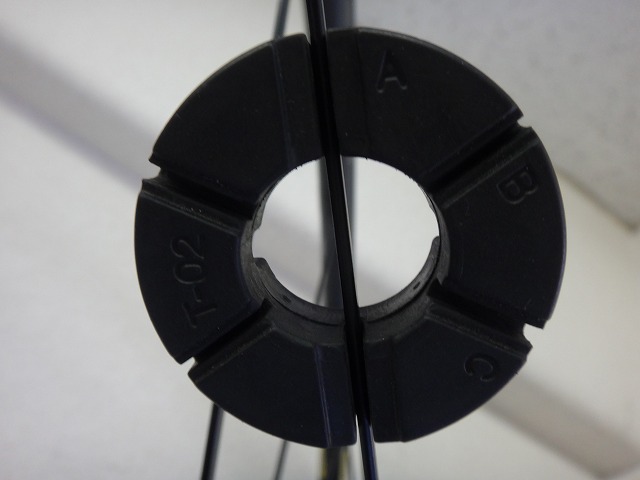
The number-2 spoke fits perfectly into slot A of the Fulcrum spoke wrench.
This tool has a wide contact surface, so it minimizes spoke twisting,
and I frequently use it whenever it fits, regardless of the wheel or spoke manufacturer.
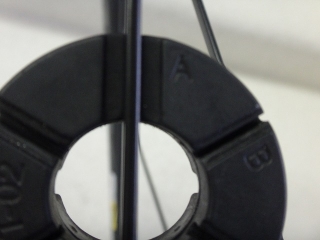
However, the number-4 spoke doesn't fit into slot A.
So I had to use a different spoke wrench that did fit.
Regarding the butted section dimensions of the spokes,
measured with calipers, the number-2 spoke measured 4.0/1.9mm,
and the number-4 spoke measured 4.2/2.2mm.
In my previous article, I wrote that the number-4 spoke had a cross-section closer to square compared to the number-2,
but since Mavic basically doesn't use asymmetric lacing
(the "R-SYS rear wheel" is excluded from this consideration since the spoke material itself differs),
I assumed based on my past experience that the number-4 spoke was thicker left-to-right but shorter front-to-back.
The reason there's no image of the number-4 spoke in that article is simply because I didn't have one in stock at the time.
In reality, both diameters are slightly larger,
so it's certain that the number-4 spoke has greater spoke density than the number-2,
and a rear wheel with number-4 spokes on the drive side and number-2 on the non-drive side technically constitutes subtle asymmetric lacing.
Moreover, I've even found a way to distinguish between number-4 and number-2 spokes!
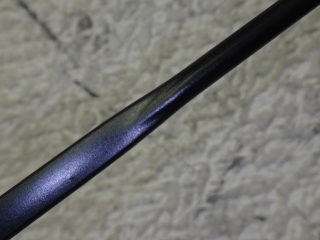
↑The number-4 spoke has a fin-like end to the butted section.
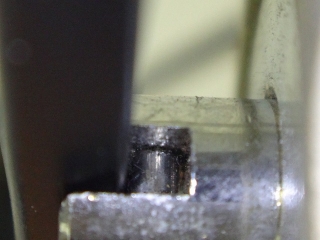
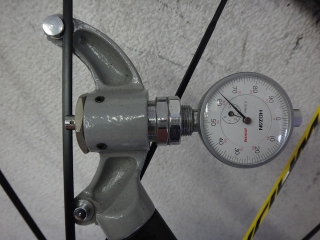
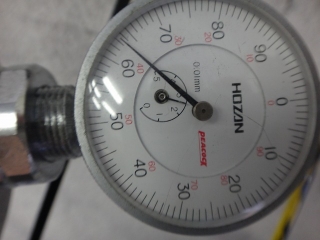
The H1ST is measured by the value where the probe contacts the bottom, since spoke width is within 2.35mm
around 250–260.
The image shows the rim, which had been shifted toward the non-drive side, now adjusted toward the drive side—it's slightly over-tensioned compared to the hanging average, so it reads around 264 or so.
If I wanted to get it to 260, I could fine-tune it by loosening the non-drive side slightly while tightening the drive side,
but I decided there was no need to loosen it unnecessarily, so I only tightened the drive side.
The first-ST (initial spoke tension) for aluminum spokes I've written about in this blog is my own measured average for hanging wheels.
That's why I didn't want to write about it
If a new wheel is noticeably lower than that,
I'll tension it after obtaining the customer's consent,
and when disassembling for rim replacement, I record the first-ST beforehand.
Since the relationship between first-ST and second-ST for Fulcrum and Mavic aluminum spokes—shown as a bell-curve—is not disclosed,
I can only use first-ST as my working spoke tension.

↑I've recreated the table on Mavic aluminum spokes.
I've also re-measured the spoke dimensions.
I'm replacing the table from the previous article with this one.
There was an error in saying the number-4 spoke was closer to square than the number-2,
which I'm removing, but since I've documented the mistake here, I ask for your understanding.
Regarding the H1ST of the number-4 spoke, I knew it was around 260,
but at the time I wrote that article, I didn't have a reliable source (actual spoke) in the shop,
so I marked it with "?"—but since then I've confirmed it with several spokes, so I'm setting it at 260.
If the spoke type is the same for the rear drive side and front wheel, or for radial and 4-cross lacing (like the Ksyrium Disc front wheel),
the H1ST should be roughly equivalent.
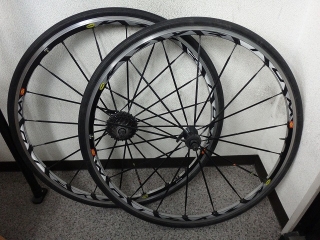
↑As an example, this is the original Ksyrium SLC with the rim holes relief-machined to create the original Ksyrium SL,
all using number-1 spokes (originally only that type),
with front and rear right averages of 308 and 311 respectively.

However, the title of this article is not
"Ksyrium Pro Exalith."
Let me start with the relevant work first.
The rear wheel rim was significantly shifted toward the non-drive side.
I forget which Swiss wheelbuilder made it, but apparently it was purchased through overseas online shopping.
The front wheel also had some centering issues, though not as severe as the rear,
and since it was brand new and unused, there was no need to suspect rim warping or spoke bending,
so the work itself wasn't particularly time-consuming.
By the way, when I asked the customer why they bought this Ksyrium, they said:
"Because somewhere online there was a blog post that said,
'When you buy a high-end Ksyrium model without really understanding the differences,
the rear wheel comes with something called R-SYS,
but the rear wheel with full aluminum spokes is the real deal—it uses radial lacing on the drive side (isopulse design),
continuing the legacy of the original Ksyrium and representing the true successor.'
After reading that post (acting clueless), apparently they decided to buy it.
Well, I wouldn't say R-SYS is bad per se,
but selling an R-SYS rear wheel under the Ksyrium name seems a bit off to me.
Now, onto the main topic of the title.
I didn't take a photo of the front wheel,
but the front wheel uses what I called Mavic's number-2 spoke in my previous aluminum spoke article,
while the rear wheel has number-4 spokes on the drive side and number-2 spokes on the non-drive side.
The number-2 spoke fits perfectly into slot A of the Fulcrum spoke wrench.
This tool has a wide contact surface, so it minimizes spoke twisting,
and I frequently use it whenever it fits, regardless of the wheel or spoke manufacturer.
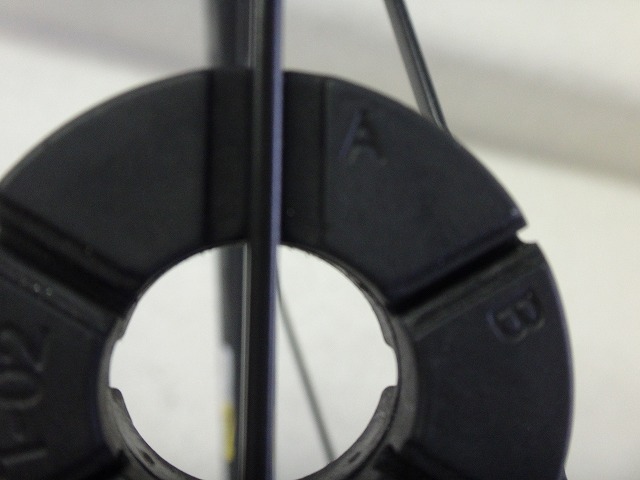
However, the number-4 spoke doesn't fit into slot A.
So I had to use a different spoke wrench that did fit.
Regarding the butted section dimensions of the spokes,
measured with calipers, the number-2 spoke measured 4.0/1.9mm,
and the number-4 spoke measured 4.2/2.2mm.
In my previous article, I wrote that the number-4 spoke had a cross-section closer to square compared to the number-2,
but since Mavic basically doesn't use asymmetric lacing
(the "R-SYS rear wheel" is excluded from this consideration since the spoke material itself differs),
I assumed based on my past experience that the number-4 spoke was thicker left-to-right but shorter front-to-back.
The reason there's no image of the number-4 spoke in that article is simply because I didn't have one in stock at the time.
In reality, both diameters are slightly larger,
so it's certain that the number-4 spoke has greater spoke density than the number-2,
and a rear wheel with number-4 spokes on the drive side and number-2 on the non-drive side technically constitutes subtle asymmetric lacing.
Moreover, I've even found a way to distinguish between number-4 and number-2 spokes!
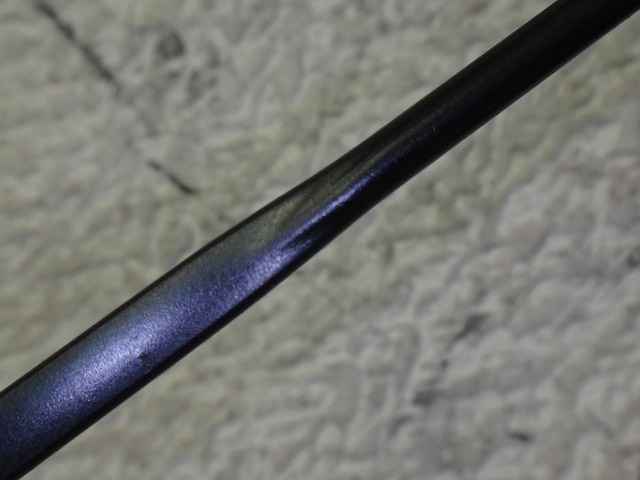
↑The number-4 spoke has a fin-like end to the butted section.
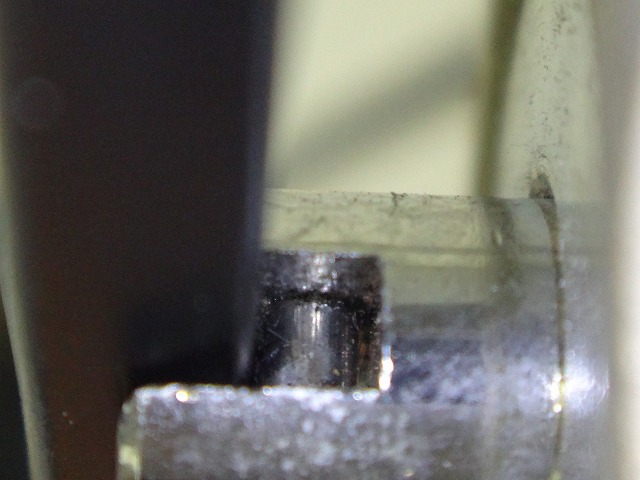
The H1ST is measured by the value where the probe contacts the bottom, since spoke width is within 2.35mm

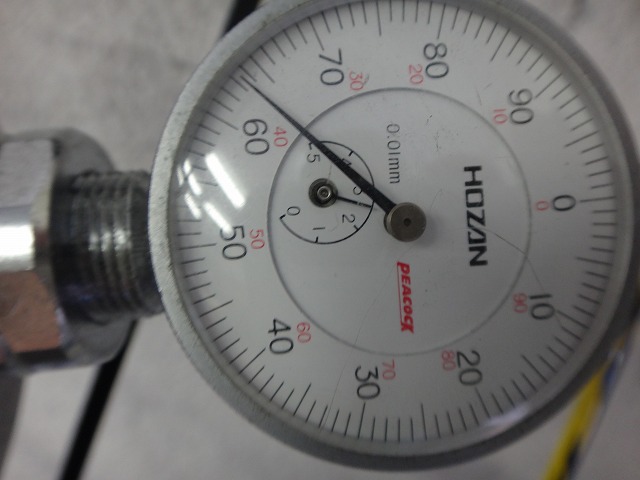
around 250–260.
The image shows the rim, which had been shifted toward the non-drive side, now adjusted toward the drive side—it's slightly over-tensioned compared to the hanging average, so it reads around 264 or so.
If I wanted to get it to 260, I could fine-tune it by loosening the non-drive side slightly while tightening the drive side,
but I decided there was no need to loosen it unnecessarily, so I only tightened the drive side.
The first-ST (initial spoke tension) for aluminum spokes I've written about in this blog is my own measured average for hanging wheels.
If a new wheel is noticeably lower than that,
I'll tension it after obtaining the customer's consent,
and when disassembling for rim replacement, I record the first-ST beforehand.
Since the relationship between first-ST and second-ST for Fulcrum and Mavic aluminum spokes—shown as a bell-curve—is not disclosed,
I can only use first-ST as my working spoke tension.

↑I've recreated the table on Mavic aluminum spokes.
I've also re-measured the spoke dimensions.
I'm replacing the table from the previous article with this one.
There was an error in saying the number-4 spoke was closer to square than the number-2,
which I'm removing, but since I've documented the mistake here, I ask for your understanding.
Regarding the H1ST of the number-4 spoke, I knew it was around 260,
but at the time I wrote that article, I didn't have a reliable source (actual spoke) in the shop,
so I marked it with "?"—but since then I've confirmed it with several spokes, so I'm setting it at 260.
If the spoke type is the same for the rear drive side and front wheel, or for radial and 4-cross lacing (like the Ksyrium Disc front wheel),
the H1ST should be roughly equivalent.
↑As an example, this is the original Ksyrium SLC with the rim holes relief-machined to create the original Ksyrium SL,
all using number-1 spokes (originally only that type),
with front and rear right averages of 308 and 311 respectively.