I've received numerous comments asking me to write about aluminum spokes,
and customers have mentioned it in person as well.
At minimum, some short-sighted fool (playing dumb) claiming that
"aluminum spokes are basically meaningless compared to steel spokes"
is clearly wrong.
I could end the discussion by saying "if you use Racing Zero a bit,
it's obvious the wheel has a hardness you can't get with steel spokes"
based on feel alone, but rather than that kind of thing,
I'll write about how it fits within the Nomu Lab wheel philosophy.
"Primary Spoke Tension (hereafter Primary ST)"
"Secondary Spoke Tension (hereafter Secondary ST)"
"Spoke Specific Gravity"
"Beaker Theory"
I could apply all these to aluminum spokes,
but the beaker theory stuff (which I've never touched on before) gets long
and isn't directly related to aluminum spokes, so I'll cover that another time.
First, about Primary ST.
Primary ST is literally the numerical reading shown on the spoke tension meter.
It's Nomu Lab terminology, just so you know.
Secondary ST is the estimated spoke tension value when Primary ST is converted using a conversion table,
and this is what people generally mean when they say "spoke tension."
You might reasonably say, "Why use such confusing terminology?
Just call Primary ST 'meter reading' and Secondary ST 'spoke tension',"
and that's a fair point. However,
Primary ST also increases/decreases with nipple tightening/loosening,
it's a type of quantification of spoke tension,
and you can't discuss wheel hardness or drive stiffness based only on
spoke tension (meaning Secondary ST).
I'll explain why below.
Aluminum spokes use the flat-blade aero design of Racing Zero
(a square aero where the butted section has uniform shape everywhere).
This isn't because I deliberately chose something convenient for my argument—
it's because I believe it's the aluminum spoke with the least variability in observable facts,
allowing me to express my ideas against the most stable observational baseline.
On that point, tie spokes don't work.
I'll write more about that later,
but first let me explain why I didn't choose Mavic aluminum spokes.

Mavic aluminum spokes exist in at least 4 types.
There might be more, but I'm just not knowledgeable enough.
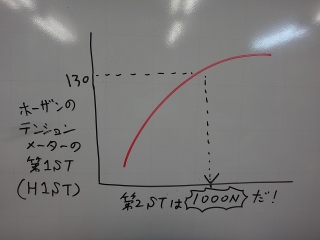
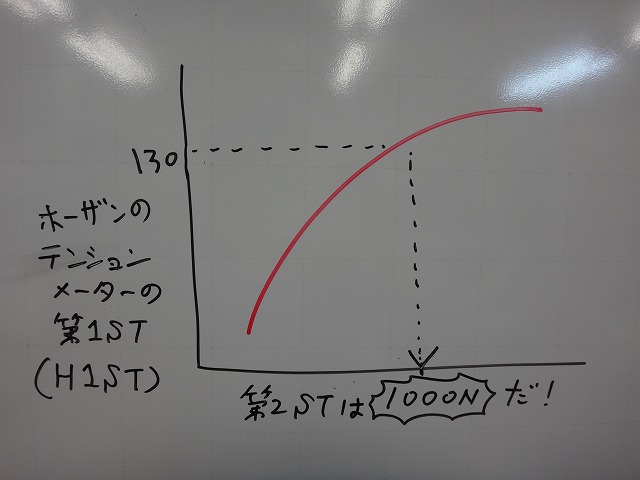
The "H1ST" in the diagram above—ignore that for now.
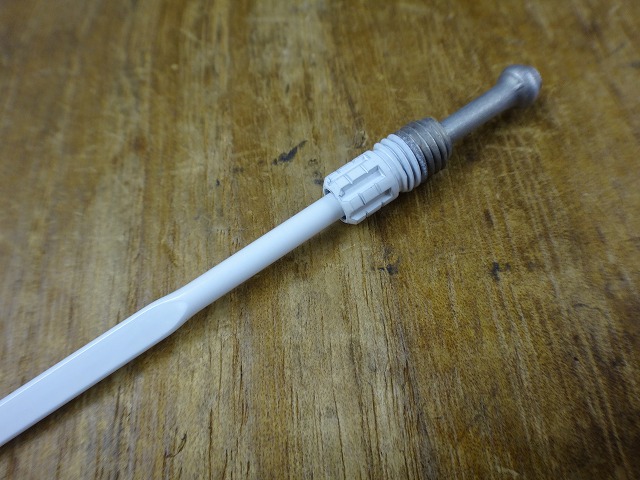
Spoke Type 1 has a shape that's existed since the original Ksyrium SSC,
with fish-tail-like grooves at the ends of the butted section,
making it the type with the greatest front-to-back width.
Spoke Type 2 has less front-to-back width than 1 and no groove at the butted boundary.
Spoke Type 3 is a round cross-section spoke.
Spoke Type 4 resembles 2 closely but differs in flattening ratio.
Ksyrium from the original generation through ES used small nipples with small tool-engaging splines,
but R-SYS nipples have larger-diameter splines requiring different tools.
Ksyrium after R-SYS onward uses R-SYS-sized nipples, and in either case
the nipples are sealed in during spoke manufacturing,
so you can't measure spoke weight as a standalone component.
This makes it difficult to determine precise spoke specific gravity.
This is why I don't use Mavic spokes when discussing aluminum spokes.
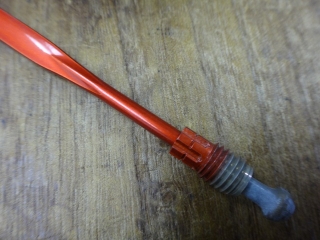
↑Spoke Type 1
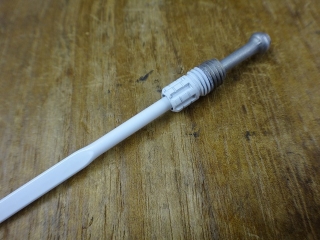
↑Spoke Type 2
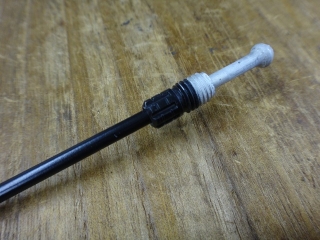
↑Spoke Type 3
For Spoke Type 4 (→here)
Next, about the relationship between Primary ST and Secondary ST.
This overlaps with what I've written before (→here)(→here), but I'll touch on it lightly.
Regarding Third Spoke Tension, I won't touch the core of it,
but I'll write about it when I cover beaker theory.
If it were true that "when Primary ST doubles, Secondary ST also doubles,
and when Primary ST becomes n times, Secondary ST also becomes n times...",
then graphing the relationship between Primary ST and Secondary ST would yield a straight line.
But in reality, that's not the case. That's why a conversion table is necessary.
As written in the linked articles,
DT and Park Tool tension meters are calibrated against conversion tables
and are supposed to have no individual error (Park Tool is slightly suspect).
Hozan acknowledges error between individual meters
and includes individual conversion tables with each meter.
For example, with my Hozan meter, when Primary ST shows 130
for a 14G plain round spoke, Secondary ST is 1000N.
Secondary ST should be the same value if each instrument is accurate,
but Primary ST shows completely different numbers if the tension meter manufacturer differs,
and even the same (supposedly) products have subtle errors.
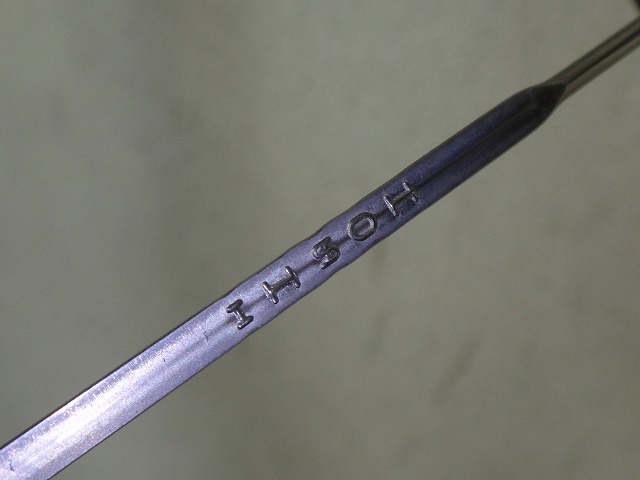
From here on, as shown in the diagram above,
I'll call the Hozan tension meter's Primary ST as H1ST.
DT would be D1ST, Park Tool would be P1ST.
When measuring the same spoke, H1ST, D1ST, and P1ST readings vary,
but when converted using each meter's conversion table, Secondary ST becomes identical.

This is my Hozan tension meter's conversion table.
As I mentioned before, Hozan's H1ST is supposed to vary
as much as there are individual meters.
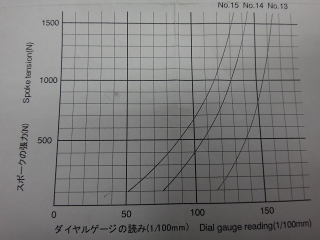
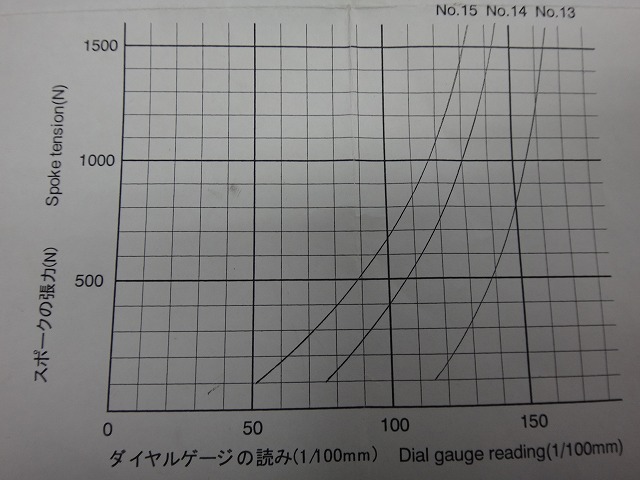
This is a graph of Primary ST and Secondary ST.
My diagram has the axes reversed from this one, so the curve's bend is also reversed,
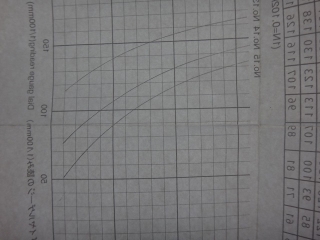
but looking at it backlit, like this, it becomes the same.
Since DT's conversion table has this orientation (horizontal axis: Secondary ST, vertical axis: Primary ST),
I've gotten in the habit of drawing it this way.
Though unrelated to today's topic, one reason is that it's easier to visualize things this way,
similar to how stress-strain curves bend.
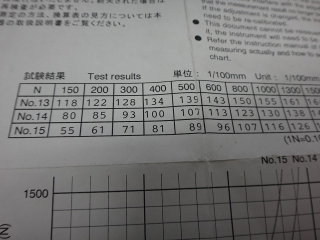
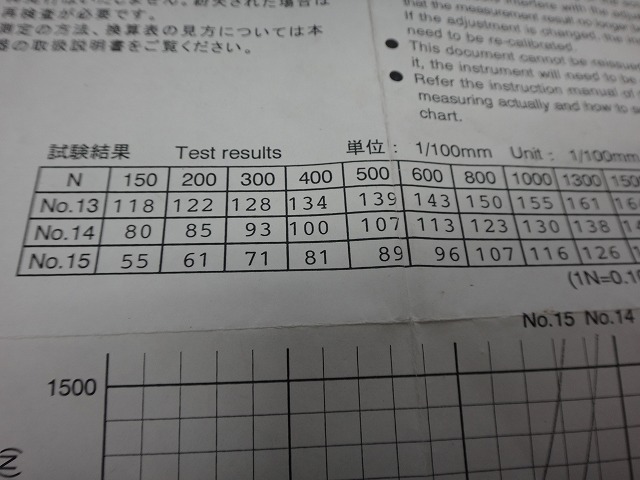
The specific Primary ST values look like this.
Hozan's tension meter only has readings for 13G, 14G, and 15G plain spokes,
and I don't have data for butted spokes.
So I can't measure Competition or CX-RAY with this.
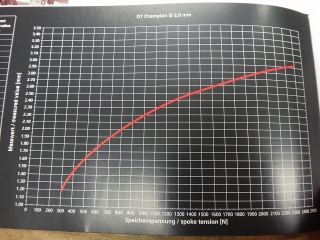
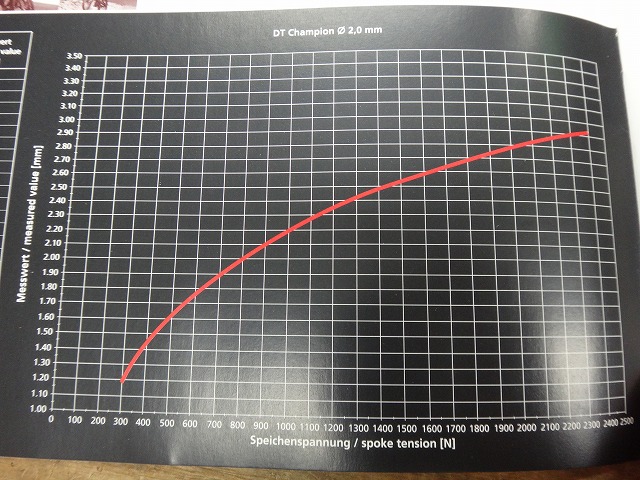
This is DT's graph (Champion 14G plain).
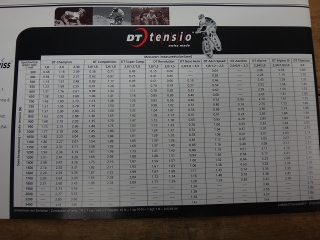
There's also a numbers-only table.
The first thing I did was create a comparison table between D1ST and H1ST.
To be specific, let's say a certain Competition (14G) shows D1ST of 2.00.
According to DT's conversion table, at D1ST of 1.96, Secondary ST is 1200N,
and at 2.04, it's 1300N, so
this Competition's Secondary ST would be around 1250N,
but when I measure it with H1ST, it shows 134.
According to Hozan's conversion table, 14G plain at 1300N Secondary ST shows 138,
and 15G plain shows 126, which matches the actual situation pretty well.
I've done this detailed research on frequently-used spokes and created
a "H1ST table for butted spokes,"
so now I can measure butted spokes with my Hozan tension meter.
For Sapim spokes, I assume they're identical to DT spokes of the same cross-section
and derive H1ST from DT's conversion table.
Plain spokes—Leader and Champion are basically the same,
and I treat CX-RAY and Aero Lite, Race and Competition as identical too.
Actually, Race has a clearly longer 1.8mm round butted section than Competition,
visible in the decimal places of spoke specific gravity, so the specific gravity does differ,
but I judge that there's no problem in wheel building even if we assume
Race's D1ST or H1ST is the same as Competition.
For Laser and Revolution, I don't use them often, so when building wheels with these spokes,
I use the DT tension meter.
Determining H1ST is extremely tedious.
Apart from that use, I don't use the DT meter except when checking H1ST.
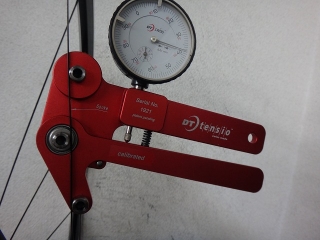
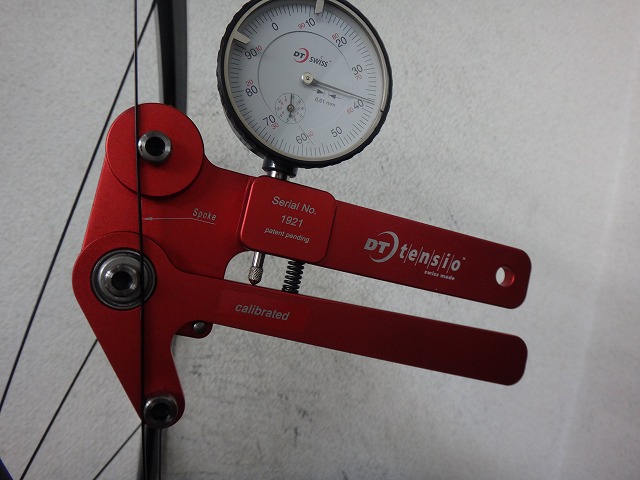
One important thing.
D1ST in DT's conversion table is a reading taken with the probe applied from the left-right direction of the spoke.
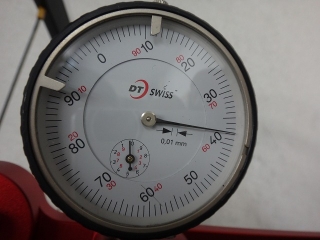
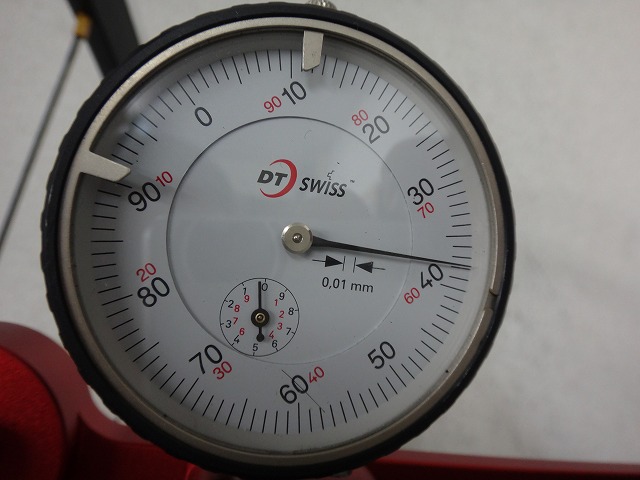
With (pseudo-)Aero Lite CX-RAY, it showed just under 0.38.
Aero Lite is 0.37 at 1000N and 0.41 at 1050N, so
this CX-RAY's Secondary ST is just over 1000N.
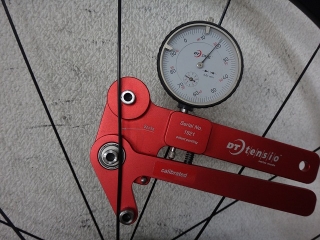

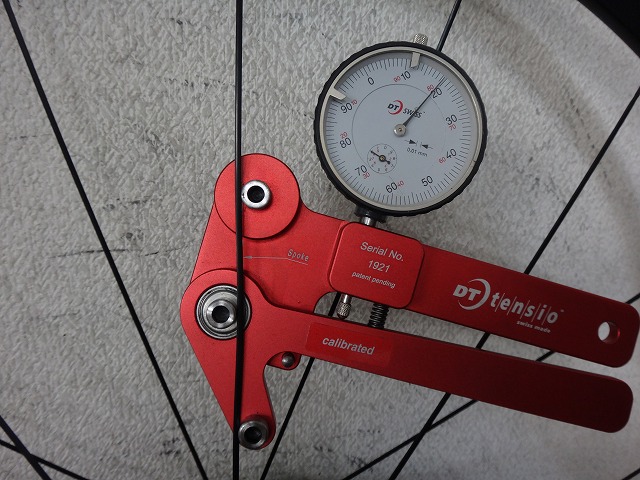
When I measured from the front-to-back direction, the reading jumped to 2.19.
This isn't a value used in the conversion table,
but I actually track detailed values like "when CX-RAY's D1ST is 0.38 from left-right,
it's 2.19 from front-to-back."
For reasons I'll explain later, H1ST basically uses front-to-back readings.
By the way, the "front-to-back" H1ST for this spoke is 130.
Unless otherwise specified, H1ST values below are front-to-back measurements.
I'll mention it later, but remember that "with flat spokes,
measuring on the side with larger radius gives larger numbers
than measuring on the side with smaller radius."
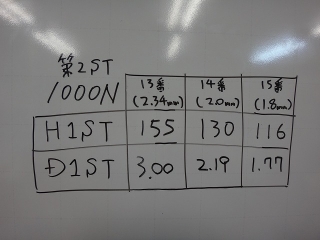
I've compiled the H1ST and D1ST values for 13G, 14G, and 15G plain spokes
when Secondary ST is 1000N.
Round spokes show the same Primary ST no matter the measurement direction.
This difference in Primary ST amount can be thought of as quantifying
the wheel's tactile hardness and drive engagement quality.
It quantifies the resistance to deformation in front-to-back and left-right directions respectively, so
for example, when 14G plain at 1000N is expressed in D1ST,
left-right deformation resistance 2.19, front-to-back deformation resistance 2.19,
and Aero Lite at just over 1000N can be expressed as
left-right deformation resistance 0.38, front-to-back deformation resistance 2.19.
Considering the simplest wheel—a radial front wheel—
a front wheel with 13G plain at H1ST 155 and
a front wheel with 15G plain at H1ST 116 have the same spoke tension (Secondary ST),
yet the feel when riding and deflection when applying side load
are definitely harder and less flexible in the former case.
If we claimed that "wheel stiffness is identical as long as Secondary ST is the same,
regardless of Primary ST,"
then spokes should simply be as light as possible,
so long as they don't undergo plastic deformation from tension.
Taking it to an extreme: if there were an ultra-thin plain spoke
with H1ST around 50 that could still hold 1000N Secondary ST,
that would give the same stiffness as 13G at H1ST 155 by this logic.
Obviously, that's not true.
Even when Secondary ST (I'll keep saying this, but meaning Secondary ST)
is identical, differences in Primary ST create differences in wheel hardness.
Of course, a spoke with larger Primary ST relative to Secondary ST
would have larger spoke specific gravity,
which works against weight reduction—that's the tradeoff.
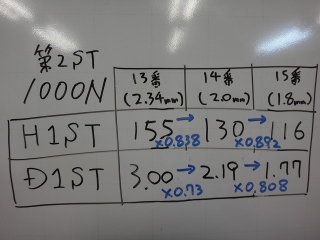
By the way, the ratio between H1ST and D1ST isn't constant. It's not even close.
This is an extremely headache-inducing problem for me,
but I'll cover it when I write about beaker theory.
Sapim's CX and CX-RAY are both
elliptical flat-blade aero spokes with spoke specific gravities of 100% and 65%.
From manufacturer specs, rough calculation gives 98.9% and 63.6%,
but actual measurement shows about 1% higher.
Well, I'll just say 100% and 65% for simplicity.
When these spokes are tensioned to the maximum
(at which point the nipple can't be tightened further),
H1ST is around 190 for CX and 150 for CX-RAY.
The earlier black CX-RAY at 130 is from Nomu Lab Wheel No. 5's front wheel,
but there's no way I'm tensioning it up to 150 (or could, for that matter).
H1ST of 150 on CX-RAY is seen in cases like
24H four-spoke rear laced wheels where the free side is tensioned to the max
(otherwise the anti-free side goes flabby).
Even that's only possible with certain rims.
Specifically, something like a Meccanico complete rear wheel is like that.
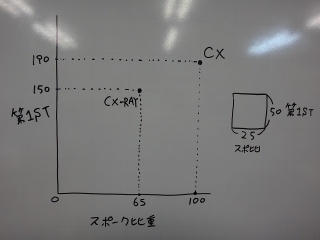
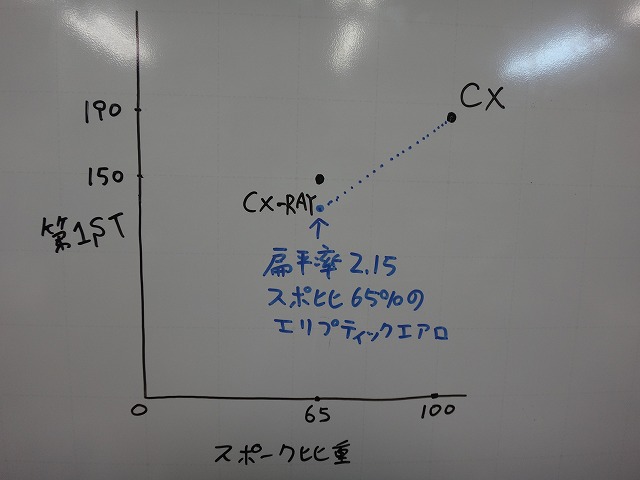
I've graphed the relationship between Primary ST and spoke specific gravity for CX and CX-RAY.
To avoid making it look contrived, I've been careful to draw it
roughly to scale based on the grid on the whiteboard,
matching the ratio of the square on the right.
Here, if I imagine laying out elliptical aero spokes
where spoke specific gravity is changed in 1% increments from CX to CX-RAY,
I consider what collection of points that would form.
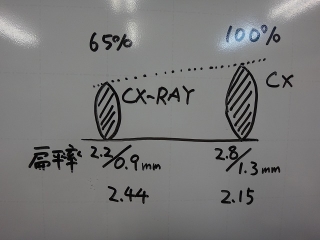
CX and CX-RAY have different flattening ratios.
CX is slightly more squat.
The flattening ratio for round spokes is 1, so
the further from that, the flatter it is.
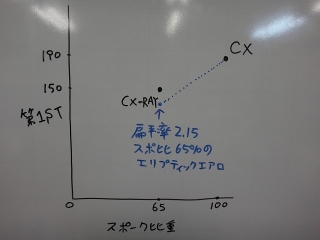
I imagined what the collection of points would look like
if CX's flattening ratio were maintained while spoke specific gravity were reduced to 65%.
In reality, there'd be a bit more scatter, but
you'd see a point where "you could draw a nice straight line through here,"
and that drawn line is the blue dashed line.
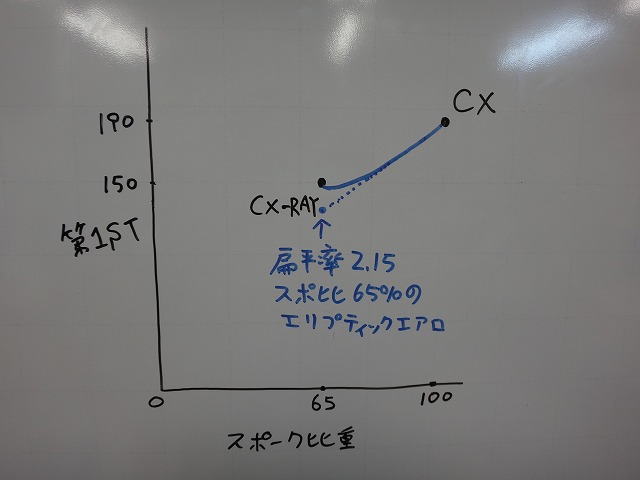
Since actual CX-RAY's flattening ratio isn't 2.15 but rather 2.44,
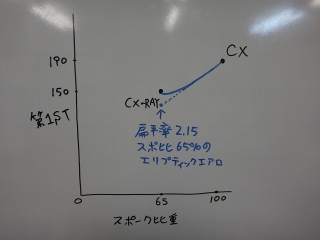
a spoke with 2.15 flattening ratio and 65% specific gravity should
receive an upward correction to Primary ST
(the left-right vs. front-to-back difference in D1ST is the basis).
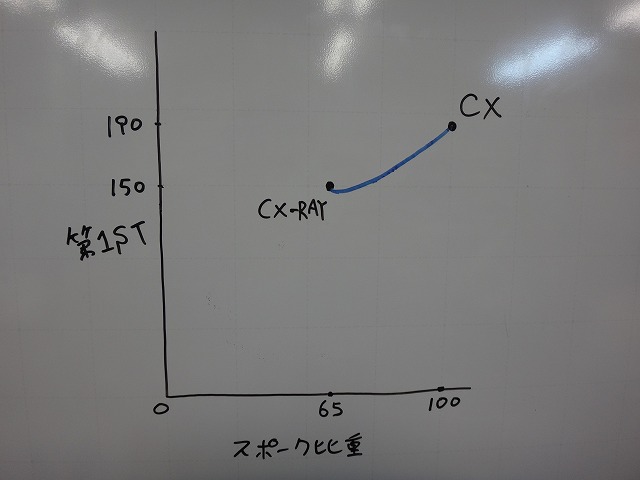
If flattening ratio gradually changed from CX to CX-RAY,
the blue dashed line would rise up to become the blue solid line, and
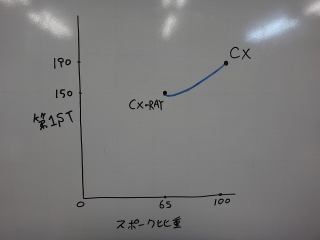
it would look like this.
Though it doesn't really matter whether it curves a bit or stays fairly straight—
it won't affect the rest of this discussion.
You might be thinking "Hey, finally talk about aluminum spokes already,"
but all this preamble was necessary.
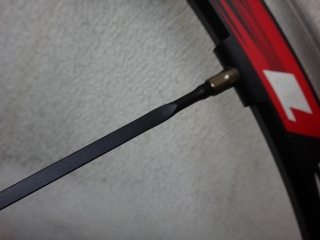
And here it is, finally.
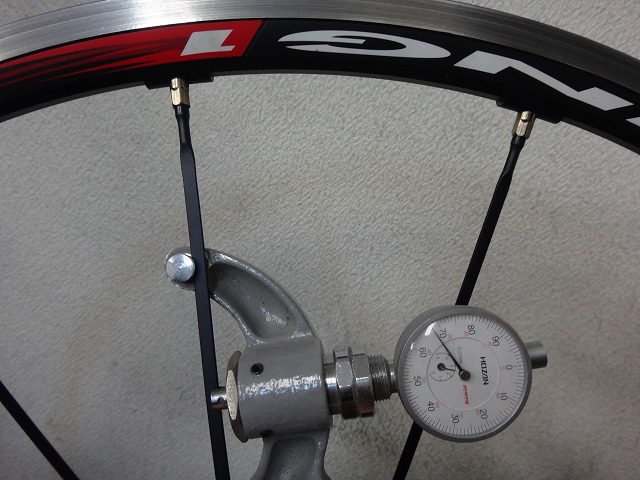
Fulcrum's flat-blade aluminum spokes.
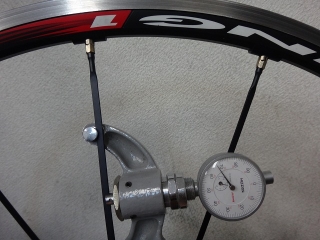
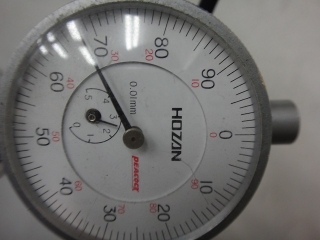
The H1ST measured 268.
This is a somewhat exceptional value.
It's because I'm further tightening Racing 1 from the brass nipple era.
For current aluminum-nipple Racing Zero front or rear-right,
H1ST is around 235.
Below 220, the ride feel noticeably becomes mushy.
A while back, a Racing Zero 2WAY-FIT
that had a rim swap at some shop was obviously mushy, so
I re-tensioned it (→here), and
the minimum H1ST was 205, maximum 220.
From there, I tensioned it up to where the minimum is 230 and average is around 235.
I reported these numbers to the customer—
not with the intention of maintaining 235 on any other Hozan meter going forward,
but to show that it matches the other Racing Zeros we have in the shop.
Next, I'll measure spoke specific gravity.
But first.
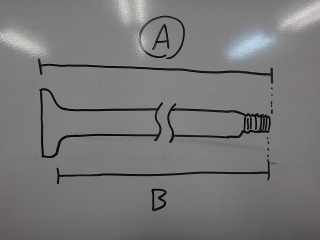
There's the question of how to define this aluminum spoke's length.
Should it be the total length (A in the diagram above),
or the length below the neck (B in the diagram).
This spoke's nominal length is 279.2mm. I checked what that measurement refers to
and found it matches the total length A exactly, so I'll use that.
It's slightly disadvantageous for specific gravity, but I'll go with it.

I got a scale that can measure from 0.1g so I can calculate
even with fewer spokes.
I don't think anodize color affects weight, but
I'll measure them separately just to be sure.
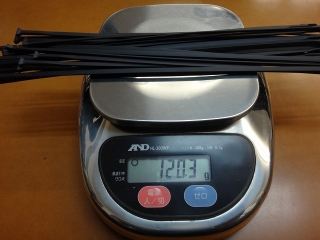
↑Black, 24 spokes
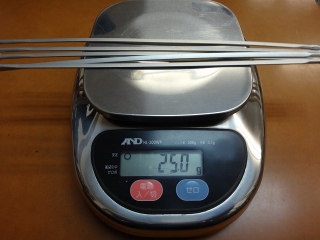
↑Silver, 5 spokes
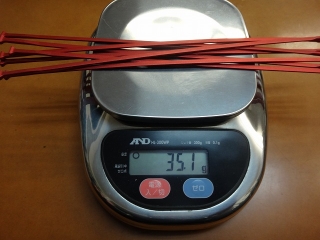
↑Red, 7 spokes
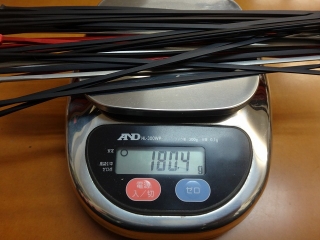
↑36 spokes together
Each spoke comes out to just slightly over 5g.
So this spoke's specific gravity came out to 69.8%.
Since I rounded Sapim's value too, let's call this 70%.
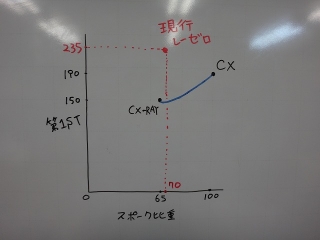
I've added that to the earlier diagram.
You can see it's way off the chart.
Where's this "basically the same as steel spokes" business?
Is someone going to look at this and still claim "Primary ST is unrelated to drive stiffness!"?

↑Biased version
Next, why I didn't measure tie spokes, also from Fulcrum.
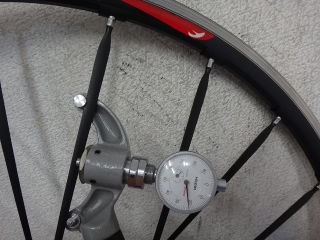
On the free side of the Racing 1 rear wheel,
measuring this tie spoke section gives
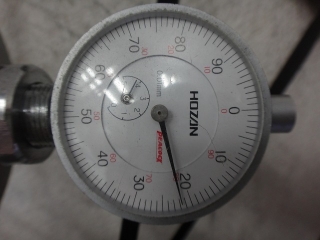
H1ST just over 421.
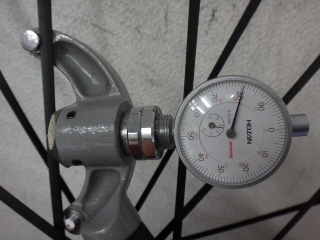
But measuring a bit closer to the hub gives
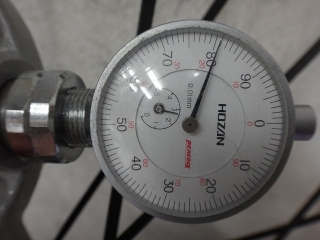
281, plummeting. The flattening ratio changes there.
To be clear, it's the same spoke in both cases.
Since flat spokes give nearly identical readings no matter where you measure,
I avoided tie spokes to get stable numbers.
Also, going way back, I included H1ST values for Mavic aluminum spokes where possible.
For round spokes, the reading is the same front-to-back and left-right.
The reason Mavic's round aluminum spoke H1ST is highest is related to
the fact that H1ST is measured from the front-to-back direction of the spoke.
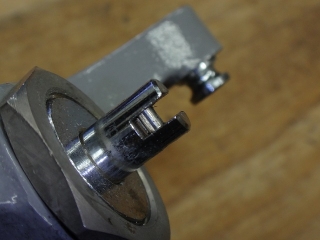
The probe on Hozan's tension meter has a U-shaped indent,
and the spoke rests in the bottom of this indent.
Since it can measure 13G plain spoke (2.34mm diameter),
the max width must be slightly smaller than that, so
I can create a table converting D1ST left-right for CX-RAY and Aero Lite
to H1ST left-right.
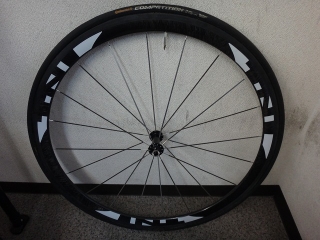
This is my personal Nomu Lab Wheel No. 2.
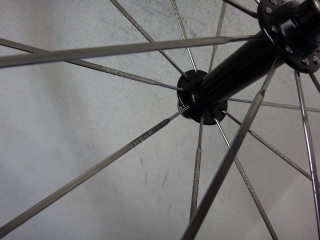

Built with Star Aero Spoke Bright Type II
tensioned as tight as possible.
Hehehehe.
This wheel's spoke specific gravity is about 93%.
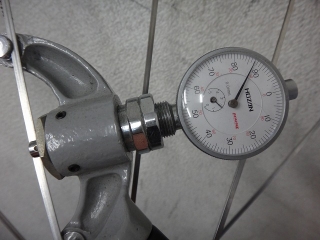
The H1ST is 187.
As I mentioned earlier, CX maxes out around 190,
so tensioning an Aero SB II with slightly less specific gravity
to this level means it's tensioned pretty hard.
Here's a concrete CX-RAY value:
when front-to-back H1ST is 130, left-right is around 78.
At 120, it's around 63.
So this Aero SB II, despite different flattening ratio from CX-RAY,
should have left-right H1ST less than 187, but...
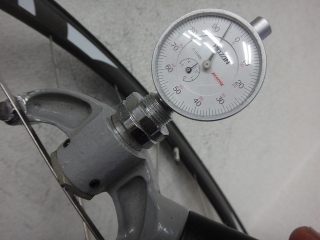
In reality it came out to just under 295—a ridiculous number.
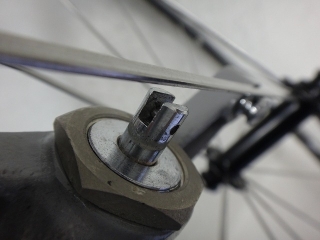
This is because the spoke doesn't fit into the probe indent.
Fulcrum's flat aluminum spoke's narrower side width is
about 1.4mm in actual measurement, so it can be measured front-to-back, but
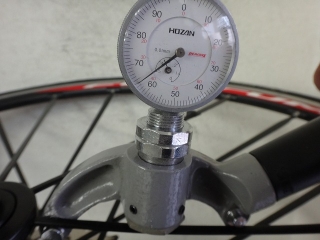
not from left-right.
The tie spoke too shows
281 front-to-back but 364 left-right.
The reason Mavic round aluminum spoke numbers jump is this, and
why I take H1ST from the front-to-back direction is because of this.
So the aluminum round spoke's 360 is wrong—it should actually be lower.
However, knowing "not fitting in the indent, but reads 360" is useful
as a reference when re-tensioning after rim swap work.
So there's value in measuring it.
So what's so great about aluminum spokes?
As I wrote in blue earlier, copying it here:
a spoke with larger Primary ST relative to Secondary ST
would have larger spoke specific gravity,
which works against weight reduction—that's the tradeoff.
This was written with "spokes are only steel" as the underlying assumption.
Achieving Primary ST that the 100% specific gravity steel spoke can't reach,
while keeping spoke specific gravity around the same as CX-RAY or even slightly heavier...
that's only possible because the actual specific gravity differs between aluminum and steel.
Some guy claims that comparing this to aluminum and steel ingots or something,
looking only at material properties, means it's meaningless (playing dumb),
but that's completely wrong. You have to evaluate them as spokes.
By the way, I should mention that there's someone out there who
criticizes other companies' wheels saying "that's no good, this doesn't work either,"
then shows off the complete wheel they designed themselves and selected parts for—
but the actual product wasn't that impressive.
A 24H, equal-diameter-both-sides, four-spoke rear wheel
with free-side H1ST of 150 and anti-free-side at 120.
For a four-spoke lacing, the 150 to 120 ratio is pretty even, but
that's mainly because of the offset rim.
If they were hitting 150 with CX-RAY, that'd be something, but
it's a pillar-brand aero spoke with heavier specific gravity than CX-RAY,
so they're not tensioning it that hard.
Making it worse, the anti-free-side radial lace has spoke wiggle,
so it deflects some...
Setting rim stiffness aside, during pedaling the inner edge of the rear rim
(noticeably enough that you feel the energy loss from it) is being squeezed,
or in other words, it's a rear wheel with poor engagement,
which is my assessment just looking at the thing with all my experience with various wheels.
The actual owner's experience matched that assessment pretty well, so
yeah, I was right about that.
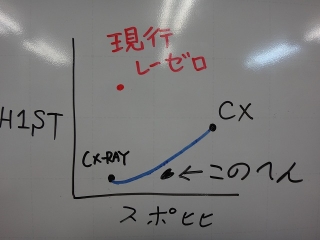
A free-side pillar spoke at H1ST 150
means something like this.
Racing Zero is distant indeed.
If aluminum and steel "have no difference as spokes,"
or "basically no difference," then
show me a 70% specific gravity steel spoke tensioned to H1ST 230.
That's impossible, dumbass.
Even at 100% specific gravity it's difficult.
Or looking at it differently, I can't even imagine
building a 16H front wheel with 70% specific gravity steel spokes
(same count as Racing Zero)
that could exceed its stiffness.
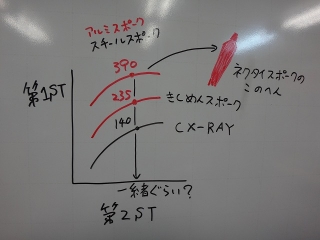
Anticipated objections.
If H1ST on tie aluminum spoke is 390,
flat aluminum spoke is 235, and CX-RAY is 140,
aren't their Secondary STs (meaning typical spoke tension)
all about the same?
That's correct.
For example, Racing Zero and Racing 3—the rims are probably the same weight
or Zero is slightly lighter—but
Racing 3's spokes are bulky square aero,
H1ST is around 180-185.
You wouldn't expect the difference in Primary ST
between spokes to translate directly to Secondary ST difference
more than twice over.
The load on the rim hole with these identical Primary STs
probably isn't that different.
However, claiming these have identical drive stiffness or impact resistance
is still unreasonable.
As I wrote earlier, Secondary ST (1000N) is the same for
a 13G front wheel and a 15G front wheel, yet they obviously don't have the same stiffness or impact resistance.
It's not perfectly precise one-to-one, but
the difference in deflection resistance at 1000N—represented by
Primary ST of 155 for 13G and 116 for 15G—
should reflect some of the difference.
So what to take from the graph is not
"since the visible Primary ST differs but Secondary ST is similar,
aluminum spokes are meaningless,"
but rather
"with the same Secondary ST, each spoke's stiffness (Primary ST) differs,"
and moreover, when viewed relative to specific gravity,
it's way off the chart.
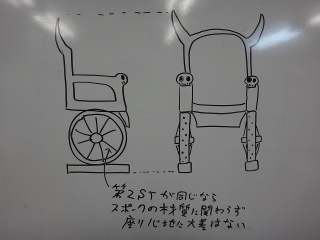
If you evaluate statically using only Secondary ST,
sure, you might say they're "roughly the same"
if you're using the wheel legs of a chair.
If I swapped Racing Zero and custom-built wheels
and asked you to guess which is which riding without looking,
I might be able to tell. But
if I had a chair with wheel legs (same Secondary ST)
and asked you to guess the spoke material by how it sits,
I couldn't confidently guess.

There's more to come.
Hypothetically, if we could tension steel spokes to H1ST of around 230,
whether that's with shouldered steel spokes or
straight steel spokes, things differ a little
in terms of strain during drive.
Straight spoke handles twist and strain better,
so it would be stronger against those movements.
Furthermore, aluminum spokes, due to their material nature,
require larger cross-sections, but
that gives huge freedom in spoke-head shape design.
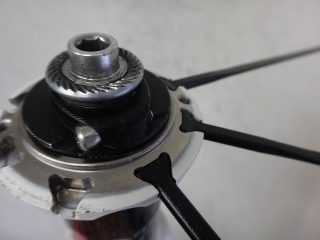
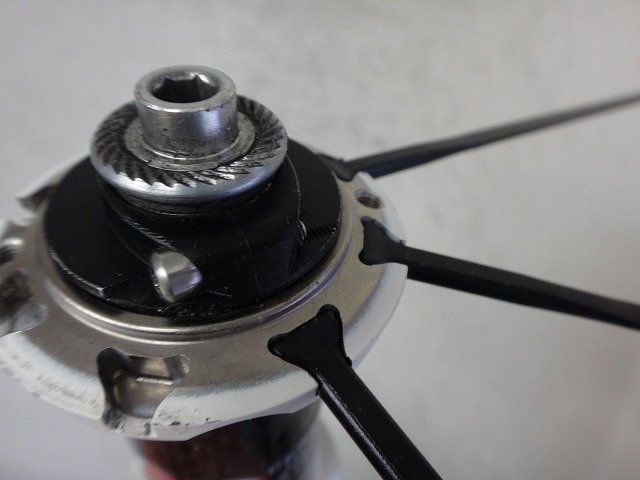
The Fulcrum aluminum spoke's elliptical head
locks perfectly like puzzle pieces on front and rear-left,
and while there's slight play on rear-right,
it has virtually no range of motion.
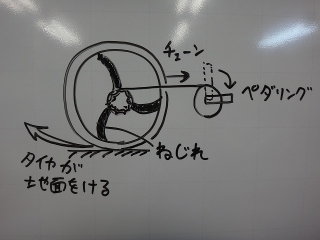
So with identical spoke tension (meaning Secondary ST),
because spoke-head rocking is nearly eliminated,
losses related to engagement quality should be minimal.
Once you say this, aluminum spoke advantages become so dominant
it's impossible to isolate just this factor and feel it separately.
That wraps up the aluminum spoke talk where I lose more the more I write.
For beaker theory, I need more time.
Addendum:
It's fine for me to express opinions, even if they're wrong,
about clear observational facts.
But I find it objectionable when
someone, who I won't name,
takes a "conclusion first" approach, wielding pseudo-theory
like a cudgel to justify it
for their own wheel.
Lightweight and Racing Zero are the product of
much smarter people than me sweating blood to think things through,
so hand-built wheels can't possibly win.
The one foot in the door is using lighter rims than complete wheels—that's it.
If you can't appreciate Lightweight and Racing Zero's greatness honestly,
your lack of perspective is so glaring it makes me wonder if you're all there.
By that logic in this discussion, if through my own ingenuity
I could get CX-RAY to H1ST 235, I could claim
"my wheels beat Racing Zero!" or "aluminum spokes are meaningless, hehe."
But it's impossible. CX-RAY doesn't have infinite breaking strength either.
However, without citing specific gravity or actual examples (Racing Zero spokes, etc.),
if someone claims steel and aluminum spokes weigh about the same...
Once I attended a Shimano technical seminar
by someone involved in developing the C75 wheel.
This guy, fifties probably, was racing long-course triathlons,
and during the bike segment claimed
"I can sense wind yaw angle (yaw angle)."
Even that he could actively maintain optimal aerodynamic yaw angle
by adjusting his bike trajectory in a zigzag to read the wind.
I wanted to ask if he'd about-face and go home if wind switched direction, but
hearing him confidently say this in a pro-shop-staff-only seminar,
so absurdly, I just sketched a caricature of the guy
on the back of the seminar materials to pass time.
(Plenty of people were sleeping, so at least I was listening.)
Hearing that made me think: the C75 wheel is
"something designed by someone who genuinely believed
they could read wind yaw angle while riding."
That kind of, whether intentional or not, occult-tinged
philosophy or worldview embedded in a product's history
is just unsettling.
(On whether it's actually good, don't ask—readers of this blog already know the answer.)
Which is why
I suddenly thought of it for some reason.
and customers have mentioned it in person as well.
At minimum, some short-sighted fool (playing dumb) claiming that
"aluminum spokes are basically meaningless compared to steel spokes"
is clearly wrong.
I could end the discussion by saying "if you use Racing Zero a bit,
it's obvious the wheel has a hardness you can't get with steel spokes"
based on feel alone, but rather than that kind of thing,
I'll write about how it fits within the Nomu Lab wheel philosophy.
"Primary Spoke Tension (hereafter Primary ST)"
"Secondary Spoke Tension (hereafter Secondary ST)"
"Spoke Specific Gravity"
"Beaker Theory"
I could apply all these to aluminum spokes,
but the beaker theory stuff (which I've never touched on before) gets long
and isn't directly related to aluminum spokes, so I'll cover that another time.
First, about Primary ST.
Primary ST is literally the numerical reading shown on the spoke tension meter.
It's Nomu Lab terminology, just so you know.
Secondary ST is the estimated spoke tension value when Primary ST is converted using a conversion table,
and this is what people generally mean when they say "spoke tension."
You might reasonably say, "Why use such confusing terminology?
Just call Primary ST 'meter reading' and Secondary ST 'spoke tension',"
and that's a fair point. However,
Primary ST also increases/decreases with nipple tightening/loosening,
it's a type of quantification of spoke tension,
and you can't discuss wheel hardness or drive stiffness based only on
spoke tension (meaning Secondary ST).
I'll explain why below.
Aluminum spokes use the flat-blade aero design of Racing Zero
(a square aero where the butted section has uniform shape everywhere).
This isn't because I deliberately chose something convenient for my argument—
it's because I believe it's the aluminum spoke with the least variability in observable facts,
allowing me to express my ideas against the most stable observational baseline.
On that point, tie spokes don't work.
I'll write more about that later,
but first let me explain why I didn't choose Mavic aluminum spokes.

Mavic aluminum spokes exist in at least 4 types.
There might be more, but I'm just not knowledgeable enough.
The "H1ST" in the diagram above—ignore that for now.
Spoke Type 1 has a shape that's existed since the original Ksyrium SSC,
with fish-tail-like grooves at the ends of the butted section,
making it the type with the greatest front-to-back width.
Spoke Type 2 has less front-to-back width than 1 and no groove at the butted boundary.
Spoke Type 3 is a round cross-section spoke.
Spoke Type 4 resembles 2 closely but differs in flattening ratio.
Ksyrium from the original generation through ES used small nipples with small tool-engaging splines,
but R-SYS nipples have larger-diameter splines requiring different tools.
Ksyrium after R-SYS onward uses R-SYS-sized nipples, and in either case
the nipples are sealed in during spoke manufacturing,
so you can't measure spoke weight as a standalone component.
This makes it difficult to determine precise spoke specific gravity.
This is why I don't use Mavic spokes when discussing aluminum spokes.

↑Spoke Type 1
↑Spoke Type 2

↑Spoke Type 3
For Spoke Type 4 (→here)
Next, about the relationship between Primary ST and Secondary ST.
This overlaps with what I've written before (→here)(→here), but I'll touch on it lightly.
Regarding Third Spoke Tension, I won't touch the core of it,
but I'll write about it when I cover beaker theory.
If it were true that "when Primary ST doubles, Secondary ST also doubles,
and when Primary ST becomes n times, Secondary ST also becomes n times...",
then graphing the relationship between Primary ST and Secondary ST would yield a straight line.
But in reality, that's not the case. That's why a conversion table is necessary.
As written in the linked articles,
DT and Park Tool tension meters are calibrated against conversion tables
and are supposed to have no individual error (Park Tool is slightly suspect).
Hozan acknowledges error between individual meters
and includes individual conversion tables with each meter.
For example, with my Hozan meter, when Primary ST shows 130
for a 14G plain round spoke, Secondary ST is 1000N.
Secondary ST should be the same value if each instrument is accurate,
but Primary ST shows completely different numbers if the tension meter manufacturer differs,
and even the same (supposedly) products have subtle errors.
From here on, as shown in the diagram above,
I'll call the Hozan tension meter's Primary ST as H1ST.
DT would be D1ST, Park Tool would be P1ST.
When measuring the same spoke, H1ST, D1ST, and P1ST readings vary,
but when converted using each meter's conversion table, Secondary ST becomes identical.

This is my Hozan tension meter's conversion table.
As I mentioned before, Hozan's H1ST is supposed to vary
as much as there are individual meters.
This is a graph of Primary ST and Secondary ST.
My diagram has the axes reversed from this one, so the curve's bend is also reversed,

but looking at it backlit, like this, it becomes the same.
Since DT's conversion table has this orientation (horizontal axis: Secondary ST, vertical axis: Primary ST),
I've gotten in the habit of drawing it this way.
Though unrelated to today's topic, one reason is that it's easier to visualize things this way,
similar to how stress-strain curves bend.
The specific Primary ST values look like this.
Hozan's tension meter only has readings for 13G, 14G, and 15G plain spokes,
and I don't have data for butted spokes.
So I can't measure Competition or CX-RAY with this.
This is DT's graph (Champion 14G plain).

There's also a numbers-only table.
The first thing I did was create a comparison table between D1ST and H1ST.
To be specific, let's say a certain Competition (14G) shows D1ST of 2.00.
According to DT's conversion table, at D1ST of 1.96, Secondary ST is 1200N,
and at 2.04, it's 1300N, so
this Competition's Secondary ST would be around 1250N,
but when I measure it with H1ST, it shows 134.
According to Hozan's conversion table, 14G plain at 1300N Secondary ST shows 138,
and 15G plain shows 126, which matches the actual situation pretty well.
I've done this detailed research on frequently-used spokes and created
a "H1ST table for butted spokes,"
so now I can measure butted spokes with my Hozan tension meter.
For Sapim spokes, I assume they're identical to DT spokes of the same cross-section
and derive H1ST from DT's conversion table.
Plain spokes—Leader and Champion are basically the same,
and I treat CX-RAY and Aero Lite, Race and Competition as identical too.
Actually, Race has a clearly longer 1.8mm round butted section than Competition,
visible in the decimal places of spoke specific gravity, so the specific gravity does differ,
but I judge that there's no problem in wheel building even if we assume
Race's D1ST or H1ST is the same as Competition.
For Laser and Revolution, I don't use them often, so when building wheels with these spokes,
I use the DT tension meter.
Determining H1ST is extremely tedious.
Apart from that use, I don't use the DT meter except when checking H1ST.
One important thing.
D1ST in DT's conversion table is a reading taken with the probe applied from the left-right direction of the spoke.
With (pseudo-)Aero Lite CX-RAY, it showed just under 0.38.
Aero Lite is 0.37 at 1000N and 0.41 at 1050N, so
this CX-RAY's Secondary ST is just over 1000N.
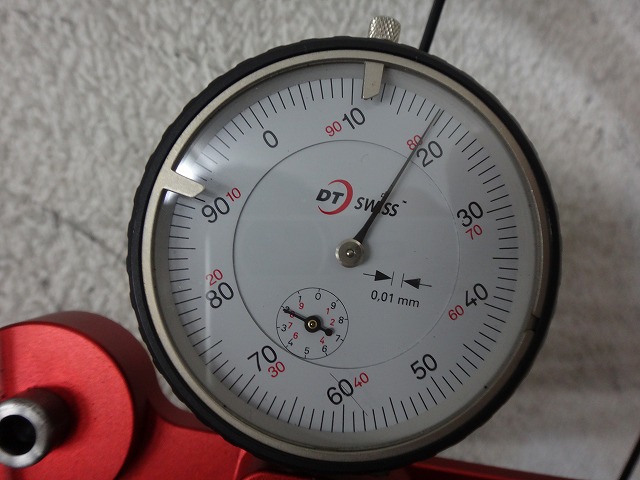
When I measured from the front-to-back direction, the reading jumped to 2.19.
This isn't a value used in the conversion table,
but I actually track detailed values like "when CX-RAY's D1ST is 0.38 from left-right,
it's 2.19 from front-to-back."
For reasons I'll explain later, H1ST basically uses front-to-back readings.
By the way, the "front-to-back" H1ST for this spoke is 130.
Unless otherwise specified, H1ST values below are front-to-back measurements.
I'll mention it later, but remember that "with flat spokes,
measuring on the side with larger radius gives larger numbers
than measuring on the side with smaller radius."

I've compiled the H1ST and D1ST values for 13G, 14G, and 15G plain spokes
when Secondary ST is 1000N.
Round spokes show the same Primary ST no matter the measurement direction.
This difference in Primary ST amount can be thought of as quantifying
the wheel's tactile hardness and drive engagement quality.
It quantifies the resistance to deformation in front-to-back and left-right directions respectively, so
for example, when 14G plain at 1000N is expressed in D1ST,
left-right deformation resistance 2.19, front-to-back deformation resistance 2.19,
and Aero Lite at just over 1000N can be expressed as
left-right deformation resistance 0.38, front-to-back deformation resistance 2.19.
Considering the simplest wheel—a radial front wheel—
a front wheel with 13G plain at H1ST 155 and
a front wheel with 15G plain at H1ST 116 have the same spoke tension (Secondary ST),
yet the feel when riding and deflection when applying side load
are definitely harder and less flexible in the former case.
If we claimed that "wheel stiffness is identical as long as Secondary ST is the same,
regardless of Primary ST,"
then spokes should simply be as light as possible,
so long as they don't undergo plastic deformation from tension.
Taking it to an extreme: if there were an ultra-thin plain spoke
with H1ST around 50 that could still hold 1000N Secondary ST,
that would give the same stiffness as 13G at H1ST 155 by this logic.
Obviously, that's not true.
Even when Secondary ST (I'll keep saying this, but meaning Secondary ST)
is identical, differences in Primary ST create differences in wheel hardness.
Of course, a spoke with larger Primary ST relative to Secondary ST
would have larger spoke specific gravity,
which works against weight reduction—that's the tradeoff.
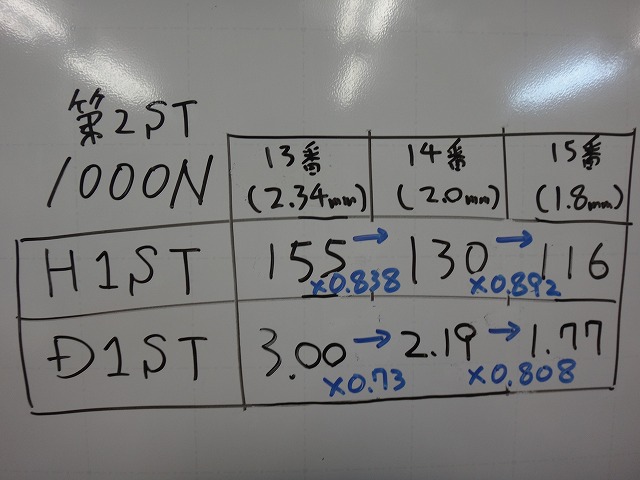
By the way, the ratio between H1ST and D1ST isn't constant. It's not even close.
This is an extremely headache-inducing problem for me,
but I'll cover it when I write about beaker theory.
Sapim's CX and CX-RAY are both
elliptical flat-blade aero spokes with spoke specific gravities of 100% and 65%.
From manufacturer specs, rough calculation gives 98.9% and 63.6%,
but actual measurement shows about 1% higher.
Well, I'll just say 100% and 65% for simplicity.
When these spokes are tensioned to the maximum
(at which point the nipple can't be tightened further),
H1ST is around 190 for CX and 150 for CX-RAY.
The earlier black CX-RAY at 130 is from Nomu Lab Wheel No. 5's front wheel,
but there's no way I'm tensioning it up to 150 (or could, for that matter).
H1ST of 150 on CX-RAY is seen in cases like
24H four-spoke rear laced wheels where the free side is tensioned to the max
(otherwise the anti-free side goes flabby).
Even that's only possible with certain rims.
Specifically, something like a Meccanico complete rear wheel is like that.
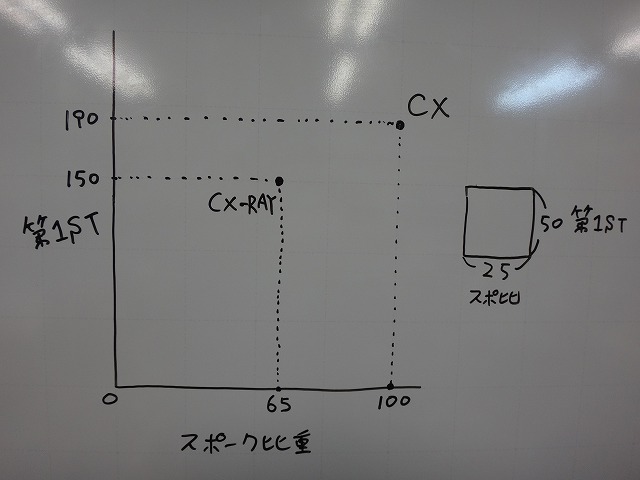
I've graphed the relationship between Primary ST and spoke specific gravity for CX and CX-RAY.
To avoid making it look contrived, I've been careful to draw it
roughly to scale based on the grid on the whiteboard,
matching the ratio of the square on the right.
Here, if I imagine laying out elliptical aero spokes
where spoke specific gravity is changed in 1% increments from CX to CX-RAY,
I consider what collection of points that would form.
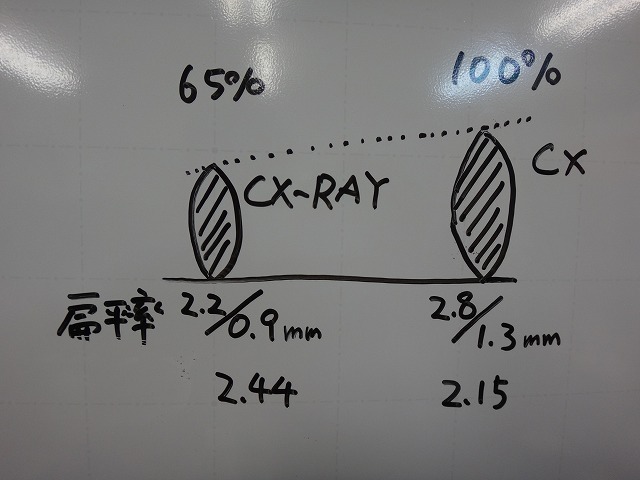
CX and CX-RAY have different flattening ratios.
CX is slightly more squat.
The flattening ratio for round spokes is 1, so
the further from that, the flatter it is.
I imagined what the collection of points would look like
if CX's flattening ratio were maintained while spoke specific gravity were reduced to 65%.
In reality, there'd be a bit more scatter, but
you'd see a point where "you could draw a nice straight line through here,"
and that drawn line is the blue dashed line.
Since actual CX-RAY's flattening ratio isn't 2.15 but rather 2.44,
a spoke with 2.15 flattening ratio and 65% specific gravity should
receive an upward correction to Primary ST
(the left-right vs. front-to-back difference in D1ST is the basis).
If flattening ratio gradually changed from CX to CX-RAY,
the blue dashed line would rise up to become the blue solid line, and
it would look like this.
Though it doesn't really matter whether it curves a bit or stays fairly straight—
it won't affect the rest of this discussion.
You might be thinking "Hey, finally talk about aluminum spokes already,"
but all this preamble was necessary.

And here it is, finally.
Fulcrum's flat-blade aluminum spokes.
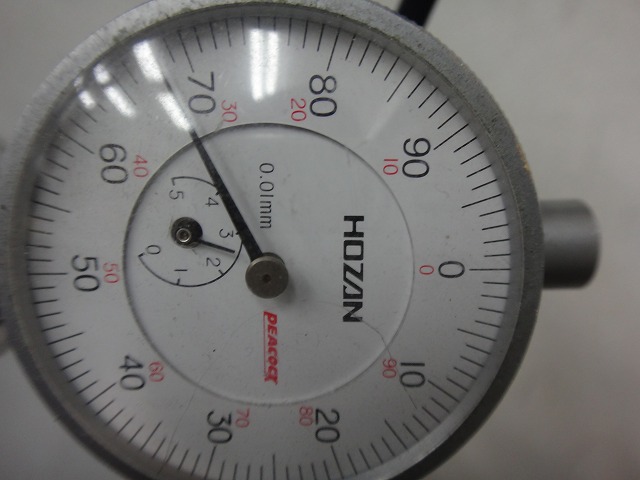
The H1ST measured 268.
This is a somewhat exceptional value.
It's because I'm further tightening Racing 1 from the brass nipple era.
For current aluminum-nipple Racing Zero front or rear-right,
H1ST is around 235.
Below 220, the ride feel noticeably becomes mushy.
A while back, a Racing Zero 2WAY-FIT
that had a rim swap at some shop was obviously mushy, so
I re-tensioned it (→here), and
the minimum H1ST was 205, maximum 220.
From there, I tensioned it up to where the minimum is 230 and average is around 235.
I reported these numbers to the customer—
not with the intention of maintaining 235 on any other Hozan meter going forward,
but to show that it matches the other Racing Zeros we have in the shop.
Next, I'll measure spoke specific gravity.
But first.
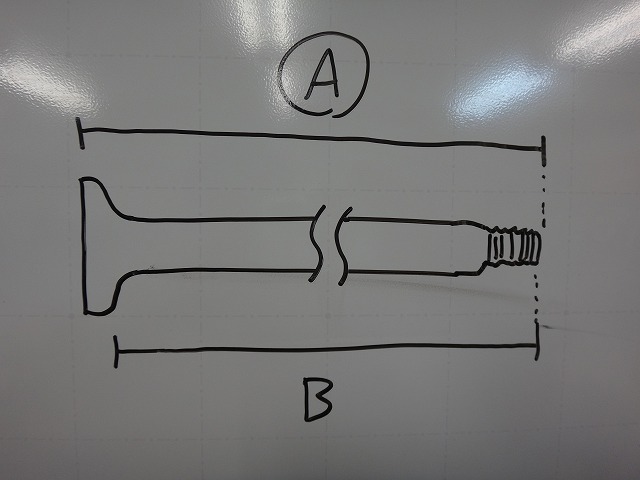
There's the question of how to define this aluminum spoke's length.
Should it be the total length (A in the diagram above),
or the length below the neck (B in the diagram).
This spoke's nominal length is 279.2mm. I checked what that measurement refers to
and found it matches the total length A exactly, so I'll use that.
It's slightly disadvantageous for specific gravity, but I'll go with it.
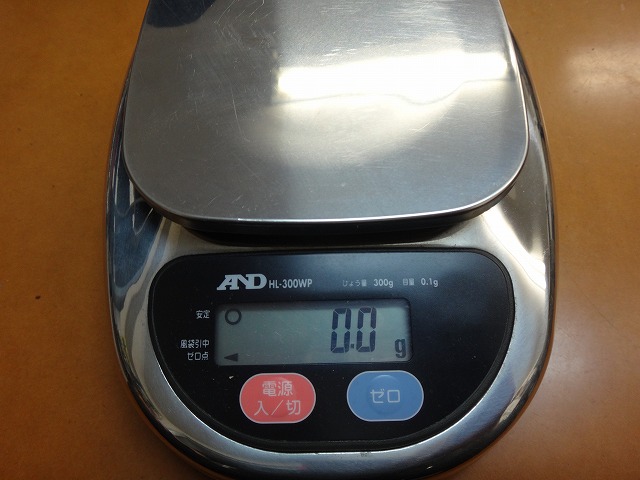
I got a scale that can measure from 0.1g so I can calculate
even with fewer spokes.
I don't think anodize color affects weight, but
I'll measure them separately just to be sure.
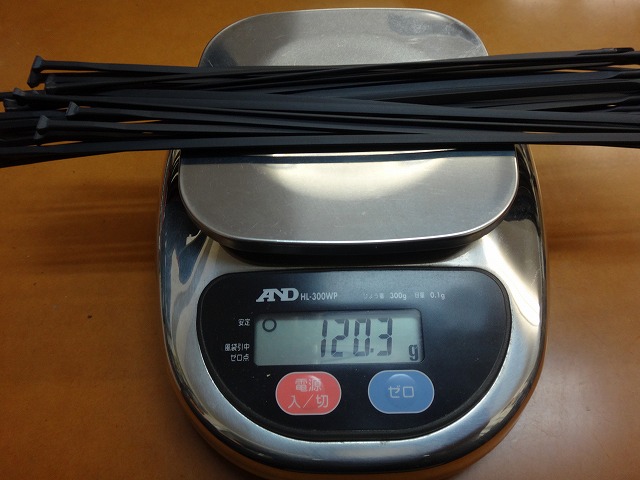
↑Black, 24 spokes
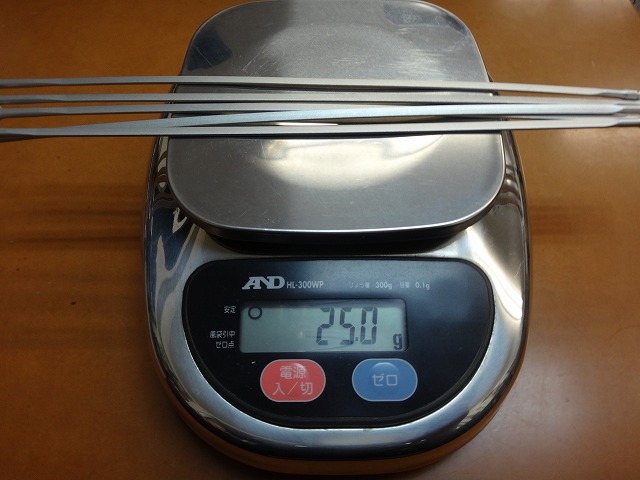
↑Silver, 5 spokes
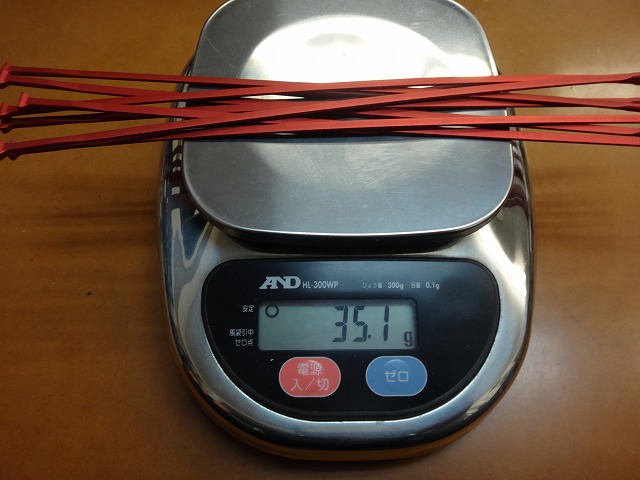
↑Red, 7 spokes
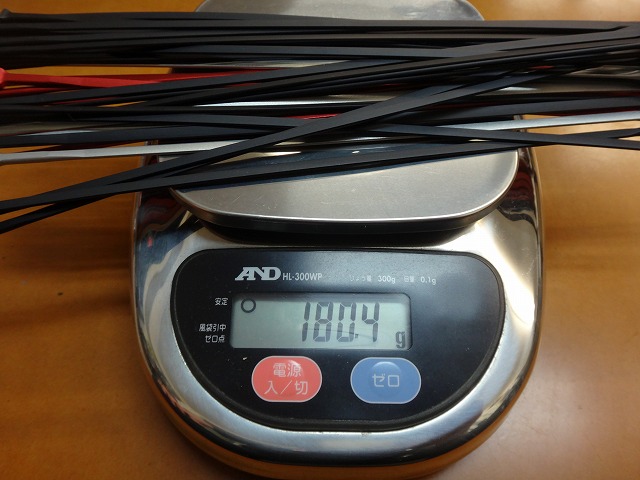
↑36 spokes together
Each spoke comes out to just slightly over 5g.
So this spoke's specific gravity came out to 69.8%.
Since I rounded Sapim's value too, let's call this 70%.
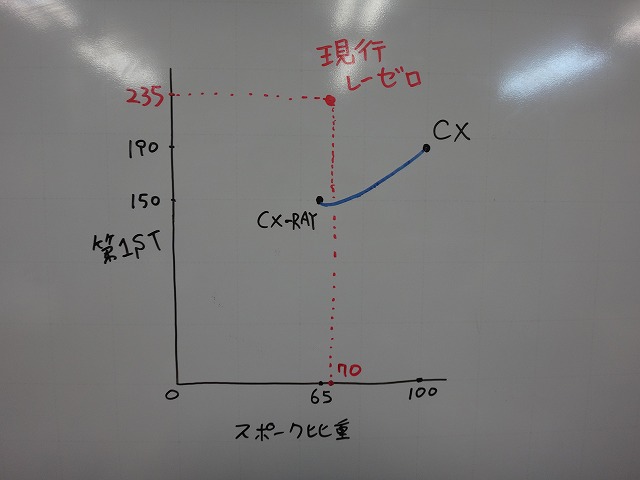
I've added that to the earlier diagram.
You can see it's way off the chart.
Where's this "basically the same as steel spokes" business?
Is someone going to look at this and still claim "Primary ST is unrelated to drive stiffness!"?

↑Biased version
Next, why I didn't measure tie spokes, also from Fulcrum.
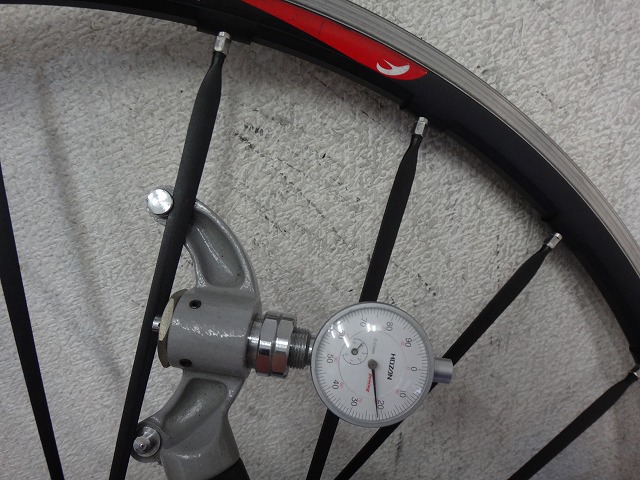
On the free side of the Racing 1 rear wheel,
measuring this tie spoke section gives

H1ST just over 421.
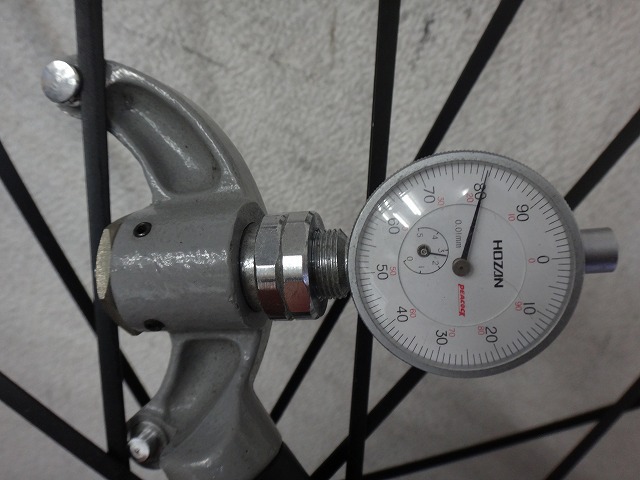
But measuring a bit closer to the hub gives
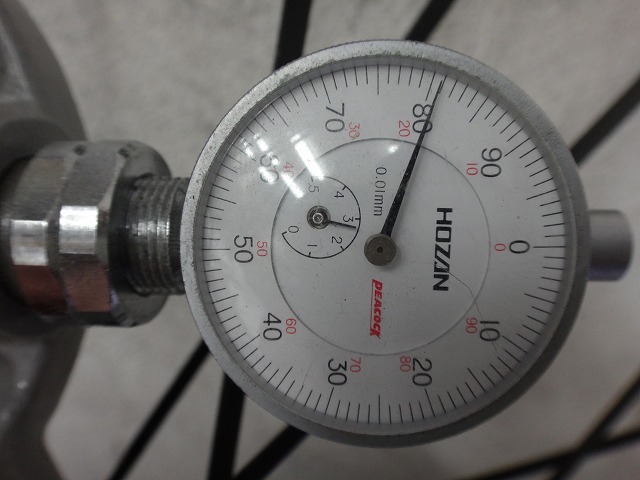
281, plummeting. The flattening ratio changes there.
To be clear, it's the same spoke in both cases.
Since flat spokes give nearly identical readings no matter where you measure,
I avoided tie spokes to get stable numbers.
Also, going way back, I included H1ST values for Mavic aluminum spokes where possible.
For round spokes, the reading is the same front-to-back and left-right.
The reason Mavic's round aluminum spoke H1ST is highest is related to
the fact that H1ST is measured from the front-to-back direction of the spoke.

The probe on Hozan's tension meter has a U-shaped indent,
and the spoke rests in the bottom of this indent.
Since it can measure 13G plain spoke (2.34mm diameter),
the max width must be slightly smaller than that, so
I can create a table converting D1ST left-right for CX-RAY and Aero Lite
to H1ST left-right.
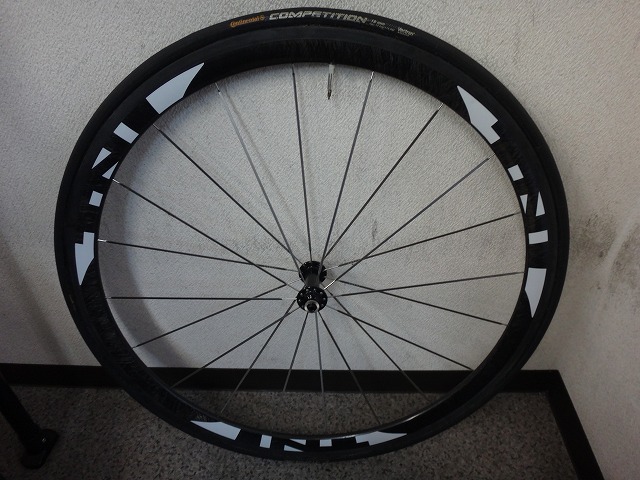
This is my personal Nomu Lab Wheel No. 2.
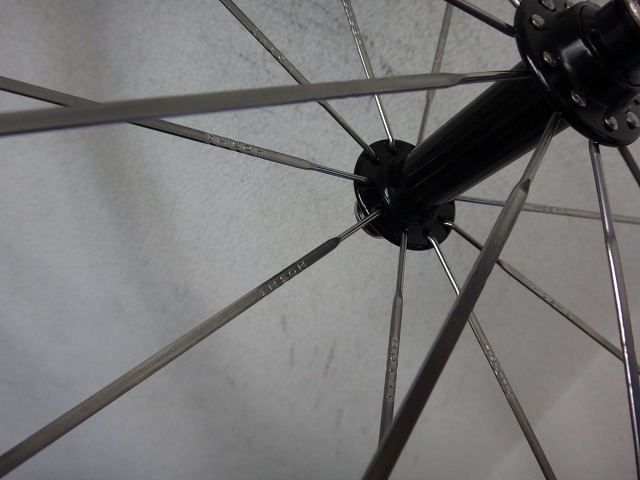
Built with Star Aero Spoke Bright Type II
tensioned as tight as possible.
Hehehehe.
This wheel's spoke specific gravity is about 93%.

The H1ST is 187.
As I mentioned earlier, CX maxes out around 190,
so tensioning an Aero SB II with slightly less specific gravity
to this level means it's tensioned pretty hard.
Here's a concrete CX-RAY value:
when front-to-back H1ST is 130, left-right is around 78.
At 120, it's around 63.
So this Aero SB II, despite different flattening ratio from CX-RAY,
should have left-right H1ST less than 187, but...
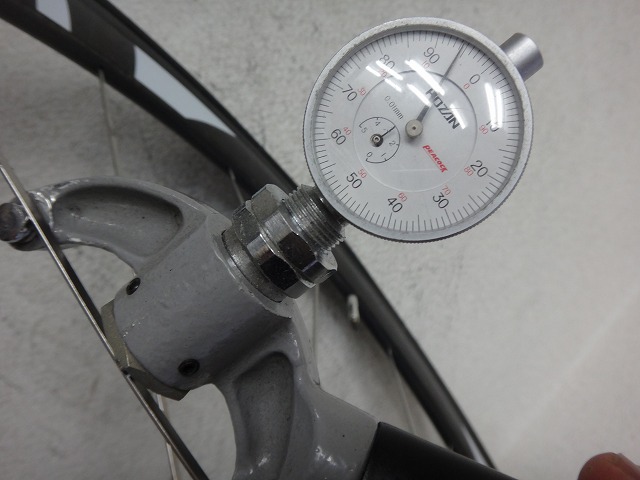
In reality it came out to just under 295—a ridiculous number.
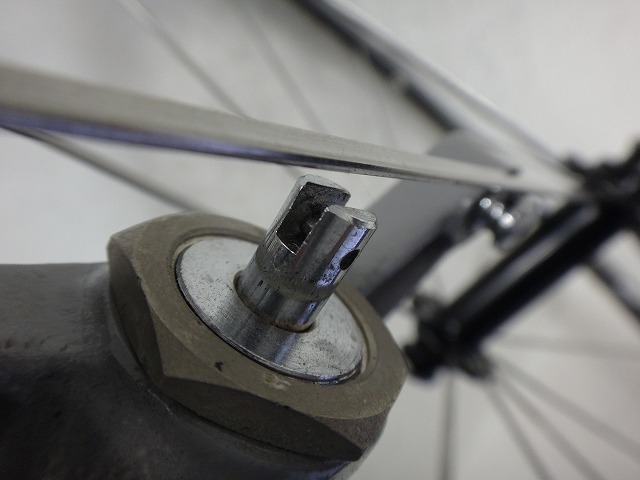
This is because the spoke doesn't fit into the probe indent.
Fulcrum's flat aluminum spoke's narrower side width is
about 1.4mm in actual measurement, so it can be measured front-to-back, but
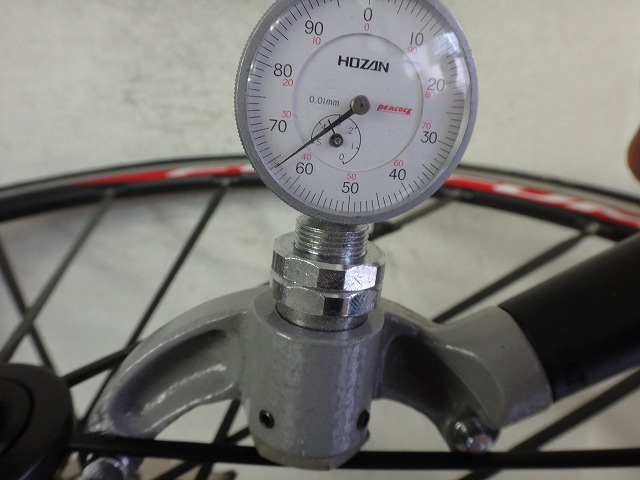
not from left-right.
The tie spoke too shows
281 front-to-back but 364 left-right.
The reason Mavic round aluminum spoke numbers jump is this, and
why I take H1ST from the front-to-back direction is because of this.
So the aluminum round spoke's 360 is wrong—it should actually be lower.
However, knowing "not fitting in the indent, but reads 360" is useful
as a reference when re-tensioning after rim swap work.
So there's value in measuring it.
So what's so great about aluminum spokes?
As I wrote in blue earlier, copying it here:
a spoke with larger Primary ST relative to Secondary ST
would have larger spoke specific gravity,
which works against weight reduction—that's the tradeoff.
This was written with "spokes are only steel" as the underlying assumption.
Achieving Primary ST that the 100% specific gravity steel spoke can't reach,
while keeping spoke specific gravity around the same as CX-RAY or even slightly heavier...
that's only possible because the actual specific gravity differs between aluminum and steel.
Some guy claims that comparing this to aluminum and steel ingots or something,
looking only at material properties, means it's meaningless (playing dumb),
but that's completely wrong. You have to evaluate them as spokes.
By the way, I should mention that there's someone out there who
criticizes other companies' wheels saying "that's no good, this doesn't work either,"
then shows off the complete wheel they designed themselves and selected parts for—
but the actual product wasn't that impressive.
A 24H, equal-diameter-both-sides, four-spoke rear wheel
with free-side H1ST of 150 and anti-free-side at 120.
For a four-spoke lacing, the 150 to 120 ratio is pretty even, but
that's mainly because of the offset rim.
If they were hitting 150 with CX-RAY, that'd be something, but
it's a pillar-brand aero spoke with heavier specific gravity than CX-RAY,
so they're not tensioning it that hard.
Making it worse, the anti-free-side radial lace has spoke wiggle,
so it deflects some...
Setting rim stiffness aside, during pedaling the inner edge of the rear rim
(noticeably enough that you feel the energy loss from it) is being squeezed,
or in other words, it's a rear wheel with poor engagement,
which is my assessment just looking at the thing with all my experience with various wheels.
The actual owner's experience matched that assessment pretty well, so
yeah, I was right about that.
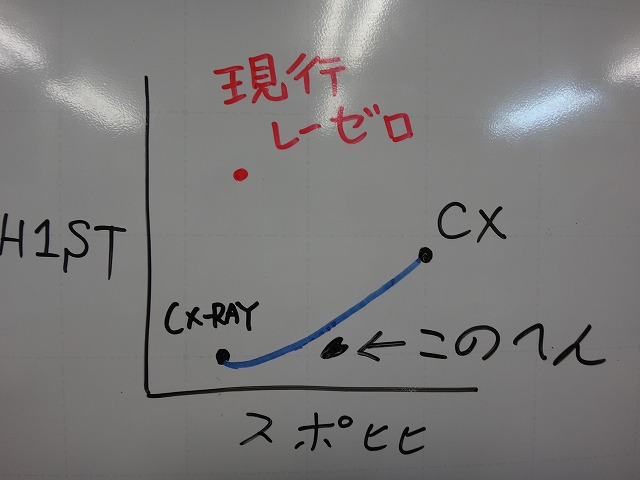
A free-side pillar spoke at H1ST 150
means something like this.
Racing Zero is distant indeed.
If aluminum and steel "have no difference as spokes,"
or "basically no difference," then
show me a 70% specific gravity steel spoke tensioned to H1ST 230.
That's impossible, dumbass.
Even at 100% specific gravity it's difficult.
Or looking at it differently, I can't even imagine
building a 16H front wheel with 70% specific gravity steel spokes
(same count as Racing Zero)
that could exceed its stiffness.
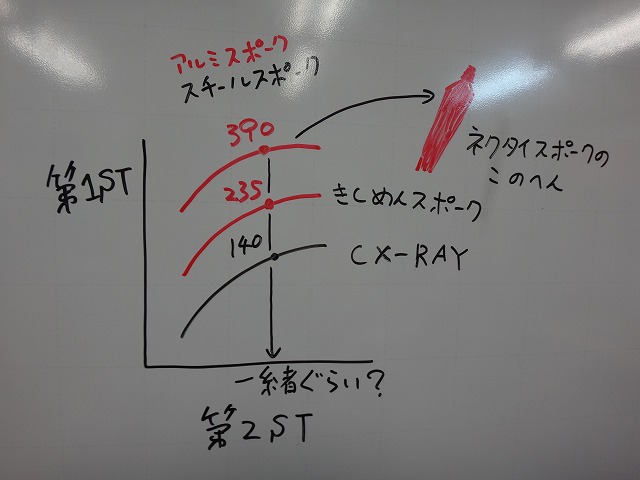
Anticipated objections.
If H1ST on tie aluminum spoke is 390,
flat aluminum spoke is 235, and CX-RAY is 140,
aren't their Secondary STs (meaning typical spoke tension)
all about the same?
That's correct.
For example, Racing Zero and Racing 3—the rims are probably the same weight
or Zero is slightly lighter—but
Racing 3's spokes are bulky square aero,
H1ST is around 180-185.
You wouldn't expect the difference in Primary ST
between spokes to translate directly to Secondary ST difference
more than twice over.
The load on the rim hole with these identical Primary STs
probably isn't that different.
However, claiming these have identical drive stiffness or impact resistance
is still unreasonable.
As I wrote earlier, Secondary ST (1000N) is the same for
a 13G front wheel and a 15G front wheel, yet they obviously don't have the same stiffness or impact resistance.
It's not perfectly precise one-to-one, but
the difference in deflection resistance at 1000N—represented by
Primary ST of 155 for 13G and 116 for 15G—
should reflect some of the difference.
So what to take from the graph is not
"since the visible Primary ST differs but Secondary ST is similar,
aluminum spokes are meaningless,"
but rather
"with the same Secondary ST, each spoke's stiffness (Primary ST) differs,"
and moreover, when viewed relative to specific gravity,
it's way off the chart.

If you evaluate statically using only Secondary ST,
sure, you might say they're "roughly the same"
if you're using the wheel legs of a chair.
If I swapped Racing Zero and custom-built wheels
and asked you to guess which is which riding without looking,
I might be able to tell. But
if I had a chair with wheel legs (same Secondary ST)
and asked you to guess the spoke material by how it sits,
I couldn't confidently guess.

There's more to come.
Hypothetically, if we could tension steel spokes to H1ST of around 230,
whether that's with shouldered steel spokes or
straight steel spokes, things differ a little
in terms of strain during drive.
Straight spoke handles twist and strain better,
so it would be stronger against those movements.
Furthermore, aluminum spokes, due to their material nature,
require larger cross-sections, but
that gives huge freedom in spoke-head shape design.
The Fulcrum aluminum spoke's elliptical head
locks perfectly like puzzle pieces on front and rear-left,
and while there's slight play on rear-right,
it has virtually no range of motion.
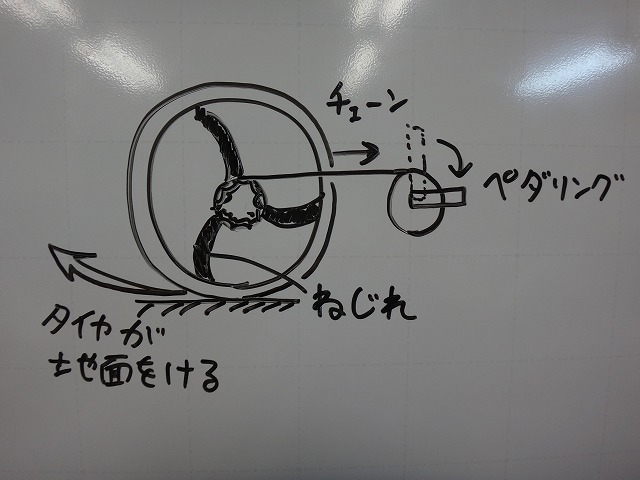
So with identical spoke tension (meaning Secondary ST),
because spoke-head rocking is nearly eliminated,
losses related to engagement quality should be minimal.
Once you say this, aluminum spoke advantages become so dominant
it's impossible to isolate just this factor and feel it separately.
That wraps up the aluminum spoke talk where I lose more the more I write.
For beaker theory, I need more time.
Addendum:
It's fine for me to express opinions, even if they're wrong,
about clear observational facts.
But I find it objectionable when
someone, who I won't name,
takes a "conclusion first" approach, wielding pseudo-theory
like a cudgel to justify it
for their own wheel.
Lightweight and Racing Zero are the product of
much smarter people than me sweating blood to think things through,
so hand-built wheels can't possibly win.
The one foot in the door is using lighter rims than complete wheels—that's it.
If you can't appreciate Lightweight and Racing Zero's greatness honestly,
your lack of perspective is so glaring it makes me wonder if you're all there.
By that logic in this discussion, if through my own ingenuity
I could get CX-RAY to H1ST 235, I could claim
"my wheels beat Racing Zero!" or "aluminum spokes are meaningless, hehe."
But it's impossible. CX-RAY doesn't have infinite breaking strength either.
However, without citing specific gravity or actual examples (Racing Zero spokes, etc.),
if someone claims steel and aluminum spokes weigh about the same...
Once I attended a Shimano technical seminar
by someone involved in developing the C75 wheel.
This guy, fifties probably, was racing long-course triathlons,
and during the bike segment claimed
"I can sense wind yaw angle (yaw angle)."
Even that he could actively maintain optimal aerodynamic yaw angle
by adjusting his bike trajectory in a zigzag to read the wind.
I wanted to ask if he'd about-face and go home if wind switched direction, but
hearing him confidently say this in a pro-shop-staff-only seminar,
so absurdly, I just sketched a caricature of the guy
on the back of the seminar materials to pass time.
(Plenty of people were sleeping, so at least I was listening.)
Hearing that made me think: the C75 wheel is
"something designed by someone who genuinely believed
they could read wind yaw angle while riding."
That kind of, whether intentional or not, occult-tinged
philosophy or worldview embedded in a product's history
is just unsettling.
(On whether it's actually good, don't ask—readers of this blog already know the answer.)
Which is why
I suddenly thought of it for some reason.
Products Mentioned in This Article
- 🛒 Fulcrum Racing Zero bicycle wheel
- 🛒 Mavic Ksyrium SSC bicycle wheel
- 🛒 Park Tool spoke tension meter
- 🛒 Hozan spoke tension meter
* Amazon affiliate links — prices may vary
Original Japanese post: のむラボ日記 #3462