I converted the front chainring of my road bike for commuting and solo practice rides (※) to single-speed.
※solo practice rides done on the sly
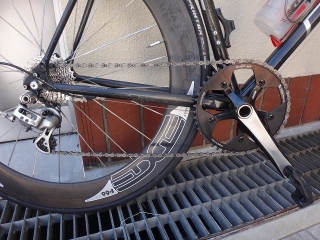
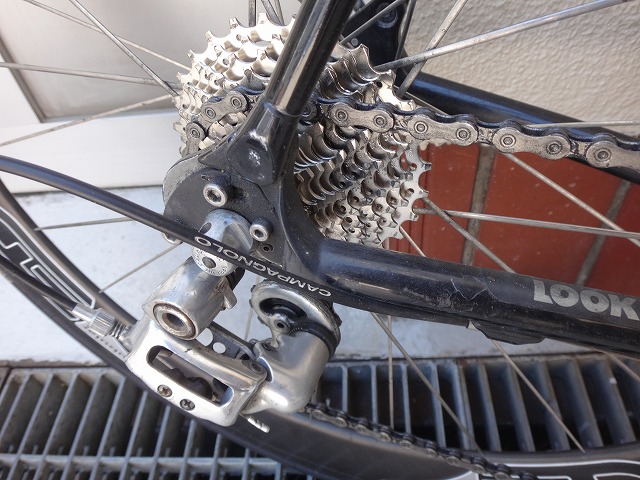
For the first time in years, I tried to remove the Kilroy mark on the rear rim, and it turned out to be a suntan line instead. Well, that's fine anyway.
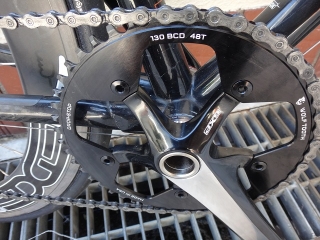
I switched to a Wolf Tooth narrow-wide chainring and removed the front derailleur.
There are various manufacturers of narrow-wide chainrings, but to my knowledge, at least Wolf Tooth and SRAM have no reported chain drop incidents on road bikes.
Apparently it happens very rarely on cyclocross bikes, so if you're concerned about it, you can install a Wolf Tooth Gnarwolf or Praxis Works chain guide.
In that case, however, you lose much of the weight savings benefit from ditching the front derailleur.
With mechanical drivetrains, you can also remove the shifter wire and inner cable, which saves additional weight.
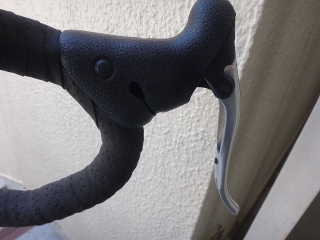
With Campagnolo and SRAM, you can disassemble the internals of the left lever and convert it to a simple brake lever.
"Can" means you can revert it back to normal.
In either case, the return spring on the lever side disappears, but if assembled properly, the return spring on the brake body alone is enough to return the lever.
Actually, since you don't have to fight the spring force of the lever, the pull becomes lighter.
Most of my road bike cranks have a PCD of 144mm or 135mm, but narrow-wide chainrings in these PCDs are almost non-existent
(135mm ones exist from an American garage maker, but lack larger tooth counts),
so I needed to switch to PCD 130mm or 110mm cranks.
For PCD 130mm cranks I'd like to use,
there's the FC-7402 Dura-Ace, Campagnolo Super Record Pro,
FC-6600G Ultegra SL, etc.,
but this time I went with a SRAM GXP crank that was handy.
Since I use 165mm crank length, that also narrows my options.
With 144mm PCD cranks I mainly use 52-42T, and with 130mm cranks I use 52-39T,
but in both cases I keep the smallest sprocket at 25T.
42×25T calculates to 39×23.21T, so 42×25T ≈ 39×23T.
When converting to front single chainring,
a low gear ratio around 39×23T and a top gear ratio with a gear ratio of 4x or higher should cover most climbs in commuting and practice rides. Most passes are manageable.
This may only make sense to people in the Osaka area, but whether the "most passes" I'm referring to includes Jusan Pass is somewhat of a watershed for how seriously I'm training.
Can I cruise smoothly at 39×23T (≈ 34×20T)? Not at the moment, frankly.
By the way, PASS13 in this blog's URL comes from Jusan Pass.
What I wanted was to approximate the outer×top and inner×low of 52-39T×11-25T with a front single chainring.
Initially I ran 48T×11-32T.
This equates to 52×12T and 39×26T at the extremes.
It's shifted a bit light on the heavy end, but as long as there's 4x or more on the heavy end, it's fine.
Also, even though 52×13T, 48×12T, and 44×11T all have the same 4x gear ratio, they feel different under the pedal due to the different front ring sizes—but I'll ignore that discussion for now.
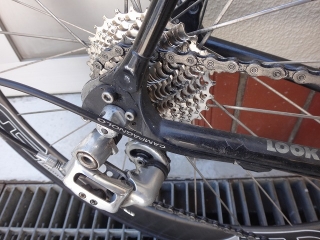
In the image above I've switched to Shimano 11-speed with an 11-28T sprocket.
The rear derailleur doesn't officially support 28T, but it's worked without issues.
I ditched the 32T not for mechanical reasons but because the visual aesthetic of a 32T sprocket is too un-road-bike-like for me to stomach.
↑ In the current state where 32T sprockets are included in original component groupset combinations,
I probably shouldn't be saying that!
48T×11-28T equates to 52×12T and 39×23T (just under—22.75T) at the extremes.
With 11-32T, the tooth gaps between shifts are 1-1-1-2-2-2-2-3-3-4, making cadence changes per shift rather grinding,
but with 11-28T it becomes 1-1-1-1-2-2-2-2-3-3.
Someone will probably say "If it's going to be grinding then why go single speed?" but that's not a single-chainring issue—it's just the nature of a wide ratio.
When running 52×39T for commuting or flat practice, you might hardly or never use the inner ring,
in which case you're essentially riding a 52T single-speed.
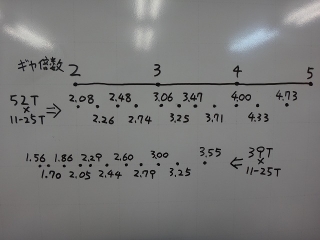
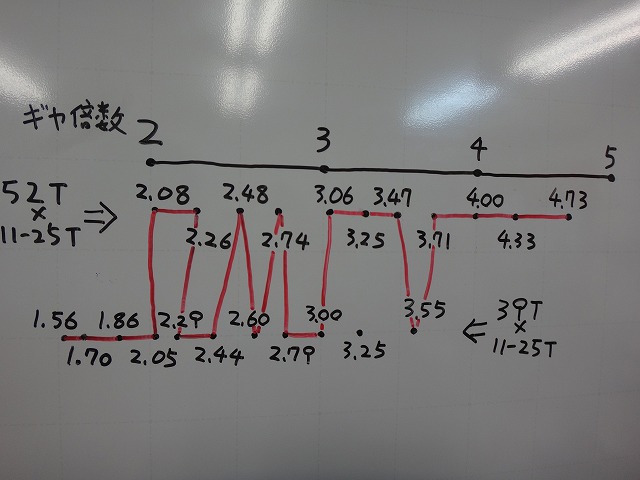
↑ Writing out the gear ratios for 52-39T×11-25T gives this chart.
Since inner×top is 3.55, the four heavier rings on the outer×top side are "ratios only the outer can produce,"
and since outer×low is 2.08, the four lighter rings on the inner×low side are "ratios only the inner can produce."
The eighth cog from the inner top at 2.05 is nearly identical to outer×low's 2.08, so you could say inner-only ratios number just three cogs.
Beyond that, there are several gear ratios where outer and inner values match or approximate each other.
Front double×11-speed looks like a "22-color colored pencil set," but you're actually looking at 22 pencils with many near-duplicate colors mixed in.
Excluding the duplicates, the actual distinct colors number around 15.
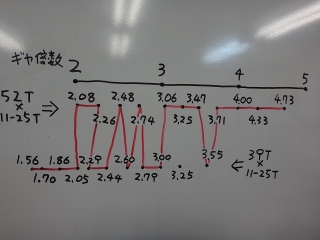
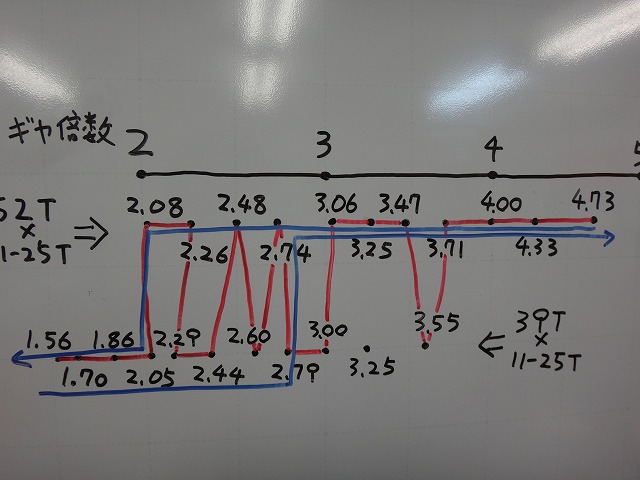
Shifting strictly by gear ratio order with 52-39T×11-25T gives this pattern.
52×16T = 39×12T = 3.25 is where I ignored the inner option to reduce front shifts.
Of course, this kind of shifting pattern isn't realistic.
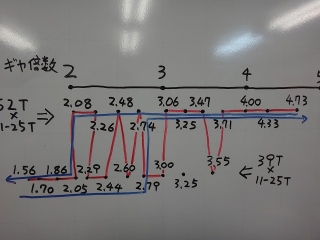
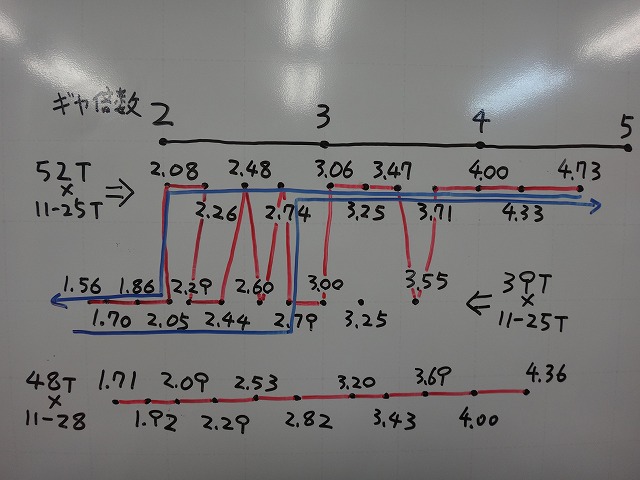
In reality, I'd probably use from outer×top down to outer×low or so, then shift to the inner's three unique-to-inner lighter ratios, and shift back to outer from the inner×low area around the 3rd or 4th cog from the inner top.
Shimano's electronic drivetrains' synchro shift feature is designed to execute this precise sequence automatically.
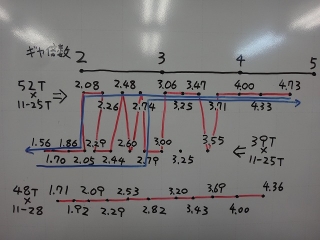
Overlaying a 48T single×11-28T gear ratio chart,
it becomes an 11-color, 11-pencil colored pencil set with shortened extremes.
Earlier I mentioned the 22-pencil set is really about 15 colors, so if rear sprockets grew to around 15-speed,
a front single might become fully sufficient.
To get 39×25T's lightness at 52T, the math gives 33.33T, so about 34T.
With 52×11-34T, if you can tighten tooth gaps enough that gear ratio changes per shift don't feel grinding (cadence changes feel acceptable),
a front derailleur becomes unnecessary.
I'm not trying to claim with this that front single is a strictly superior alternative to front double, eliminating weight and eliminating front shift troubles.
In reality, I've accepted trade-offs on the extreme gear ratios.
It's not something to do with just 11-speed.
Additionally, with Shimano Hollowtech II cranks, SRAM GXP cranks, and press-fit bottom brackets, another project doesn't pan out.
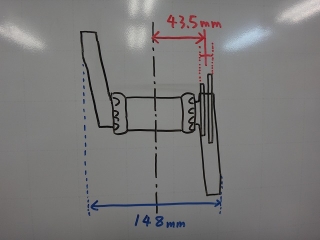
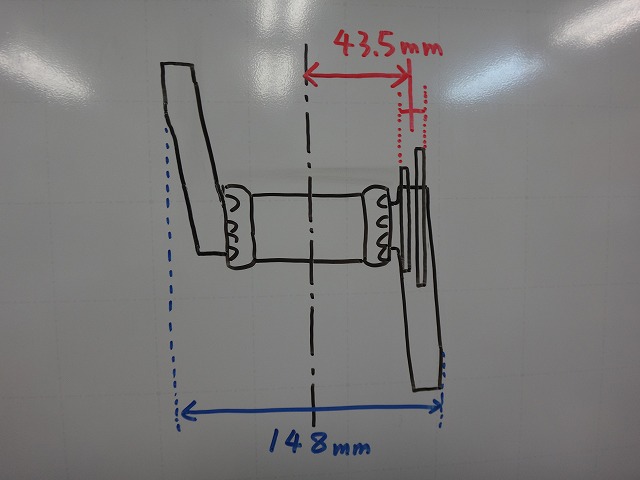
That other project is "tightening Q-factor."
You can choose handlebar width based on shoulder width, so it seems odd you can't choose crank width based on hip width (widening is easy, narrowing isn't).
There's a reason, though. The distance from the midpoint between the outer edge of the outer chainring and the inner edge of the inner chainring to the frame center is called "chainline,"
and for Shimano this is set at 43.5mm.
If you use third-party cranksets and the chainline deviates significantly from this,
the front derailleur adjustment range gets exceeded and the derailleur interferes with the chain at outer×top or inner×low.
Maintaining chainline while tightening Q-factor is structurally impossible, so aside from crank length, width isn't easily changed.
It's not that I'm unaware of La Crankset or such. But even those aren't tightening Q-factor that significantly...
The diagram above shows a Hollowtech II-type bottom bracket, but this type can't change Q-factor (the distance between pedal mounting faces of left and right cranks).
Q-factor on current major-brand cranksets is almost always around 148mm.
Campagnolo Ultra-Torque cranks used to have "145.5mm" marked on the pedal mounting face, but assembling this crank in the air without threading it through the frame
and measuring with both crank arms in phase gives 147mm.
On one of my road bikes I've mounted fixed-gear cranks with square-taper bottom brackets, which have 135mm Q-factor, or 132mm if left-right symmetry isn't required.
I've tried handlebar widths from 340mm to 440mm.
340mm is best for car filtering and easier on three-rollers, but the steering feel is too peaky and difficult to use.
440mm is just plainly too wide to use.
So I settled on 400mm (outer to outer).
When running cranks with Q-factor in the 130mm range, there's no particular discomfort, but after three consecutive days on those,
switching to 148mm-range cranks gives that sensation of "Wow! So wide! Feels weird!"
What I'm getting at is: I've had the experience of finding handlebars too narrow, but never Q-factor too narrow.
I haven't reached "the turning point where further tightening gets uncomfortable," so I don't know where the sweet spot is.
That fixed-gear crank is PCD 144mm, so the smallest ring is 42T, and there's barely 1mm clearance between the inner chainring and the right chainstay—you could fit a water droplet in the gap.
The chainline is inboard of what the manufacturer intended, but since I've arranged it so the derailleur doesn't interfere at inner×low,
it works fine in practice.
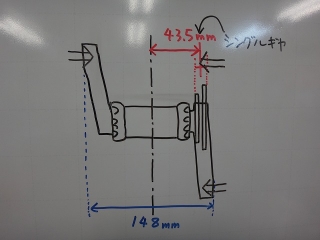
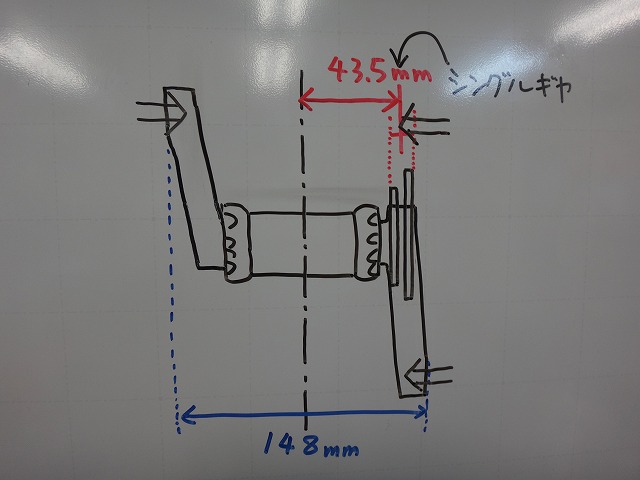
When designing front single with narrow-wide chainrings, there's no need to be finicky about chainline,
so you could potentially position the chainring at the current chainline position or thereabouts,
and perhaps tighten Q-factor accordingly.
Since I'm not a component manufacturer, I can't tighten Q-factor while staying with Hollowtech II format, but with square-taper cranks it's somewhat possible.
I mentioned FC-7402 and Super Record Pro earlier as PCD 130mm crank options
because experience has taught me those are cranks where you can do this.
The next model after FC-7402, the FC-7410, doesn't work—its stock bottom bracket has a 103mm shaft, and there's almost no shorter Shimano-taper bottom bracket out there.
Also, FC-7410 with its standard bottom bracket and crankset pairing results in the right crank sitting 2mm inboard of the left, so if you care about left-right symmetry,
you need to install a 2mm washer on the right pedal only.
The next step up, FC-7700/7701, uses Octalink bottom brackets, which means dedicated 109.5mm (double) or 118.5mm (triple) bottom brackets—no other options exist.
So Q-factor stays fixed.
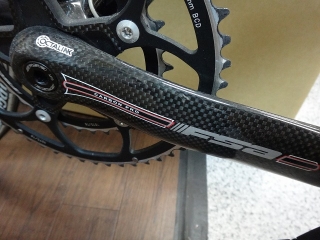
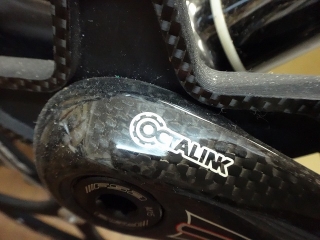
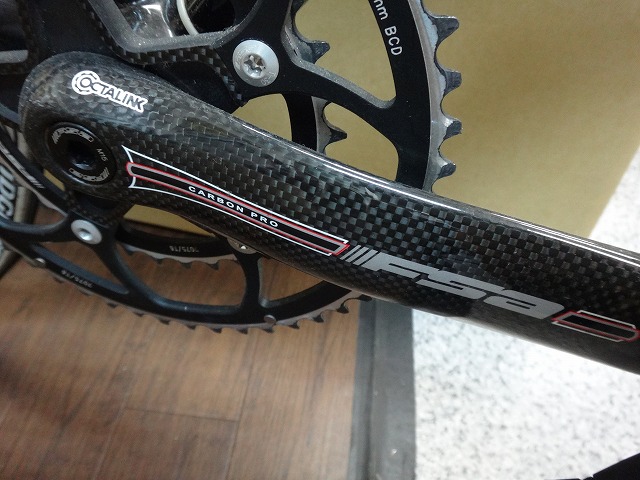
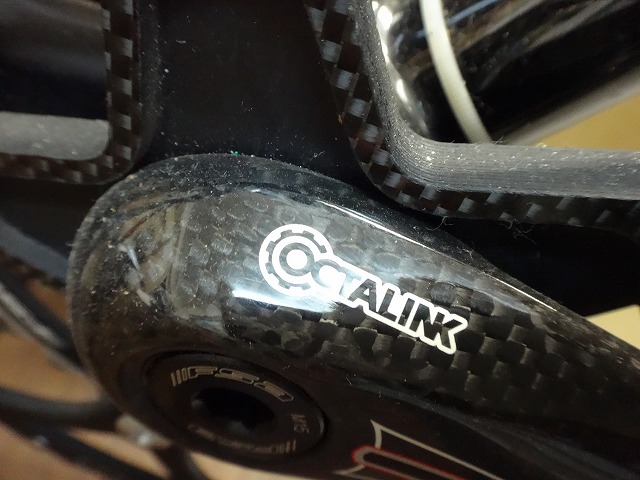
Third-party cranks compatible with Octalink bottom brackets exist from Sugino and FSA and such
(you see them more often as Specialized-branded cranks on Specialized complete bikes than as Sugino-branded ones),
but since Shimano was adamant about not letting anyone else make Octalink bottom brackets,
there are no third-party Octalink bottom brackets.
After FC-7800 and beyond, it switched to Hollowtech II, so Q-factor fiddling became completely off-limits.
So if there were a narrow-wide chainring in PCD 144mm, you could tighten Q-factor while going single-speed—very useful—but sadly no such part exists.
Also, front single-chainring options for road cranks seem to only be considered for cyclocross demand, and outside of Wolf Tooth, most manufacturers only lineup up to about 42T.
Wolf Tooth, meanwhile, offers:
PCD 130mm 5-arm: 38-52T in 2T increments;
PCD 110mm 5-arm: 34-52T in 2T increments;
4-arm for R9100-series: 36-50T in 2T increments.
Since they're narrow-wide chainrings, 2T increments are expected, but I figured I'd mention it anyway.
I'm not a Wolf Tooth employee, by the way.
Incidentally, the PCD 110mm 5-arm also comes in an elliptical (non-circular) chainring option.
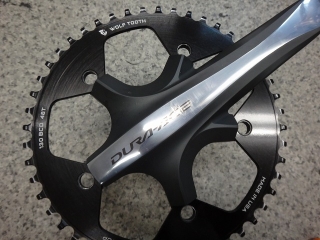
For PCD 130mm 165mm cranks, I also have an FC-7900,
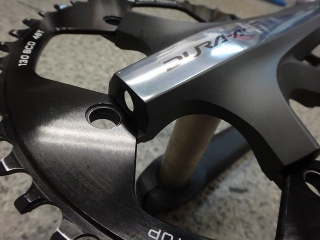
↑ but this gap is hopelessly ugly.
With 4-arm models like FC-9000 and FC-R9100, companies like RIDEA and Absolute Black make parts to cleanly cover this,
but for 7900 Praxis Works made one that's now discontinued (not even on their home site) and hard to find.
Search "praxis works 7900 bolt kit" and you'll find images, though.
Anyway, back to the point—initially I ran 48T×11-32T, then switched the sprocket to 11-28T, and I realized in practice I barely use even the 48×12T ratio (4x) on solo rides.
A 4x ratio means 50.1 km/h at 100 rpm on a 700C tubular—that's a speed I can't sustain under my own power.
It's only useful for not having to pedal downhill.

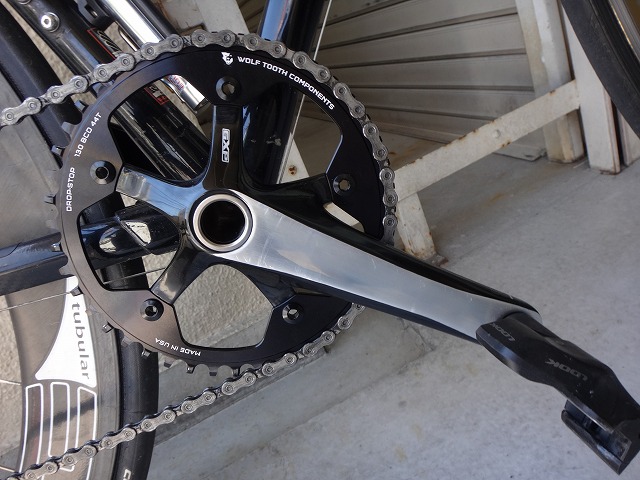
48T must be mounted to the outer position of a 5-arm crank.
Depending on the frame, there might be exceptions, but otherwise the chainring interferes with the right chainstay.
44T, however, seems designed for the inner position,
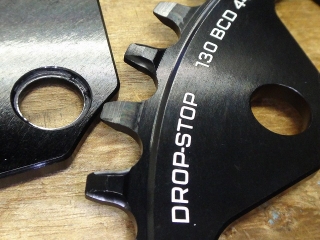
and the outer holes aren't countersunk for socket-head bolts.
But with Wolf Tooth,
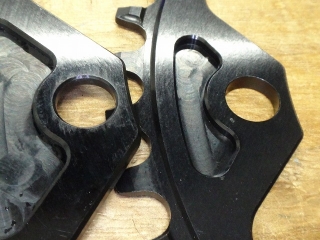
even tooth counts designed for the inner position lack countersunk holes on the inside.
This holds for 34T too, so I'd guess all inner-position options are like this (I don't know where the cutoff is, sorry),
and the problem is that a chainring without countersinks on both sides doesn't fit single-speed bolts since they're too short—you need longer double-chainring bolts or other workarounds on the threaded side.
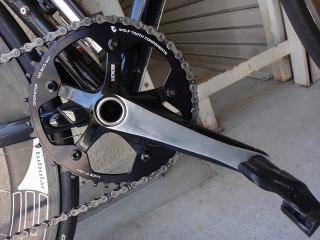
I switched to 44T, deliberately mounting it to the outer position.
Knowing I can't switch back to 48T, I also trimmed my chain down.
Expressed in the extremes of 52×39T, 44T×11-28T becomes 52×13T ~ 39×25T (just under—24.81T), a true 11-pencil, 11-color set.
Also, somewhat irrelevant, but shifting from 39×25T to 52×13T takes only about a second—something a front double can't do, even electronic drivetrains (honestly, electronic might be slower).
I've always liked single-speeds, and before this I already had cyclocross, hill-climb, and time-trial bikes in single-gear configuration.
Before narrow-wide chainrings came out, I was fabricating chain-retention parts one at a time, but nowadays even that's unnecessary.
What a convenient world we live in.
※solo practice rides done on the sly
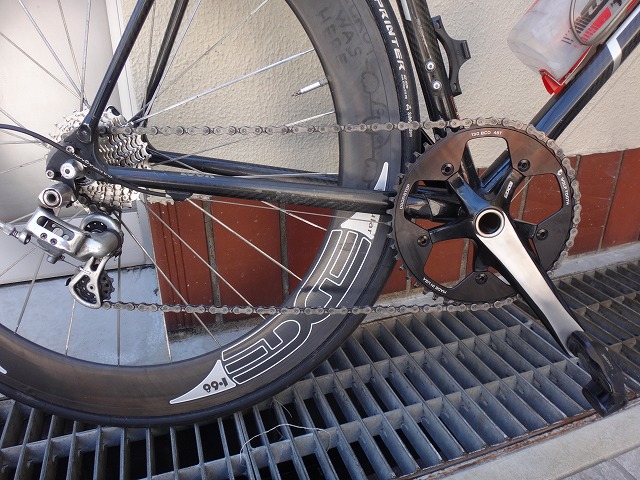
For the first time in years, I tried to remove the Kilroy mark on the rear rim, and it turned out to be a suntan line instead. Well, that's fine anyway.
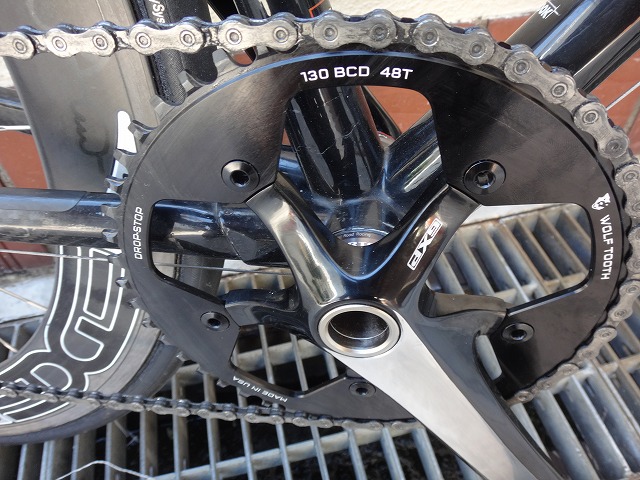
I switched to a Wolf Tooth narrow-wide chainring and removed the front derailleur.
There are various manufacturers of narrow-wide chainrings, but to my knowledge, at least Wolf Tooth and SRAM have no reported chain drop incidents on road bikes.
Apparently it happens very rarely on cyclocross bikes, so if you're concerned about it, you can install a Wolf Tooth Gnarwolf or Praxis Works chain guide.
In that case, however, you lose much of the weight savings benefit from ditching the front derailleur.
With mechanical drivetrains, you can also remove the shifter wire and inner cable, which saves additional weight.
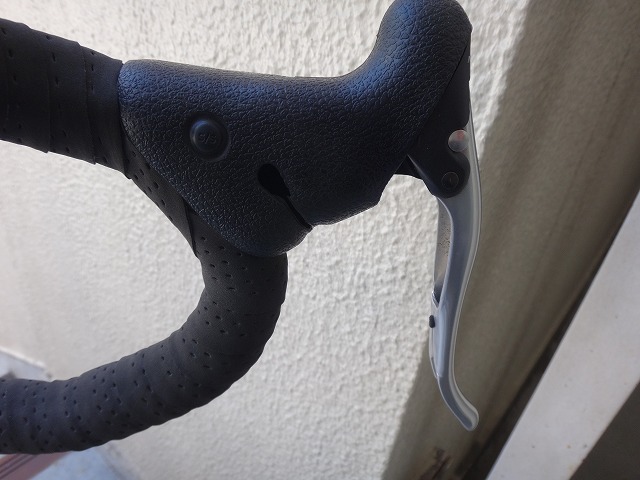
With Campagnolo and SRAM, you can disassemble the internals of the left lever and convert it to a simple brake lever.
"Can" means you can revert it back to normal.
In either case, the return spring on the lever side disappears, but if assembled properly, the return spring on the brake body alone is enough to return the lever.
Actually, since you don't have to fight the spring force of the lever, the pull becomes lighter.
Most of my road bike cranks have a PCD of 144mm or 135mm, but narrow-wide chainrings in these PCDs are almost non-existent
(135mm ones exist from an American garage maker, but lack larger tooth counts),
so I needed to switch to PCD 130mm or 110mm cranks.
For PCD 130mm cranks I'd like to use,
there's the FC-7402 Dura-Ace, Campagnolo Super Record Pro,
FC-6600G Ultegra SL, etc.,
but this time I went with a SRAM GXP crank that was handy.
Since I use 165mm crank length, that also narrows my options.
With 144mm PCD cranks I mainly use 52-42T, and with 130mm cranks I use 52-39T,
but in both cases I keep the smallest sprocket at 25T.
42×25T calculates to 39×23.21T, so 42×25T ≈ 39×23T.
When converting to front single chainring,
a low gear ratio around 39×23T and a top gear ratio with a gear ratio of 4x or higher should cover most climbs in commuting and practice rides. Most passes are manageable.
This may only make sense to people in the Osaka area, but whether the "most passes" I'm referring to includes Jusan Pass is somewhat of a watershed for how seriously I'm training.
Can I cruise smoothly at 39×23T (≈ 34×20T)? Not at the moment, frankly.
By the way, PASS13 in this blog's URL comes from Jusan Pass.
What I wanted was to approximate the outer×top and inner×low of 52-39T×11-25T with a front single chainring.
Initially I ran 48T×11-32T.
This equates to 52×12T and 39×26T at the extremes.
It's shifted a bit light on the heavy end, but as long as there's 4x or more on the heavy end, it's fine.
Also, even though 52×13T, 48×12T, and 44×11T all have the same 4x gear ratio, they feel different under the pedal due to the different front ring sizes—but I'll ignore that discussion for now.
In the image above I've switched to Shimano 11-speed with an 11-28T sprocket.
The rear derailleur doesn't officially support 28T, but it's worked without issues.
I ditched the 32T not for mechanical reasons but because the visual aesthetic of a 32T sprocket is too un-road-bike-like for me to stomach.
↑ In the current state where 32T sprockets are included in original component groupset combinations,
I probably shouldn't be saying that!
48T×11-28T equates to 52×12T and 39×23T (just under—22.75T) at the extremes.
With 11-32T, the tooth gaps between shifts are 1-1-1-2-2-2-2-3-3-4, making cadence changes per shift rather grinding,
but with 11-28T it becomes 1-1-1-1-2-2-2-2-3-3.
Someone will probably say "If it's going to be grinding then why go single speed?" but that's not a single-chainring issue—it's just the nature of a wide ratio.
When running 52×39T for commuting or flat practice, you might hardly or never use the inner ring,
in which case you're essentially riding a 52T single-speed.

↑ Writing out the gear ratios for 52-39T×11-25T gives this chart.
Since inner×top is 3.55, the four heavier rings on the outer×top side are "ratios only the outer can produce,"
and since outer×low is 2.08, the four lighter rings on the inner×low side are "ratios only the inner can produce."
The eighth cog from the inner top at 2.05 is nearly identical to outer×low's 2.08, so you could say inner-only ratios number just three cogs.
Beyond that, there are several gear ratios where outer and inner values match or approximate each other.
Front double×11-speed looks like a "22-color colored pencil set," but you're actually looking at 22 pencils with many near-duplicate colors mixed in.
Excluding the duplicates, the actual distinct colors number around 15.
Shifting strictly by gear ratio order with 52-39T×11-25T gives this pattern.
52×16T = 39×12T = 3.25 is where I ignored the inner option to reduce front shifts.
Of course, this kind of shifting pattern isn't realistic.
In reality, I'd probably use from outer×top down to outer×low or so, then shift to the inner's three unique-to-inner lighter ratios, and shift back to outer from the inner×low area around the 3rd or 4th cog from the inner top.
Shimano's electronic drivetrains' synchro shift feature is designed to execute this precise sequence automatically.
Overlaying a 48T single×11-28T gear ratio chart,
it becomes an 11-color, 11-pencil colored pencil set with shortened extremes.
Earlier I mentioned the 22-pencil set is really about 15 colors, so if rear sprockets grew to around 15-speed,
a front single might become fully sufficient.
To get 39×25T's lightness at 52T, the math gives 33.33T, so about 34T.
With 52×11-34T, if you can tighten tooth gaps enough that gear ratio changes per shift don't feel grinding (cadence changes feel acceptable),
a front derailleur becomes unnecessary.
I'm not trying to claim with this that front single is a strictly superior alternative to front double, eliminating weight and eliminating front shift troubles.
In reality, I've accepted trade-offs on the extreme gear ratios.
It's not something to do with just 11-speed.
Additionally, with Shimano Hollowtech II cranks, SRAM GXP cranks, and press-fit bottom brackets, another project doesn't pan out.
That other project is "tightening Q-factor."
You can choose handlebar width based on shoulder width, so it seems odd you can't choose crank width based on hip width (widening is easy, narrowing isn't).
There's a reason, though. The distance from the midpoint between the outer edge of the outer chainring and the inner edge of the inner chainring to the frame center is called "chainline,"
and for Shimano this is set at 43.5mm.
If you use third-party cranksets and the chainline deviates significantly from this,
the front derailleur adjustment range gets exceeded and the derailleur interferes with the chain at outer×top or inner×low.
Maintaining chainline while tightening Q-factor is structurally impossible, so aside from crank length, width isn't easily changed.
The diagram above shows a Hollowtech II-type bottom bracket, but this type can't change Q-factor (the distance between pedal mounting faces of left and right cranks).
Q-factor on current major-brand cranksets is almost always around 148mm.
Campagnolo Ultra-Torque cranks used to have "145.5mm" marked on the pedal mounting face, but assembling this crank in the air without threading it through the frame
and measuring with both crank arms in phase gives 147mm.
On one of my road bikes I've mounted fixed-gear cranks with square-taper bottom brackets, which have 135mm Q-factor, or 132mm if left-right symmetry isn't required.
I've tried handlebar widths from 340mm to 440mm.
340mm is best for car filtering and easier on three-rollers, but the steering feel is too peaky and difficult to use.
440mm is just plainly too wide to use.
So I settled on 400mm (outer to outer).
When running cranks with Q-factor in the 130mm range, there's no particular discomfort, but after three consecutive days on those,
switching to 148mm-range cranks gives that sensation of "Wow! So wide! Feels weird!"
What I'm getting at is: I've had the experience of finding handlebars too narrow, but never Q-factor too narrow.
I haven't reached "the turning point where further tightening gets uncomfortable," so I don't know where the sweet spot is.
That fixed-gear crank is PCD 144mm, so the smallest ring is 42T, and there's barely 1mm clearance between the inner chainring and the right chainstay—you could fit a water droplet in the gap.
The chainline is inboard of what the manufacturer intended, but since I've arranged it so the derailleur doesn't interfere at inner×low,
it works fine in practice.
When designing front single with narrow-wide chainrings, there's no need to be finicky about chainline,
so you could potentially position the chainring at the current chainline position or thereabouts,
and perhaps tighten Q-factor accordingly.
Since I'm not a component manufacturer, I can't tighten Q-factor while staying with Hollowtech II format, but with square-taper cranks it's somewhat possible.
I mentioned FC-7402 and Super Record Pro earlier as PCD 130mm crank options
because experience has taught me those are cranks where you can do this.
The next model after FC-7402, the FC-7410, doesn't work—its stock bottom bracket has a 103mm shaft, and there's almost no shorter Shimano-taper bottom bracket out there.
Also, FC-7410 with its standard bottom bracket and crankset pairing results in the right crank sitting 2mm inboard of the left, so if you care about left-right symmetry,
you need to install a 2mm washer on the right pedal only.
The next step up, FC-7700/7701, uses Octalink bottom brackets, which means dedicated 109.5mm (double) or 118.5mm (triple) bottom brackets—no other options exist.
So Q-factor stays fixed.
Third-party cranks compatible with Octalink bottom brackets exist from Sugino and FSA and such
(you see them more often as Specialized-branded cranks on Specialized complete bikes than as Sugino-branded ones),
but since Shimano was adamant about not letting anyone else make Octalink bottom brackets,
there are no third-party Octalink bottom brackets.
After FC-7800 and beyond, it switched to Hollowtech II, so Q-factor fiddling became completely off-limits.
So if there were a narrow-wide chainring in PCD 144mm, you could tighten Q-factor while going single-speed—very useful—but sadly no such part exists.
Also, front single-chainring options for road cranks seem to only be considered for cyclocross demand, and outside of Wolf Tooth, most manufacturers only lineup up to about 42T.
Wolf Tooth, meanwhile, offers:
PCD 130mm 5-arm: 38-52T in 2T increments;
PCD 110mm 5-arm: 34-52T in 2T increments;
4-arm for R9100-series: 36-50T in 2T increments.
Since they're narrow-wide chainrings, 2T increments are expected, but I figured I'd mention it anyway.
I'm not a Wolf Tooth employee, by the way.
Incidentally, the PCD 110mm 5-arm also comes in an elliptical (non-circular) chainring option.
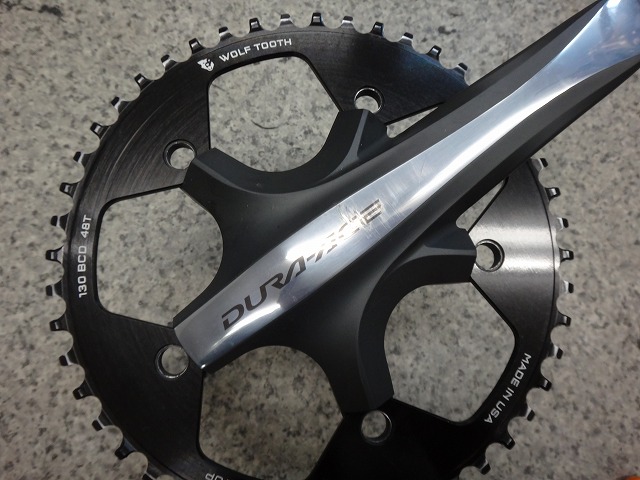
For PCD 130mm 165mm cranks, I also have an FC-7900,
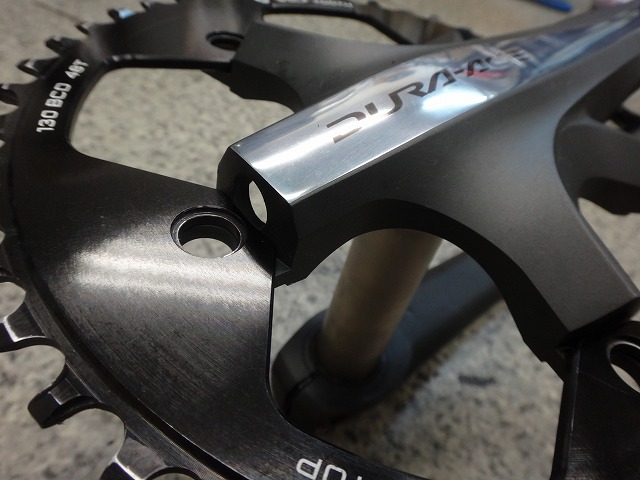
↑ but this gap is hopelessly ugly.
With 4-arm models like FC-9000 and FC-R9100, companies like RIDEA and Absolute Black make parts to cleanly cover this,
but for 7900 Praxis Works made one that's now discontinued (not even on their home site) and hard to find.
Search "praxis works 7900 bolt kit" and you'll find images, though.
Anyway, back to the point—initially I ran 48T×11-32T, then switched the sprocket to 11-28T, and I realized in practice I barely use even the 48×12T ratio (4x) on solo rides.
A 4x ratio means 50.1 km/h at 100 rpm on a 700C tubular—that's a speed I can't sustain under my own power.
It's only useful for not having to pedal downhill.
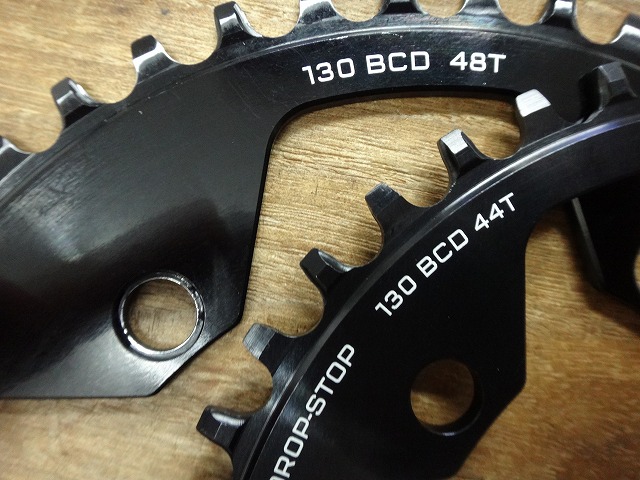
48T must be mounted to the outer position of a 5-arm crank.
Depending on the frame, there might be exceptions, but otherwise the chainring interferes with the right chainstay.
44T, however, seems designed for the inner position,

and the outer holes aren't countersunk for socket-head bolts.
But with Wolf Tooth,
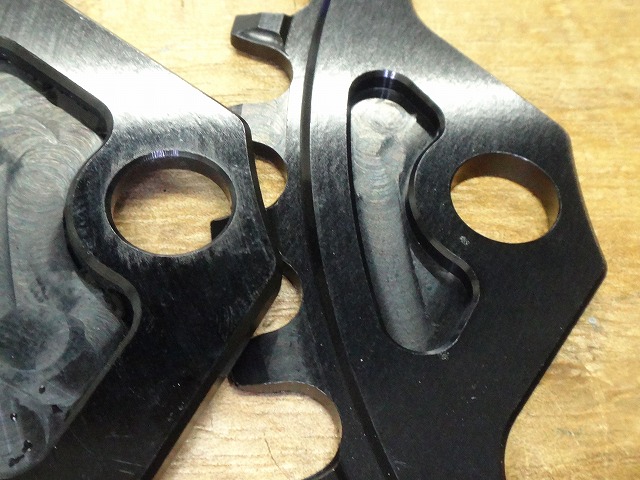
even tooth counts designed for the inner position lack countersunk holes on the inside.
This holds for 34T too, so I'd guess all inner-position options are like this (I don't know where the cutoff is, sorry),
and the problem is that a chainring without countersinks on both sides doesn't fit single-speed bolts since they're too short—you need longer double-chainring bolts or other workarounds on the threaded side.
I switched to 44T, deliberately mounting it to the outer position.
Knowing I can't switch back to 48T, I also trimmed my chain down.
Expressed in the extremes of 52×39T, 44T×11-28T becomes 52×13T ~ 39×25T (just under—24.81T), a true 11-pencil, 11-color set.
Also, somewhat irrelevant, but shifting from 39×25T to 52×13T takes only about a second—something a front double can't do, even electronic drivetrains (honestly, electronic might be slower).
I've always liked single-speeds, and before this I already had cyclocross, hill-climb, and time-trial bikes in single-gear configuration.
Before narrow-wide chainrings came out, I was fabricating chain-retention parts one at a time, but nowadays even that's unnecessary.
What a convenient world we live in.