Another wheel day (and so on).
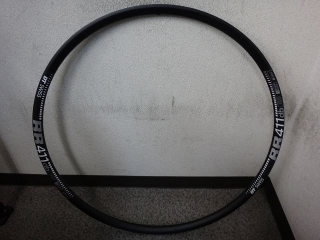
Building a wheel with a DT RR411db rim.
Starting with the front wheel.
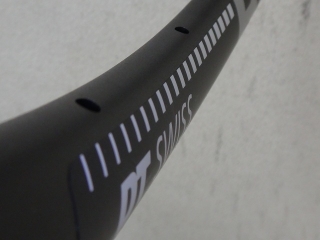
The RR411 comes in a rim brake version with a finished braking zone
and a disc brake version without finishing.
The rim brake version further comes in both non-offset and
asymmetric (offset rim) specifications.
In the case of disc brake specification,
the front wheel has an occhio (spoke dish) for the disc mount,
so by reversing the offset direction between front and rear wheels,
there's a valid reason to use an offset rim—
which is why only the asymmetric model is available.
The "411" in the model name originally indicated the nominal weight,
but the RR411db actually weighs 410g.
You'd think it should be 411g, but I digress—
the rim brake version weighs 435g, which is even further off.
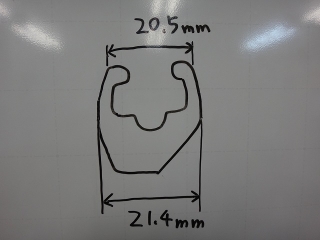
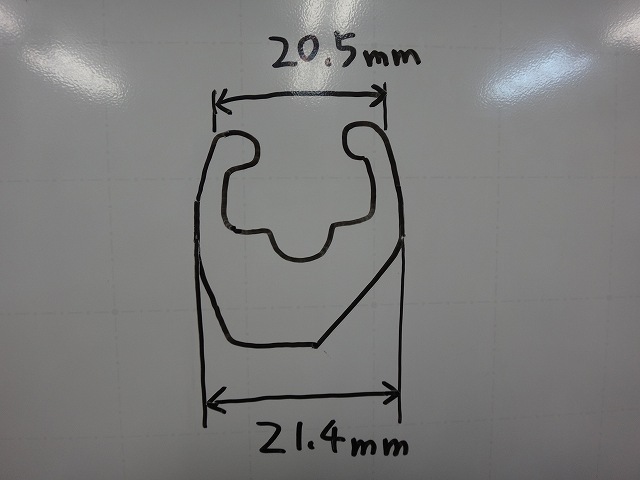
The nominal rim width is supposedly 21mm for the RR411 and 22mm for the RR411db,
but no matter how I measure it, it's not 22mm.
At the widest point it's about 21.4mm,
and from there it tapers slightly toward the outer circumference,
ending up at around 20.5mm at the rim's outermost edge.
Usually when building wheels I don't give rim width much thought,
but with this front wheel, I can't avoid it.
With a non-disc-mount front hub and a non-offset rim,
the spoke angles on left and right are the same.
So there's no need for things like different spoke diameters or different spoke counts on each side.
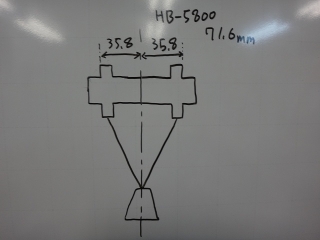
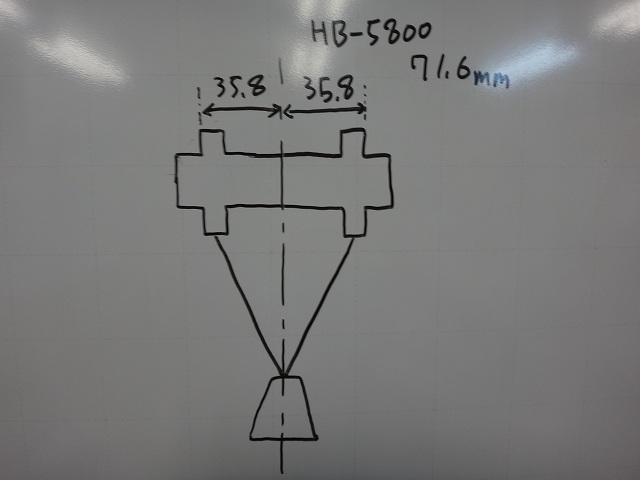
In the diagram above I've noted the 105 hub's flange width,
but that's only because Dura-Ace and Ultegra hubs aren't available, so 105 was used—
there's no particular reason I chose the 105.
Flange width 71.6mm, 35.8mm on each side.
That 35.8mm figure will come up again shortly.
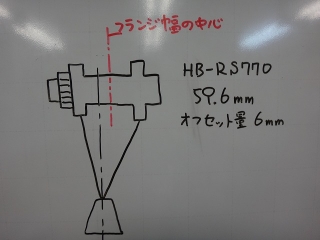
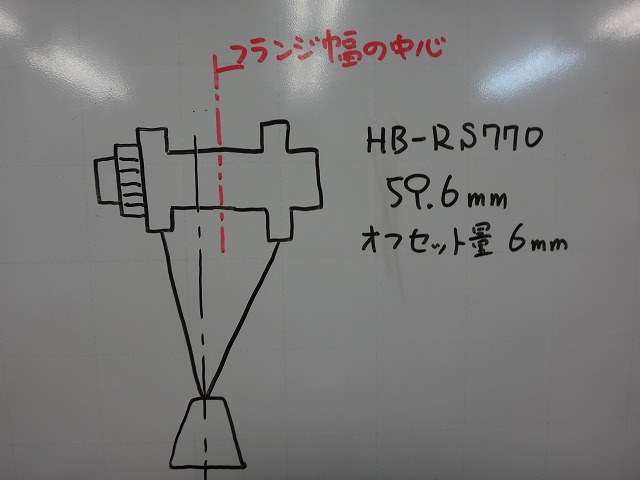
This time I'm building the front wheel with a Shimano RS770 through-axle disc hub,
which has a disc mount so there's an occhio.
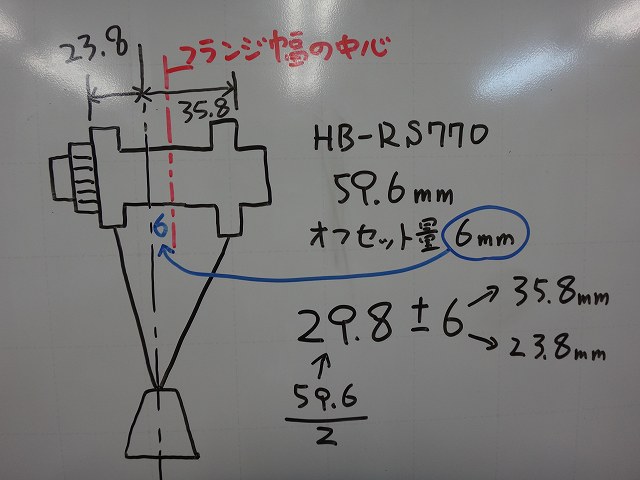
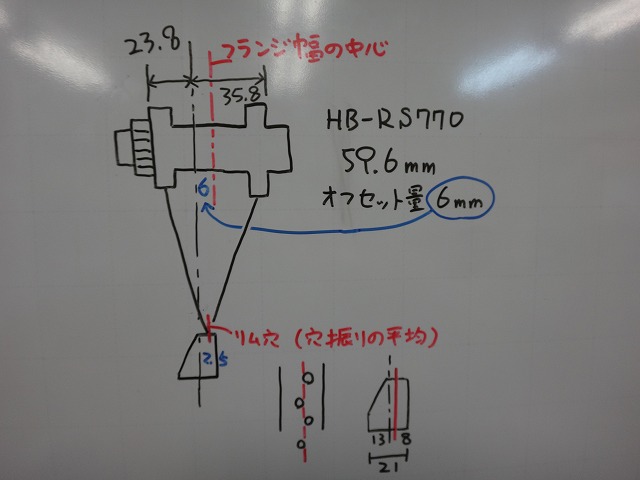
According to current Shimano specs, the flange width is 59.6mm with an offset of 6mm,
which is an awkward way to express it, so you have to calculate it.
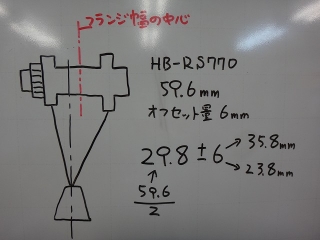
The calculation is: half of 59.6, which is 29.8,
plus or minus the offset amount.
This gives you 35.8mm on the right and 23.8mm on the left from the center of the over-locknut dimension.
Older Shimano catalogs used to list these calculated figures directly,
but nowadays they show flange width and offset amount instead.
The right side being 35.8mm means
the RS770 is essentially a design where Shimano simply narrowed the flange width
of their non-disc front hub by the amount needed for the left disc mount.
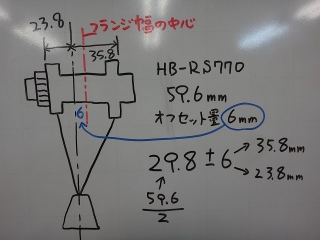
The offset amount is the 6mm shown in the diagram above.
So far I've been drawing this with a non-offset rim, but
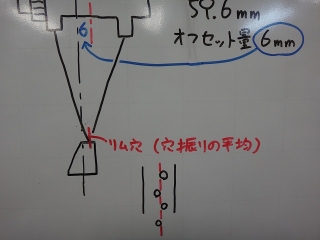
if this were an offset rim,
the rim would be offset in a way that absorbs the hub's offset.
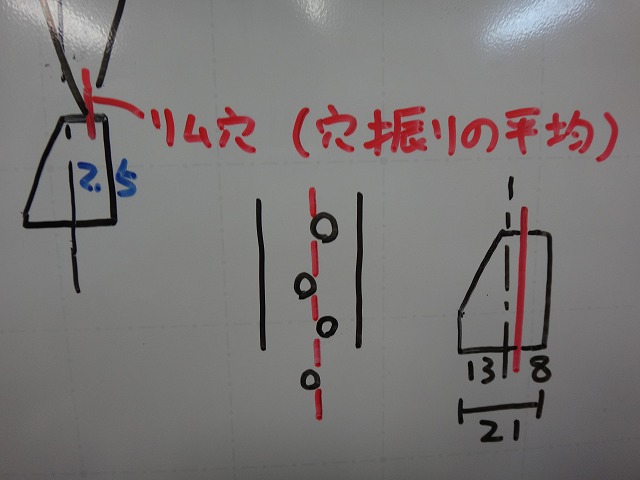
The RR411db rim holes have run-out, so
taking the average of their left-right positions as the rim hole location,
I investigated how much offset there was.
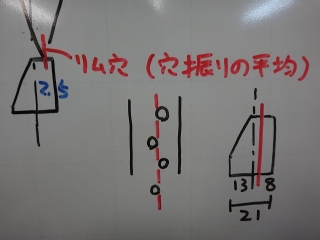
With the rim at about 21mm, I found roughly 13mm and 8mm.
This gives an offset of about 2.5mm,
but measurement precision is somewhat questionable, so
I'd say somewhere between 2mm and 3mm is certain.
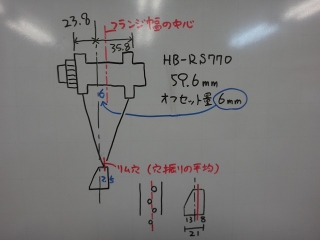
This brings the actual offset down from 6mm to just over 3mm.
The question now is how much different spoke diameter and count lacing to incorporate.
If I use semi-comp lacing, the anti-rotor side will probably have higher tension
(it's just that the anti-rotor side becomes the tension-limiting side).
Semi-comp (different diameters left-right) and 4-6 lacing (different counts left-right)
have the former giving greater correction,
but lately when I build front wheels with CX75 or RS770 hubs
I often use semi-comp.
With a 6mm offset and different diameter/count lacing on both sides,
with Dura-Ace track rear hubs with single-threaded disc mounts,
the small-flange HB-7710 has an offset of 2.75mm,
while the large-flange HB-7600 has 5.25mm.
For those I used same diameter, same count lacing.
For the HB-7600 I sometimes thought it'd be nice to use
lacing on the left side only, but given competitive requirements
I've only ever done both sides unlaced or both sides laced.
Hmm, it's tricky. Having the anti-rotor side at higher tension
isn't terrible in itself, but too much difference is problematic.
What comes to mind is the Zonda DB, which used very different spoke lacing
to build a disc brake front wheel while deliberately making the lower-spoke-count side carry more weight
to reduce anti-rotor side tension.
If I were the Zonda DB designer, would I have used reverse different-diameter lacing?
How to build this front wheel is the same problem, just with different magnitude elements.
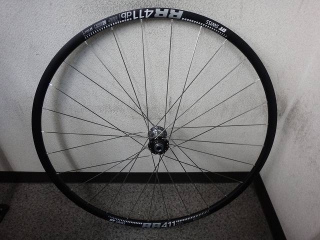
Built.
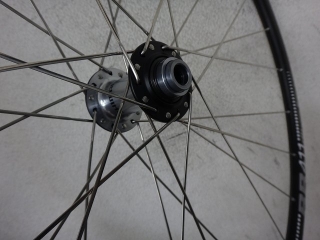
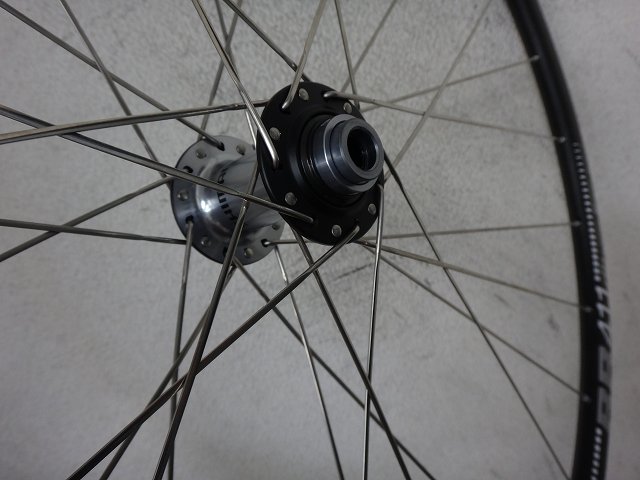
HB-RS770, all CX-RAY, 4-6 reverse Italian lacing.
I'll do the spoke wrapping later.
I chickened out and avoided semi-comp. Whether that was the right call is unclear,
but it was after a lot of deliberation.
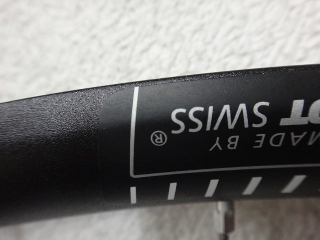
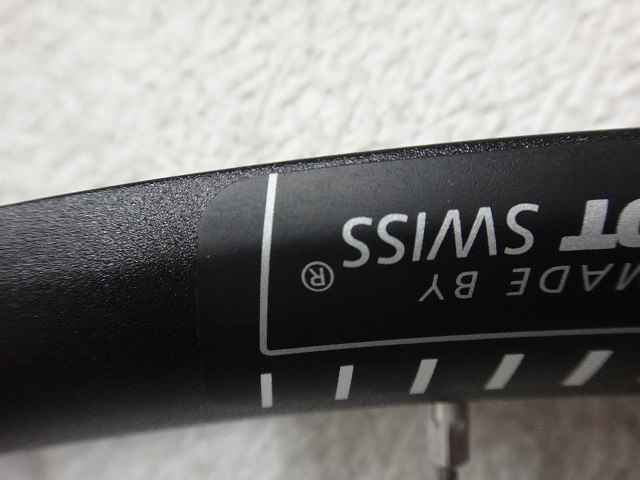
I keep telling them not to slap stickers right at the rim edge!
On DT rims, the sticker adhesive is weak and the edges peel back,
fluttering around like bonito flakes on okonomiyaki,
but this sticker feels different from previous rims.
I suspect brake heat is a major factor in sticker peeling,
so with disc brakes where that doesn't happen,
it should peel less.
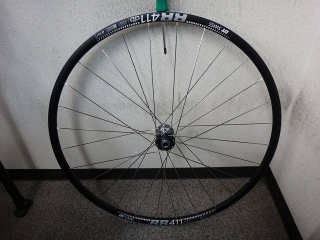
Like Campagnolo hand-built rims,
the sticker phase relative to the valve hole is
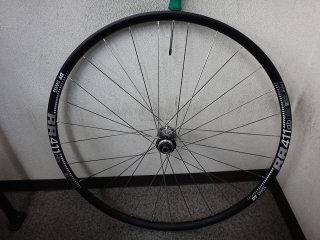
offset by 90° between left and right sides of the rim.
Normally you'd build this so it matches front and rear wheels,
but with rim brakes where the rear rim is offset,
you need to match the front rim to the rear
(build the front wheel first, and if it's wrong, rebuild it;
if there's radial lacing and no markings on the front hub, you can just flip it).
With a disc hub, the offset rim holes are offset
to the right on the front wheel and to the left on the rear,
so the sticker-to-valve-hole phase relationship will absolutely never match front-to-rear.

Building a wheel with a DT RR411db rim.
Starting with the front wheel.
The RR411 comes in a rim brake version with a finished braking zone
and a disc brake version without finishing.
The rim brake version further comes in both non-offset and
asymmetric (offset rim) specifications.
In the case of disc brake specification,
the front wheel has an occhio (spoke dish) for the disc mount,
so by reversing the offset direction between front and rear wheels,
there's a valid reason to use an offset rim—
which is why only the asymmetric model is available.
The "411" in the model name originally indicated the nominal weight,
but the RR411db actually weighs 410g.
You'd think it should be 411g, but I digress—
the rim brake version weighs 435g, which is even further off.
The nominal rim width is supposedly 21mm for the RR411 and 22mm for the RR411db,
but no matter how I measure it, it's not 22mm.
At the widest point it's about 21.4mm,
and from there it tapers slightly toward the outer circumference,
ending up at around 20.5mm at the rim's outermost edge.
Usually when building wheels I don't give rim width much thought,
but with this front wheel, I can't avoid it.
With a non-disc-mount front hub and a non-offset rim,
the spoke angles on left and right are the same.
So there's no need for things like different spoke diameters or different spoke counts on each side.
In the diagram above I've noted the 105 hub's flange width,
but that's only because Dura-Ace and Ultegra hubs aren't available, so 105 was used—
there's no particular reason I chose the 105.
Flange width 71.6mm, 35.8mm on each side.
That 35.8mm figure will come up again shortly.
This time I'm building the front wheel with a Shimano RS770 through-axle disc hub,
which has a disc mount so there's an occhio.
According to current Shimano specs, the flange width is 59.6mm with an offset of 6mm,
which is an awkward way to express it, so you have to calculate it.

The calculation is: half of 59.6, which is 29.8,
plus or minus the offset amount.
This gives you 35.8mm on the right and 23.8mm on the left from the center of the over-locknut dimension.
Older Shimano catalogs used to list these calculated figures directly,
but nowadays they show flange width and offset amount instead.
The right side being 35.8mm means
the RS770 is essentially a design where Shimano simply narrowed the flange width
of their non-disc front hub by the amount needed for the left disc mount.
The offset amount is the 6mm shown in the diagram above.
So far I've been drawing this with a non-offset rim, but

if this were an offset rim,
the rim would be offset in a way that absorbs the hub's offset.
The RR411db rim holes have run-out, so
taking the average of their left-right positions as the rim hole location,
I investigated how much offset there was.
With the rim at about 21mm, I found roughly 13mm and 8mm.
This gives an offset of about 2.5mm,
but measurement precision is somewhat questionable, so
I'd say somewhere between 2mm and 3mm is certain.
This brings the actual offset down from 6mm to just over 3mm.
The question now is how much different spoke diameter and count lacing to incorporate.
If I use semi-comp lacing, the anti-rotor side will probably have higher tension
(it's just that the anti-rotor side becomes the tension-limiting side).
Semi-comp (different diameters left-right) and 4-6 lacing (different counts left-right)
have the former giving greater correction,
but lately when I build front wheels with CX75 or RS770 hubs
I often use semi-comp.
With a 6mm offset and different diameter/count lacing on both sides,
with Dura-Ace track rear hubs with single-threaded disc mounts,
the small-flange HB-7710 has an offset of 2.75mm,
while the large-flange HB-7600 has 5.25mm.
For those I used same diameter, same count lacing.
For the HB-7600 I sometimes thought it'd be nice to use
lacing on the left side only, but given competitive requirements
I've only ever done both sides unlaced or both sides laced.
Hmm, it's tricky. Having the anti-rotor side at higher tension
isn't terrible in itself, but too much difference is problematic.
What comes to mind is the Zonda DB, which used very different spoke lacing
to build a disc brake front wheel while deliberately making the lower-spoke-count side carry more weight
to reduce anti-rotor side tension.
If I were the Zonda DB designer, would I have used reverse different-diameter lacing?
How to build this front wheel is the same problem, just with different magnitude elements.

Built.
HB-RS770, all CX-RAY, 4-6 reverse Italian lacing.
I'll do the spoke wrapping later.
I chickened out and avoided semi-comp. Whether that was the right call is unclear,
but it was after a lot of deliberation.
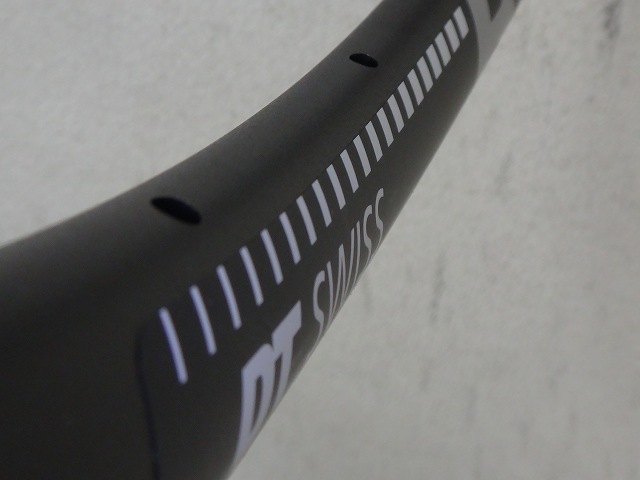
I keep telling them not to slap stickers right at the rim edge!
On DT rims, the sticker adhesive is weak and the edges peel back,
fluttering around like bonito flakes on okonomiyaki,
but this sticker feels different from previous rims.
I suspect brake heat is a major factor in sticker peeling,
so with disc brakes where that doesn't happen,
it should peel less.
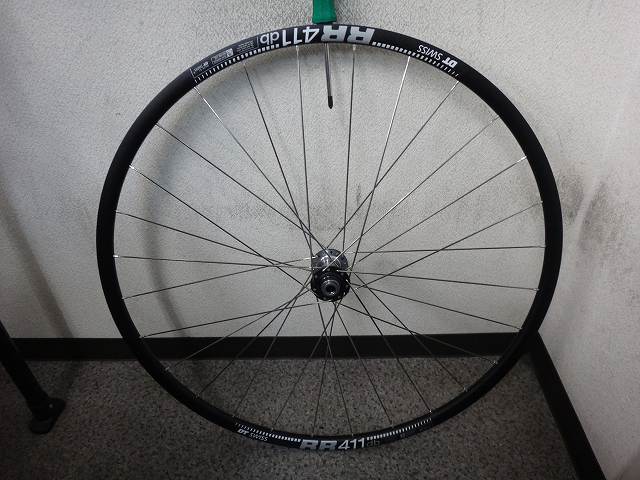
Like Campagnolo hand-built rims,
the sticker phase relative to the valve hole is
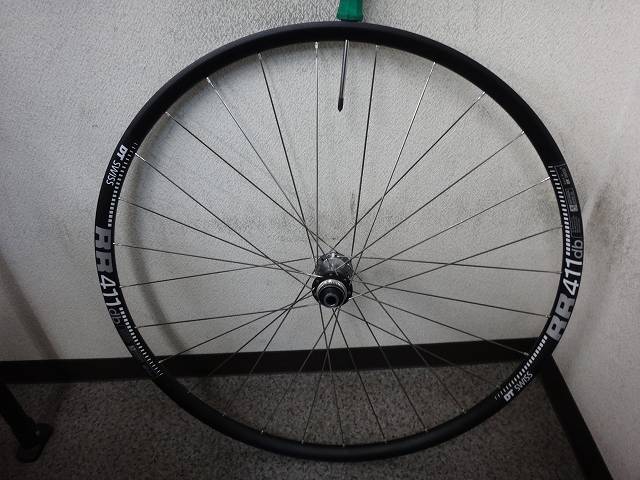
offset by 90° between left and right sides of the rim.
Normally you'd build this so it matches front and rear wheels,
but with rim brakes where the rear rim is offset,
you need to match the front rim to the rear
(build the front wheel first, and if it's wrong, rebuild it;
if there's radial lacing and no markings on the front hub, you can just flip it).
With a disc hub, the offset rim holes are offset
to the right on the front wheel and to the left on the rear,
so the sticker-to-valve-hole phase relationship will absolutely never match front-to-rear.