Another day, another wheel build (and so on).
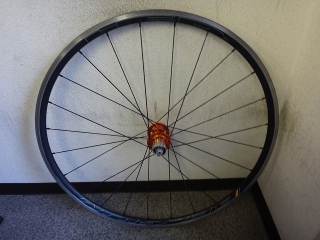
A customer left me a rear wheel that was built with HED Belgium rims.
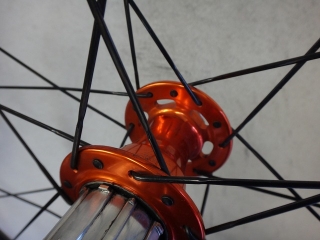
It's got a Crisking R45 hub, 24H, black CX-RAY, reverse Italian laced.
This wheel itself isn't relevant, but the other day I got a comment asking
"why are there wheels laced reverse Italian?"
And my thinking (or that of many predecessors) is that
"reverse Italian lacing seems to have less drag when the freebody gets tightened,"
which is why we do it that way. But for instance,
if you built 100 or 1000 rear wheels each in Italian and reverse Italian lacing
under identical conditions, I don't actually have solid data showing that
reverse Italian had more nipple loosening or
more spoke breakage—that kind of accumulated evidence and reasoning doesn't exist.
What IS clear, separate from that, is that
reverse Italian lacing reduces the likelihood of bending spokes during chain drops.
To be precise, when the final crossing is woven in.
If the reason for doing Italian lacing is just
"reverse Italian lacing looks kinda gross to me,"
then reverse Italian, which has the clear advantage of resisting chain drops,
would be better—or so the reverse Italian faction probably thinks.
But me? I do Italian lacing because
"reverse Italian lacing kinda grosses me out."
Rather than worrying about chain drop damage,
I'd rather use the lacing method that seems (seems, mind you) to resist
freebody twisting better, and weighing all the factors,
I think that's the better choice.
Though if a customer wanted reverse Italian, I'd do that.
It's really just a matter of that.
And even as I say "just a matter of that,"
this rear wheel is getting relaced to Italian anyway.
Also, my rule of thumb that reverse Italian lacing is mainly done by Americans
held true again this time.
The customer bought this wheel online from America, apparently.
Though we're only using the hub.
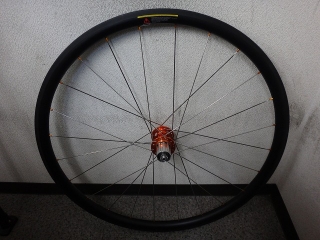
Built it.
The rim is a tubeless-compatible 30mm deep carbon rim.
Apparently it's from a brand that also runs online shops,
but it's a special custom spec that the brand doesn't normally do.
That's made wheel building a real pain (more on that later).
The rim's actual weight measured 30g heavier than the spec weight, so
I told them either rebuild it or send me one that matches spec.
At first they pushed back, then offered a "2000 yen discount on rim cost,"
but I refused that outright. Then in 3 days they had
a rim matching spec ready. Scary stuff (which side is scarier is a secret).
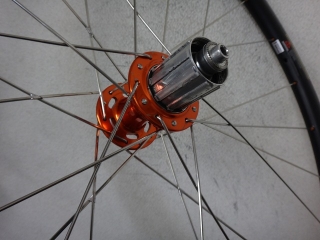
Half comp, 46 Italian laced with built-in reinforcement.
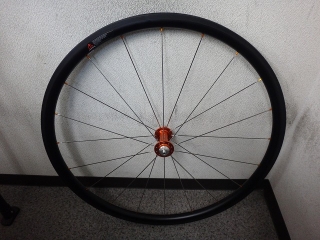
Built the front wheel too.
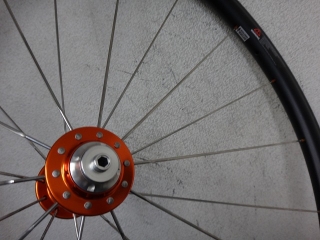
Crisking R45 front hub, 20H, CX-RAY outpoke radial lacing.
This hub is a separate one the customer sourced themselves, in the same color.
I forgot to mention: both wheels have orange aluminum nipples,
and since DT doesn't make that color, I used Sapim 12mm.
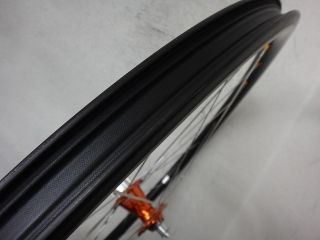
This rim has no holes on the outer edge except for the valve hole,
which makes even the initial truing process extremely tedious.

A customer left me a rear wheel that was built with HED Belgium rims.
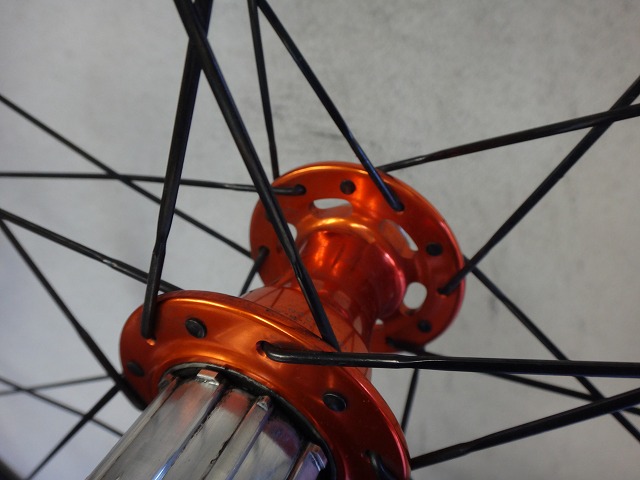
It's got a Crisking R45 hub, 24H, black CX-RAY, reverse Italian laced.
This wheel itself isn't relevant, but the other day I got a comment asking
"why are there wheels laced reverse Italian?"
And my thinking (or that of many predecessors) is that
"reverse Italian lacing seems to have less drag when the freebody gets tightened,"
which is why we do it that way. But for instance,
if you built 100 or 1000 rear wheels each in Italian and reverse Italian lacing
under identical conditions, I don't actually have solid data showing that
reverse Italian had more nipple loosening or
more spoke breakage—that kind of accumulated evidence and reasoning doesn't exist.
What IS clear, separate from that, is that
reverse Italian lacing reduces the likelihood of bending spokes during chain drops.
To be precise, when the final crossing is woven in.
If the reason for doing Italian lacing is just
"reverse Italian lacing looks kinda gross to me,"
then reverse Italian, which has the clear advantage of resisting chain drops,
would be better—or so the reverse Italian faction probably thinks.
But me? I do Italian lacing because
"reverse Italian lacing kinda grosses me out."
Rather than worrying about chain drop damage,
I'd rather use the lacing method that seems (seems, mind you) to resist
freebody twisting better, and weighing all the factors,
I think that's the better choice.
Though if a customer wanted reverse Italian, I'd do that.
It's really just a matter of that.
And even as I say "just a matter of that,"
this rear wheel is getting relaced to Italian anyway.
Also, my rule of thumb that reverse Italian lacing is mainly done by Americans
held true again this time.
The customer bought this wheel online from America, apparently.
Though we're only using the hub.
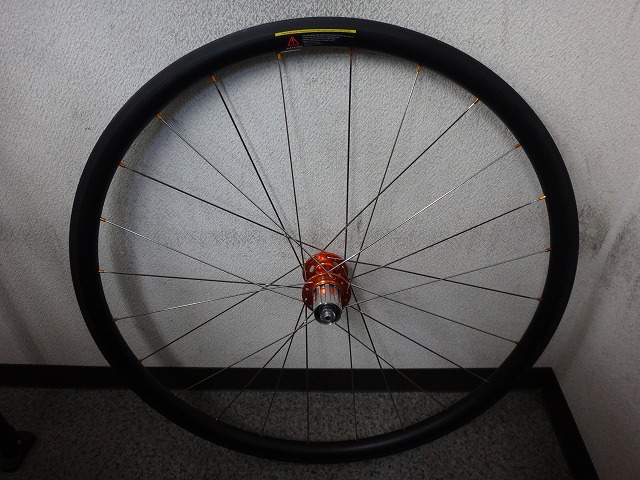
Built it.
The rim is a tubeless-compatible 30mm deep carbon rim.
Apparently it's from a brand that also runs online shops,
but it's a special custom spec that the brand doesn't normally do.
That's made wheel building a real pain (more on that later).
The rim's actual weight measured 30g heavier than the spec weight, so
I told them either rebuild it or send me one that matches spec.
At first they pushed back, then offered a "2000 yen discount on rim cost,"
but I refused that outright. Then in 3 days they had
a rim matching spec ready. Scary stuff (which side is scarier is a secret).

Half comp, 46 Italian laced with built-in reinforcement.
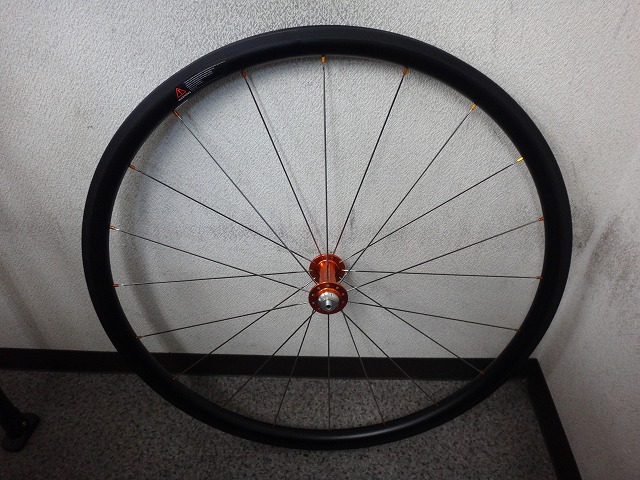
Built the front wheel too.
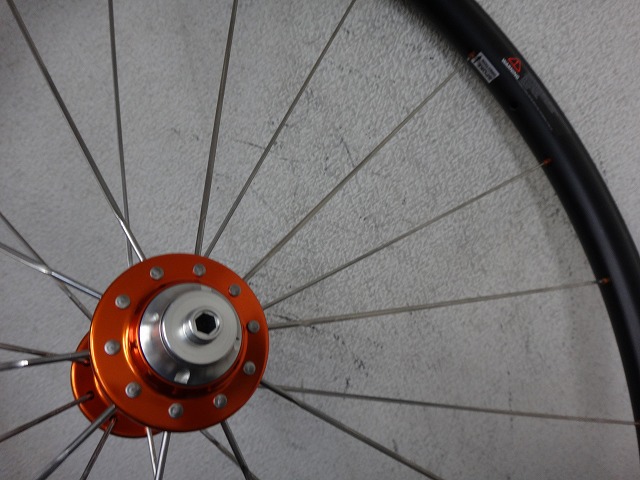
Crisking R45 front hub, 20H, CX-RAY outpoke radial lacing.
This hub is a separate one the customer sourced themselves, in the same color.
I forgot to mention: both wheels have orange aluminum nipples,
and since DT doesn't make that color, I used Sapim 12mm.
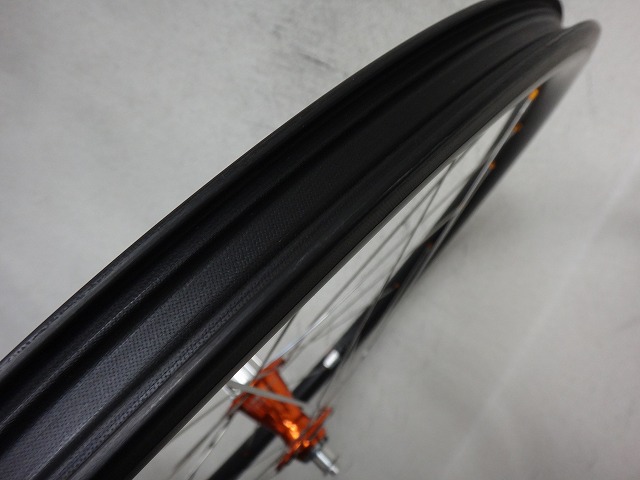
This rim has no holes on the outer edge except for the valve hole,
which makes even the initial truing process extremely tedious.