Another wheel day (and so on).
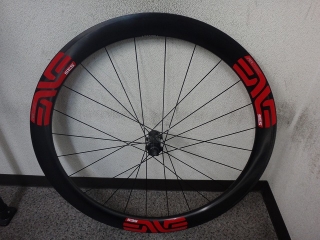
I built a front wheel using the ENVE 4.5 AR Disc rim.
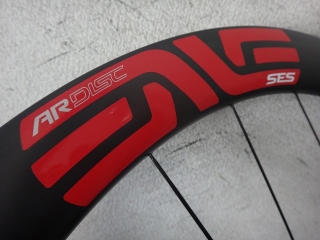
The rim side sticker appears to have been replaced with a red one from the original spare parts.
Smart Envi System road rims are designed for asphalt use,
but this rim alone is for asphalt/gravel, and
the specified tire width for other models is all 23-28mm
(with 25mm being aerodynamically optimal), whereas
this rim alone is 28-32mm (with 28mm being aerodynamically optimal).
The reason the minimum specified tire width is 28mm is probably because
the rim's inner width is 25mm (outer width 31mm), which is extremely wide,
so a thin tire would become what's called a "pinched" tire and be dangerous.
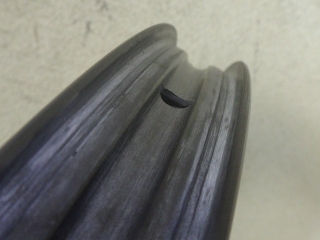
Also, since it's hookless bead, this is a tubeless tire-only rim.
The hump isn't a sharp protrusion but a surface hump with width, so
if a tire were to come off due to impact from bucketing,
the tire bead would have to climb over the surface hump,
so structurally it essentially won't come off.
Apparently to avoid drilling rim holes through the surface hump,
the rim holes are positioned at the rim's center without offset, but
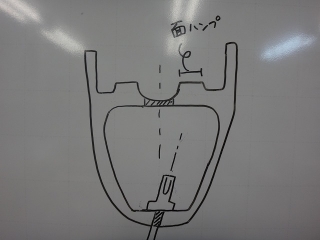
because of this (exaggerated in the drawing),
the spoke's incident angle doesn't align with the center of the rim hole,
making it harder to engage the tool for turning the internal nipples.
Since this is a front rim at 49mm depth, the rear rim is 55mm depth, so
I expect the rear rim will be somewhat easier to work with.
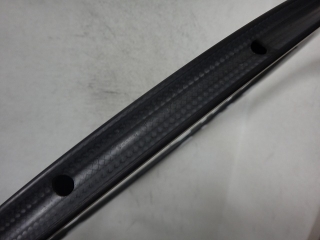
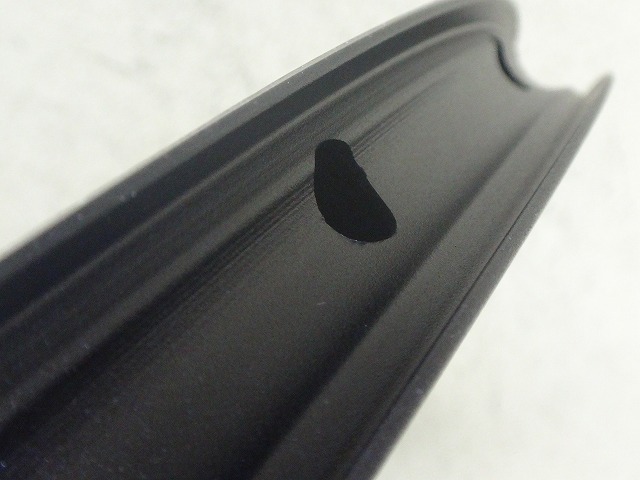
As for Nomu Lab Wheel No. 2's rim, the rim width has gotten slightly wider since 2017.
With the old 19.1mm width rim, the outer holes had no offset,
but with the new 20.5mm width rim (image above), offset is provided.
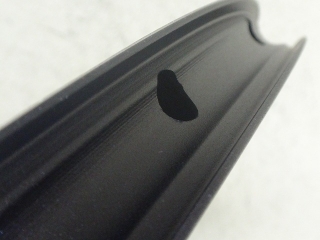
This is DT's RR 411db rim, and despite having no hump,
there are rim holes directly beneath the tire bead.
What's different about this rim compared to the previous two types is
that while you can grab the Torx socket of the Squorx nipple and turn the nipple from the outer side,
since these are external nipples that can be adjusted normally from the inner side,
there's no need for aggressive offset on the rim's outer edge.
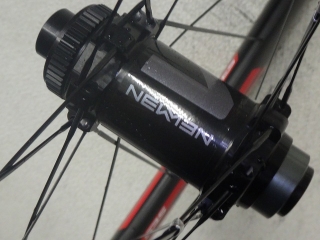
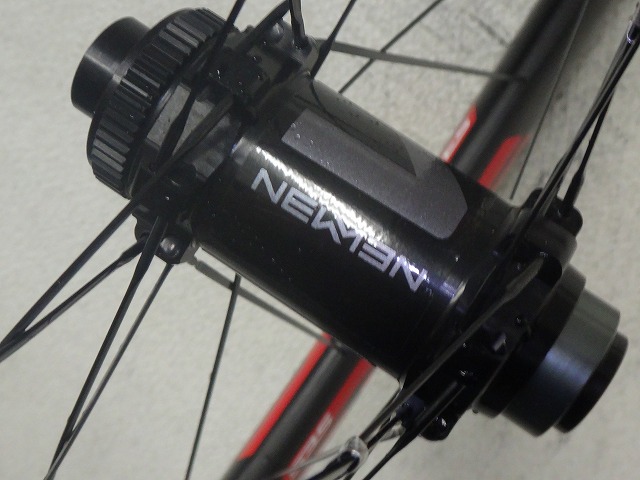
The hub is from German manufacturer Numen,
model Evolution SL Straight Pull CL,
and this is the only road hub model from this company.
Not that it matters much, but
the logo is still readable even upside down, same as the ENVE rim.
The company has an Evolution SL model for MTB with bent spokes,
and the straight spoke version of that is the Evolution SL Straight Pull.
These hubs both have 6-bolt rotor mounting, but
the road version Evolution SL Straight Pull CL features a centerlock (CL) rotor mounting interface.
The MTB Evolution SL Straight Pull comes only in 28H spec—a bold lineup choice—
and since it's for MTB, versions with 148mm rear (BOOST standard) and
SRAM XD freebody exist, but
the road Evolution SL Straight Pull CL
comes only in 24H with front hub at 100×15mm only,
and rear hub at 142×12mm only.
Why a road through-axle with 15mm diameter anyway—
I'll write about that later.
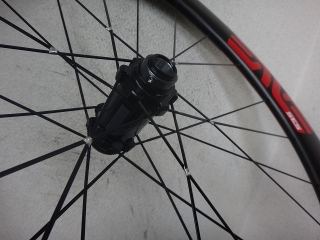
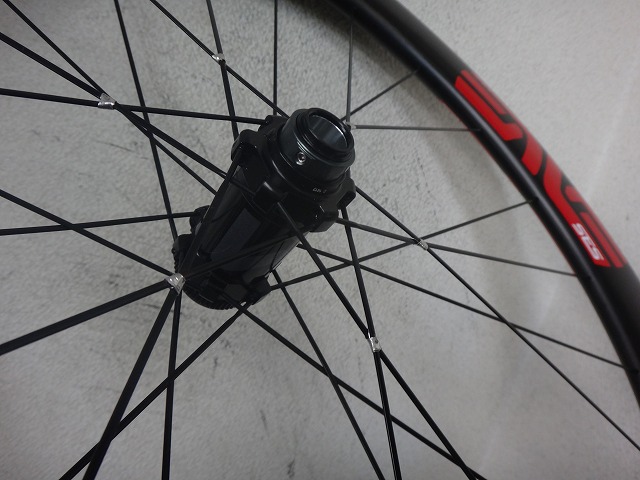
Built with black CX-RAY straight spokes on both sides.
The 2-cross lacing on both sides is the hub maker's specification, so there's nothing I can do about it.
The final crossing can be braided or not, but
I braided both sides and tied only the non-rotor side.
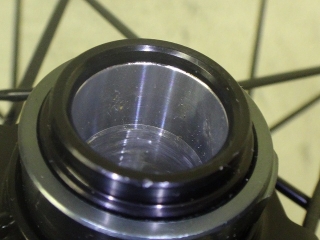
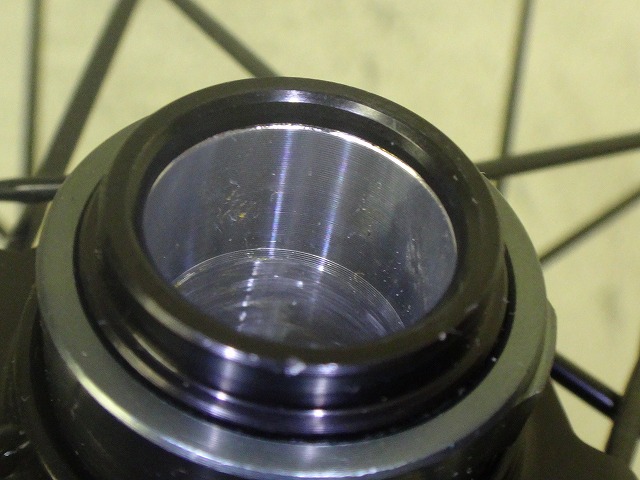
This front hub has a 15mm through-axle, but
the rim of the end hole is chamfered, and

by press-fitting a very thin flanged adapter,
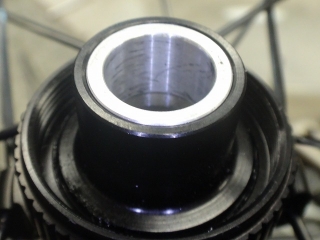
it can be converted to a 12mm through-axle.
Which means, if you don't mind 6-bolt rotor mounting,
you could build a disc road or cyclocross wheel using the 28H MTB hub,
and if you're not using BOOST standard, you could build an MTB wheel
using the 24H road hub.
The MTB hub doesn't seem to have variations like
stronger seals designed for the expected usage conditions
or larger diameter bearings compared to the road hub.
According to the manufacturer's website, only the road hub has
lightening on the freewheel body splines, which is the key design difference,
but the rear hub I have on order has splines with no lightening.

I built a front wheel using the ENVE 4.5 AR Disc rim.

The rim side sticker appears to have been replaced with a red one from the original spare parts.
Smart Envi System road rims are designed for asphalt use,
but this rim alone is for asphalt/gravel, and
the specified tire width for other models is all 23-28mm
(with 25mm being aerodynamically optimal), whereas
this rim alone is 28-32mm (with 28mm being aerodynamically optimal).
The reason the minimum specified tire width is 28mm is probably because
the rim's inner width is 25mm (outer width 31mm), which is extremely wide,
so a thin tire would become what's called a "pinched" tire and be dangerous.
Also, since it's hookless bead, this is a tubeless tire-only rim.
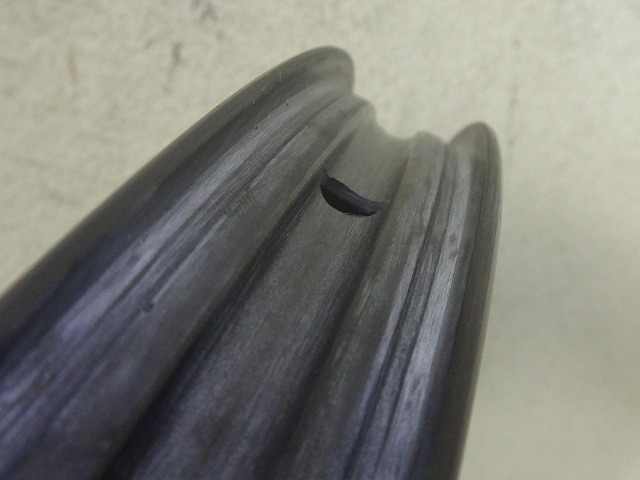
The hump isn't a sharp protrusion but a surface hump with width, so
if a tire were to come off due to impact from bucketing,
the tire bead would have to climb over the surface hump,
so structurally it essentially won't come off.
Apparently to avoid drilling rim holes through the surface hump,
the rim holes are positioned at the rim's center without offset, but

because of this (exaggerated in the drawing),
the spoke's incident angle doesn't align with the center of the rim hole,
making it harder to engage the tool for turning the internal nipples.
Since this is a front rim at 49mm depth, the rear rim is 55mm depth, so
I expect the rear rim will be somewhat easier to work with.
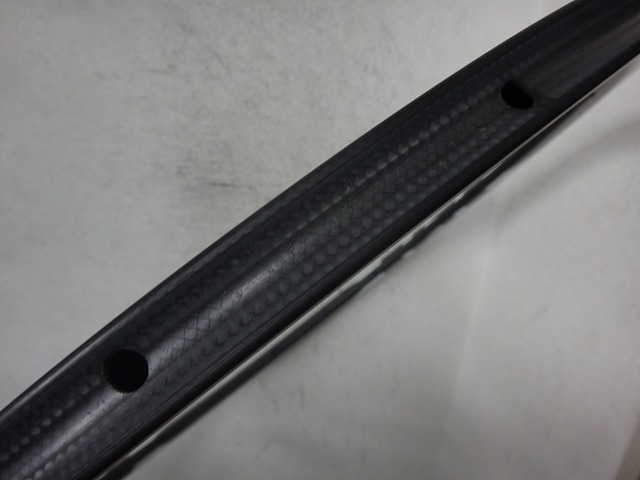
As for Nomu Lab Wheel No. 2's rim, the rim width has gotten slightly wider since 2017.
With the old 19.1mm width rim, the outer holes had no offset,
but with the new 20.5mm width rim (image above), offset is provided.
This is DT's RR 411db rim, and despite having no hump,
there are rim holes directly beneath the tire bead.
What's different about this rim compared to the previous two types is
that while you can grab the Torx socket of the Squorx nipple and turn the nipple from the outer side,
since these are external nipples that can be adjusted normally from the inner side,
there's no need for aggressive offset on the rim's outer edge.
The hub is from German manufacturer Numen,
model Evolution SL Straight Pull CL,
and this is the only road hub model from this company.
Not that it matters much, but
the logo is still readable even upside down, same as the ENVE rim.
The company has an Evolution SL model for MTB with bent spokes,
and the straight spoke version of that is the Evolution SL Straight Pull.
These hubs both have 6-bolt rotor mounting, but
the road version Evolution SL Straight Pull CL features a centerlock (CL) rotor mounting interface.
The MTB Evolution SL Straight Pull comes only in 28H spec—a bold lineup choice—
and since it's for MTB, versions with 148mm rear (BOOST standard) and
SRAM XD freebody exist, but
the road Evolution SL Straight Pull CL
comes only in 24H with front hub at 100×15mm only,
and rear hub at 142×12mm only.
Why a road through-axle with 15mm diameter anyway—
I'll write about that later.
Built with black CX-RAY straight spokes on both sides.
The 2-cross lacing on both sides is the hub maker's specification, so there's nothing I can do about it.
The final crossing can be braided or not, but
I braided both sides and tied only the non-rotor side.
This front hub has a 15mm through-axle, but
the rim of the end hole is chamfered, and
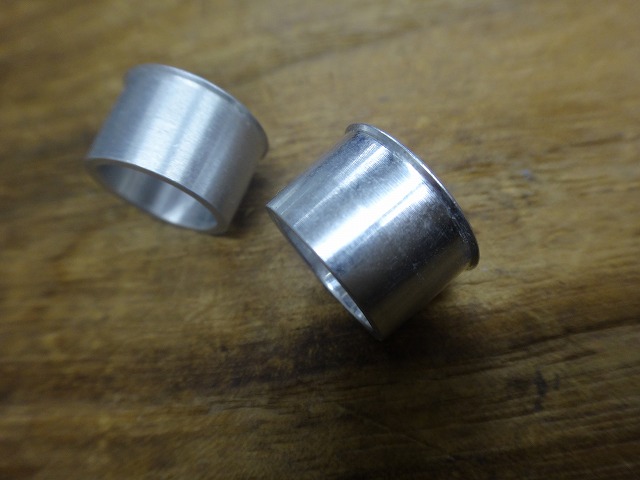
by press-fitting a very thin flanged adapter,
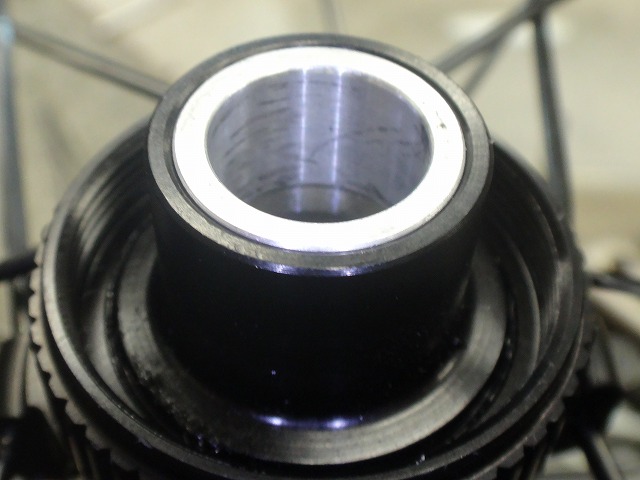
it can be converted to a 12mm through-axle.
Which means, if you don't mind 6-bolt rotor mounting,
you could build a disc road or cyclocross wheel using the 28H MTB hub,
and if you're not using BOOST standard, you could build an MTB wheel
using the 24H road hub.
The MTB hub doesn't seem to have variations like
stronger seals designed for the expected usage conditions
or larger diameter bearings compared to the road hub.
According to the manufacturer's website, only the road hub has
lightening on the freewheel body splines, which is the key design difference,
but the rear hub I have on order has splines with no lightening.