A customer dropped off a Smart Envy System 3.4 in WO spec.
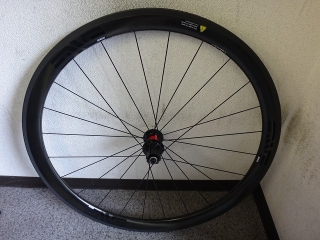
Starting with the rear wheel.
Both wheels are built with DT 240S hubs, but the rear wheel has been shoe-rubbing.
Even though it's an SES 3.4, this rim is the latest spec, so the brake zone has file marks,
and when it rubs the shoe it squeaks loudly—making it even more obvious.
By the way, the customer's lever reach is set loose (large gap between rim and shoe).
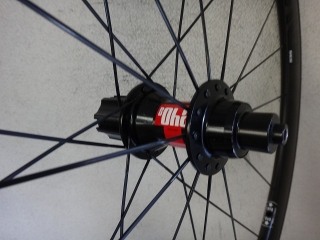
DT 240S hub, 24H, black, CX-RAY 4-cross lacing.
I always think it's strange that wheels built this way—so last-century—
are still around today.
Someone who doesn't know better might think "I bought an SES wheel and it rubs,"
and the rim gets blamed for a problem it didn't cause.
I can't tell if this is Envy's standard off-the-shelf factory-built complete wheel.
If it's off-the-shelf, it's either a DT 240S hub, a Chris King R45 hub,
or an ENVE carbon hub,
but only the ENVE hub is instantly recognizable as factory-built.
However, a few signs made me think this wasn't factory-built:
the spoke length on the freewheel side was slightly long,
and on the non-freewheel side it was abnormally long (more than 4 threads sticking out past the nipple),
with an asymmetrical long-short distribution left to right.
When rebuilding, the customer wanted to upgrade the hub to a Chris King R45,
change the freewheel side from CX-RAY to Comp,
and change the non-freewheel side from radial lacing to 6-cross,
so I couldn't reuse spokes on either side.
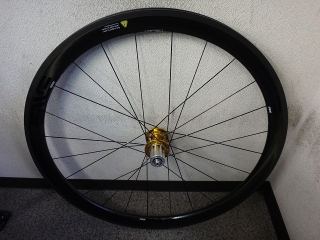
Built.
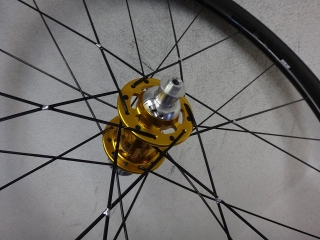
R45 hub, 24H, black, half Comp, 4-cross lacing with spoke wire.
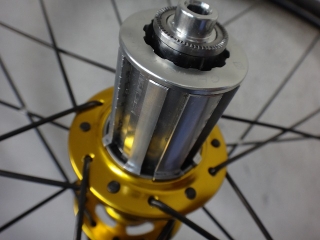
This hub showed old build marks, and since the customer wasn't the original owner,
I mentioned it just in case they didn't know—and indeed they didn't.
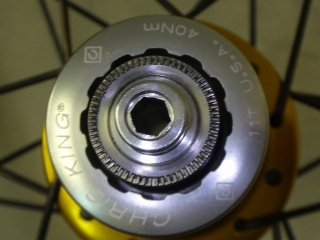
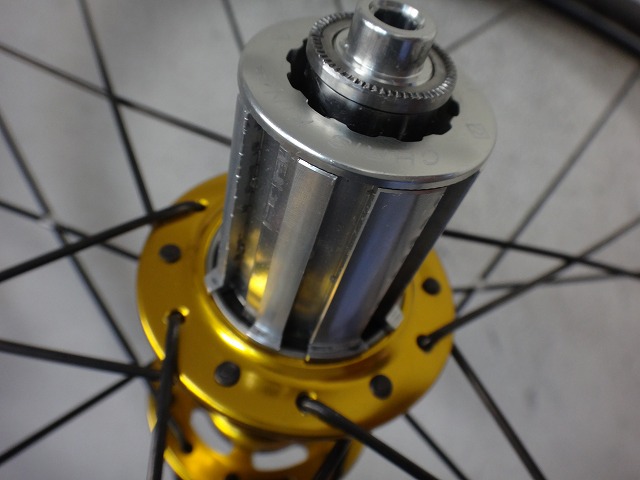
Actually, Chris King's Campagnolo-compatible freebody
is not compatible with Campagnolo's OEM lockring.
The OEM lockring has a smaller thread diameter,
so you need the dedicated lockring.
But the lockring that came on this hub was for 11T top,
so if 12T sprockets are used, a different lockring will be needed.
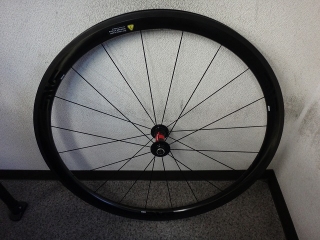
Next, the front wheel.
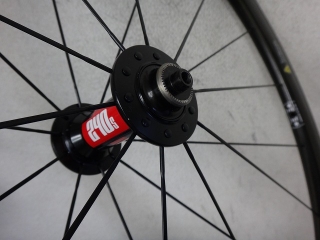
DT 240S hub, 20H, black, CX-RAY outpoke radial lacing.
Unlike the rear wheel, the spoke length was just slightly long—within tolerance.
If the rear wheel rebuild hadn't involved changing the hub,
I would've dealt with the low tension by tightening up,
but since the hub is changing, spoke reuse might not be possible.
There's a flange diameter difference, and flange width differs too:
the DT rear hub is narrower, while the R45 front hub is narrower.
The spokes being slightly long actually worked in my favor this time.
The spoke length difference was minus 1mm after rounding,
or minus about 0.5mm before rounding.
I could've reused them without cutting, but since CX-RAY has larger individual length variation than plain spokes,
I cut just 0.5mm to even them out.
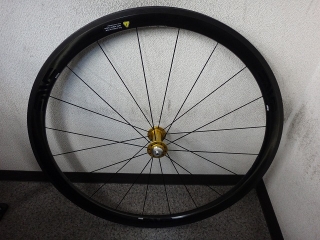
Built.
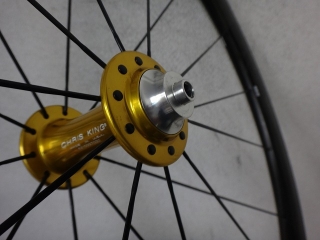
R45 hub, 20H, black, CX-RAY outpoke radial lacing.
Before, I wrote that the rim inner diameter listed on DT rim stickers
didn't match where I actually measured, making spoke length calculations unreliable,
and that it's not me that's wrong—with Mavic or Envy, my measurements match their specs,
so DT's "rim inner diameter" definition is the problem, not mine.
Actually, when I built an SES 4.5 AR Disc recently,
the difference between my measurement and the spec was under 1mm,
so I calculated spoke length using the spec value.
Here, "measurement" and "spec" refer to rim inner diameter diameter,
and I actually use the radius for calculations, so the difference is negligible.
Looking at the maker website, the front rim with 38mm height is listed as 580mm,
and the rear rim with 42mm height as 573mm,
but these numbers differed hugely from my actual measurements.
The difference was about 18mm. Not 1.8mm—18mm.
I started to suspect maybe the rim I thought was SES 3.4 was actually SES 4.5,
so I measured the rim height—the rear rim was indeed 42mm—so no mistake there.
I'm skeptical by nature, so while I check published specs for rim inner diameter,
I always measure it myself and never rely on specs alone.
Why the published value is so obviously wrong, I don't know.
One more thing: ZIPP rims have large individual variation in rim inner diameter,
so I always measure each one individually.
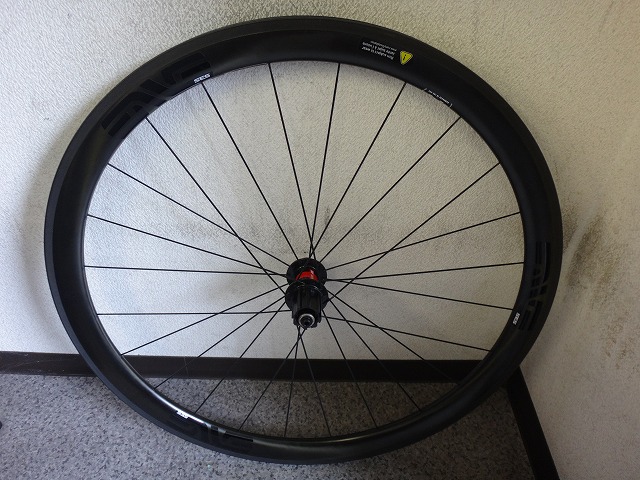
Starting with the rear wheel.
Both wheels are built with DT 240S hubs, but the rear wheel has been shoe-rubbing.
Even though it's an SES 3.4, this rim is the latest spec, so the brake zone has file marks,
and when it rubs the shoe it squeaks loudly—making it even more obvious.
By the way, the customer's lever reach is set loose (large gap between rim and shoe).
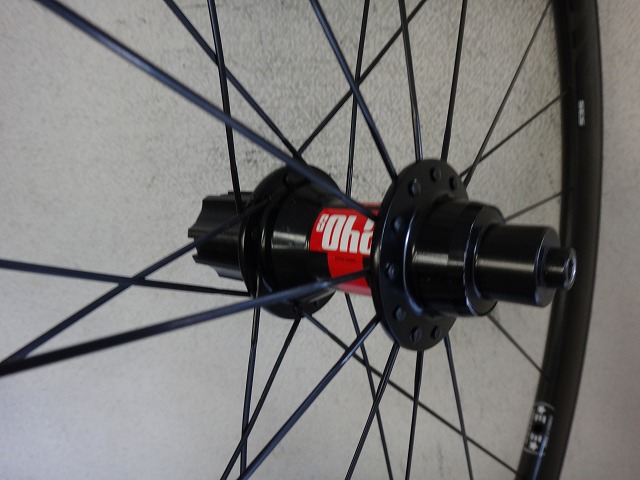
DT 240S hub, 24H, black, CX-RAY 4-cross lacing.
I always think it's strange that wheels built this way—so last-century—
are still around today.
Someone who doesn't know better might think "I bought an SES wheel and it rubs,"
and the rim gets blamed for a problem it didn't cause.
I can't tell if this is Envy's standard off-the-shelf factory-built complete wheel.
If it's off-the-shelf, it's either a DT 240S hub, a Chris King R45 hub,
or an ENVE carbon hub,
but only the ENVE hub is instantly recognizable as factory-built.
However, a few signs made me think this wasn't factory-built:
the spoke length on the freewheel side was slightly long,
and on the non-freewheel side it was abnormally long (more than 4 threads sticking out past the nipple),
with an asymmetrical long-short distribution left to right.
When rebuilding, the customer wanted to upgrade the hub to a Chris King R45,
change the freewheel side from CX-RAY to Comp,
and change the non-freewheel side from radial lacing to 6-cross,
so I couldn't reuse spokes on either side.
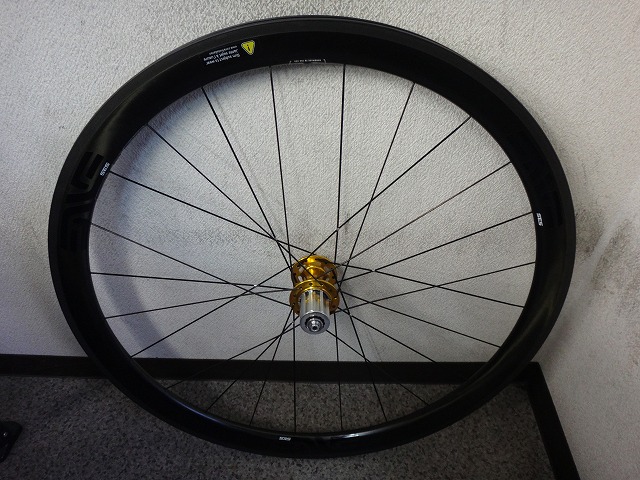
Built.
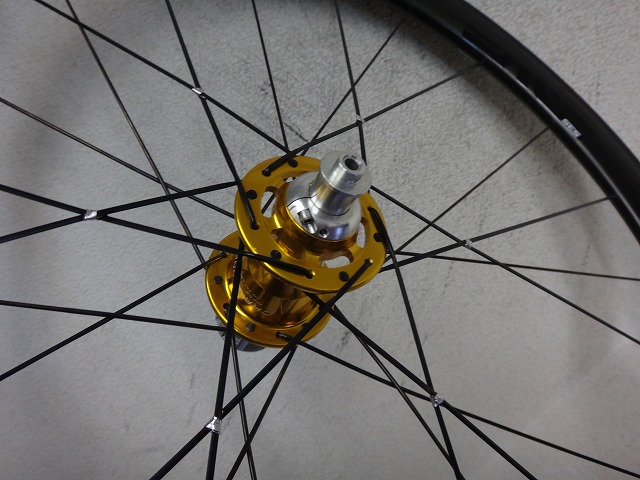
R45 hub, 24H, black, half Comp, 4-cross lacing with spoke wire.
This hub showed old build marks, and since the customer wasn't the original owner,
I mentioned it just in case they didn't know—and indeed they didn't.

Actually, Chris King's Campagnolo-compatible freebody
is not compatible with Campagnolo's OEM lockring.
The OEM lockring has a smaller thread diameter,
so you need the dedicated lockring.
But the lockring that came on this hub was for 11T top,
so if 12T sprockets are used, a different lockring will be needed.
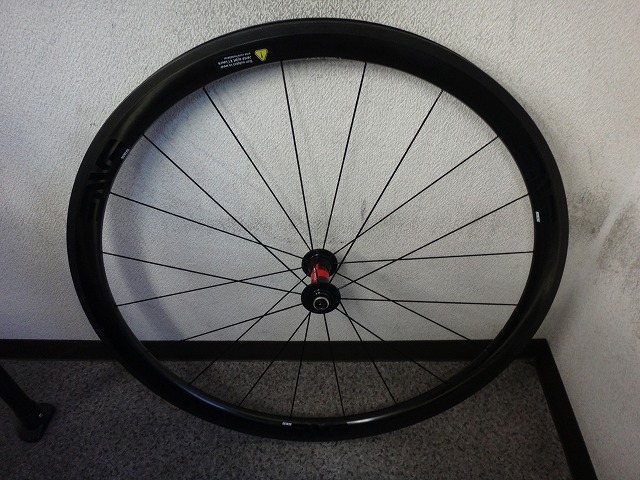
Next, the front wheel.
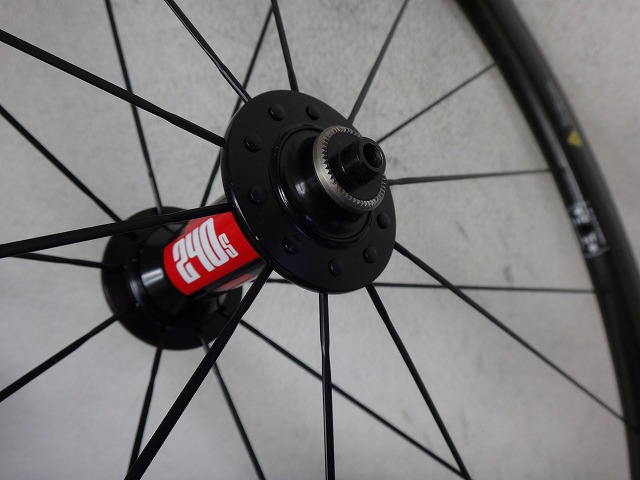
DT 240S hub, 20H, black, CX-RAY outpoke radial lacing.
Unlike the rear wheel, the spoke length was just slightly long—within tolerance.
If the rear wheel rebuild hadn't involved changing the hub,
I would've dealt with the low tension by tightening up,
but since the hub is changing, spoke reuse might not be possible.
There's a flange diameter difference, and flange width differs too:
the DT rear hub is narrower, while the R45 front hub is narrower.
The spokes being slightly long actually worked in my favor this time.
The spoke length difference was minus 1mm after rounding,
or minus about 0.5mm before rounding.
I could've reused them without cutting, but since CX-RAY has larger individual length variation than plain spokes,
I cut just 0.5mm to even them out.
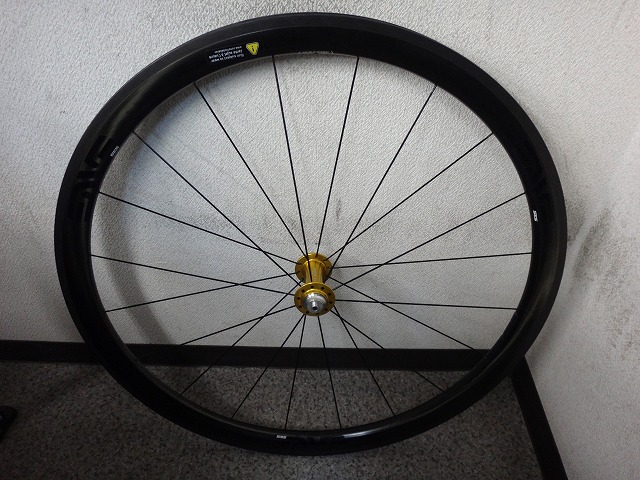
Built.
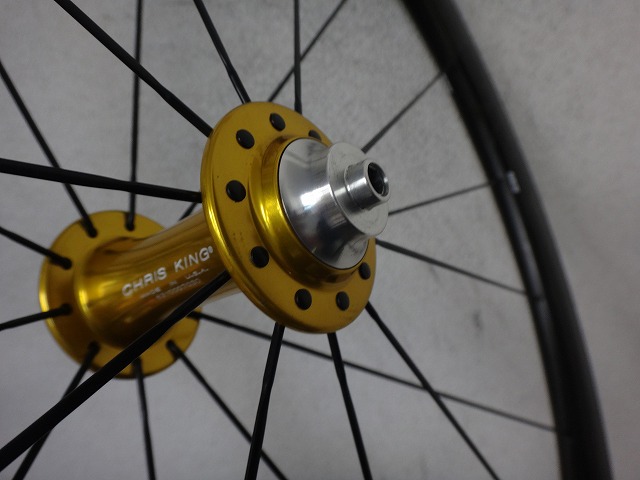
R45 hub, 20H, black, CX-RAY outpoke radial lacing.
Before, I wrote that the rim inner diameter listed on DT rim stickers
didn't match where I actually measured, making spoke length calculations unreliable,
and that it's not me that's wrong—with Mavic or Envy, my measurements match their specs,
so DT's "rim inner diameter" definition is the problem, not mine.
Actually, when I built an SES 4.5 AR Disc recently,
the difference between my measurement and the spec was under 1mm,
so I calculated spoke length using the spec value.
Here, "measurement" and "spec" refer to rim inner diameter diameter,
and I actually use the radius for calculations, so the difference is negligible.
Looking at the maker website, the front rim with 38mm height is listed as 580mm,
and the rear rim with 42mm height as 573mm,
but these numbers differed hugely from my actual measurements.
The difference was about 18mm. Not 1.8mm—18mm.
I started to suspect maybe the rim I thought was SES 3.4 was actually SES 4.5,
so I measured the rim height—the rear rim was indeed 42mm—so no mistake there.
I'm skeptical by nature, so while I check published specs for rim inner diameter,
I always measure it myself and never rely on specs alone.
Why the published value is so obviously wrong, I don't know.
One more thing: ZIPP rims have large individual variation in rim inner diameter,
so I always measure each one individually.