The valve rattle prevention guard used on Campagnolo Bora wheels and similar rims—the valve bush WH-BUU002—has undergone another specification change.
This is now the third generation.
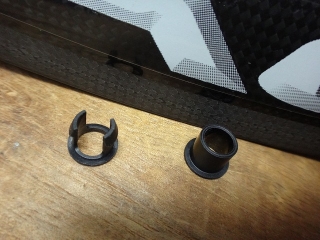
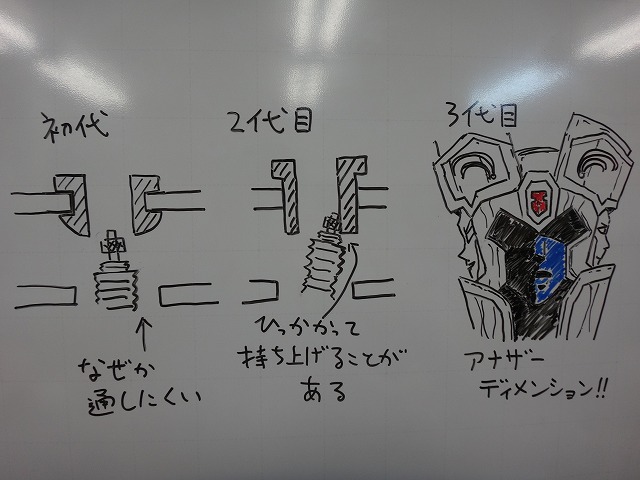
↑The image on the left shows the original two-prong design, and the right shows the second-generation pipe type,
but the third generation has become the Gemini type.
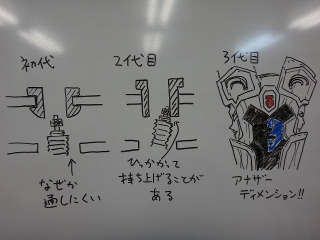
The first generation made it extremely difficult to feed the valve through,
especially with valves that didn't have threads cut into the valve body itself.
But when I thought "there's no way this is going through," and tried feeding the valve through from inside the rim...
somehow it slides through just fine. It's strange.
I've figured out the trick (it's also important to orient the prongs in the front-to-back direction of the rim),
but because it was so difficult, some people probably got frustrated and just removed it and used the wheel without it.
However, this is quite a functional component—it's not something you can just do without.
Compared to the first generation, the second generation slides in smoothly,
but there were cases where the fit was loose due to individual variations in rim holes,
and the bush would occasionally fall out after the valve was installed.
I also often saw during inspections cases where someone didn't notice the bush flew off when inserting the valve
and lost it, still using the wheel without it.
There were many examples where people had wrapped tape around the valve repeatedly as a workaround because it was lost.
With threaded valves, you can prevent loss and dropping out by tightening the valve nut.
In actual use, the second generation felt significantly better,
but without the prongs there's a possibility it could fall out, and conversely,
adding prongs makes it difficult to feed the valve through... a real dilemma.
To resolve this, a new shape was developed:
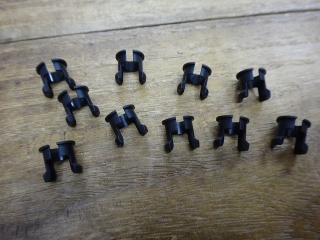
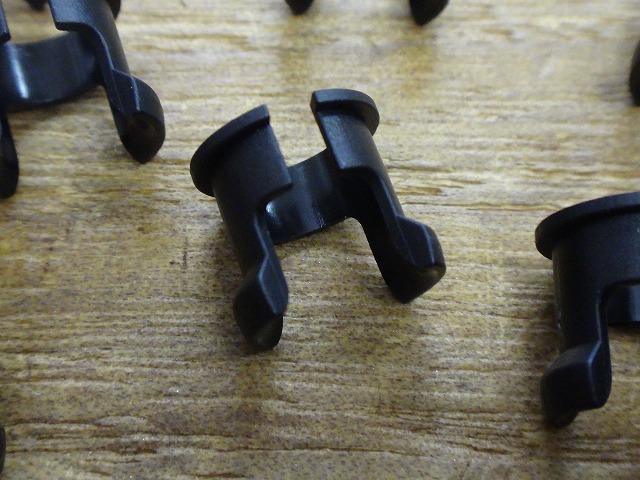
this third-generation WH-BUU002.
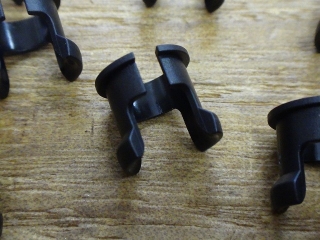
They must have really thought hard about this—it's gotten a quite elaborate design.
Instead of prongs, they've added a split.
It might just be me, but it looks exactly like the helmet of a Gemini Gold Saint from Saint Seiya.
As I always write, the fact that they changed the specification without changing the part number
is probably so they could quietly and gradually transition to the new shape.
If the part number stayed the same, you couldn't deliberately order the first or second generation designs.
This is now the third generation.

↑The image on the left shows the original two-prong design, and the right shows the second-generation pipe type,
but the third generation has become the Gemini type.
The first generation made it extremely difficult to feed the valve through,
especially with valves that didn't have threads cut into the valve body itself.
But when I thought "there's no way this is going through," and tried feeding the valve through from inside the rim...
somehow it slides through just fine. It's strange.
I've figured out the trick (it's also important to orient the prongs in the front-to-back direction of the rim),
but because it was so difficult, some people probably got frustrated and just removed it and used the wheel without it.
However, this is quite a functional component—it's not something you can just do without.
Compared to the first generation, the second generation slides in smoothly,
but there were cases where the fit was loose due to individual variations in rim holes,
and the bush would occasionally fall out after the valve was installed.
I also often saw during inspections cases where someone didn't notice the bush flew off when inserting the valve
and lost it, still using the wheel without it.
There were many examples where people had wrapped tape around the valve repeatedly as a workaround because it was lost.
With threaded valves, you can prevent loss and dropping out by tightening the valve nut.
In actual use, the second generation felt significantly better,
but without the prongs there's a possibility it could fall out, and conversely,
adding prongs makes it difficult to feed the valve through... a real dilemma.
To resolve this, a new shape was developed:

this third-generation WH-BUU002.
They must have really thought hard about this—it's gotten a quite elaborate design.
Instead of prongs, they've added a split.
It might just be me, but it looks exactly like the helmet of a Gemini Gold Saint from Saint Seiya.
As I always write, the fact that they changed the specification without changing the part number
is probably so they could quietly and gradually transition to the new shape.
If the part number stayed the same, you couldn't deliberately order the first or second generation designs.