I've been so busy lately that writing this felt like a real chore.
Below are my usual "replies to comments."
First, about the R-SYS repair.
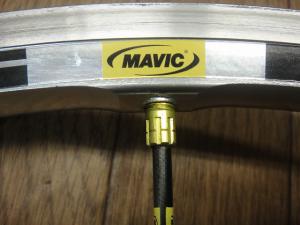
"I have the R-SYS mentioned above, but a spoke broke.
However, I don't know how to purchase spokes.
If you know,
could you please tell me?
Thank you!"
I received a comment like this.
You can buy them at any shop that handles Mavic, and
they'll repair it anywhere too.
If it's just replacing one spoke, it should take about 10 minutes.
I'm just arbitrarily raising the barrier for doing repairs elsewhere (laugh).
Next, regarding Tni carbon rim wheels
with a lineup of 18, 20, 24, and 28 holes,
someone asked if it's better to use 24 holes on the front for heavier riders.
Regarding Tni carbon rims (38 and 50), the 24H and 28H are rear-wheel only.
There's even a sticker specifying the freewheel-side orientation.
While there appear to be no spoke runout issues to the naked eye,
using them on the front wheel just doesn't feel right.
So even for a rider weighing around 85kg, you need to build the front with 20H,
but if you use CX spokes instead of CX-RAY, the rigidity feeling—or rather,
the reduced spoke deformation—changes dramatically,
so building with that specification is recommended.
Next, I received a comment suggesting that
hand-built wheels using straight-pull hubs from Novatec or DT
could be competitive with factory-built wheels.
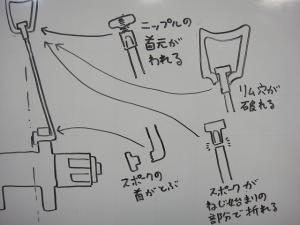
Let's consider building a wheel with normal J-bend spokes and a normal hub for them.
When nipples are tightened excessively during assembly,
the rim holes might be the first thing to fail.
Especially with carbon rims, that's likely.
But when it comes to failure cases from long-term use,
spoke neck breaks are overwhelmingly the most common.
In rare cases not shown in the diagram above, there are failures at the start of aero-butting, mid-spoke breaks, and hub flange tears.
By switching to straight-pull spokes,
you essentially eliminate the worry about spoke neck breaks
from long-term use.
At least in terms of failure cases, they're stronger than the nipple side,
so you can build wheels more confidently than with conventional J-bend spokes.
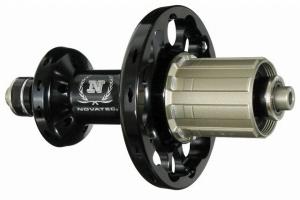
↑For example, Novatec has hubs like this.
Super high-low flange, right?
This is what I unofficially consider to be
the level of high-low flange where "even radial lacing on the non-freewheel side is acceptable."
If this were, say, 20H, the freewheel side would be 10H in 3-cross lacing,
but since the naming gets confusing, I call it "2-cross,"
which was the content of my last post on phase theory, part 3.
2-cross is equivalent to 4-cross on normal hubs, so
a wheel built with this hub becomes equivalent to 4-0 lacing.
But whether that actually produces a better wheel
is something I have doubts about.
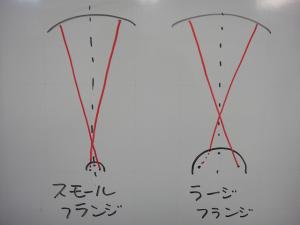
The smaller the non-freewheel-side flange becomes,
the less meaningful tangent lacing becomes.
As the small flange gets smaller, the spoke angle
approaches that of radial lacing.
But it's not pointless to do it.
If you lace 20 spokes (I avoid the "20H" expression because some hubs are 1H-2-spoke)
on the rear wheel's non-freewheel side in 2-cross, or 3-cross for 24H,
you can further reduce left-right tension differences.
Though when I say tension difference reduction, the freewheel side doesn't become more even—
only the non-freewheel side gets higher tension,
so it's simply a rigidity increase.
But with that Novatec hub,
it won't let you lace the non-freewheel side in anything other than radial.
The Tni AL300, which is the rim for Nomu Lab Wheel #1, is
about the same rim weight as Fulcrum Racing 3,
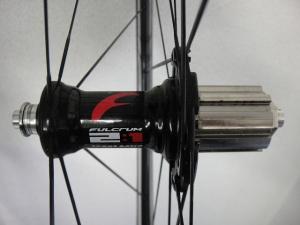
but Fulcrum also has similar hub dimensions plus a 2:1 spoke count ratio.
In other words, building a wheel with that Novatec hub
would essentially just result in a degraded Racing 3, I suspect.
In that case, it's better to recommend Racing 3 to customers.
Also, rather than using a super high-low flange hub that only allows 4-0 equivalent lacing,
it seems better to build 4-4 or 4-6 lacing with a Tni Evolution hub.
(Even if you end up using J-bend spokes.)
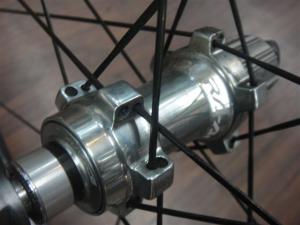
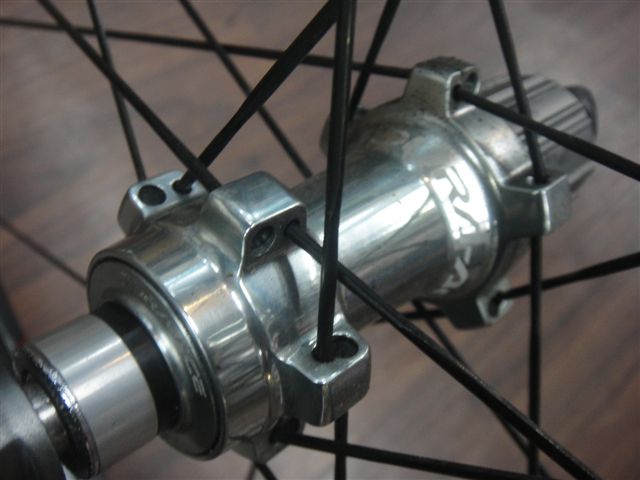
↑Or suppose you acquired a hub like this.
This is 20 spokes with 2-cross on both sides,
but if it were 24 spokes and it were possible to do 3-cross on the non-freewheel side only,
you'd get a wheel equivalent to 4-6 lacing.
However, the directionality of the spoke head portion is extremely limited,
so even if this were 12H (24 spokes),
you couldn't build it in 3-cross (4-spoke for 12H).
Straight-pull spoke hubs have limited building methods, so
you can't change wheel characteristics at all based on how you lace them.
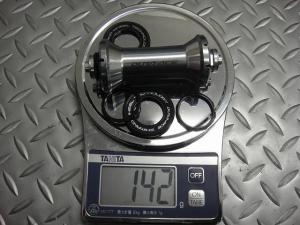
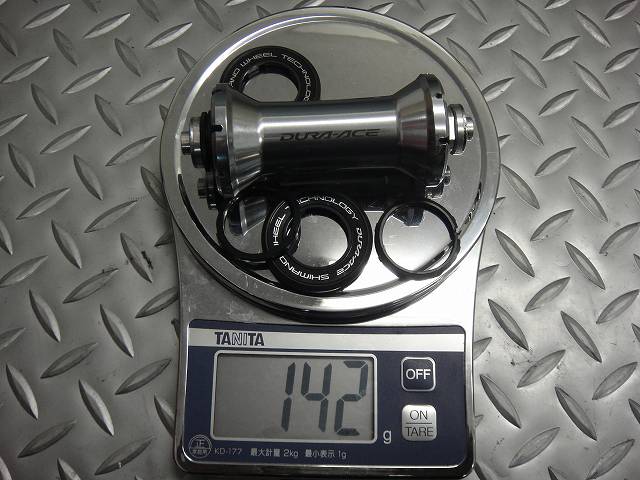
So what about front hubs?
You can only do radial lacing, but that shouldn't cause any problems.
As for DT and Sapim straight-spoke availability through domestic distributors,
DT has none, and Sapim only carries round plain "Leader" and round-butted "Race,"
but they don't handle the critical CX-RAY straight.
So even if straight-pull spoke hubs were stably supplied,
it's essentially impossible to build an attractive front wheel.
Building a front wheel with straight-pull Race spokes is
worse than building with J-bend CX-RAY spokes.
So for wheels built with straight steel spokes,
for light perimeter, buy Shimano C24; for left-right balance, Racing 3;
for firm, snappy feel focused on vertical stiffness, buy Ksilium Elite.
Next.
I received a comment from someone using 26-inch tubular wheels
asking if there's any rim that's being stably supplied.
Colima has never dropped 26-inch tubular rims from their lineup,
but they're unsuitable for regular use. The internal nipples make daily maintenance inconvenient.
Until recently, you could get Niji Corsa Bambino or Araya R-50,
but...
Currently I have no leads. Sorry I can't be more helpful.
Below are my usual "replies to comments."
First, about the R-SYS repair.
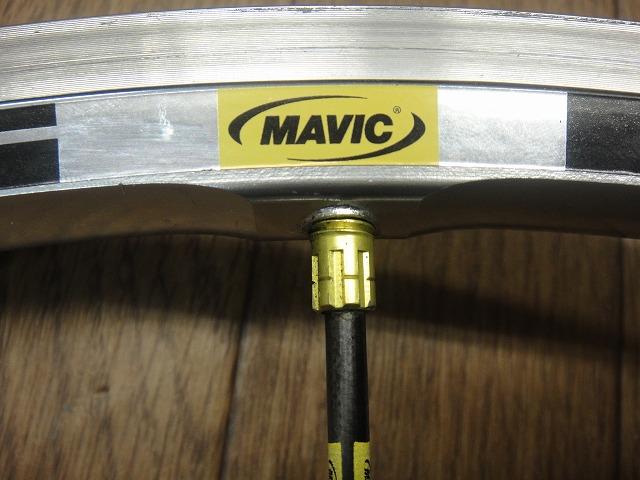
"I have the R-SYS mentioned above, but a spoke broke.
However, I don't know how to purchase spokes.
If you know,
could you please tell me?
Thank you!"
I received a comment like this.
You can buy them at any shop that handles Mavic, and
they'll repair it anywhere too.
If it's just replacing one spoke, it should take about 10 minutes.
I'm just arbitrarily raising the barrier for doing repairs elsewhere (laugh).
Next, regarding Tni carbon rim wheels
with a lineup of 18, 20, 24, and 28 holes,
someone asked if it's better to use 24 holes on the front for heavier riders.
Regarding Tni carbon rims (38 and 50), the 24H and 28H are rear-wheel only.
There's even a sticker specifying the freewheel-side orientation.
While there appear to be no spoke runout issues to the naked eye,
using them on the front wheel just doesn't feel right.
So even for a rider weighing around 85kg, you need to build the front with 20H,
but if you use CX spokes instead of CX-RAY, the rigidity feeling—or rather,
the reduced spoke deformation—changes dramatically,
so building with that specification is recommended.
Next, I received a comment suggesting that
hand-built wheels using straight-pull hubs from Novatec or DT
could be competitive with factory-built wheels.
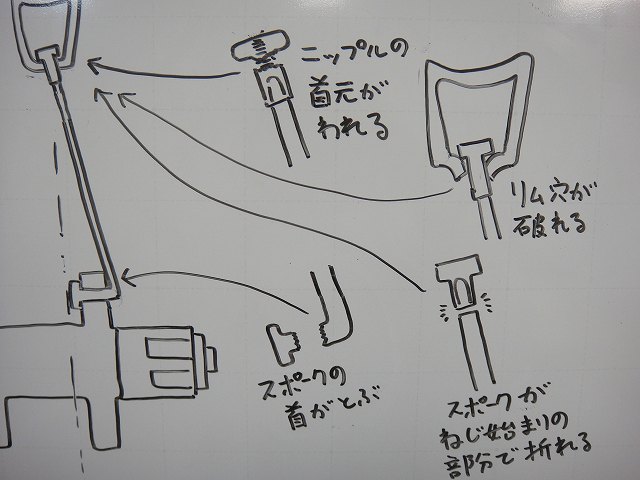
Let's consider building a wheel with normal J-bend spokes and a normal hub for them.
When nipples are tightened excessively during assembly,
the rim holes might be the first thing to fail.
Especially with carbon rims, that's likely.
But when it comes to failure cases from long-term use,
spoke neck breaks are overwhelmingly the most common.
In rare cases not shown in the diagram above, there are failures at the start of aero-butting, mid-spoke breaks, and hub flange tears.
By switching to straight-pull spokes,
you essentially eliminate the worry about spoke neck breaks
from long-term use.
At least in terms of failure cases, they're stronger than the nipple side,
so you can build wheels more confidently than with conventional J-bend spokes.
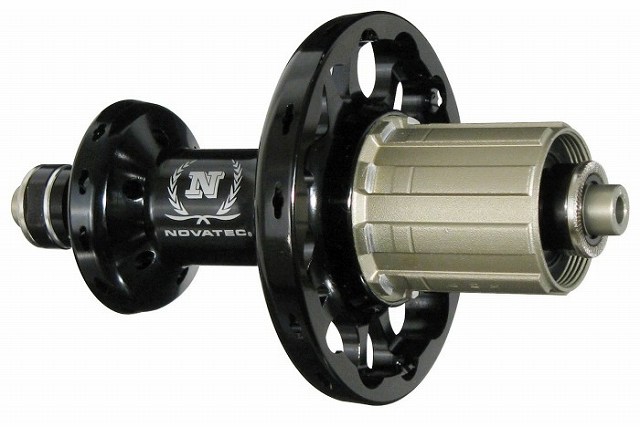
↑For example, Novatec has hubs like this.
Super high-low flange, right?
This is what I unofficially consider to be
the level of high-low flange where "even radial lacing on the non-freewheel side is acceptable."
If this were, say, 20H, the freewheel side would be 10H in 3-cross lacing,
but since the naming gets confusing, I call it "2-cross,"
which was the content of my last post on phase theory, part 3.
2-cross is equivalent to 4-cross on normal hubs, so
a wheel built with this hub becomes equivalent to 4-0 lacing.
But whether that actually produces a better wheel
is something I have doubts about.
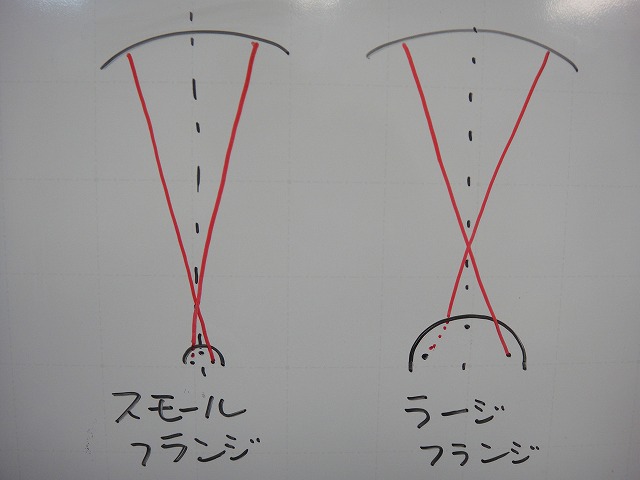
The smaller the non-freewheel-side flange becomes,
the less meaningful tangent lacing becomes.
As the small flange gets smaller, the spoke angle
approaches that of radial lacing.
But it's not pointless to do it.
If you lace 20 spokes (I avoid the "20H" expression because some hubs are 1H-2-spoke)
on the rear wheel's non-freewheel side in 2-cross, or 3-cross for 24H,
you can further reduce left-right tension differences.
Though when I say tension difference reduction, the freewheel side doesn't become more even—
only the non-freewheel side gets higher tension,
so it's simply a rigidity increase.
But with that Novatec hub,
it won't let you lace the non-freewheel side in anything other than radial.
The Tni AL300, which is the rim for Nomu Lab Wheel #1, is
about the same rim weight as Fulcrum Racing 3,
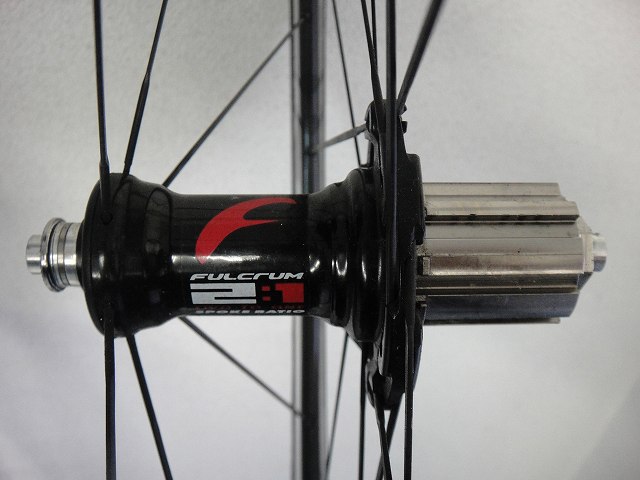
but Fulcrum also has similar hub dimensions plus a 2:1 spoke count ratio.
In other words, building a wheel with that Novatec hub
would essentially just result in a degraded Racing 3, I suspect.
In that case, it's better to recommend Racing 3 to customers.
Also, rather than using a super high-low flange hub that only allows 4-0 equivalent lacing,
it seems better to build 4-4 or 4-6 lacing with a Tni Evolution hub.
(Even if you end up using J-bend spokes.)
↑Or suppose you acquired a hub like this.
This is 20 spokes with 2-cross on both sides,
but if it were 24 spokes and it were possible to do 3-cross on the non-freewheel side only,
you'd get a wheel equivalent to 4-6 lacing.
However, the directionality of the spoke head portion is extremely limited,
so even if this were 12H (24 spokes),
you couldn't build it in 3-cross (4-spoke for 12H).
Straight-pull spoke hubs have limited building methods, so
you can't change wheel characteristics at all based on how you lace them.
So what about front hubs?
You can only do radial lacing, but that shouldn't cause any problems.
As for DT and Sapim straight-spoke availability through domestic distributors,
DT has none, and Sapim only carries round plain "Leader" and round-butted "Race,"
but they don't handle the critical CX-RAY straight.
So even if straight-pull spoke hubs were stably supplied,
it's essentially impossible to build an attractive front wheel.
Building a front wheel with straight-pull Race spokes is
worse than building with J-bend CX-RAY spokes.
So for wheels built with straight steel spokes,
for light perimeter, buy Shimano C24; for left-right balance, Racing 3;
for firm, snappy feel focused on vertical stiffness, buy Ksilium Elite.
Next.
I received a comment from someone using 26-inch tubular wheels
asking if there's any rim that's being stably supplied.
Colima has never dropped 26-inch tubular rims from their lineup,
but they're unsuitable for regular use. The internal nipples make daily maintenance inconvenient.
Until recently, you could get Niji Corsa Bambino or Araya R-50,
but...
Currently I have no leads. Sorry I can't be more helpful.