Another day of wheel building (and so on).
Today I rebuilt Reynolds DV46UL wheels.
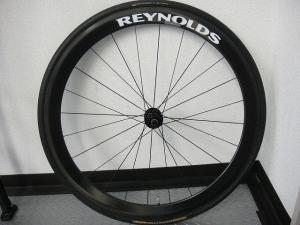
↑Before rebuild
I rebuilt MV32UL wheels the other day, but this is a different customer.
What's the same is that they wanted "freewheel side Campagnolo, non-freewheel side CX-RAY, 46-spoke laced and soldered construction," and since they came from another prefecture, I did an impromptu rebuild.

Before the rebuild, the configuration was freewheel side Campagnolo and non-freewheel side Aero Lite.
I often get asked "Why use CX-RAY instead of Aero Lite?" so let me explain.
Sapim CX-RAY is handled domestically at lengths up to 304mm, and they stock it in 2mm increments without any trouble building 700C wheels from that range.
The CX-RAY can easily be cut 8mm with a spoke cutter, but I've made my own rule to "only cut up to 6mm."
This means that according to my shop's internal standards, if I stock spokes in 6mm increments, I'm covered for every spoke length I need.
For example, say I need 274mm—as long as I or the wholesaler have stock of 280mm, 278mm, or 276mm in addition to 274mm, there's no problem.
The Sapim wholesaler doesn't have perfect stock, but they've never left a gap in the lengths I actually need.
I also do my best to be prepared for walk-in and impromptu wheel builds on my end.
With DT's Aero Lite, though, the domestically available lengths for both silver and black are only four types: 270mm, 280mm, 290mm, and 300mm.
The Aero Lite can be cut about 10mm, so this distribution assumes shops have a spoke cutter.
Say I need 274mm.
If stock of 280mm runs out, I'm stuck.
I can't make 274mm from 290mm.
In reality, stock-outs happen frequently, so I don't keep them in regular inventory.
Also, if I cut from 270mm, I can't build for rims like 80mm-height ones.
(Those need around 250mm or so)
Radial lacing on the non-freewheel side of low-profile rims sometimes needs just over 300mm, and that won't work either.
DT as a manufacturer naturally offers finer increments.
Basically, it depends on the wholesaler's commitment.
Getting back to Reynolds, the non-freewheel side radial lacing usually has pretty mushy spoke tension, but this rebuild before was relatively decent.
The different-diameter spoke specifications might be helping.
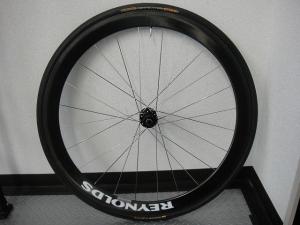
Rebuilt.
I fumbled a bit during the initial build, so it took a little longer.
(I realized I'd miscalculated the spoke length after I'd already started building)
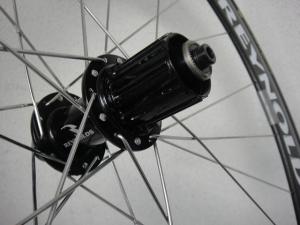
I soldered the lacing, but before that I had the customer verify the improved tension on the non-freewheel side.
We went from 40-spoke to 46-spoke lacing, and there's the benefit of maintaining the same freewheel-side tension while improving non-freewheel-side tension, balanced against the weight penalty from the extra total spoke length and the aerodynamic disadvantage that tangential lacing disturbs the air more than radial lacing.
When you weigh all that together, you prioritize what you can "feel while riding" and downplay what you can't.
Can you actually feel the weight increase and aero penalty from non-freewheel-side tangential lacing? That's debatable. But the improvement in non-freewheel-side spoke tension is something you feel when you ride.
Sometimes I get comments like "Are you just trying to trash other shops' or manufacturers' wheels and claim yours are better?" but this isn't because I built it—it's just physics.
To prove that, I've disclosed about 90% of my wheel-building method here, leaving out the trade secrets.
Readers who build their own wheels have actually sent me reports confirming the results through their own builds.
(There are a few, and I'm always really grateful—you teach me a lot.)
If you have a truing stand at home, give it a try sometime.
If you don't have one, or if it seems better to have my shop build your wheels, we'd be happy to take them. We'll do our best.
Today I rebuilt Reynolds DV46UL wheels.
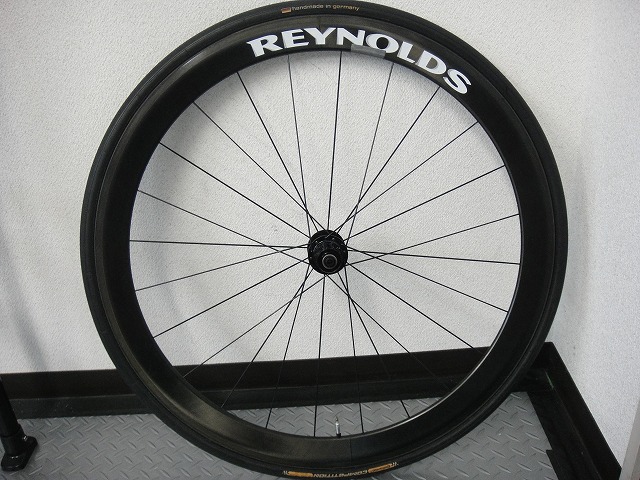
↑Before rebuild
I rebuilt MV32UL wheels the other day, but this is a different customer.
What's the same is that they wanted "freewheel side Campagnolo, non-freewheel side CX-RAY, 46-spoke laced and soldered construction," and since they came from another prefecture, I did an impromptu rebuild.
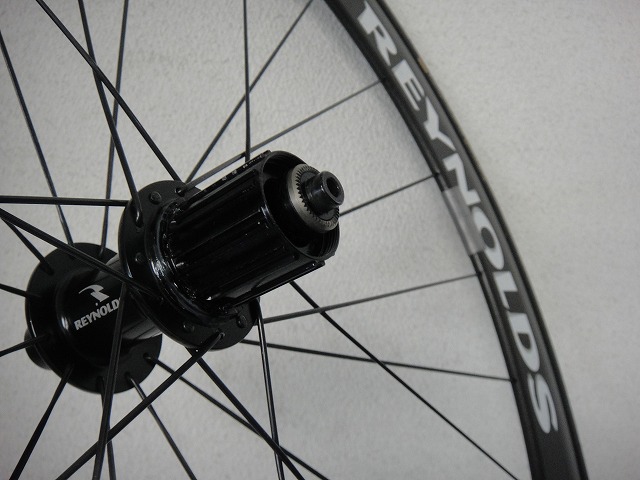
Before the rebuild, the configuration was freewheel side Campagnolo and non-freewheel side Aero Lite.
I often get asked "Why use CX-RAY instead of Aero Lite?" so let me explain.
Sapim CX-RAY is handled domestically at lengths up to 304mm, and they stock it in 2mm increments without any trouble building 700C wheels from that range.
The CX-RAY can easily be cut 8mm with a spoke cutter, but I've made my own rule to "only cut up to 6mm."
This means that according to my shop's internal standards, if I stock spokes in 6mm increments, I'm covered for every spoke length I need.
For example, say I need 274mm—as long as I or the wholesaler have stock of 280mm, 278mm, or 276mm in addition to 274mm, there's no problem.
The Sapim wholesaler doesn't have perfect stock, but they've never left a gap in the lengths I actually need.
I also do my best to be prepared for walk-in and impromptu wheel builds on my end.
With DT's Aero Lite, though, the domestically available lengths for both silver and black are only four types: 270mm, 280mm, 290mm, and 300mm.
The Aero Lite can be cut about 10mm, so this distribution assumes shops have a spoke cutter.
Say I need 274mm.
If stock of 280mm runs out, I'm stuck.
I can't make 274mm from 290mm.
In reality, stock-outs happen frequently, so I don't keep them in regular inventory.
Also, if I cut from 270mm, I can't build for rims like 80mm-height ones.
(Those need around 250mm or so)
Radial lacing on the non-freewheel side of low-profile rims sometimes needs just over 300mm, and that won't work either.
DT as a manufacturer naturally offers finer increments.
Basically, it depends on the wholesaler's commitment.
Getting back to Reynolds, the non-freewheel side radial lacing usually has pretty mushy spoke tension, but this rebuild before was relatively decent.
The different-diameter spoke specifications might be helping.
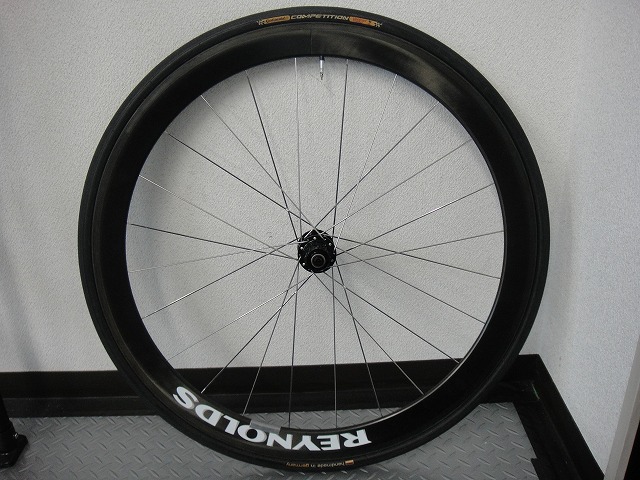
Rebuilt.
I fumbled a bit during the initial build, so it took a little longer.
(I realized I'd miscalculated the spoke length after I'd already started building)
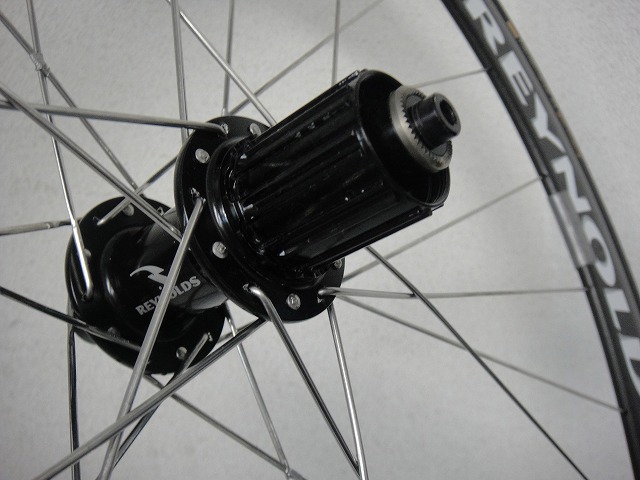
I soldered the lacing, but before that I had the customer verify the improved tension on the non-freewheel side.
We went from 40-spoke to 46-spoke lacing, and there's the benefit of maintaining the same freewheel-side tension while improving non-freewheel-side tension, balanced against the weight penalty from the extra total spoke length and the aerodynamic disadvantage that tangential lacing disturbs the air more than radial lacing.
When you weigh all that together, you prioritize what you can "feel while riding" and downplay what you can't.
Can you actually feel the weight increase and aero penalty from non-freewheel-side tangential lacing? That's debatable. But the improvement in non-freewheel-side spoke tension is something you feel when you ride.
Sometimes I get comments like "Are you just trying to trash other shops' or manufacturers' wheels and claim yours are better?" but this isn't because I built it—it's just physics.
To prove that, I've disclosed about 90% of my wheel-building method here, leaving out the trade secrets.
Readers who build their own wheels have actually sent me reports confirming the results through their own builds.
(There are a few, and I'm always really grateful—you teach me a lot.)
If you have a truing stand at home, give it a try sometime.
If you don't have one, or if it seems better to have my shop build your wheels, we'd be happy to take them. We'll do our best.