I got an order for a Fulcrum Racing ZERO and sold it.
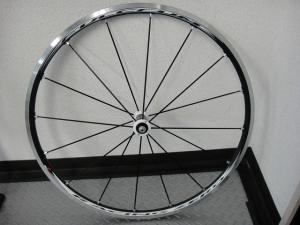
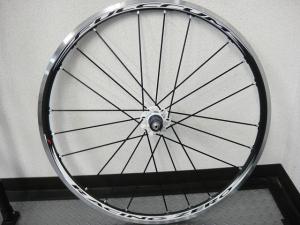
Tubular specification.
With an aluminum rim and steel spokes, no matter how much you increase the spoke tension, you can't reach this kind of vertical stiffness.
Whether that translates directly to how it rides depends entirely on the rider's ability.
The trend is that the stronger riders complain about how "stiff" it is.
This extreme stiffness as a characteristic can become an unmatched wheel if it matches the terrain gradient where it's used, the riding distance, and the rider's leg characteristics.
A certain athlete I know has the original Racing 1 WO, but uses Nomu Lab Wheel #1 regularly.
But they're not dividing them up where training equals Nomu Lab #1 and racing equals Racing 1.
Even in races, when it becomes longer distance and longer duration, the Racing 1 "gets to their legs," so they use Nomu Lab #1 in situations like that.
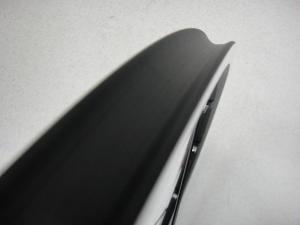
The rim profile is fairly deep.
Like a disc wheel, there are no holes except the valve hole, so the gluing surface area is large and the tire should stick more securely.
For the pre-sale inspection, the centering was spot on.
The runout was minimal enough I didn't need to touch it, but I made a slight adjustment anyway.
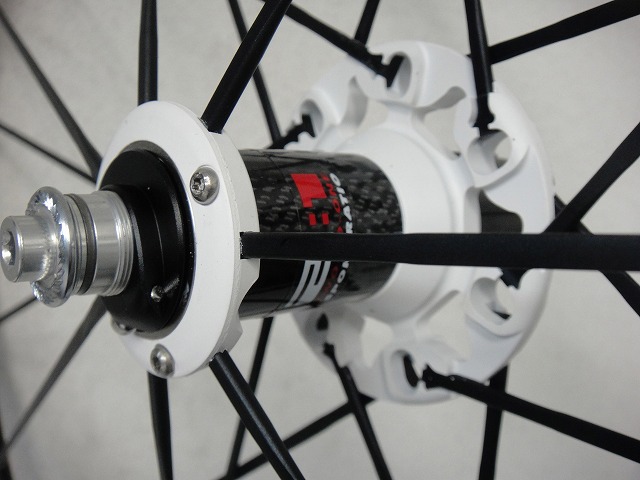
The rear hub rotation was slightly stiff, so I made it a bit loose, but if I made it too loose bearing play would develop. Even without that, Campagnolo Fulcrum's high-end models have retained ball bearings that tend to develop play within 500 km of riding when brand new (on the other hand, they break in and become lighter to rotate), so it's good to check them frequently for the first one to three months after purchase.
This time, there was no issue with selling it right off the shelf, but you can't know if there's an issue without looking, so a complete inspection is necessary.
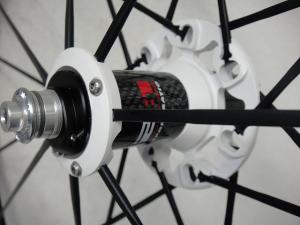
Amazing.
Not long ago, I received a comment saying "I can now 'read wheels by looking at them'" after reading this blog.
Wheels he had casually owned before—the Zonda 2 WAY-FIT and ZIPP 404—he can now "read by looking at" things like flange width and spoke lacing, and as a result he's now able to explain all the various things he'd been thinking about regarding actual usability.
The comment also mentioned "not buying a ○○○○ (I'll spare the name) wheel just because of the price turned out to be the right choice."
Looking at wheels without colored glasses is extremely important.
I can't design and actually make hubs however I like, so I can only find "the optimal solution with limitations" from commercially available materials. But manufacturers of complete wheels can do whatever they want with materials and design.
For example (hypothetically), say there are two wheels where the ratio of freewheel-side to non-freewheel-side spoke count is 2:1.
One has equal diameter flanges on both sides with the freewheel side having equivalent coaxial flange reverse Italian lacing, and the other is ultra high-low flange with the freewheel side having equivalent coaxial flange Italian lacing.
Which would you consider the superior wheel?
If the rim weight is the same, it would almost certainly be the latter.
Well, that's just hypothetically speaking (←how many times am I gonna say this?).
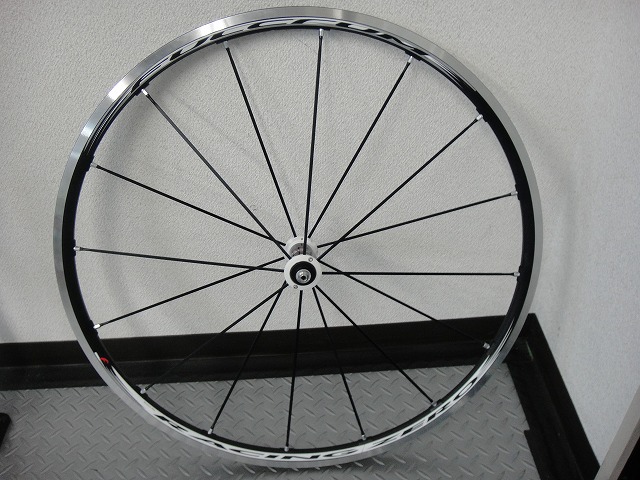
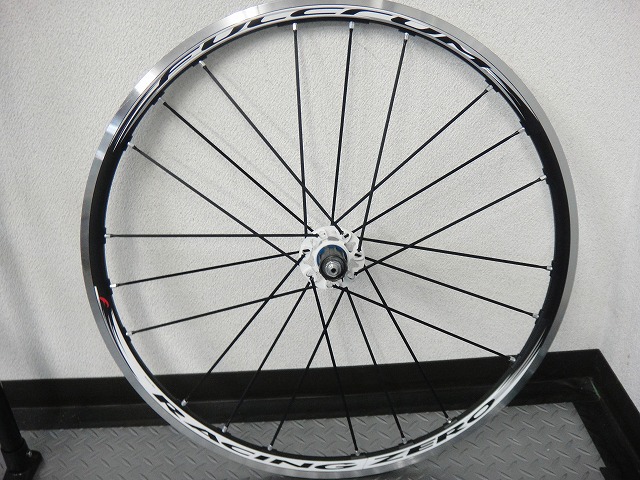
Tubular specification.
With an aluminum rim and steel spokes, no matter how much you increase the spoke tension, you can't reach this kind of vertical stiffness.
Whether that translates directly to how it rides depends entirely on the rider's ability.
The trend is that the stronger riders complain about how "stiff" it is.
This extreme stiffness as a characteristic can become an unmatched wheel if it matches the terrain gradient where it's used, the riding distance, and the rider's leg characteristics.
A certain athlete I know has the original Racing 1 WO, but uses Nomu Lab Wheel #1 regularly.
But they're not dividing them up where training equals Nomu Lab #1 and racing equals Racing 1.
Even in races, when it becomes longer distance and longer duration, the Racing 1 "gets to their legs," so they use Nomu Lab #1 in situations like that.
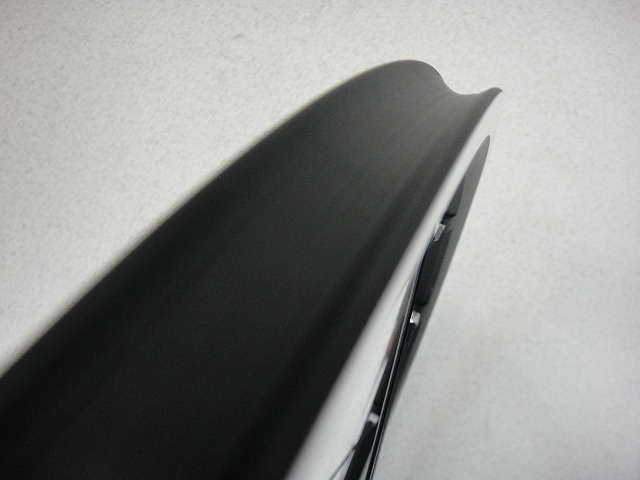
The rim profile is fairly deep.
Like a disc wheel, there are no holes except the valve hole, so the gluing surface area is large and the tire should stick more securely.
For the pre-sale inspection, the centering was spot on.
The runout was minimal enough I didn't need to touch it, but I made a slight adjustment anyway.
The rear hub rotation was slightly stiff, so I made it a bit loose, but if I made it too loose bearing play would develop. Even without that, Campagnolo Fulcrum's high-end models have retained ball bearings that tend to develop play within 500 km of riding when brand new (on the other hand, they break in and become lighter to rotate), so it's good to check them frequently for the first one to three months after purchase.
This time, there was no issue with selling it right off the shelf, but you can't know if there's an issue without looking, so a complete inspection is necessary.
Amazing.
Not long ago, I received a comment saying "I can now 'read wheels by looking at them'" after reading this blog.
Wheels he had casually owned before—the Zonda 2 WAY-FIT and ZIPP 404—he can now "read by looking at" things like flange width and spoke lacing, and as a result he's now able to explain all the various things he'd been thinking about regarding actual usability.
The comment also mentioned "not buying a ○○○○ (I'll spare the name) wheel just because of the price turned out to be the right choice."
Looking at wheels without colored glasses is extremely important.
I can't design and actually make hubs however I like, so I can only find "the optimal solution with limitations" from commercially available materials. But manufacturers of complete wheels can do whatever they want with materials and design.
For example (hypothetically), say there are two wheels where the ratio of freewheel-side to non-freewheel-side spoke count is 2:1.
One has equal diameter flanges on both sides with the freewheel side having equivalent coaxial flange reverse Italian lacing, and the other is ultra high-low flange with the freewheel side having equivalent coaxial flange Italian lacing.
Which would you consider the superior wheel?
If the rim weight is the same, it would almost certainly be the latter.
Well, that's just hypothetically speaking (←how many times am I gonna say this?).