Regarding the Polar V800 2,
I've done more research and have some additional findings to share.
First, I've confirmed that you cannot disable (or stop using) the activity tracking function.
Even if the device sits completely still on a desk all day without moving,
an estimated basal metabolic rate is "deducted every day."
What I mean is,
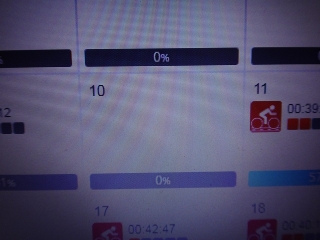
I selected a day when I wasn't using it at all and didn't move it,
and looked at the details.
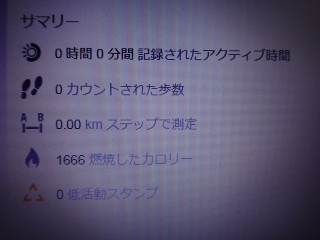
The manually recorded exercise time is zero,
and the step count recorded is also zero,
but the estimated 24-hour calorie burn is 1666 kcal.
This estimated calorie burn is automatically calculated from my profile—
height, weight, age, and gender.
On completely unused days, this 1666 kcal figure
was consistently the same with no exceptions
(if I changed my profile, this estimated value would change).
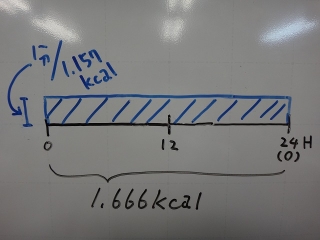
So here's what's happening.
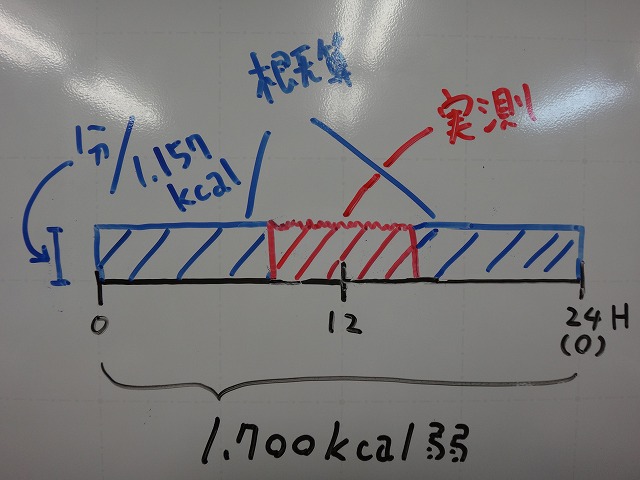
Since 24 hours = 1440 minutes and 1666 kcal,
the calorie burn per minute is 1.157 kcal.
Now, let's say on this particular day I wore the heart rate sensor for just 6 hours
and measured exercise time, and though it was labeled "exercise," I maintained a resting heart rate.
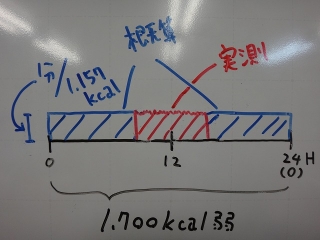
For only 6 hours of the 24-hour period, the calorie burn would be measured (calculated from heart rate data).
If Polar's estimation is accurate, the measured resting value and
the estimated value shouldn't differ much,
so the day's total calorie burn should come to around 1700 kcal.
And further, if during those 6 hours I wore the heart rate sensor while doing
workout-level training at roughly 11 kcal per minute,
and the measured calorie burn during that time was 4000 kcal,
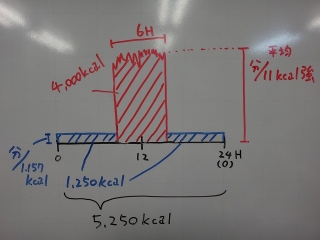
it would look like this.
With traditional sports heart rate monitor functions alone,
only the red portion in the figure above—
the "measured calorie burn during manual recording"—would have been logged.
But with the V800 2, even during periods when I'm not measuring,
or when I'm not wearing it on my wrist,
the estimated basal metabolic rate is automatically added
in the analysis software (Polar Flow).
In my case, the estimated basal metabolic rate is 1.157 kcal per minute, so
for the 18 hours when the device wasn't being used, that's 1250 kcal. And since
the 4000 kcal measured during exercise includes the measured basal metabolic rate,
adding these two together gives a total calorie burn of 5250 kcal.
Furthermore, there's another element not yet included:
"estimated exercise calorie burn from accelerometer activation."
The device automatically generates another unnecessary estimate:
for both the measured calorie burn during exercise recording and
the estimated calorie burn from accelerometer motion,
it calculates "if this were walking, how many steps would it be."
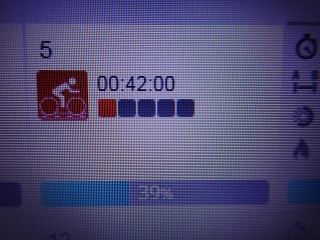
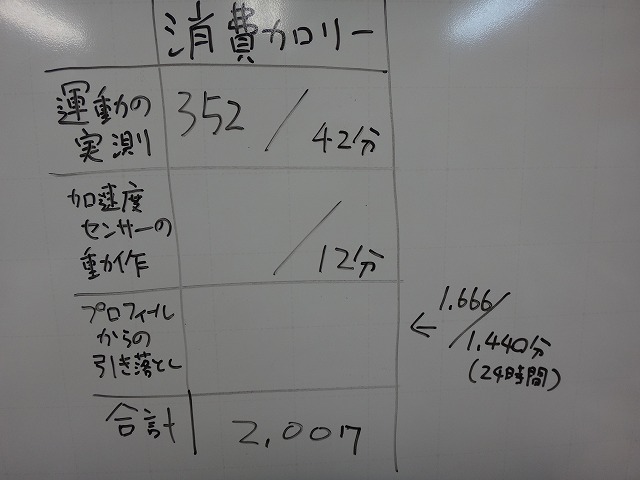
I found a day where the seconds digit of the manual exercise time
was at 00 seconds.
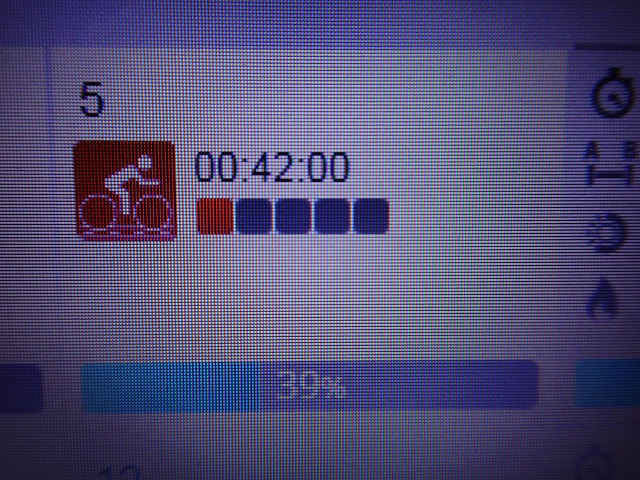
This means the exercise time measured with the heart rate sensor was exactly 42 minutes.
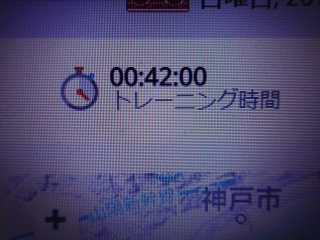
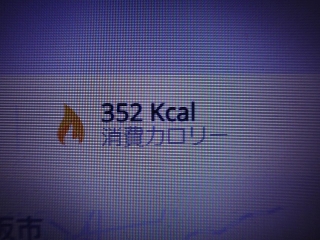
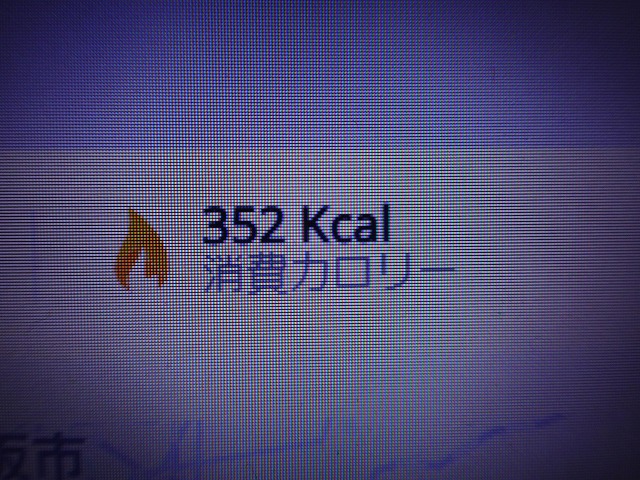
352 kcal in 42 minutes, so that's 8.38 kcal per minute.
It's under 10 because it was a leisurely-paced commute home.

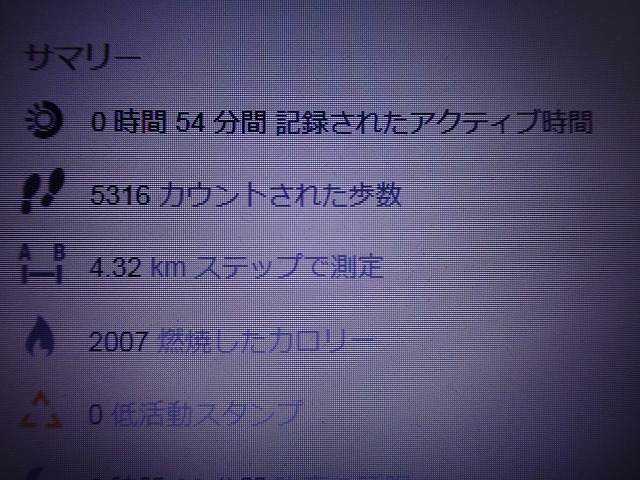
Looking at that day's analysis results:
Although the manual measurement time was 42 minutes,
the recorded active time is 54 minutes.
Those extra 12 minutes come from when the accelerometer was active
outside of my manual measurement time.
Under normal use, this would be time spent on the wrist without the heart rate sensor,
but in my case it's time when I carried my road bike from the entrance,
or time when I rode for errands to the post office or convenience store
(mostly the latter).
Adding together the measured data from heart rate sensor wear, the estimate from the accelerometer, and
the estimated basal metabolic rate from my profile,
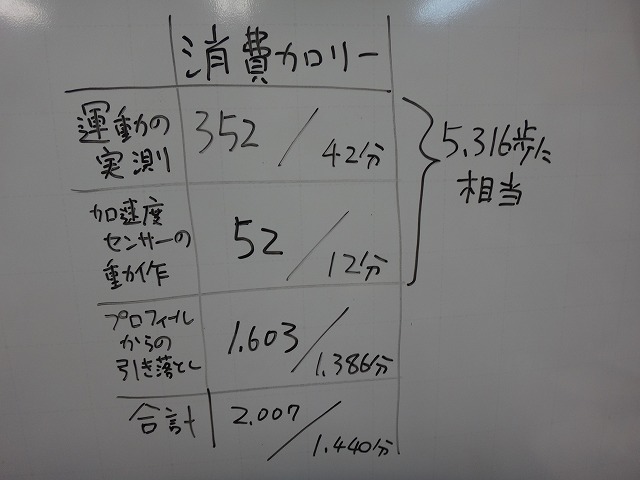
that day's total calorie burn came to 2007 kcal.

Plugging in the known information,
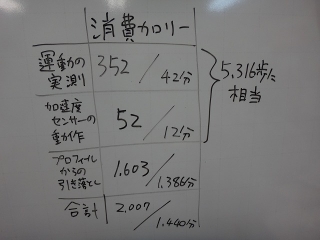
the remainder comes out like this.
And the device automatically calculates what both of those calorie burns
would equal in walking steps.
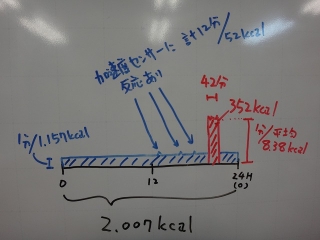
Expressed in the figure from earlier, it looks like this.
What matters to me is only the red portion—the manual measurement—and
I have no current need for the activity tracking function.
If that 42-minute manual measurement represented some meaningful training content,
I write down the key points in my training log (called "wagasogisou").
Polar Flow's analysis includes the blue portions,
but in my usage pattern, this is just noise.
That said, although I've never made active use of it,
if I were to wear the V800 2 on my wrist for 24 hours
without the heart rate sensor and without any manual measurement,
the estimated step count should differ very little from actual steps,
and the estimated calorie burn based on accelerometer data should be
quite accurate. That's what an activity tracker is, after all.
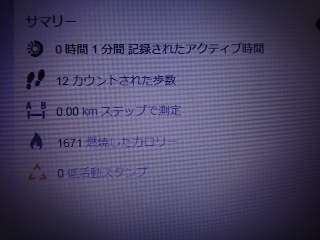
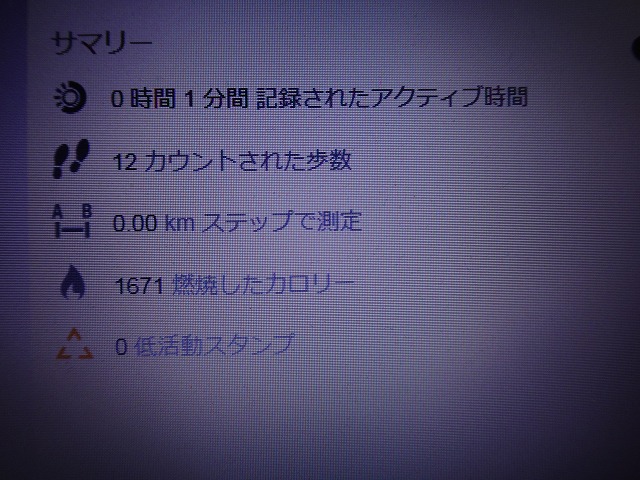
↑This is a record from a different day, but
I wasn't using the V800 2 that day either.
However, the accelerometer detected when I removed it from the handlebar mount
and carried it to the computer for charging.
It recorded 12 steps in 1 minute and 5 kcal of calorie burn separate from basal metabolism.
This is so annoying.
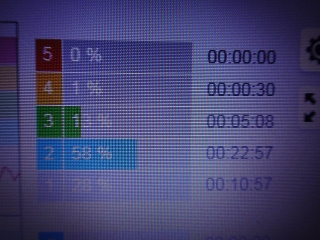
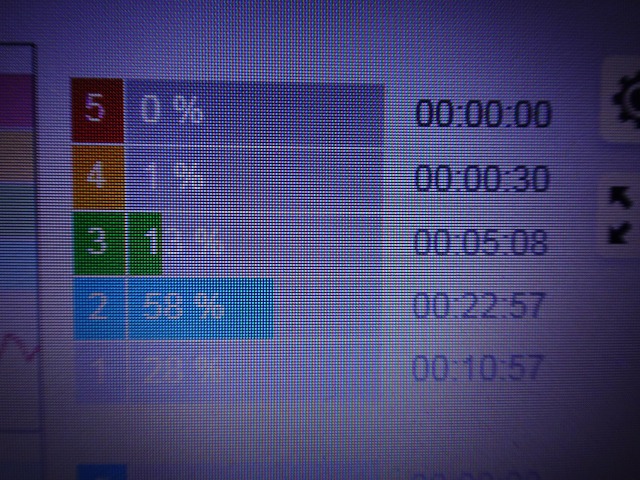
Here's the breakdown of that 42-minute manual measurement by heart rate zone.
Even when added up, there are only 39 minutes 32 seconds,
because there was 2 minutes 28 seconds when my heart rate was below
Zone 1 (50-59% of max heart rate).
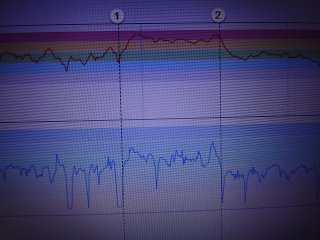
This is a different workout, a fairly hard flat-road effort.
The graph shows heart rate on top and speed on the bottom.
Lap 2 starts from a traffic light with a standing start,
and the dip in speed partway through was when I thought I'd hit a red light
but it turned green and I could proceed. When I break out just Lap 2 by zone,
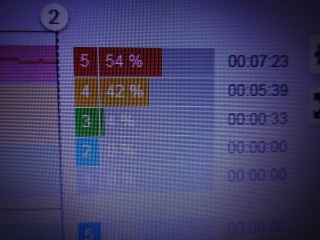
it looks like this.
Since this segment is a time trial target, I note it in my training log
on days when I push hard.
Now, about the V800 2's interval timer.
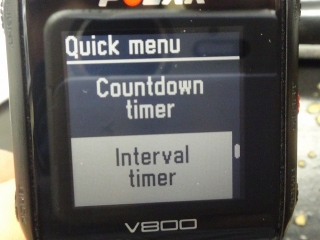
Actually, the V800 2 does have an interval timer.
For example, when doing single-leg pedaling on a 3-roller trainer,
alternating legs: right leg 1 minute → 10 second rest (switch legs) → left leg 1 minute → 10 second rest (switch legs) → ...
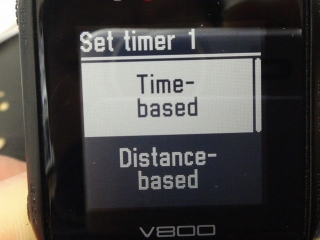
You can set Timer 1 and Timer 2 individually
on either a time or distance basis.
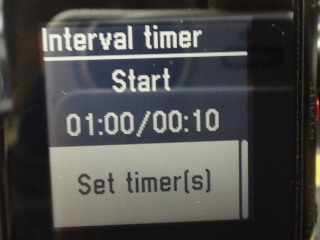
I set Timer 1 to time-based 1 minute and Timer 2 to time-based 10 seconds.
For running, this feature might be useful: set Timer 1 to distance-based 400m (sprint)
and Timer 2 to time-based 30 seconds (rest),
mixing distance and time basis in this way.
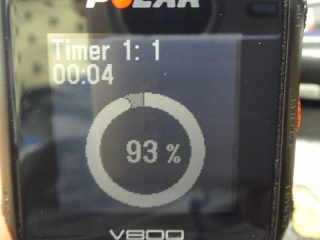
So I activated the interval timer.
The "Timer 1: 1" shown at the top means
this is the 1st repetition of Timer 1. So
Timer 1: 1 – right leg 1 minute
Timer 2: 1 – rest
Timer 1: 2 – left leg 1 minute
Timer 2: 2 – rest
and so on. However, Polar and Pioneer differ in
whether the interval timer interacts with the main workout recording,
and in Polar's case, this is inconvenient for me.
Here's what I mean:
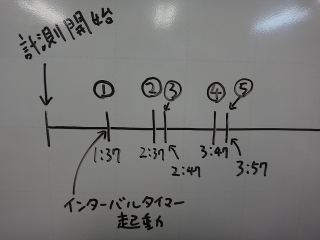
If I started a workout and then, separately, activated the interval timer,
happening to do so 1 minute 37 seconds after starting the workout,
the time up to that point is "automatically" recorded as Lap 1.
Then 1 minute later, Timer 1: 1 is recorded as Lap 2 at 2:37,
then 10 seconds later, Timer 2: 1 is recorded as Lap 3 at 2:47,
then 1 minute later, Timer 1: 2 is recorded as Lap 4 at 3:47,
then 10 seconds later, Timer 2: 2 is recorded as Lap 5 at 3:57
—all automatically.
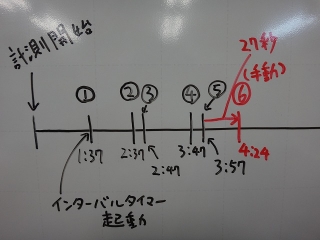
Then Timer 1: 3 continues running, but if I happen to press the lap button
manually 27 seconds into it,
4:24 is recorded as Lap 6 (27 seconds), and
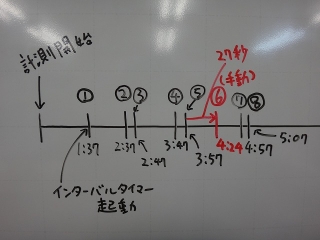
33 seconds later, Timer 1: 3 completes and is recorded as Lap 7 (33 seconds).
My point is that Polar's interval timer automatically interferes with
the main workout lap times.
I find this very confusing and inconvenient.
The countdown timer, while it doesn't show repetition counts,
doesn't automatically record laps when repeating, so
"set the timer to 70 seconds, and switch legs before it counts down to 60 seconds remaining"
is easier to use than the interval timer.
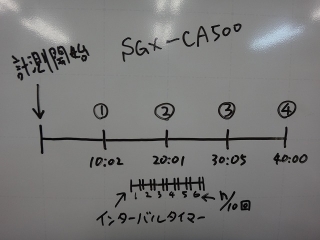
With Pioneer's SGX-CA500, the interval timer doesn't interact with
the main workout recording (workout time or manually recorded lap times).
For example, you can manually record laps roughly every 10 minutes while
separately using the interval timer for single-leg pedaling whenever you want,
and since they're independent, unwanted lap times won't be
recorded automatically.
Polar does make heart rate monitors without the activity tracking function—
the V650 and M460. The reason is straightforward:
they're not wrist watches, they're cycling computers.
I've done more research and have some additional findings to share.
First, I've confirmed that you cannot disable (or stop using) the activity tracking function.
Even if the device sits completely still on a desk all day without moving,
an estimated basal metabolic rate is "deducted every day."
What I mean is,
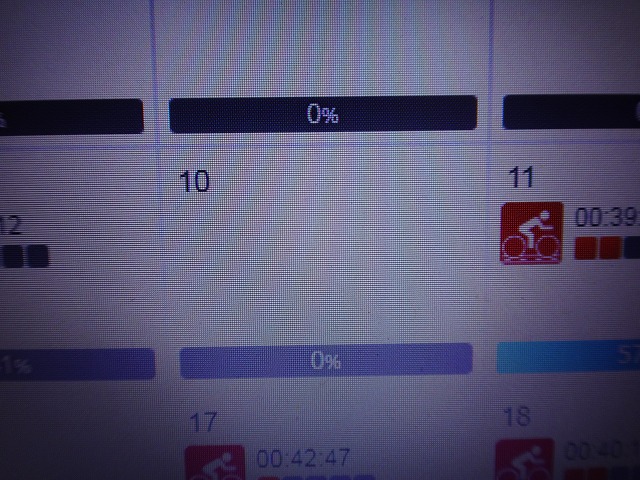
I selected a day when I wasn't using it at all and didn't move it,
and looked at the details.

The manually recorded exercise time is zero,
and the step count recorded is also zero,
but the estimated 24-hour calorie burn is 1666 kcal.
This estimated calorie burn is automatically calculated from my profile—
height, weight, age, and gender.
On completely unused days, this 1666 kcal figure
was consistently the same with no exceptions
(if I changed my profile, this estimated value would change).
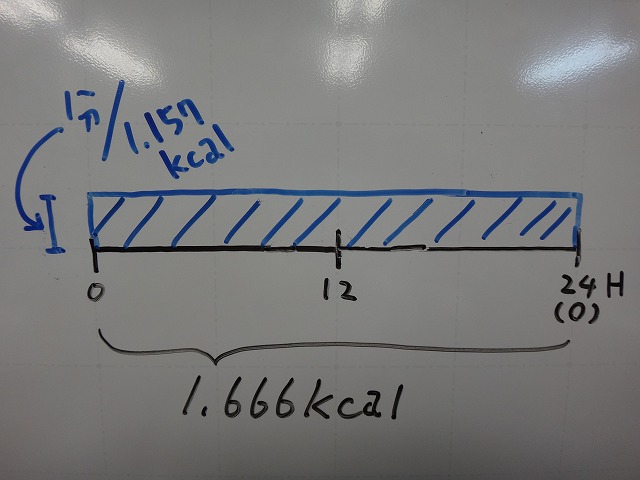
So here's what's happening.
Since 24 hours = 1440 minutes and 1666 kcal,
the calorie burn per minute is 1.157 kcal.
Now, let's say on this particular day I wore the heart rate sensor for just 6 hours
and measured exercise time, and though it was labeled "exercise," I maintained a resting heart rate.
For only 6 hours of the 24-hour period, the calorie burn would be measured (calculated from heart rate data).
If Polar's estimation is accurate, the measured resting value and
the estimated value shouldn't differ much,
so the day's total calorie burn should come to around 1700 kcal.
And further, if during those 6 hours I wore the heart rate sensor while doing
workout-level training at roughly 11 kcal per minute,
and the measured calorie burn during that time was 4000 kcal,

it would look like this.
With traditional sports heart rate monitor functions alone,
only the red portion in the figure above—
the "measured calorie burn during manual recording"—would have been logged.
But with the V800 2, even during periods when I'm not measuring,
or when I'm not wearing it on my wrist,
the estimated basal metabolic rate is automatically added
in the analysis software (Polar Flow).
In my case, the estimated basal metabolic rate is 1.157 kcal per minute, so
for the 18 hours when the device wasn't being used, that's 1250 kcal. And since
the 4000 kcal measured during exercise includes the measured basal metabolic rate,
adding these two together gives a total calorie burn of 5250 kcal.
Furthermore, there's another element not yet included:
"estimated exercise calorie burn from accelerometer activation."
The device automatically generates another unnecessary estimate:
for both the measured calorie burn during exercise recording and
the estimated calorie burn from accelerometer motion,
it calculates "if this were walking, how many steps would it be."
I found a day where the seconds digit of the manual exercise time
was at 00 seconds.
This means the exercise time measured with the heart rate sensor was exactly 42 minutes.

352 kcal in 42 minutes, so that's 8.38 kcal per minute.
It's under 10 because it was a leisurely-paced commute home.
Looking at that day's analysis results:
Although the manual measurement time was 42 minutes,
the recorded active time is 54 minutes.
Those extra 12 minutes come from when the accelerometer was active
outside of my manual measurement time.
Under normal use, this would be time spent on the wrist without the heart rate sensor,
but in my case it's time when I carried my road bike from the entrance,
or time when I rode for errands to the post office or convenience store
(mostly the latter).
Adding together the measured data from heart rate sensor wear, the estimate from the accelerometer, and
the estimated basal metabolic rate from my profile,
that day's total calorie burn came to 2007 kcal.
Plugging in the known information,
the remainder comes out like this.
And the device automatically calculates what both of those calorie burns
would equal in walking steps.

Expressed in the figure from earlier, it looks like this.
What matters to me is only the red portion—the manual measurement—and
I have no current need for the activity tracking function.
If that 42-minute manual measurement represented some meaningful training content,
I write down the key points in my training log (called "wagasogisou").
Polar Flow's analysis includes the blue portions,
but in my usage pattern, this is just noise.
That said, although I've never made active use of it,
if I were to wear the V800 2 on my wrist for 24 hours
without the heart rate sensor and without any manual measurement,
the estimated step count should differ very little from actual steps,
and the estimated calorie burn based on accelerometer data should be
quite accurate. That's what an activity tracker is, after all.
↑This is a record from a different day, but
I wasn't using the V800 2 that day either.
However, the accelerometer detected when I removed it from the handlebar mount
and carried it to the computer for charging.
It recorded 12 steps in 1 minute and 5 kcal of calorie burn separate from basal metabolism.
This is so annoying.
Here's the breakdown of that 42-minute manual measurement by heart rate zone.
Even when added up, there are only 39 minutes 32 seconds,
because there was 2 minutes 28 seconds when my heart rate was below
Zone 1 (50-59% of max heart rate).
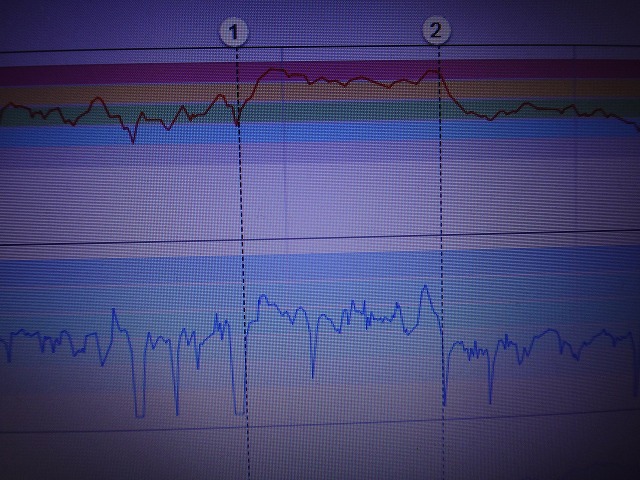
This is a different workout, a fairly hard flat-road effort.
The graph shows heart rate on top and speed on the bottom.
Lap 2 starts from a traffic light with a standing start,
and the dip in speed partway through was when I thought I'd hit a red light
but it turned green and I could proceed. When I break out just Lap 2 by zone,

it looks like this.
Since this segment is a time trial target, I note it in my training log
on days when I push hard.
Now, about the V800 2's interval timer.

Actually, the V800 2 does have an interval timer.
For example, when doing single-leg pedaling on a 3-roller trainer,
alternating legs: right leg 1 minute → 10 second rest (switch legs) → left leg 1 minute → 10 second rest (switch legs) → ...

You can set Timer 1 and Timer 2 individually
on either a time or distance basis.

I set Timer 1 to time-based 1 minute and Timer 2 to time-based 10 seconds.
For running, this feature might be useful: set Timer 1 to distance-based 400m (sprint)
and Timer 2 to time-based 30 seconds (rest),
mixing distance and time basis in this way.
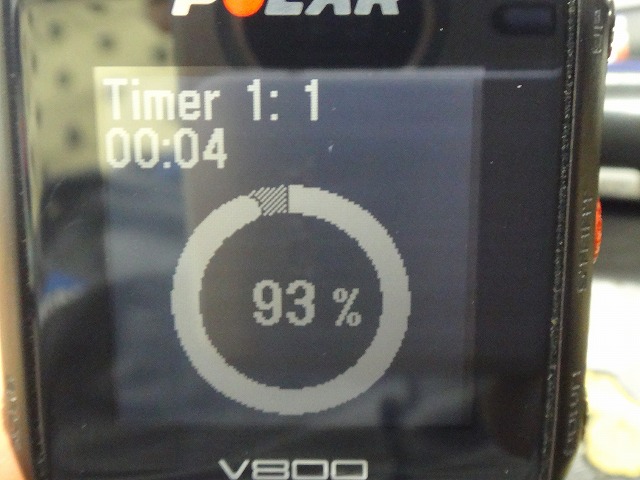
So I activated the interval timer.
The "Timer 1: 1" shown at the top means
this is the 1st repetition of Timer 1. So
Timer 1: 1 – right leg 1 minute
Timer 2: 1 – rest
Timer 1: 2 – left leg 1 minute
Timer 2: 2 – rest
and so on. However, Polar and Pioneer differ in
whether the interval timer interacts with the main workout recording,
and in Polar's case, this is inconvenient for me.
Here's what I mean:
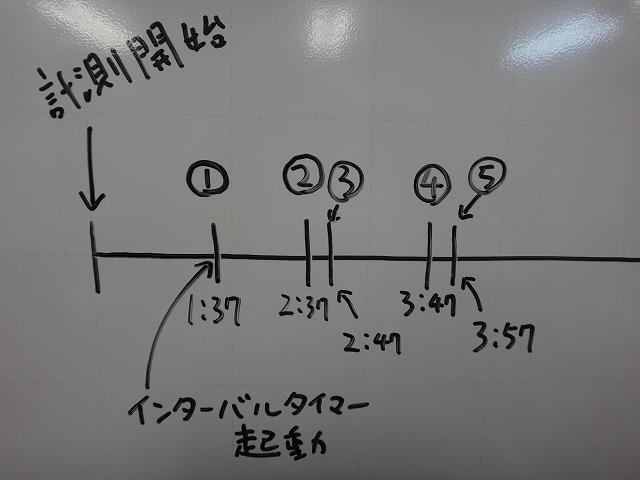
If I started a workout and then, separately, activated the interval timer,
happening to do so 1 minute 37 seconds after starting the workout,
the time up to that point is "automatically" recorded as Lap 1.
Then 1 minute later, Timer 1: 1 is recorded as Lap 2 at 2:37,
then 10 seconds later, Timer 2: 1 is recorded as Lap 3 at 2:47,
then 1 minute later, Timer 1: 2 is recorded as Lap 4 at 3:47,
then 10 seconds later, Timer 2: 2 is recorded as Lap 5 at 3:57
—all automatically.
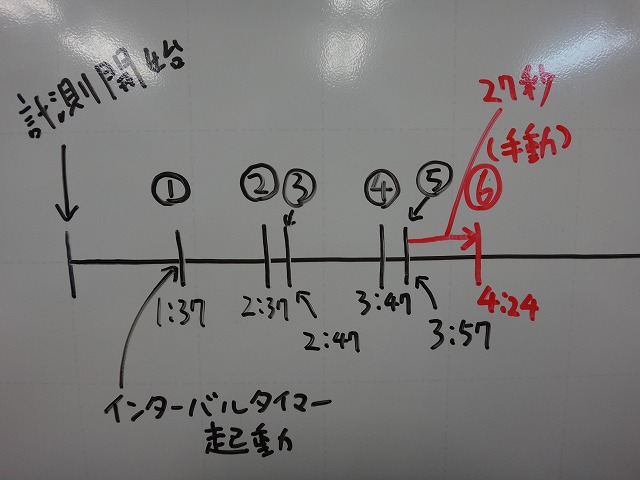
Then Timer 1: 3 continues running, but if I happen to press the lap button
manually 27 seconds into it,
4:24 is recorded as Lap 6 (27 seconds), and
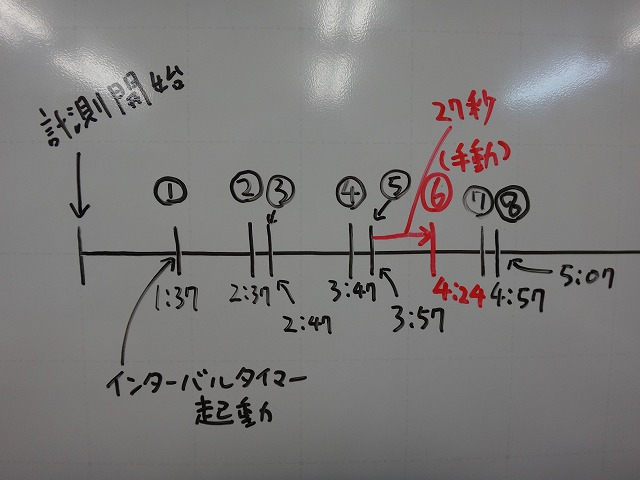
33 seconds later, Timer 1: 3 completes and is recorded as Lap 7 (33 seconds).
My point is that Polar's interval timer automatically interferes with
the main workout lap times.
I find this very confusing and inconvenient.
The countdown timer, while it doesn't show repetition counts,
doesn't automatically record laps when repeating, so
"set the timer to 70 seconds, and switch legs before it counts down to 60 seconds remaining"
is easier to use than the interval timer.

With Pioneer's SGX-CA500, the interval timer doesn't interact with
the main workout recording (workout time or manually recorded lap times).
For example, you can manually record laps roughly every 10 minutes while
separately using the interval timer for single-leg pedaling whenever you want,
and since they're independent, unwanted lap times won't be
recorded automatically.
Polar does make heart rate monitors without the activity tracking function—
the V650 and M460. The reason is straightforward:
they're not wrist watches, they're cycling computers.