A customer left me with a WH-7701 for service.
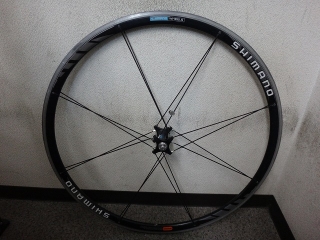
They want a hub overhaul and truing work done.
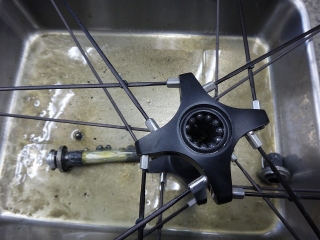
Cleaning in progress...
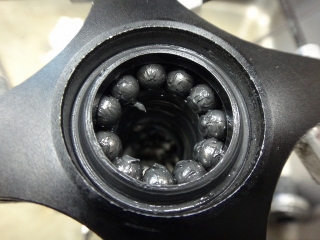
Cup and cone hubs often have different amounts of wear on the ball bearings between left and right sides, so you need to manage things carefully so the races, balls, and cones don't get swapped between sides before and after service. But since this hub uses loose balls on both sides, I have to be especially careful not to mix them up.
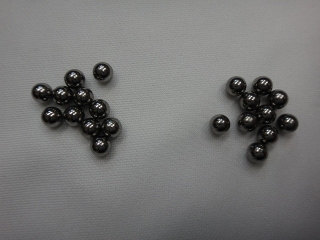
In the previous image, the ball bearings that stayed in the hub are on the left side of the photo above, and the ones I dumped into the tray are on the right side. The left side is slightly duller in color, but it's hard to see in the photo. Since they weren't worn enough to warrant replacement, I reused them. This hub has 11 balls on each side, but the left side of the photo above only shows 10 because one was still sitting in the cleaning container at that moment.

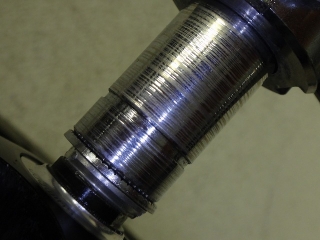
There was a very slight centering offset, but I fixed it before I even took the photos.
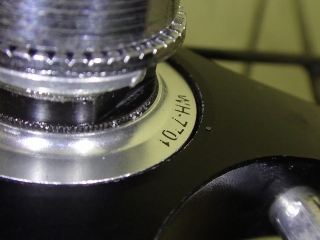
The WH-7700 and WH-7701 have hub internals equivalent to the 7700-series Dura-Ace hubs, with stepless bearing adjustment using W-nuts via a hub wrench. With the 7900-series and later digital ratchet designs, you can't dial in the bearing preload right at that sweet spot of zero play—but if you know the technique, the maintenance is superior because anyone doing the work gets identical results.
The 7800-series hubs also use the W-nut style stepless adjustment, but for some reason you can't tune them to that almost magical light, smooth rolling feel you get with the 7700 hubs. The rotation is smooth enough, but it always feels a bit sluggish. With the 7800 rear hub, the ratchet mechanism isn't the traditional Shimano design but rather uses a pole-spring system like Campagnolo's freebody, which might be related to this. The front hub has a larger diameter axle than the 7700, but the ball size is the same 3/16 inch (early models used loose 14-ball races per side, later models switched to retainer bearings). This is just my theory, but I think the contact geometry between the balls and races/cones has subtly shifted from point contact to slightly face contact. As a result, I have several 7700 hubs sitting around in my shop, but not a single 7800—that's why. Especially the front hub, which I still use in active bikes.
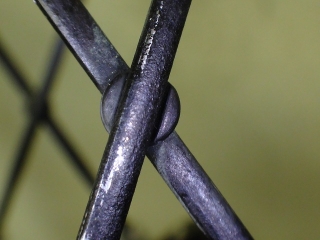
At the final spoke crossing, there's a spoke spacer inserted to prevent creaking, but
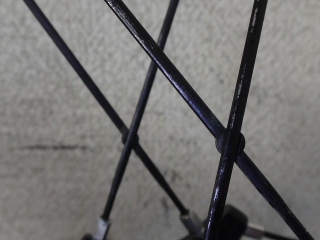
The front and rear wheels of the 7700 and the front wheel of the 7701 are built JIS-pattern at the final crossing. The reason is,
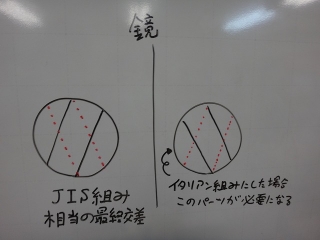
if you wanted to use Italian-pattern lacing, the spacer on the opposite final crossing would need to have its slot orientation reversed as a mirror image. If the final crossing angle were around 90 degrees, you might be able to use the same spacer on both sides with Italian lacing, but...
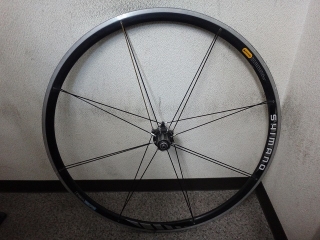
Now for the rear wheel.
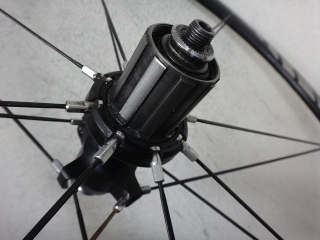
The WH-7701 rear wheel, unlike the WH-7700, is built radial on the freewheel side, and

the hub flange width is also wider. If they'd just kept the flange width consistent instead of arbitrarily making it wider or narrower with each new model, I wouldn't be calling them wide-flange fraudsters.
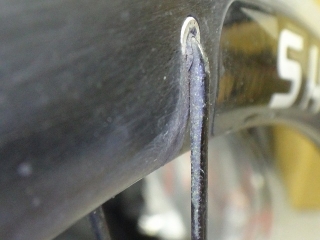
The elbow-bend spoke has its bend on the rim side, and it hooks onto the rim via a spoke washer. But the dimensions of the bend are so different from generic spokes that you can't, for example, repair the spoke section with a CX-RAY. Plus, these spokes were discontinued long ago. What I'm getting at is that the moment one of these spokes breaks, the wheel is done for. I've tried many times over the years to cobble together a repair using generic spokes, and every attempt has failed (it looks like it should work, but it doesn't).
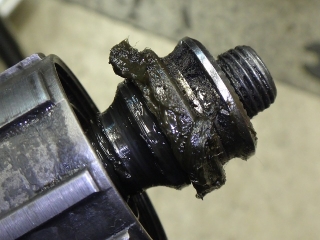
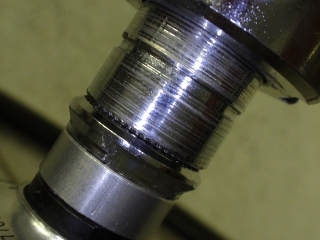
I loosened the double nut on the non-freewheel side and pushed the hub axle out toward the freewheel side. Despite how it looks, the seals are actually doing their job properly, and no sand-sized debris has gotten inside the hub.

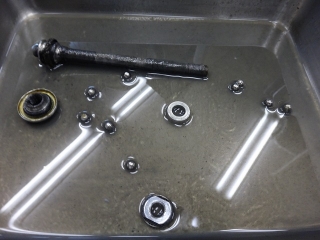
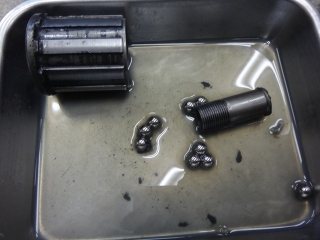
Cleaning in progress... I probably didn't even need to remove the freebody. The hollow bolt that fastens the freebody to the hub shell is steel on 7700-series hubs. The 7800-series uses a Campagnolo-style design and doesn't have this bolt form, and with the 7900-series the hollow bolt becomes aluminum. But it's single-use—meaning that every time you reinstall the freebody, the manufacturer's instructions say you must use a new bolt. I checked spare parts just now and found it's discontinued! I actuallyhave reused it quite a few times, and it's never caused any problems.
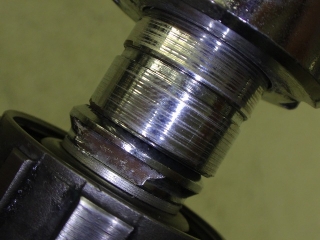
No centering offset, and even after doing a light lateral truing, the same held true.

This wheel, I'll need it for something I'm planning to write about eventually, but I don't need to take any photos for that right now.
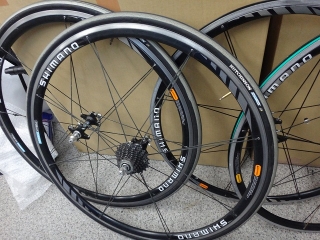
Because I've got one in my personal collection.

They want a hub overhaul and truing work done.

Cleaning in progress...

Cup and cone hubs often have different amounts of wear on the ball bearings between left and right sides, so you need to manage things carefully so the races, balls, and cones don't get swapped between sides before and after service. But since this hub uses loose balls on both sides, I have to be especially careful not to mix them up.

In the previous image, the ball bearings that stayed in the hub are on the left side of the photo above, and the ones I dumped into the tray are on the right side. The left side is slightly duller in color, but it's hard to see in the photo. Since they weren't worn enough to warrant replacement, I reused them. This hub has 11 balls on each side, but the left side of the photo above only shows 10 because one was still sitting in the cleaning container at that moment.


There was a very slight centering offset, but I fixed it before I even took the photos.

The WH-7700 and WH-7701 have hub internals equivalent to the 7700-series Dura-Ace hubs, with stepless bearing adjustment using W-nuts via a hub wrench. With the 7900-series and later digital ratchet designs, you can't dial in the bearing preload right at that sweet spot of zero play—but if you know the technique, the maintenance is superior because anyone doing the work gets identical results.
The 7800-series hubs also use the W-nut style stepless adjustment, but for some reason you can't tune them to that almost magical light, smooth rolling feel you get with the 7700 hubs. The rotation is smooth enough, but it always feels a bit sluggish. With the 7800 rear hub, the ratchet mechanism isn't the traditional Shimano design but rather uses a pole-spring system like Campagnolo's freebody, which might be related to this. The front hub has a larger diameter axle than the 7700, but the ball size is the same 3/16 inch (early models used loose 14-ball races per side, later models switched to retainer bearings). This is just my theory, but I think the contact geometry between the balls and races/cones has subtly shifted from point contact to slightly face contact. As a result, I have several 7700 hubs sitting around in my shop, but not a single 7800—that's why. Especially the front hub, which I still use in active bikes.

At the final spoke crossing, there's a spoke spacer inserted to prevent creaking, but

The front and rear wheels of the 7700 and the front wheel of the 7701 are built JIS-pattern at the final crossing. The reason is,

if you wanted to use Italian-pattern lacing, the spacer on the opposite final crossing would need to have its slot orientation reversed as a mirror image. If the final crossing angle were around 90 degrees, you might be able to use the same spacer on both sides with Italian lacing, but...
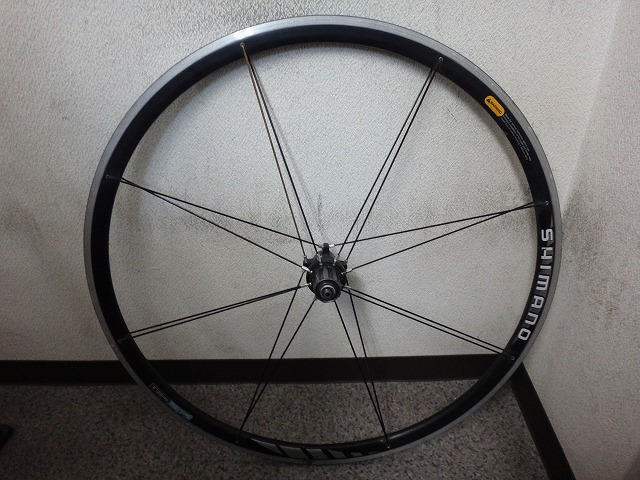
Now for the rear wheel.

The WH-7701 rear wheel, unlike the WH-7700, is built radial on the freewheel side, and

the hub flange width is also wider. If they'd just kept the flange width consistent instead of arbitrarily making it wider or narrower with each new model, I wouldn't be calling them wide-flange fraudsters.

The elbow-bend spoke has its bend on the rim side, and it hooks onto the rim via a spoke washer. But the dimensions of the bend are so different from generic spokes that you can't, for example, repair the spoke section with a CX-RAY. Plus, these spokes were discontinued long ago. What I'm getting at is that the moment one of these spokes breaks, the wheel is done for. I've tried many times over the years to cobble together a repair using generic spokes, and every attempt has failed (it looks like it should work, but it doesn't).

I loosened the double nut on the non-freewheel side and pushed the hub axle out toward the freewheel side. Despite how it looks, the seals are actually doing their job properly, and no sand-sized debris has gotten inside the hub.


Cleaning in progress... I probably didn't even need to remove the freebody. The hollow bolt that fastens the freebody to the hub shell is steel on 7700-series hubs. The 7800-series uses a Campagnolo-style design and doesn't have this bolt form, and with the 7900-series the hollow bolt becomes aluminum. But it's single-use—meaning that every time you reinstall the freebody, the manufacturer's instructions say you must use a new bolt. I checked spare parts just now and found it's discontinued! I actually


No centering offset, and even after doing a light lateral truing, the same held true.
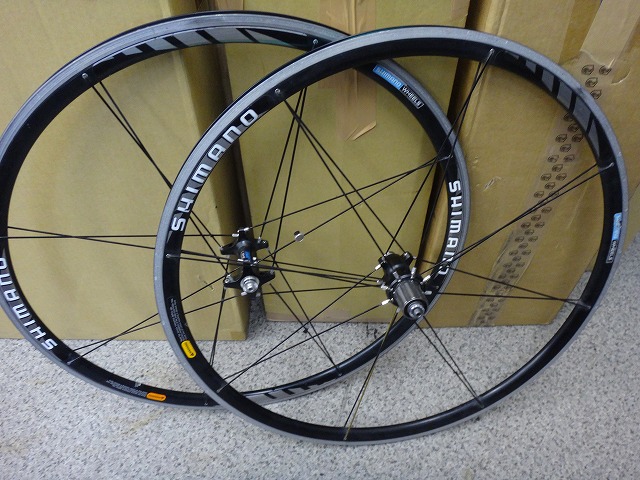
This wheel, I'll need it for something I'm planning to write about eventually, but I don't need to take any photos for that right now.

Because I've got one in my personal collection.