Another day with wheels (and so on).
Today is the last Saturday of the month, so I know the shop is closed,
but there are some jobs I can rarely get to during regular hours, so I came in anyway.
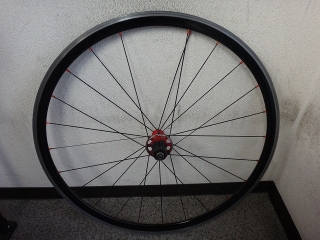
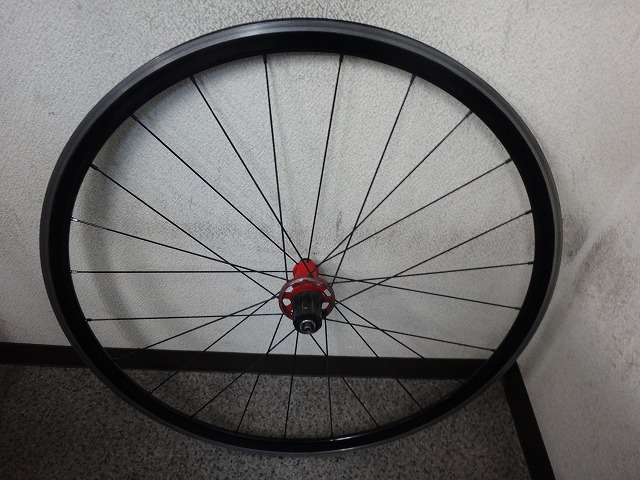
A customer left me the rear wheel of Nomu Lab Wheel No. 1 for repair.
Of course, this is one I built myself back in the day, but
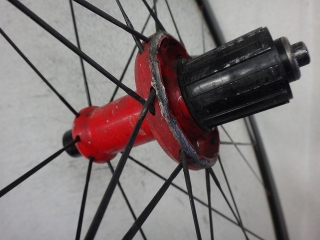
the rim on a Roval 2:1 laced rear wheel broke,
so I'm using that hub to build Nomu Lab Wheel No. 1.
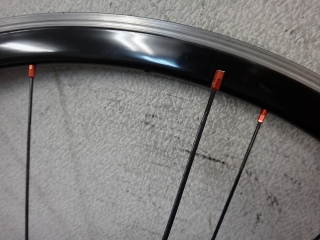

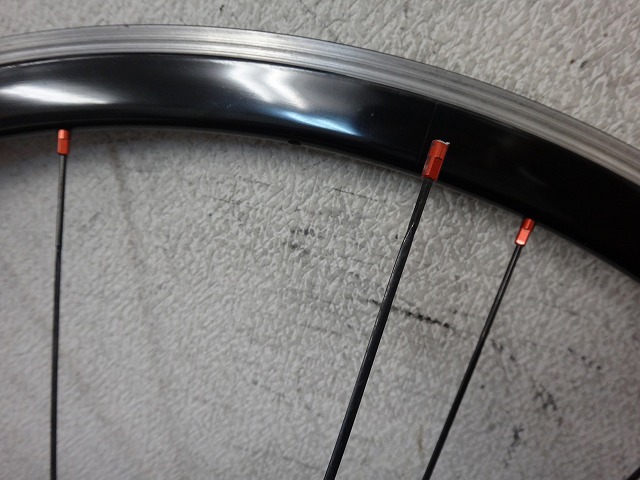
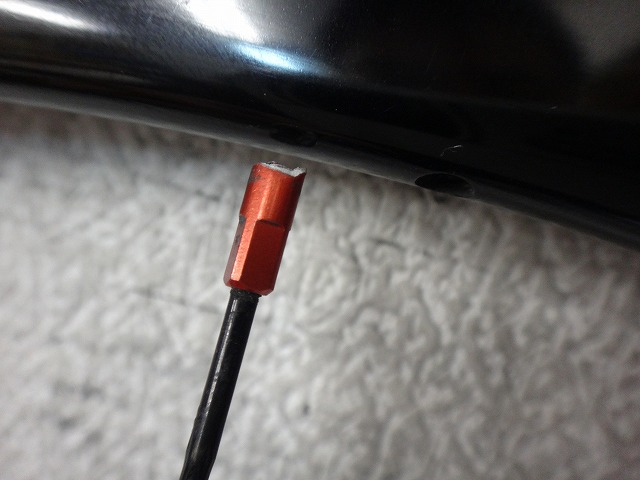
This rear wheel has been experiencing frequent spoke nipple breakage on the non-drive side,
so it needs to be rebuilt.
I can't say I didn't anticipate this happening,
so consider this free repair—the labor and nipples are my education fund.
Hand-building wheels with 2:1 lacing carries substantial risk,
and even before opening Nomu Lab, I built several rear wheels for myself.
But despite using spokes like CX-RAY and True Starlight,
which are known to resist spoke breakage,
they still experienced spoke nipple failures within a short period (as little as two months).
So I decided not to adopt 2:1 lacing as a standard specification for retail builds.
Along similar lines, Neda of Neda Wheels
also hand-builds wheels occasionally,
and he says his 2:1 laced rear wheels constantly suffer spoke breakage.
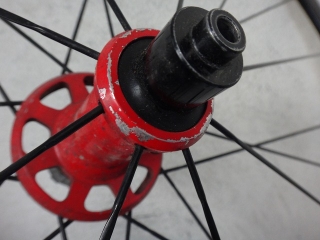
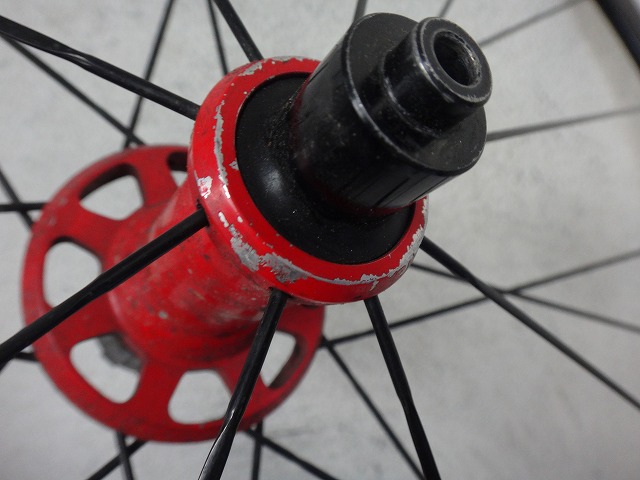
In this rear wheel's case, both sides use black CX-RAY straight spokes,
so the spoke head appears to be stronger than the nipple.
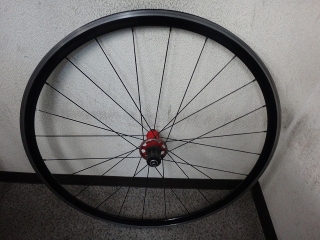
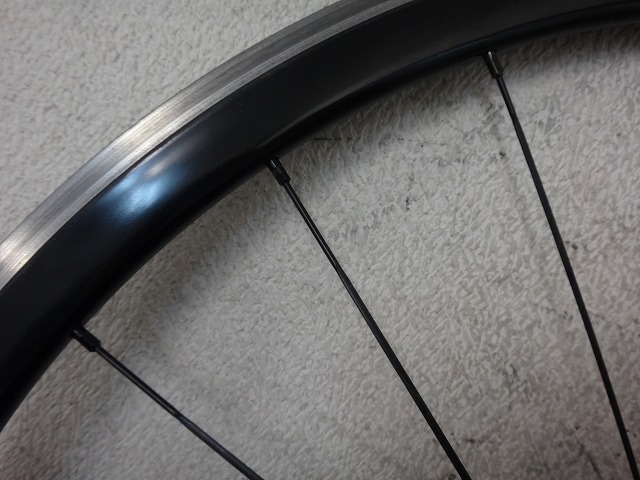
It's built.
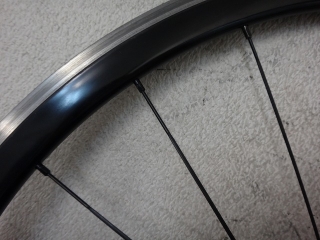
I suggested brass nipples,
but since the customer couldn't do red but wanted colored nipples,
I went with black nipples.
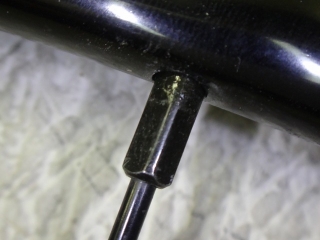
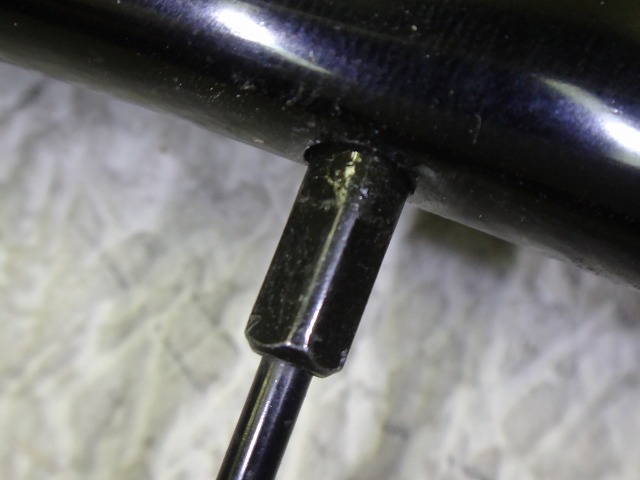
So I'm using black brass nipples, but
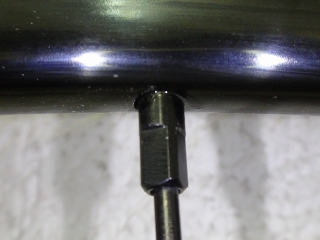
that's only on the non-drive side—the drive side uses black aluminum nipples.
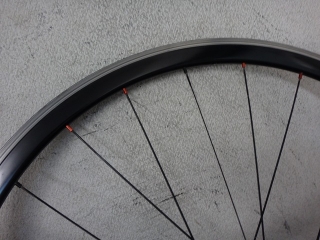
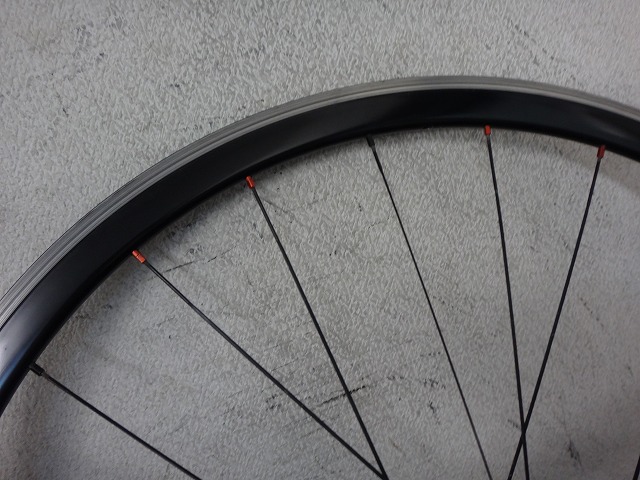
↑This is a work-in-progress shot, but doing just the non-drive side
with black brass nipples might have been the better choice.
However, since the front wheel is built with red aluminum nipples,
I'm planning to swap it to black aluminum nipples for color consistency anyway, and
labor-wise, replacing just the non-drive side or replacing everything is about the same,
so this time I went with a full swap.
If steel spokes with 2:1 lacing are supposedly no good,
then what about wheels like Zonda or Racing 3,
Bora or Speed? That's what people will ask.
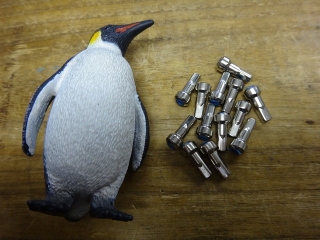
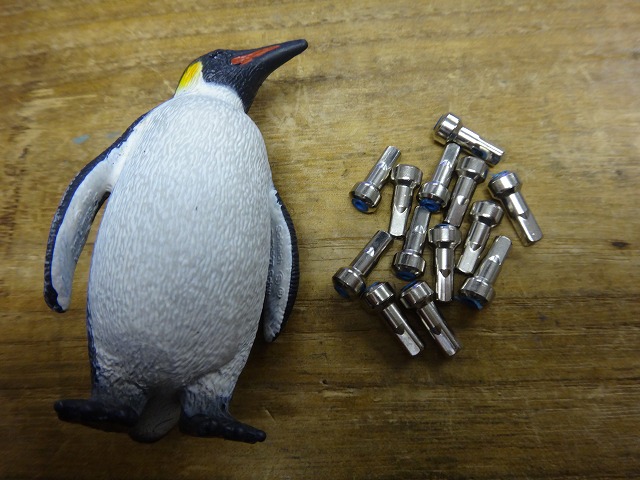
With Zonda and Racing 3,
the nipple wrench contact point is 3.2mm—same as generic nipples—but
they use proprietary brass nipples with beefy root sections,
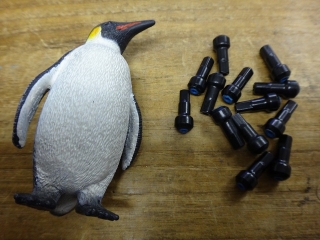
while Bora and Speed have a 4mm (3.95mm) wrench contact point
and require proprietary aluminum nipples with larger rim hole diameters
than generic ones.
Smart manufacturers anticipated nipple breakage issues.
Speaking of which, a former colleague from my previous job
said that a wheel with 2:1 lacing using current DT RR-series rims (requiring washers) rides great,
and the reason he gave was "because the total spoke tension is highest."
Give me a break. That's ridiculous.
Sure, say you have a 24H rear wheel with drive-side spoke tension at 100.
With equal spokes left and right, you'd have drive-side 100 on 12 spokes
and non-drive-side 70 on 12 spokes.
But with 2:1 lacing, you get drive-side 100 on 16 spokes
and non-drive-side 95 on 8 spokes (for a typical rear hub dimension).
When I countered this point, I was told "no, it would be 100 on 24 spokes,"
but that's beside the point, so fine—100 on 24 spokes if you want.
With a 2:1 rear wheel, the non-drive side needs to be radial laced.
If you tangent-lace the non-drive side, it becomes higher tension than the drive side,
and when you tension spokes to the limit the rim allows,
the non-drive side becomes the limiting factor.
So if the non-drive side is 100, the drive side would be less than 100.
It's hard to imagine this doesn't affect spoke characteristics,
and while there are examples of complete wheels with tangent lacing on the non-drive side—
like Fulcrum's MTB wheels with 2:1 lacing—this is uncommon.
Zonda DB and Bora DB use 2:1 lacing steel-spoke disc hubs
with radial non-drive-side lacing, but
they have flange shapes that are arguably overdeveloped for a single spoke head.
I have images for an article on this, so I'll detail it later.
"The wheel with the highest total spoke tension rides best"
(flatly stated to ride better than semi-competition 24-spoke lacing),
if that's truly a major or paramount factor,
why not just use a narrow-flange rear hub with radial lacing on both sides
and tension it to the max?
That would satisfy the condition of highest total spoke tension.
Radial non-drive-side lacing, setting tension aside,
has poor resistance to torsional distortion from the freebody rotation,
so the 2:1 lacing method, which practically requires it,
is not ideal for hand-built wheels, in my view.
I can't imagine it having better ride characteristics than
a rear wheel with the non-drive side tangent-laced with the final cross tied in.
By the way, the person who built that wheel
was completely unaware that spoke nipple breakage and head failure
are common on the non-drive side.
Building just one or two wheels, you might not notice, but
after building a hundred or two hundred,
you'll eventually experience frequent failures of nipples and spokes—and feel real pain.
In fact, right now I'm dealing with Roval repairs, so I had no choice but to build
just one 2:1 rear wheel, and I'm already feeling the pain.
Also, while I'm at it, I should mention
DT rims have distinct hole drilling, and at 24H it's 12 on each side,
so using one for an 8-on-one-side rear wheel feels odd.
When discussing 2:1 lacing and total spoke tension,
I brought up left-right different-diameter lacing and spoke quantity,
and while I can't help it if someone's incapable of understanding that,
I was literally sneered at.
But here's the thing: left-right different-diameter lacing and left-right different-quantity lacing
use the same evaluation criteria for spoke quantity thinking.
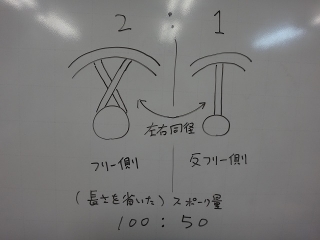
Say you use same-diameter spokes with 2:1 lacing (non-drive side radial),
the spoke quantity ratio (omitting spoke length) is 100:50 (drive:non-drive).
(Including spoke length, since radial lacing uses shorter spokes,
depending on rim depth and drive-side X-cross pattern, it comes to roughly 100:48.5).
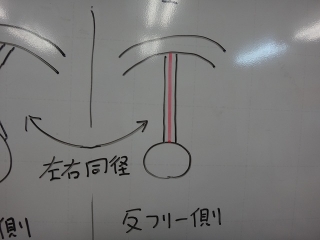
Now, if you could cleanly split the non-drive-side spokes
like splitting a chopstick in half into two separate spokes...
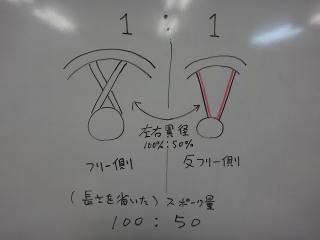
the spoke quantity ratio would stay the same,
and the left-right different-quantity lacing converts to left-right different-diameter lacing.
Of course, a spoke with 50% spoke quantity doesn't exist in reality.
Even if it did, I suspect it would either start deflecting (unyo-n)
or the head would break before you finished building the wheel.
So, left-right different-quantity lacing (typically 2:1) does achieve
a lack of left-right spoke tension difference that you simply can't get from
same-quantity spokes with different diameters—that much is true.
But it also has serious downsides: the non-drive-side spokes and nipples bear enormous loads,
it practically requires radial lacing,
and generic materials struggle to overcome these weaknesses.
The front wheel of Zonda DB uses G3 lacing,
so the spoke ratio is 1:2 (drive:non-drive),
and the Colima 12:8H 20H rear wheel
has a spoke ratio of 3:2 (drive:non-drive), but
these wheels actually make the minority-spoke side thicker—inverse different-diameter lacing, you might say.
Since left-right different-quantity lacing works too well,
they apply inverse different-diameter lacing as a counter to soften the effect—that's my theory.
But Campagnolo and Colima don't mention inverse different-diameter lacing
anywhere in their wheel descriptions. Yet that's the crucial part.
This is just my own thinking, but
I believe both Campagnolo and Colima possess the concept I call "spoke quantity"
as one of their measuring sticks for thinking about wheels.
Otherwise, they'd never come up with the combination of
left-right different-quantity lacing plus left-right inverse different-diameter lacing.
A shallow wheel philosophy that attempts 2:1 lacing in hand-built wheels
based solely on total left-right spoke tension
shouldn't bother lecturing me—it should build dozens and submit them to the market instead.
Today is the last Saturday of the month, so I know the shop is closed,
but there are some jobs I can rarely get to during regular hours, so I came in anyway.
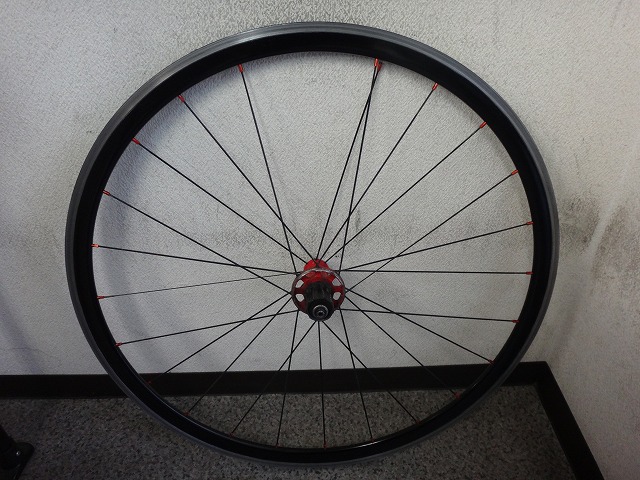
A customer left me the rear wheel of Nomu Lab Wheel No. 1 for repair.
Of course, this is one I built myself back in the day, but
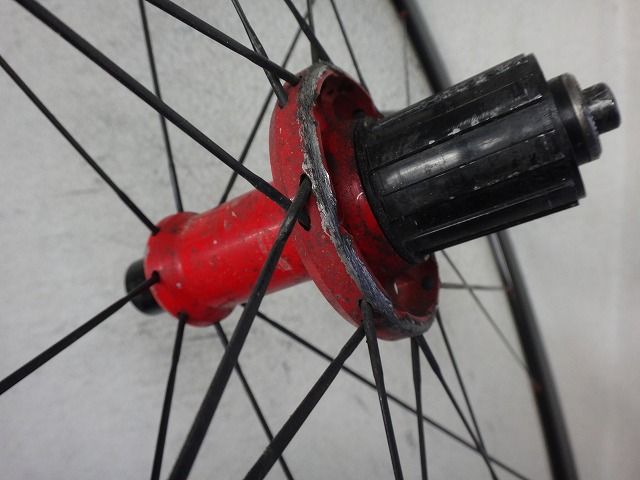
the rim on a Roval 2:1 laced rear wheel broke,
so I'm using that hub to build Nomu Lab Wheel No. 1.
This rear wheel has been experiencing frequent spoke nipple breakage on the non-drive side,
so it needs to be rebuilt.
I can't say I didn't anticipate this happening,
so consider this free repair—the labor and nipples are my education fund.
Hand-building wheels with 2:1 lacing carries substantial risk,
and even before opening Nomu Lab, I built several rear wheels for myself.
But despite using spokes like CX-RAY and True Starlight,
which are known to resist spoke breakage,
they still experienced spoke nipple failures within a short period (as little as two months).
So I decided not to adopt 2:1 lacing as a standard specification for retail builds.
Along similar lines, Neda of Neda Wheels
also hand-builds wheels occasionally,
and he says his 2:1 laced rear wheels constantly suffer spoke breakage.
In this rear wheel's case, both sides use black CX-RAY straight spokes,
so the spoke head appears to be stronger than the nipple.
It's built.
I suggested brass nipples,
but since the customer couldn't do red but wanted colored nipples,
I went with black nipples.
So I'm using black brass nipples, but

that's only on the non-drive side—the drive side uses black aluminum nipples.
↑This is a work-in-progress shot, but doing just the non-drive side
with black brass nipples might have been the better choice.
However, since the front wheel is built with red aluminum nipples,
I'm planning to swap it to black aluminum nipples for color consistency anyway, and
labor-wise, replacing just the non-drive side or replacing everything is about the same,
so this time I went with a full swap.
If steel spokes with 2:1 lacing are supposedly no good,
then what about wheels like Zonda or Racing 3,
Bora or Speed? That's what people will ask.
With Zonda and Racing 3,
the nipple wrench contact point is 3.2mm—same as generic nipples—but
they use proprietary brass nipples with beefy root sections,

while Bora and Speed have a 4mm (3.95mm) wrench contact point
and require proprietary aluminum nipples with larger rim hole diameters
than generic ones.
Smart manufacturers anticipated nipple breakage issues.
Speaking of which, a former colleague from my previous job
said that a wheel with 2:1 lacing using current DT RR-series rims (requiring washers) rides great,
and the reason he gave was "because the total spoke tension is highest."
Give me a break. That's ridiculous.
Sure, say you have a 24H rear wheel with drive-side spoke tension at 100.
With equal spokes left and right, you'd have drive-side 100 on 12 spokes
and non-drive-side 70 on 12 spokes.
But with 2:1 lacing, you get drive-side 100 on 16 spokes
and non-drive-side 95 on 8 spokes (for a typical rear hub dimension).
When I countered this point, I was told "no, it would be 100 on 24 spokes,"
but that's beside the point, so fine—100 on 24 spokes if you want.
With a 2:1 rear wheel, the non-drive side needs to be radial laced.
If you tangent-lace the non-drive side, it becomes higher tension than the drive side,
and when you tension spokes to the limit the rim allows,
the non-drive side becomes the limiting factor.
So if the non-drive side is 100, the drive side would be less than 100.
It's hard to imagine this doesn't affect spoke characteristics,
and while there are examples of complete wheels with tangent lacing on the non-drive side—
like Fulcrum's MTB wheels with 2:1 lacing—this is uncommon.
Zonda DB and Bora DB use 2:1 lacing steel-spoke disc hubs
with radial non-drive-side lacing, but
they have flange shapes that are arguably overdeveloped for a single spoke head.
I have images for an article on this, so I'll detail it later.
"The wheel with the highest total spoke tension rides best"
(flatly stated to ride better than semi-competition 24-spoke lacing),
if that's truly a major or paramount factor,
why not just use a narrow-flange rear hub with radial lacing on both sides
and tension it to the max?
That would satisfy the condition of highest total spoke tension.
Radial non-drive-side lacing, setting tension aside,
has poor resistance to torsional distortion from the freebody rotation,
so the 2:1 lacing method, which practically requires it,
is not ideal for hand-built wheels, in my view.
I can't imagine it having better ride characteristics than
a rear wheel with the non-drive side tangent-laced with the final cross tied in.
By the way, the person who built that wheel
was completely unaware that spoke nipple breakage and head failure
are common on the non-drive side.
Building just one or two wheels, you might not notice, but
after building a hundred or two hundred,
you'll eventually experience frequent failures of nipples and spokes—and feel real pain.
just one 2:1 rear wheel, and I'm already feeling the pain.
Also, while I'm at it, I should mention
DT rims have distinct hole drilling, and at 24H it's 12 on each side,
so using one for an 8-on-one-side rear wheel feels odd.
When discussing 2:1 lacing and total spoke tension,
I brought up left-right different-diameter lacing and spoke quantity,
I was literally sneered at.
But here's the thing: left-right different-diameter lacing and left-right different-quantity lacing
use the same evaluation criteria for spoke quantity thinking.

Say you use same-diameter spokes with 2:1 lacing (non-drive side radial),
the spoke quantity ratio (omitting spoke length) is 100:50 (drive:non-drive).
(Including spoke length, since radial lacing uses shorter spokes,
depending on rim depth and drive-side X-cross pattern, it comes to roughly 100:48.5).
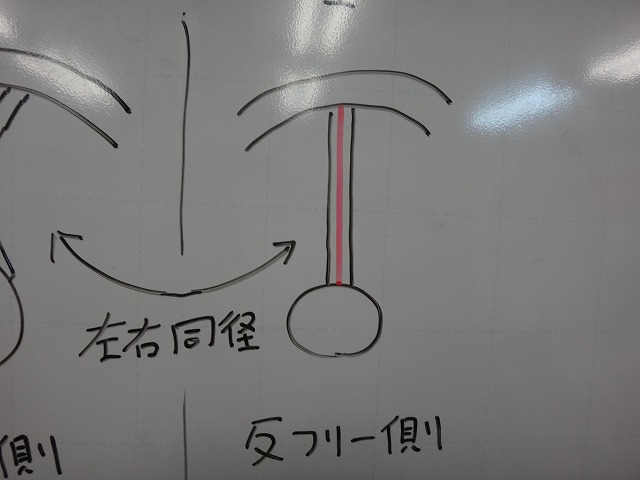
Now, if you could cleanly split the non-drive-side spokes
like splitting a chopstick in half into two separate spokes...

the spoke quantity ratio would stay the same,
and the left-right different-quantity lacing converts to left-right different-diameter lacing.
Of course, a spoke with 50% spoke quantity doesn't exist in reality.
Even if it did, I suspect it would either start deflecting (unyo-n)
or the head would break before you finished building the wheel.
So, left-right different-quantity lacing (typically 2:1) does achieve
a lack of left-right spoke tension difference that you simply can't get from
same-quantity spokes with different diameters—that much is true.
But it also has serious downsides: the non-drive-side spokes and nipples bear enormous loads,
it practically requires radial lacing,
and generic materials struggle to overcome these weaknesses.
The front wheel of Zonda DB uses G3 lacing,
so the spoke ratio is 1:2 (drive:non-drive),
and the Colima 12:8H 20H rear wheel
has a spoke ratio of 3:2 (drive:non-drive), but
these wheels actually make the minority-spoke side thicker—inverse different-diameter lacing, you might say.
Since left-right different-quantity lacing works too well,
they apply inverse different-diameter lacing as a counter to soften the effect—that's my theory.
But Campagnolo and Colima don't mention inverse different-diameter lacing
anywhere in their wheel descriptions. Yet that's the crucial part.
This is just my own thinking, but
I believe both Campagnolo and Colima possess the concept I call "spoke quantity"
as one of their measuring sticks for thinking about wheels.
Otherwise, they'd never come up with the combination of
left-right different-quantity lacing plus left-right inverse different-diameter lacing.
A shallow wheel philosophy that attempts 2:1 lacing in hand-built wheels
based solely on total left-right spoke tension
shouldn't bother lecturing me—it should build dozens and submit them to the market instead.