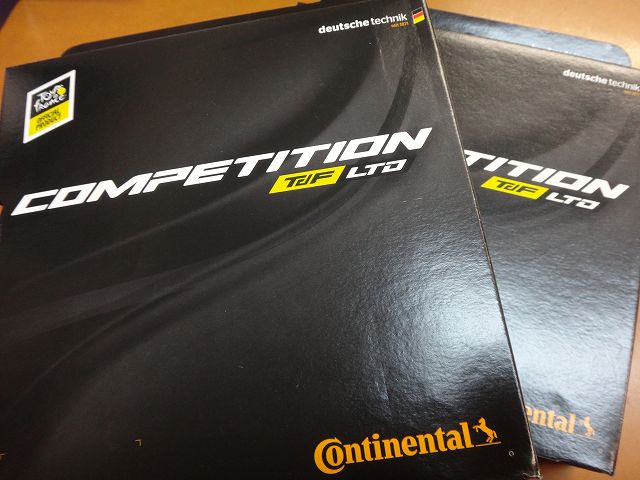
We received the limited edition Continental Competition tubular tire,

the TdF LTD (Tour de France Limited).
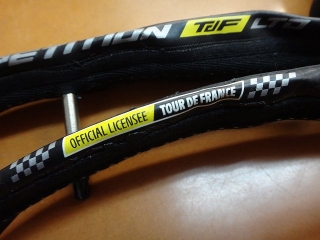
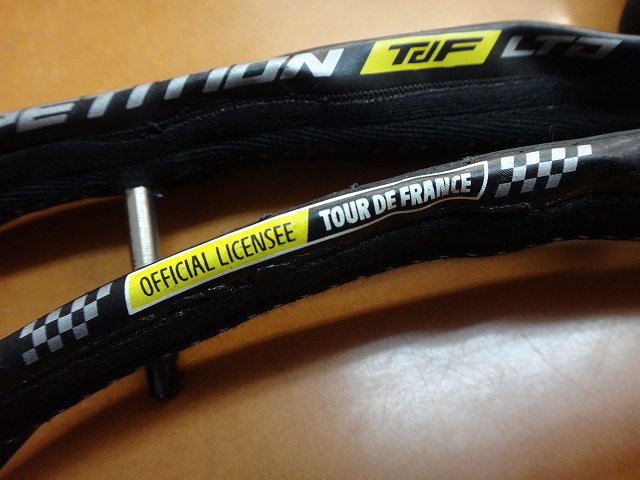
It's an official licensed product.
In commemoration of this year's Tour de France total distance of 3,640 km,
production is limited to exactly 3,640 units,
but the Japanese wholesale distributor only received 100 units.
I think Japan is one of the countries where tubular tires sell well globally,
but 100 units is pretty scarce. With 2 tires making a pair and 100 units totaling 50 pairs,
if we divide them one pair per prefecture, they're basically all gone.
Back in the day, Shimano released a Dura-Ace 25th Anniversary limited edition
component set based on the 7700,
and pro riders were using them actively in competition back then.
This tire probably has some allocation reserved for pro use among those 3,640 units.
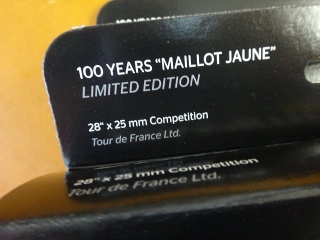
Available only in 25C width.
If it came in 22C, one size narrower, I would've bought it too.
Sorry, but our stock has already sold out.
So there's no reason to post this article just to sell inventory.
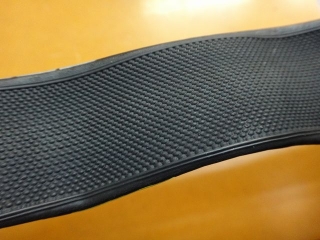
The tread pattern is the same as the standard model,
but the TPI (threads per inch) is 200 on the TdF LTD compared to 180 on the standard model,
and because of that, the weight is lighter at 250g compared to 280g for the standard 25C.
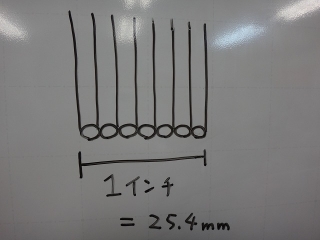
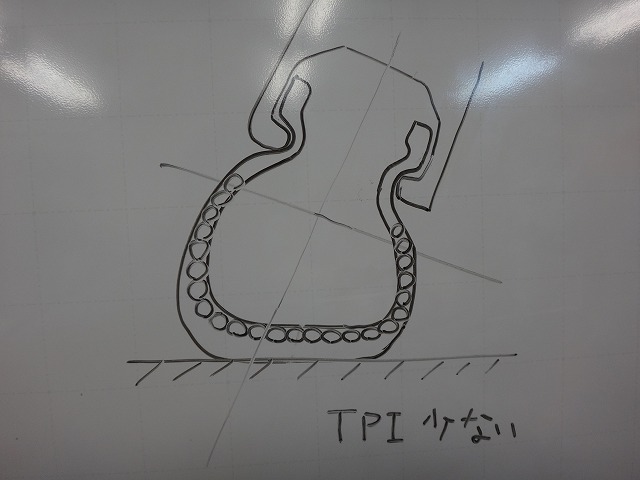
TPI stands for threads per inch, the number of threads per inch,
and in the diagram above it shows 7 TPI.
The higher the TPI, the finer the threads in the tire's casing portion become,
which results in a thinner tire with better ride quality
and generally higher cornering performance limits, but


↑something like this (in reality the casing is several layers of fiber laid diagonally and alternately)
tire performance isn't determined by TPI alone.
With Vittoria road tires,
different models are made with TPI values of 26, 60, 150, 220, 290, and 320,
but you can't simply say that Vittoria's 320 is superior to Continental's 180.
However, if the same manufacturer makes tires with different TPI values,
the one with the higher TPI is a reasonable judgment as being better.
With this TdF LTD, the sidewalls are so much more supple compared to the standard model
that a 20-point TPI difference can't fully explain it—it feels like a completely different product.
Although it's a limited edition, the pricing is reasonable at just 500 yen higher than standard
(14,500 yen → 15,000 yen),
and honestly, even at 20,000 yen per tire, people would buy them.
Well, our shop's stock sold out anyway (second mention).
Bonus
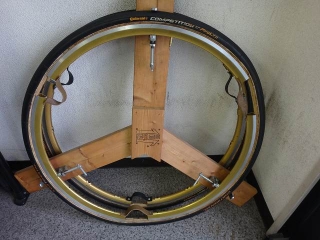
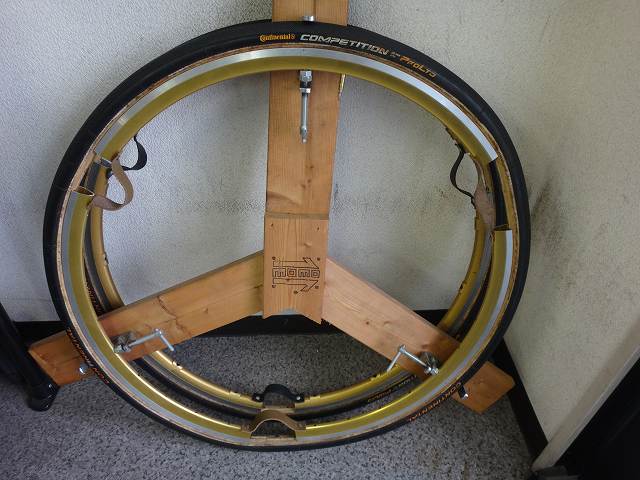
A customer left us with a Continental
Competition PRO LTD (Pro Limited) 28C tubular tire.
Continental tubular tires
often have unusually small inner diameters, making them difficult to fit onto rims,
and this tendency is especially pronounced with 19C tires rather than individual variation.
The Podium TT and Competition 19C tires
are sized so differently from other widths
that you'd notice the difference immediately.
The Competition 22C and 25C are fairly tight to install on rims for beginners,
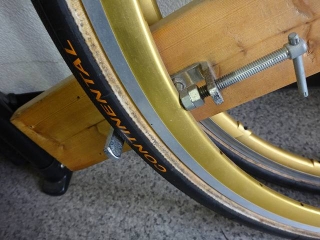
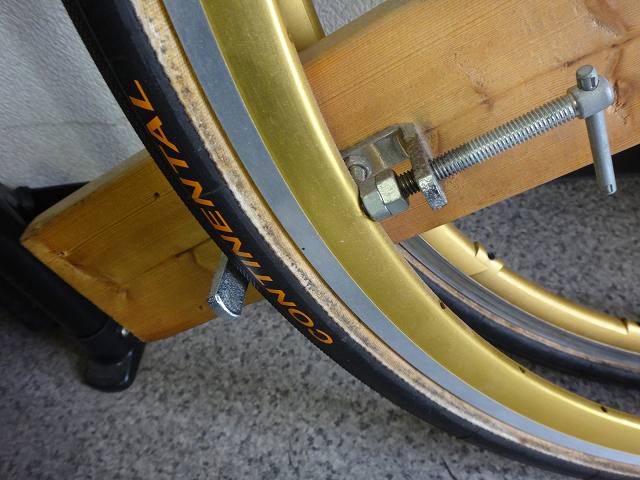
but in my case, I can mount them without using a tire stretcher (the device in the photo above).
Following this pattern, the thicker 28C Competition
(which is a non-retail version)
should theoretically be easier to fit on rims... but surprisingly,
the inner diameter is still small (though not as extreme as the 19C),
and with individual variation too, one of the two I had was particularly tight—I struggled quite a bit.
So that's why the customer asked me to stretch it, shown in the photo above.
This tire exists here because it's a pro team hand-me-down
(not a retail product, unavailable from Japanese distributors and not listed on the home country website),
and the customer purchased it in France.

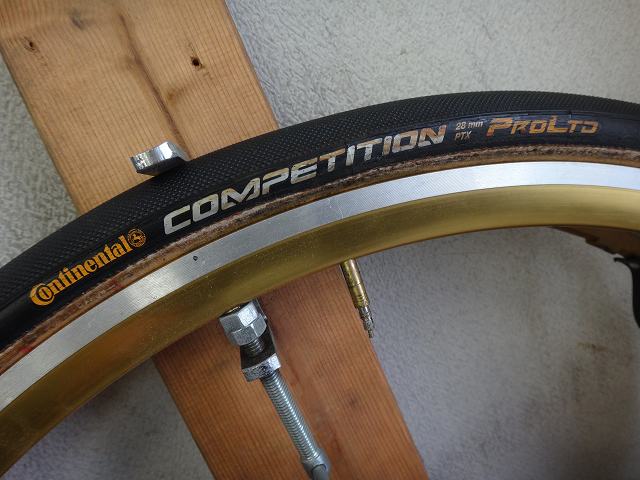
The Competition PRO LTD tire
exists in multiple label generations and tread patterns.
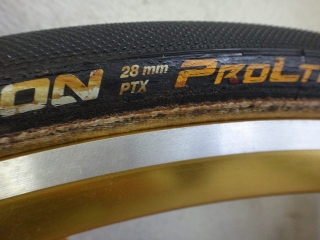
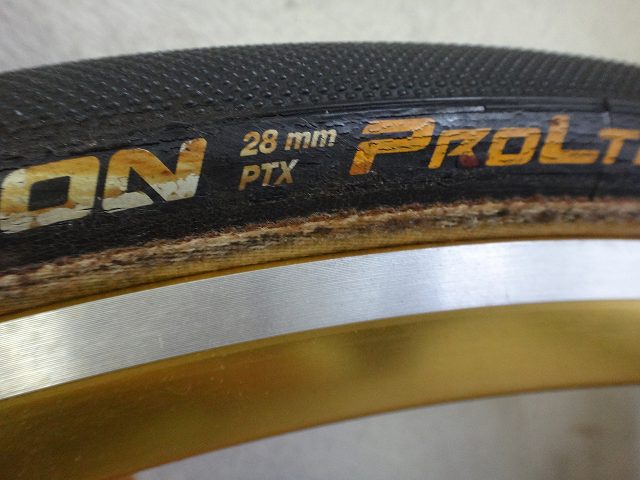
Continental tire model name labels are positioned directly below the valve,
and on the opposite side (180 degrees away)
you'll find markings for Continental or German handmade,
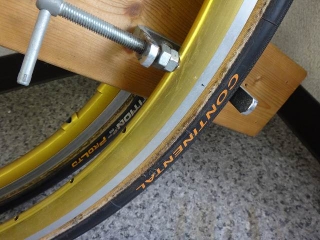
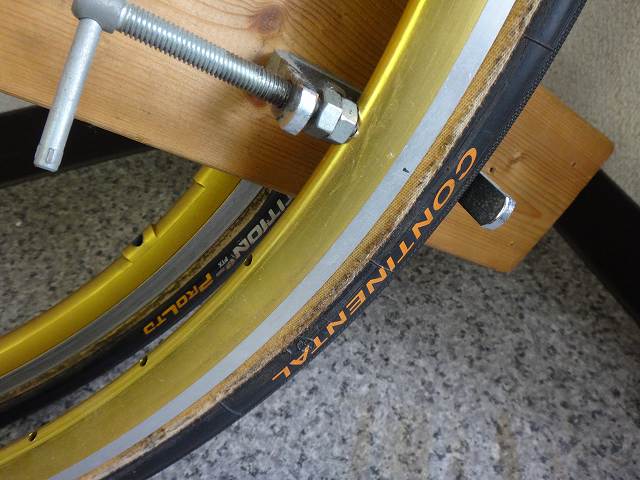
but on this tire there are labels at three positions, each 120 degrees apart.
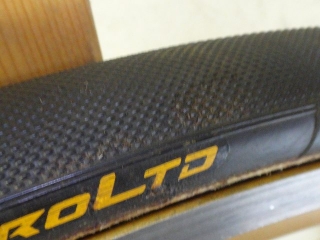
The tread pattern matches the standard model,
but pro teams apparently have center-slick or full-slick variants available.
In earlier generations of the Competition PRO LTD,
center-slick was the standard specification.
The front and rear specific tires "Attack Comp" (front) and "Force Comp" (rear)
have similar tread patterns.
To be thorough, Attack and Force
have completely different tread patterns between clincher (WO) and tubular versions.
The WO version is a slick tire with water channels on the sides,
with different channel patterns between front and rear,
while the tubular version has a center-slick with file-textured sides
and the same pattern on both front and rear.
In both WO and tubular versions, the front tire is narrower.
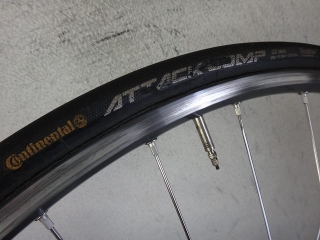
↑this is Attack Comp Tubular.
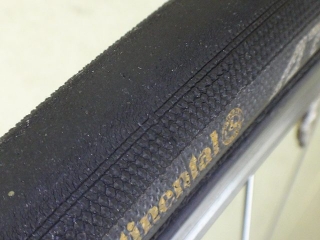
Center-slick with file-textured sides; the previous generation Competition PRO LTD
had a pattern very similar to this.

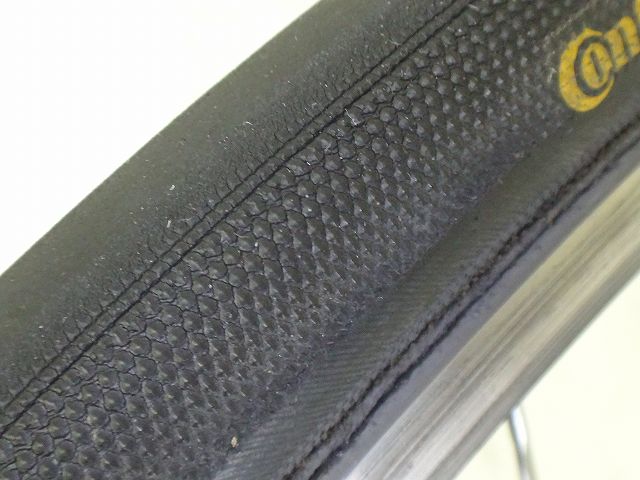
Looking at the file-textured side,
while the Competition has oval-shaped particles arranged in rows,
this one has diamond-shaped particles.
There's enough difference that the sound when you scratch it with your fingernail is different,
and my guess is that the previous-generation Competition PRO LTD's
file-textured side had oval particles.
Continental's Japanese distributors don't stock every Continental retail product as standard inventory.
For example, 700C clincher tubes come in the "Race 28 (28 inches ≈ 700C)" series,
but they stock the fairly thick Race 28,
the thinner and lighter Race 28 Lite
(which is about the same thickness and weight as Vittoria Ultra Light),
and the 25-32C wide Race 28 Wide, but they don't carry
the ultra-lightweight Race 28 Supersonic.
(They do carry the identically-named ultra-lightweight clincher tire Grand Prix Supersonic).
The Supersonic tube used to have serious issues with the valve base detaching,
and it would pinch on the rim during installation, causing frequent flats,
so it seems the distributors avoid stocking it for that reason.
With tires, Grand Prix GT, Gator Hardshell,
and Zonda Classe II also aren't stocked.
The first two clincher models probably aren't stocked because other models have overlapping character.
The Zonda Classe II is for six-day racing,
so it's hard to imagine it would sell in Japan.
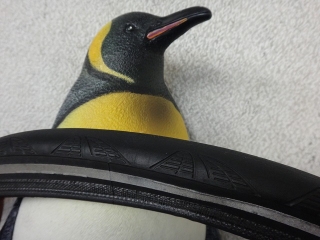
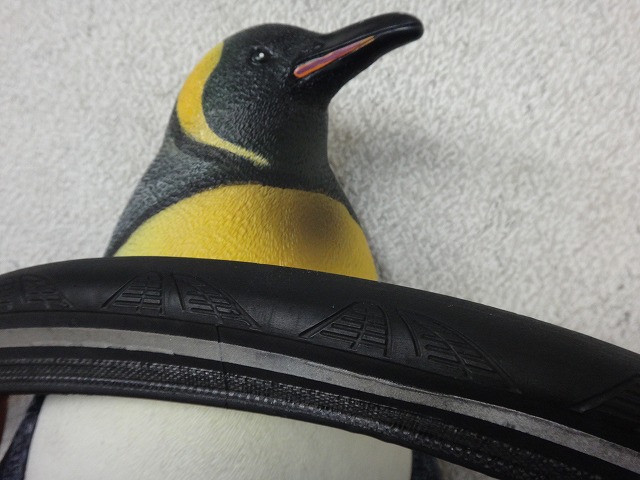
There's also a model called "Grand Prix 4000S II Reflex" with reflective tape on the sidewalls of the Grand Prix 4000S II,
but this also wasn't carried by Japanese distributors, as far as I know.
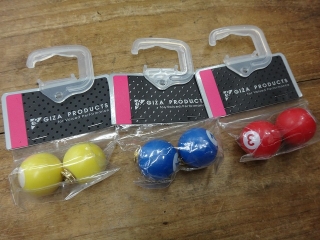
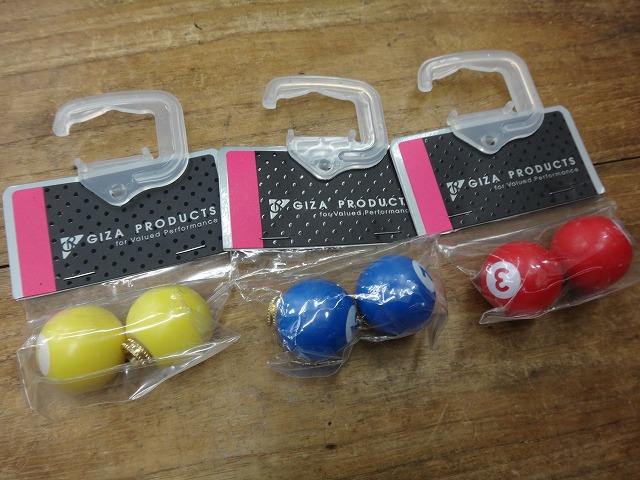
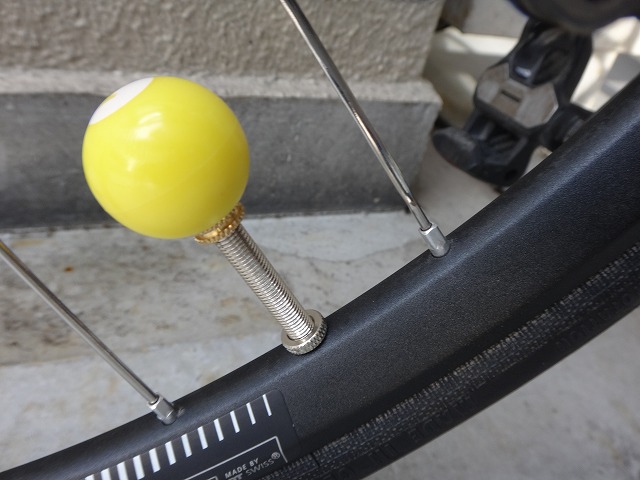
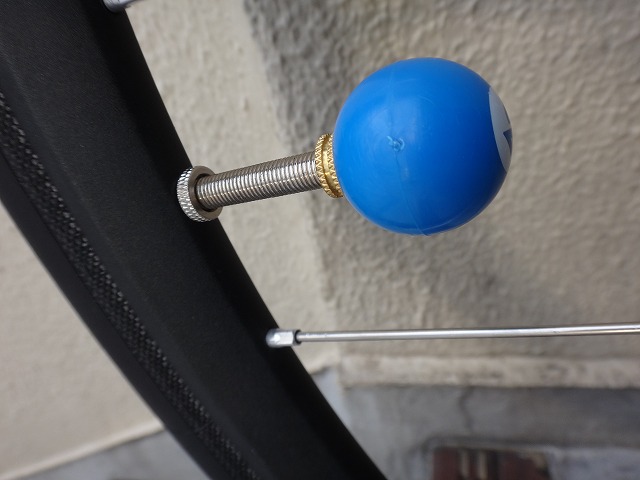
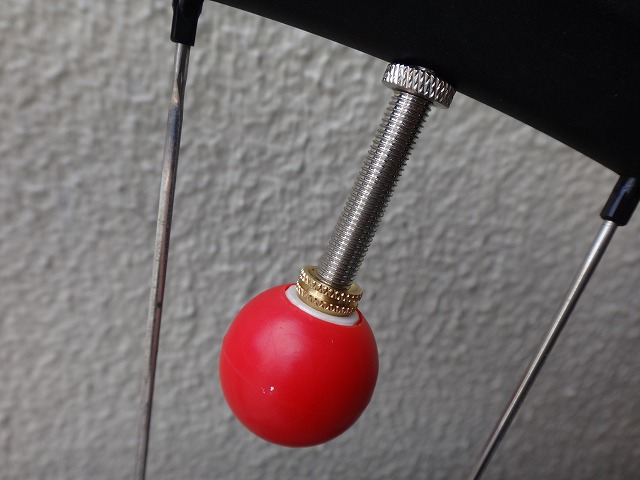
Changing topics, I found some billiard ball-themed
French valve caps and bought them.

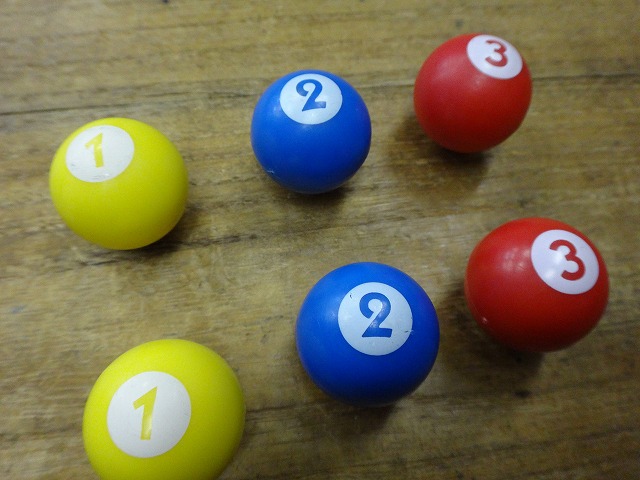
The distributor only had 5 types in stock: 1, 2, 3, 5, and 8.
Maybe other numbers existed in the past.
If only one type were to sell, it would probably be the 9 (nine ball),
so that one might have sold out previously.
I was glad numbers 1, 2, and 3 were still available.
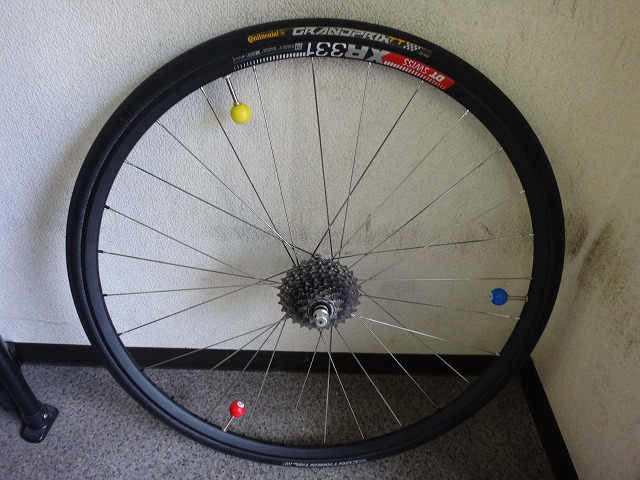
With these,
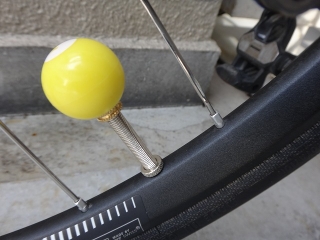
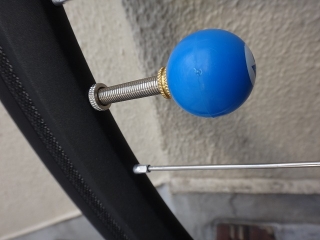
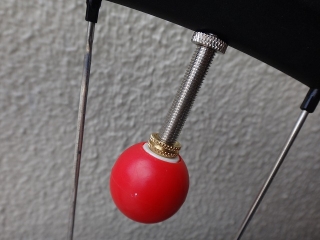
I can put numbers on each valve.
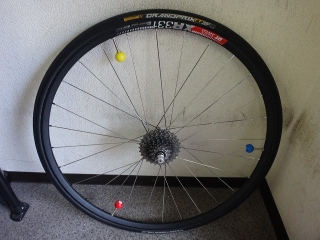
But at 11g each, I probably won't use them.
Anyway (no explanation whatsoever about the third valve),
for clincher wheels I used to run
Attack II on the front and Grand Prix 4000S II 23C on the rear.
Attack II was front-specific in 22C, and Force II was rear-specific in 24C,
but Attack/Force are now generation III,
with the front at 23C and rear at 25C, one size wider each.
And Grand Prix 4000S II has been discontinued.
So currently I run Grand Prix 5000 23C on the front
and either Grand Prix TT 23C or Gator Skin 23C on the rear,
changing the rear tire depending on conditions.
The Grand Prix TT is light at 177g actual weight in 23C (claimed 180g/23C),
with specs that are basically just Supersonic with a puncture-resistant belt added.
Grand Prix TT is center-slick plus thin file texture on the sides,
while Supersonic is full slick, so the tread patterns differ slightly.
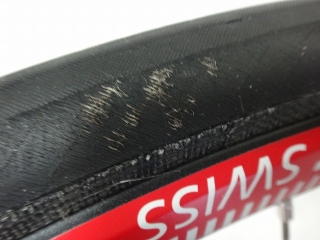
This is the previous generation Grand Prix TT from the photo earlier,
and the casing on the sidewall has fraying,
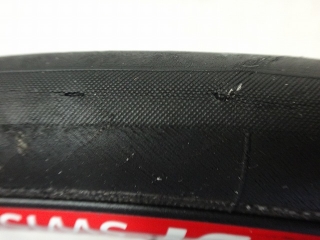
and the tread has small holes,

and you can see threads starting to show at the tire apex.
I normally replace tires early, but I didn't notice until it got like this.
It should have only been used for about 2,000 km or so.
It's light among tires you can use without too much worry,
and I do like it for rear wheel use.
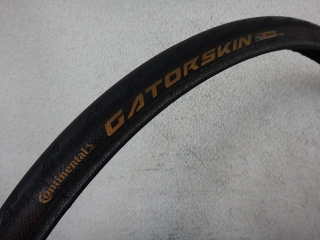
For durability-focused use, I use this Gator Skin.
A puncture-resistant belt called PolyExbraker is laid from under the tread all the way to the tire sidewall,
and it's genuinely very strong against punctures and tire cuts.
Continental tires once featured
Grand Prix 3000
Sprinter 2000
Sport 1000
as their three main models,
and Sport 1000 corresponds to today's Ultra Sport II.
Grand Prix has evolved beyond just 3000 → 4000 → 4000S → 4000S II → 5000;
there are now way too many derivative models.
Sprinter still has the model name remaining on tubular tires,
and there's a Sprinter Gator Skin model for tubular,
so perhaps the clincher Gator Skin is also at the Sprinter-equivalent grade.
The manufacturer positions it for fixed-gear, messenger, and casual city cycling use,
but at 220g claimed / 23C (227g actual), it's not that heavy,
so it works fine as a training tire for road bikes.
The next tier up is Grand Prix 4 Seasons, the Grand Prix-equivalent Gator Skin version,
which is 10g heavier than Gator Skin according to the specs.
Since it has Grand Prix-level tread,
the 4 Seasons should have superior grip performance.
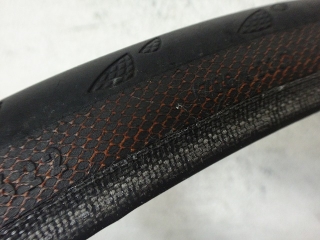
Both Gator Skin and Grand Prix 4 Seasons have PolyExbraker in brown color,
and some people apparently dislike this.
I don't mind it though.
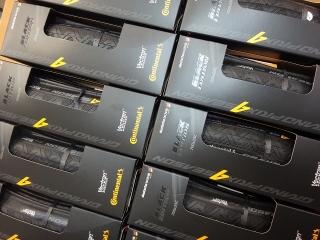
There's a limited Black Edition version of Grand Prix 4 Seasons.
This was once sold exclusively in North America,
and Japan received a small special shipment at one point (here),
but now it doesn't seem to be North America-exclusive anymore.
However, it's not listed on the home country website, so it remains a limited edition.
I purchased stock from the Japanese distributor a little while backafter being told I had to,
but since they sell steadily without any special promotion, I haven't featured them here.
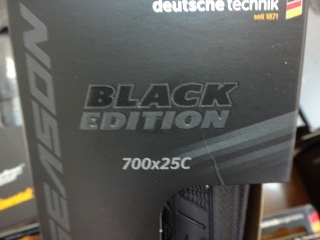
It's nice that the tire sidewall is black instead of brown, but it only comes in 25C.
So I won't be using it.
As mentioned in the linked article,
tires with PolyExbraker don't experience much tire widening from air pressure.
Separately, when I mount a new Gator Skin 23C on a DT XR331 rim
and inflate it to about 7 bar
(XR331 is actually a 29-inch MTB rim with a claimed max air pressure of 6.8 bar),
the relatively wide rim creates a stretched tire fit,
and the actual measured width becomes nearly 25C.
So the Grand Prix 4 Seasons 25C and Gator Skin 23C might not be that different in actual width
depending on which rim they're mounted on.
Though tire height and weight do differ.
the TdF LTD (Tour de France Limited).
It's an official licensed product.
In commemoration of this year's Tour de France total distance of 3,640 km,
production is limited to exactly 3,640 units,
but the Japanese wholesale distributor only received 100 units.
I think Japan is one of the countries where tubular tires sell well globally,
but 100 units is pretty scarce. With 2 tires making a pair and 100 units totaling 50 pairs,
if we divide them one pair per prefecture, they're basically all gone.
Back in the day, Shimano released a Dura-Ace 25th Anniversary limited edition
component set based on the 7700,
and pro riders were using them actively in competition back then.
This tire probably has some allocation reserved for pro use among those 3,640 units.

Available only in 25C width.
Sorry, but our stock has already sold out.
So there's no reason to post this article just to sell inventory.

The tread pattern is the same as the standard model,
but the TPI (threads per inch) is 200 on the TdF LTD compared to 180 on the standard model,
and because of that, the weight is lighter at 250g compared to 280g for the standard 25C.

TPI stands for threads per inch, the number of threads per inch,
and in the diagram above it shows 7 TPI.
The higher the TPI, the finer the threads in the tire's casing portion become,
which results in a thinner tire with better ride quality
and generally higher cornering performance limits, but

↑something like this (in reality the casing is several layers of fiber laid diagonally and alternately)
tire performance isn't determined by TPI alone.
With Vittoria road tires,
different models are made with TPI values of 26, 60, 150, 220, 290, and 320,
but you can't simply say that Vittoria's 320 is superior to Continental's 180.
However, if the same manufacturer makes tires with different TPI values,
the one with the higher TPI is a reasonable judgment as being better.
With this TdF LTD, the sidewalls are so much more supple compared to the standard model
that a 20-point TPI difference can't fully explain it—it feels like a completely different product.
Although it's a limited edition, the pricing is reasonable at just 500 yen higher than standard
(14,500 yen → 15,000 yen),
and honestly, even at 20,000 yen per tire, people would buy them.
Well, our shop's stock sold out anyway (second mention).
Bonus
A customer left us with a Continental
Competition PRO LTD (Pro Limited) 28C tubular tire.
Continental tubular tires
often have unusually small inner diameters, making them difficult to fit onto rims,
and this tendency is especially pronounced with 19C tires rather than individual variation.
The Podium TT and Competition 19C tires
are sized so differently from other widths
that you'd notice the difference immediately.
The Competition 22C and 25C are fairly tight to install on rims for beginners,
but in my case, I can mount them without using a tire stretcher (the device in the photo above).
Following this pattern, the thicker 28C Competition
(which is a non-retail version)
should theoretically be easier to fit on rims... but surprisingly,
the inner diameter is still small (though not as extreme as the 19C),
and with individual variation too, one of the two I had was particularly tight—I struggled quite a bit.
So that's why the customer asked me to stretch it, shown in the photo above.
This tire exists here because it's a pro team hand-me-down
(not a retail product, unavailable from Japanese distributors and not listed on the home country website),
and the customer purchased it in France.
The Competition PRO LTD tire
exists in multiple label generations and tread patterns.
Continental tire model name labels are positioned directly below the valve,
and on the opposite side (180 degrees away)
you'll find markings for Continental or German handmade,
but on this tire there are labels at three positions, each 120 degrees apart.
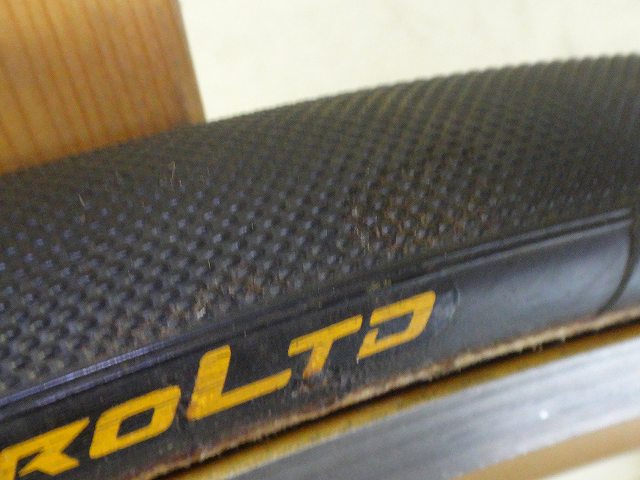
The tread pattern matches the standard model,
but pro teams apparently have center-slick or full-slick variants available.
In earlier generations of the Competition PRO LTD,
center-slick was the standard specification.
The front and rear specific tires "Attack Comp" (front) and "Force Comp" (rear)
have similar tread patterns.
To be thorough, Attack and Force
have completely different tread patterns between clincher (WO) and tubular versions.
The WO version is a slick tire with water channels on the sides,
with different channel patterns between front and rear,
while the tubular version has a center-slick with file-textured sides
and the same pattern on both front and rear.
In both WO and tubular versions, the front tire is narrower.
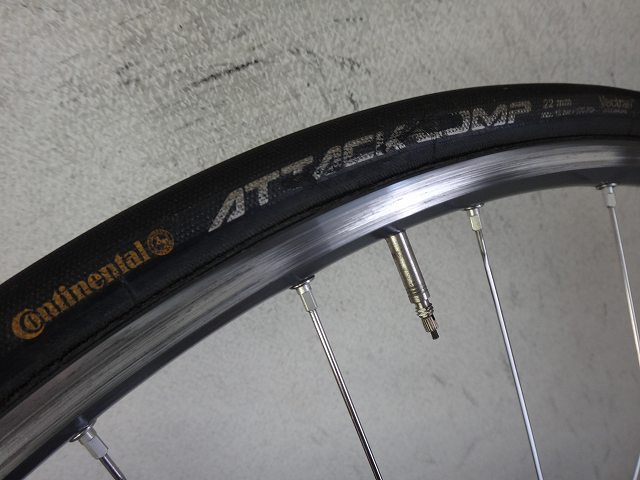
↑this is Attack Comp Tubular.
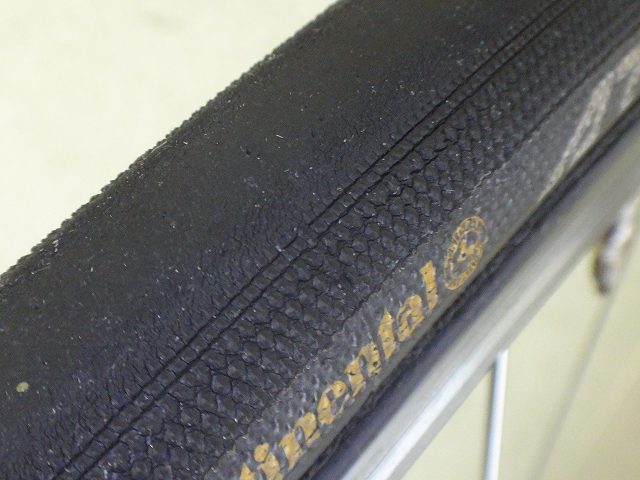
Center-slick with file-textured sides; the previous generation Competition PRO LTD
had a pattern very similar to this.
Looking at the file-textured side,
while the Competition has oval-shaped particles arranged in rows,
this one has diamond-shaped particles.
There's enough difference that the sound when you scratch it with your fingernail is different,
and my guess is that the previous-generation Competition PRO LTD's
file-textured side had oval particles.
Continental's Japanese distributors don't stock every Continental retail product as standard inventory.
For example, 700C clincher tubes come in the "Race 28 (28 inches ≈ 700C)" series,
but they stock the fairly thick Race 28,
the thinner and lighter Race 28 Lite
(which is about the same thickness and weight as Vittoria Ultra Light),
and the 25-32C wide Race 28 Wide, but they don't carry
the ultra-lightweight Race 28 Supersonic.
(They do carry the identically-named ultra-lightweight clincher tire Grand Prix Supersonic).
The Supersonic tube used to have serious issues with the valve base detaching,
and it would pinch on the rim during installation, causing frequent flats,
so it seems the distributors avoid stocking it for that reason.
With tires, Grand Prix GT, Gator Hardshell,
and Zonda Classe II also aren't stocked.
The first two clincher models probably aren't stocked because other models have overlapping character.
The Zonda Classe II is for six-day racing,
so it's hard to imagine it would sell in Japan.
There's also a model called "Grand Prix 4000S II Reflex" with reflective tape on the sidewalls of the Grand Prix 4000S II,
but this also wasn't carried by Japanese distributors, as far as I know.
Changing topics, I found some billiard ball-themed
French valve caps and bought them.
The distributor only had 5 types in stock: 1, 2, 3, 5, and 8.
Maybe other numbers existed in the past.
If only one type were to sell, it would probably be the 9 (nine ball),
so that one might have sold out previously.
I was glad numbers 1, 2, and 3 were still available.
With these,
I can put numbers on each valve.
But at 11g each, I probably won't use them.
Anyway (no explanation whatsoever about the third valve),
for clincher wheels I used to run
Attack II on the front and Grand Prix 4000S II 23C on the rear.
Attack II was front-specific in 22C, and Force II was rear-specific in 24C,
but Attack/Force are now generation III,
with the front at 23C and rear at 25C, one size wider each.
And Grand Prix 4000S II has been discontinued.
So currently I run Grand Prix 5000 23C on the front
and either Grand Prix TT 23C or Gator Skin 23C on the rear,
changing the rear tire depending on conditions.
The Grand Prix TT is light at 177g actual weight in 23C (claimed 180g/23C),
with specs that are basically just Supersonic with a puncture-resistant belt added.
Grand Prix TT is center-slick plus thin file texture on the sides,
while Supersonic is full slick, so the tread patterns differ slightly.
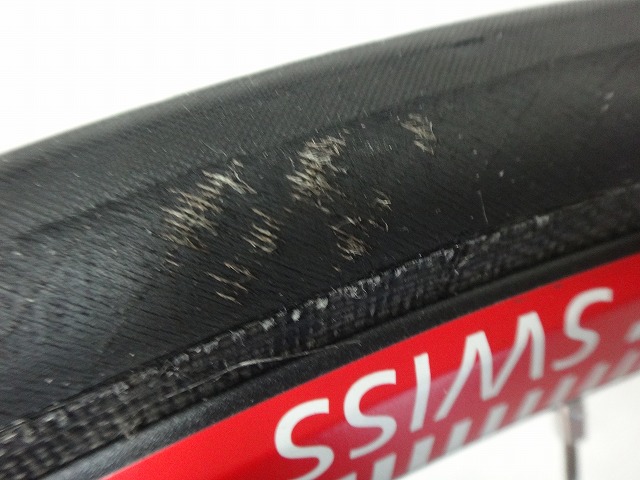
This is the previous generation Grand Prix TT from the photo earlier,
and the casing on the sidewall has fraying,
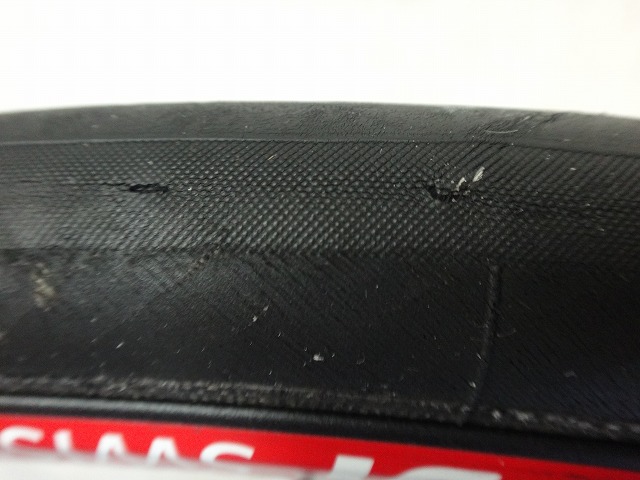
and the tread has small holes,
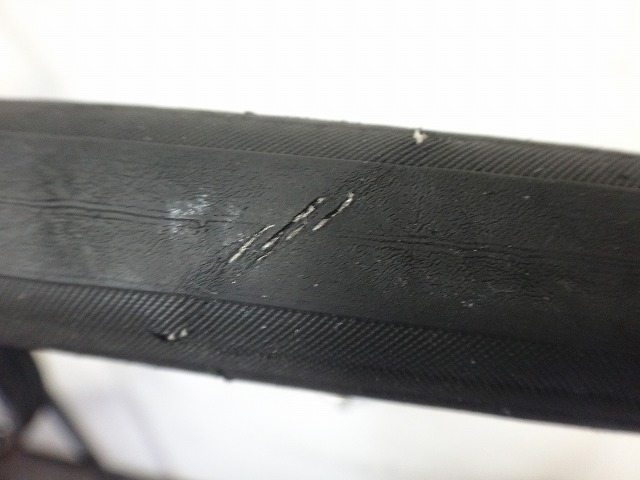
and you can see threads starting to show at the tire apex.
I normally replace tires early, but I didn't notice until it got like this.
It should have only been used for about 2,000 km or so.
It's light among tires you can use without too much worry,
and I do like it for rear wheel use.
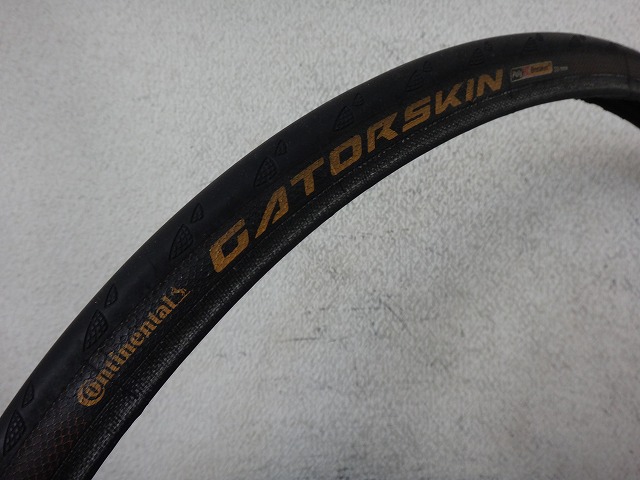
For durability-focused use, I use this Gator Skin.
A puncture-resistant belt called PolyExbraker is laid from under the tread all the way to the tire sidewall,
and it's genuinely very strong against punctures and tire cuts.
Continental tires once featured
Grand Prix 3000
Sprinter 2000
Sport 1000
as their three main models,
and Sport 1000 corresponds to today's Ultra Sport II.
Grand Prix has evolved beyond just 3000 → 4000 → 4000S → 4000S II → 5000;
there are now way too many derivative models.
Sprinter still has the model name remaining on tubular tires,
and there's a Sprinter Gator Skin model for tubular,
so perhaps the clincher Gator Skin is also at the Sprinter-equivalent grade.
The manufacturer positions it for fixed-gear, messenger, and casual city cycling use,
but at 220g claimed / 23C (227g actual), it's not that heavy,
so it works fine as a training tire for road bikes.
The next tier up is Grand Prix 4 Seasons, the Grand Prix-equivalent Gator Skin version,
which is 10g heavier than Gator Skin according to the specs.
Since it has Grand Prix-level tread,
the 4 Seasons should have superior grip performance.
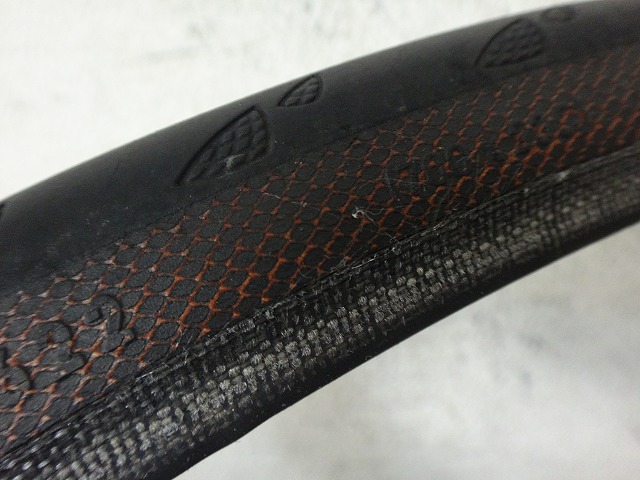
Both Gator Skin and Grand Prix 4 Seasons have PolyExbraker in brown color,
and some people apparently dislike this.
I don't mind it though.
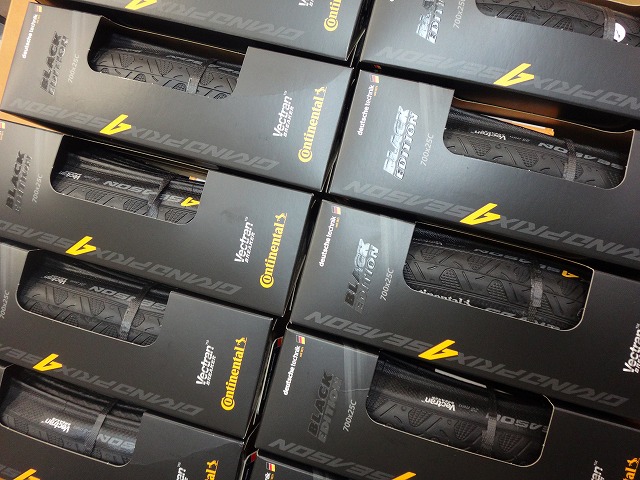
There's a limited Black Edition version of Grand Prix 4 Seasons.
This was once sold exclusively in North America,
and Japan received a small special shipment at one point (here),
but now it doesn't seem to be North America-exclusive anymore.
However, it's not listed on the home country website, so it remains a limited edition.
I purchased stock from the Japanese distributor a little while back
but since they sell steadily without any special promotion, I haven't featured them here.
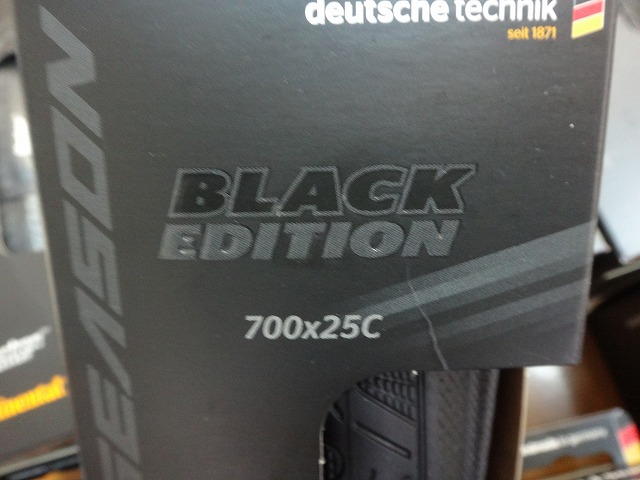
It's nice that the tire sidewall is black instead of brown, but it only comes in 25C.
So I won't be using it.
As mentioned in the linked article,
tires with PolyExbraker don't experience much tire widening from air pressure.
Separately, when I mount a new Gator Skin 23C on a DT XR331 rim
and inflate it to about 7 bar
(XR331 is actually a 29-inch MTB rim with a claimed max air pressure of 6.8 bar),
the relatively wide rim creates a stretched tire fit,
and the actual measured width becomes nearly 25C.
So the Grand Prix 4 Seasons 25C and Gator Skin 23C might not be that different in actual width
depending on which rim they're mounted on.
Though tire height and weight do differ.