One of the early computer RPG titles is
Wizardry,
and among the monsters that appear in it is ARCH MAGE
(the original Apple II version is all uppercase,
the Famicom version only in version 1 even with English settings remains all uppercase).
Mage means magician,
but arch here is a prefix meaning "chief" or "head."
When transcribing this into katakana, it's often written as "アーク" (aku),
and this allows expressions like Arch Mage, Arch Angel, and Arch Demon to indicate
higher-ranking monsters,
but when the prefix arch is pronounced "アーク,"
this only happens when the following word begins with a vowel—
in other words, from the examples above, only arch angel should be written as アークエンジェル (aku-eenjeru),
while the others should more accurately be written as アーチメイジ (aachi-meiji) and アーチデーモン (aachi-deemon)
(though it's impossible to transcribe English pronunciation into katakana with complete accuracy).
Perhaps knowing this, the Famicom version of Wizardry 1
translated ARCH MAGE as アーチメイジ (aachi-meiji),
but from the second game onward it was changed to アークメイジ (aku-meiji).
I mention "second game onward" because the PC and Famicom versions
have the order of 2 and 3 reversed (PC version 2 is Famicom version 3).
Dragon Quest 3 also has a monster whose name derives from arch mage,
and it was given the name アークマージ (aku-maaji).
The localized versions of Dragon Quest that launched overseas
(or rather in America)were initially called DRAGON WARRIOR.
There was already a tabletop RPG called Dragon Quest in America,
so the name DRAGON QUEST couldn't be used.
In October 2003, the rights issues were resolved and
the overseas version of Dragon Quest also became DRAGON QUEST
(Square and Enix merged in April 2003).
The text in the NES (Nintendo Entertainment System—the overseas Famicom) version
of DRAGON WARRIOR I uses
archaic English words from the time of Shakespeare.
In Dragon Quest 1, when you die the text reads "You have died,"
but in the NES version this becomes "Thou art dead" instead of "You are dead."
Dragon Quest was "influenced by" another early computer RPG called Ultima
(that's the diplomatic way to put it),
and even early Ultima games use archaic English words.
For example, when you enter a pub in Scenario 1, pay for a drink, and listen for information,
the text reads "Thou had best know~(You should know~!)."
I don't know whether Dragon Quest 1's localization was done by a Japanese or American person,
but perhaps they were trying to capture that Ultima-like atmosphere.
Getting back to arch—
the noun "arch" referring to bridge structures or gate shapes is pronounced "アーチ" (aachi).
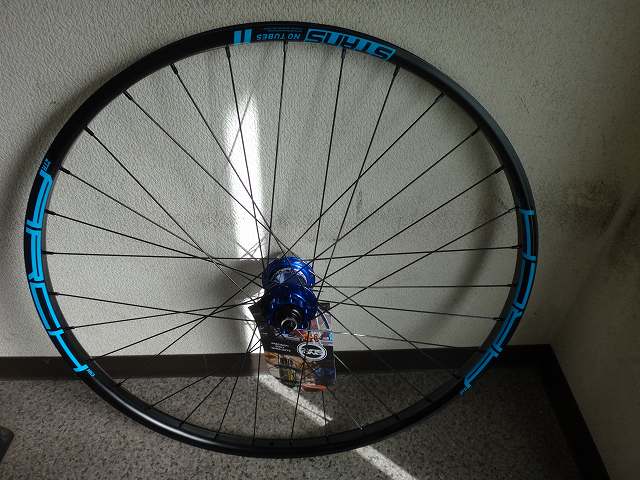
I received hand-built wheels made in-house by Chris King from a customer.
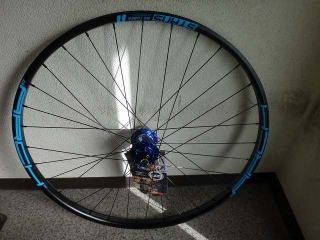
The rim is a Stan's ARCH MK3,
and naturally the hub is Chris King with ISO hubs.
About this rim—whether it's pronounced arch or ark (probably arch)—
I wasn't entirely sure, so in these cases it's faster to watch videos from English-speaking sources.
...No matter how I listened, it sounded more like "aachi," so I'll go with that.
By the way, the MK3 part is pronounced
as E-mu-kay-thee, not mark three.
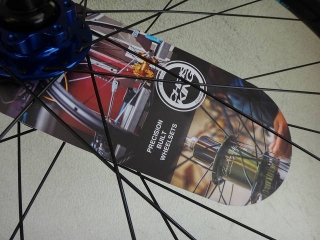
Both wheels are 32H, all-black laced with 6x6 reverse Italian pattern.
Only the rear hub has a "fancy badge,"
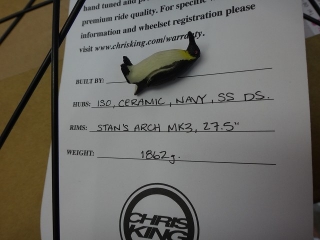
and it bears the builder's signature (just to be clear,
there isn't actually a penguin printed on the signature area).
The rear wheel had no centering drift and virtually no wobble.
Well, it certainly deserves that fancy badge!
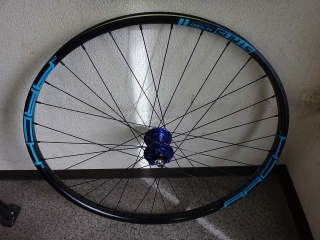
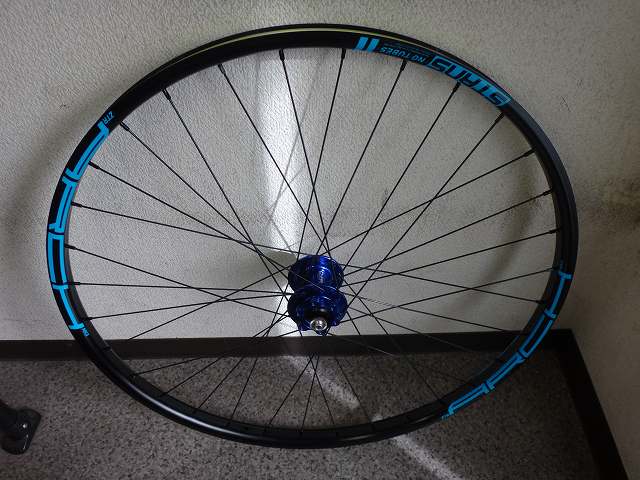
Now the front wheel.
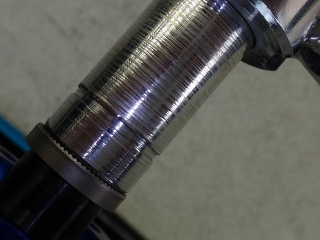
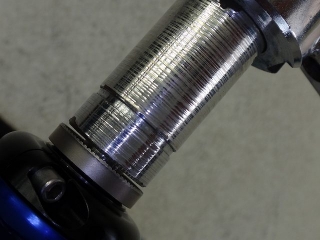
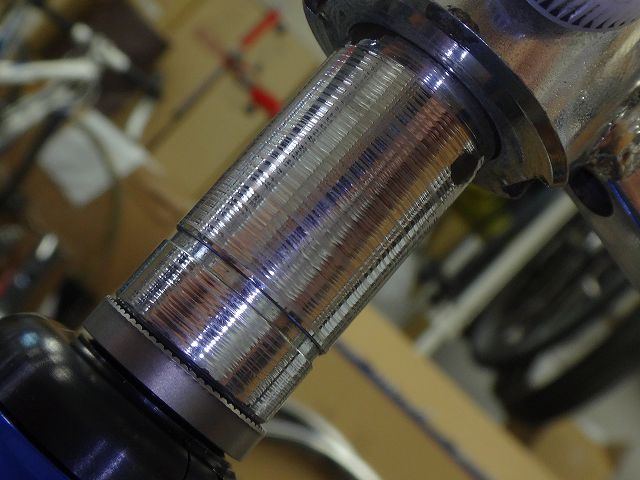
It's off center!
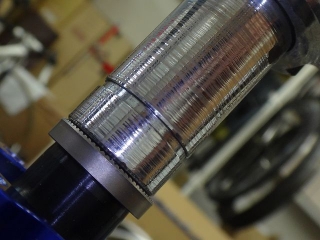
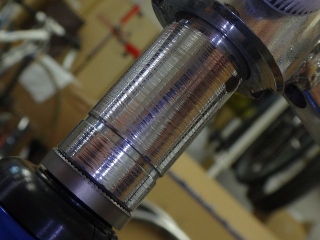
Fixed it!
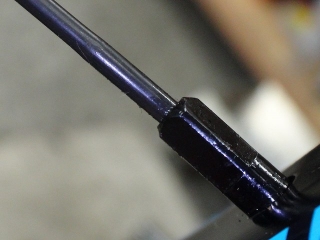
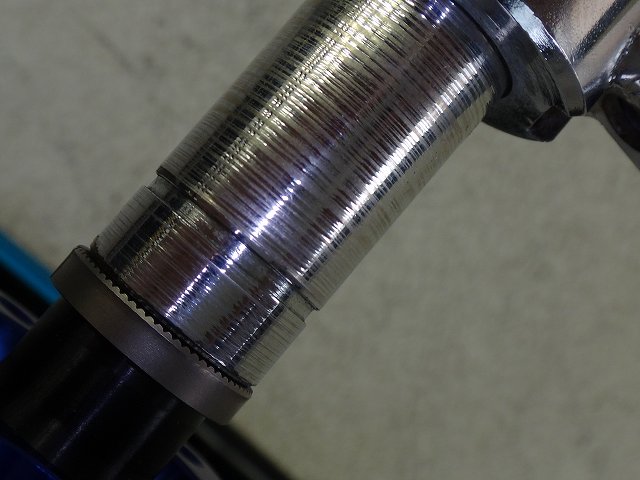
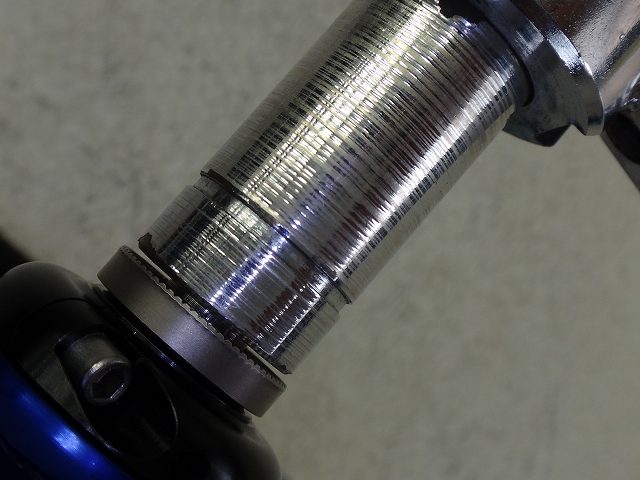
These are Sapim Race spokes, and while they have the same dimensions for butted and non-butted sections
as DT Competition spokes,
the proportion (length) of the non-butted section differs.
As you can see, the butting begins right around the nipple area,
and they're light enough to show up in spoke weight figures compared to Competition,
but from a certain length onward the range achievable with a spoke cutter becomes narrow,
so I tend to use Competition more often.
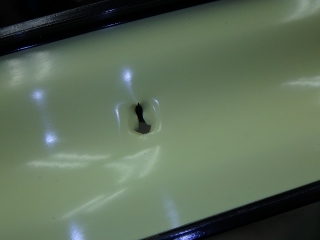
↑Front wheel
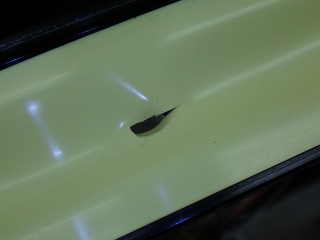
↑Rear wheel
The Stan's rim tape was applied single layer (double layer only near the valve hole),
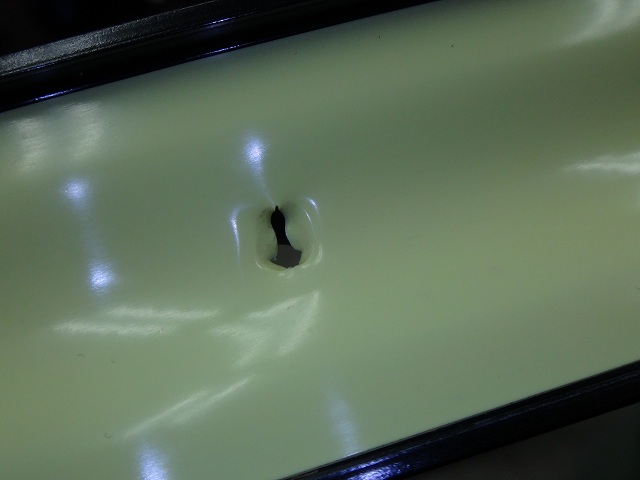
but the way the hole was cut wasn't very good.
On the front wheel it's shifted laterally,
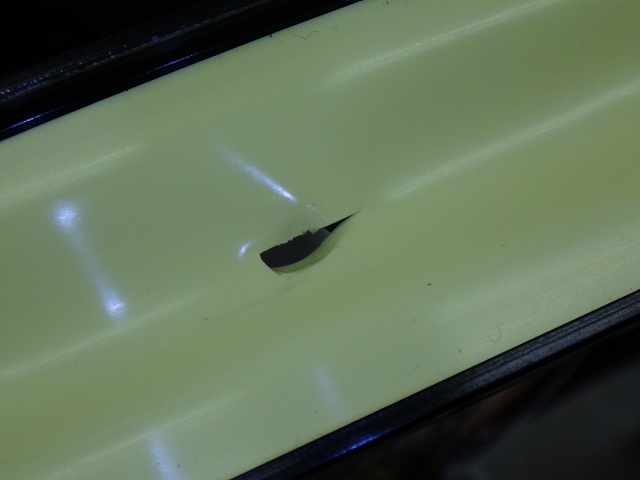
and on the rear wheel when you insert the valve
the tape could split sharply in the front-to-back direction
(if that happens it causes air leaks, so the tape would need to be replaced).
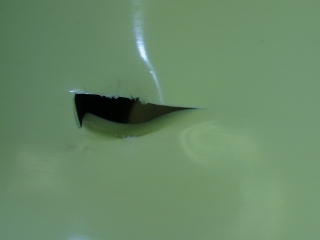
Plus it's slightly off-center from the valve hole center.
On each one, from this state I drilled a circular hole at the valve center using the heat of a soldering iron.
I was able to get the rear rim to work without replacing the tape.
Stan's tubeless tape melts from soldering iron heat.
Some manufacturers (like DT and Mavic) make rim tape that doesn't melt,
but with the type that melts, the double-layer portions get welded together by the heat.
Wizardry,
and among the monsters that appear in it is ARCH MAGE
(the original Apple II version is all uppercase,
the Famicom version only in version 1 even with English settings remains all uppercase).
Mage means magician,
but arch here is a prefix meaning "chief" or "head."
When transcribing this into katakana, it's often written as "アーク" (aku),
and this allows expressions like Arch Mage, Arch Angel, and Arch Demon to indicate
higher-ranking monsters,
but when the prefix arch is pronounced "アーク,"
this only happens when the following word begins with a vowel—
in other words, from the examples above, only arch angel should be written as アークエンジェル (aku-eenjeru),
while the others should more accurately be written as アーチメイジ (aachi-meiji) and アーチデーモン (aachi-deemon)
(though it's impossible to transcribe English pronunciation into katakana with complete accuracy).
Perhaps knowing this, the Famicom version of Wizardry 1
translated ARCH MAGE as アーチメイジ (aachi-meiji),
but from the second game onward it was changed to アークメイジ (aku-meiji).
I mention "second game onward" because the PC and Famicom versions
have the order of 2 and 3 reversed (PC version 2 is Famicom version 3).
Dragon Quest 3 also has a monster whose name derives from arch mage,
and it was given the name アークマージ (aku-maaji).
The localized versions of Dragon Quest that launched overseas
(or rather in America)were initially called DRAGON WARRIOR.
There was already a tabletop RPG called Dragon Quest in America,
so the name DRAGON QUEST couldn't be used.
In October 2003, the rights issues were resolved and
the overseas version of Dragon Quest also became DRAGON QUEST
(Square and Enix merged in April 2003).
The text in the NES (Nintendo Entertainment System—the overseas Famicom) version
of DRAGON WARRIOR I uses
archaic English words from the time of Shakespeare.
In Dragon Quest 1, when you die the text reads "You have died,"
but in the NES version this becomes "Thou art dead" instead of "You are dead."
Dragon Quest was "influenced by" another early computer RPG called Ultima
(that's the diplomatic way to put it),
and even early Ultima games use archaic English words.
For example, when you enter a pub in Scenario 1, pay for a drink, and listen for information,
the text reads "Thou had best know~(You should know~!)."
I don't know whether Dragon Quest 1's localization was done by a Japanese or American person,
but perhaps they were trying to capture that Ultima-like atmosphere.
Getting back to arch—
the noun "arch" referring to bridge structures or gate shapes is pronounced "アーチ" (aachi).
I received hand-built wheels made in-house by Chris King from a customer.
The rim is a Stan's ARCH MK3,
and naturally the hub is Chris King with ISO hubs.
About this rim—whether it's pronounced arch or ark (probably arch)—
I wasn't entirely sure, so in these cases it's faster to watch videos from English-speaking sources.
...No matter how I listened, it sounded more like "aachi," so I'll go with that.
By the way, the MK3 part is pronounced
as E-mu-kay-thee, not mark three.

Both wheels are 32H, all-black laced with 6x6 reverse Italian pattern.
Only the rear hub has a "fancy badge,"

and it bears the builder's signature (just to be clear,
there isn't actually a penguin printed on the signature area).
The rear wheel had no centering drift and virtually no wobble.
Well, it certainly deserves that fancy badge!
Now the front wheel.
It's off center!

Fixed it!

These are Sapim Race spokes, and while they have the same dimensions for butted and non-butted sections
as DT Competition spokes,
the proportion (length) of the non-butted section differs.
As you can see, the butting begins right around the nipple area,
and they're light enough to show up in spoke weight figures compared to Competition,
but from a certain length onward the range achievable with a spoke cutter becomes narrow,
so I tend to use Competition more often.
↑Front wheel
↑Rear wheel
The Stan's rim tape was applied single layer (double layer only near the valve hole),
but the way the hole was cut wasn't very good.
On the front wheel it's shifted laterally,
and on the rear wheel when you insert the valve
the tape could split sharply in the front-to-back direction
(if that happens it causes air leaks, so the tape would need to be replaced).
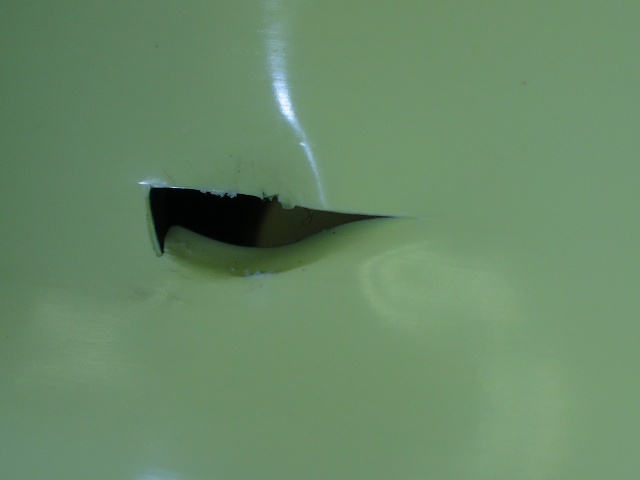
Plus it's slightly off-center from the valve hole center.
On each one, from this state I drilled a circular hole at the valve center using the heat of a soldering iron.
I was able to get the rear rim to work without replacing the tape.
Stan's tubeless tape melts from soldering iron heat.
Some manufacturers (like DT and Mavic) make rim tape that doesn't melt,
but with the type that melts, the double-layer portions get welded together by the heat.