In my previous article, I ended up writing so much about ZIPP hubs
that it became longer than the main topic (which happens often),
so I've separated it into its own post.
For this revision, I'm including photos of the hubs from my own collection.
ZIPP calls itself "ZIPP SPEED WEAPONRY," naming their competition equipment after weapons,
and ZIPP's first hub was a model called the Ballistic hub
that debuted in 1992.
The Ballistic hub featured a thick carbon body with gold-anodized flanges,
with a catalog weight of 110g for the front hub and 305g for the rear,
so following the naming convention of later models, it would be called a 110/305 hub.
The next was the 104/295 hub from 1993–1995,
which had different bearing sizes and end shapes,
but the hub body was the same as the Ballistic,
and the anodize color changed to gray.


↑This is the 104 front hub.
Specification-wise, it's almost identical to the Ballistic hub.
Next came the 100/217 hub from 1995–1999,
with the flange anodize color the same as the previous model
but a thinner carbon hub body.
The bearing size was significantly reduced,
so the rear hub in particular became much lighter.

↑This isn't from my collection
but the front wheel brought in by the customer from my previous article,
with a 100 front hub before disassembly.
As a 1998 model, there was a 182/377 hub
with an hourglass-shaped aluminum hub body emphasizing durability, but I rarely see them.
All of these up to this point were hubs for crankset spokes.
The 1999–2001 model was
a straight-spoke hub with black-anodized hub body:
the 102/282.
The rear hub is dedicated to radial lacing on the non-freewheel side.
From 2002–2005 came the 84/202 hub,
with decorative carbon end caps on both sides of the front hub and the left side of the rear hub
that barely function as dust seals.
The hub body became silver-colored.
By this era, ZIPP's rims already had dimple processing,
but when I suggested adding dimples to the hub body too,
ZIPP's worldwide dealers meeting rejected it, saying
"the hub body gets filthy" — so the idea was abandoned.
Concurrent with the 84/202 hub, with the same finish
and compatible hub axles and freewheel bodies,
was the 95/220 hub for crankset spokes.
The front hub has slightly larger flanges,
and the rear hub is high-low flange.
The 2006–2008 model was the 82/182 hub,
which looks almost identical to the previous version with only minor weight savings,
but the freewheel body is incompatible with the previous model (the pawl spring shape differs),
and the freewheel body anodize color became
red anodize for Shimano and blue anodize for Campagnolo.
Concurrent with the 82/182 hub, with the same finish
and compatible hub axles and freewheel bodies,
was the 108/208 hub for crankset spokes.
Why did the front get heavier than before?

↑This is the 208 hub.

There are decorative end caps that barely function as dust seals,
but they're held by the axle nut, so
this cap doesn't rotate along with the wheel.
The gaps in the cap are too large,
but there is one seal ahead of the bearing,
so the bearings aren't completely exposed.
The 2009 model was the 88/188 hub,
with equal-diameter large flanges on both sides
(the rear hub doesn't look particularly large at the spoke root)
and radial lacing on the freewheel side.
Dimensionally it's a problematic hub, and it ended up being incompatible with Shimano 11-speed,
but even aside from that, the rear wheel was often loose,
so customers frequently asked me to rebuild it — that rear hub had a reputation for looseness.
The next model also has the model name 88/188,
so this became distinguished as the V7 88/188 after the fact.
As the flagship road hub excluding models like the 182/377 and the 145 (suspension front hub for MTB※),
it represents Version 7.
※A suspension front hub is something that emerged
when front suspension forks started appearing on MTBs.
There was concern that "the old front hubs won't survive the shock and will break,"
so hubs were made with larger hub bodies, axle diameters, and bearing sizes.
Sunツアー made them too.
If someone unfamiliar hears about them, they might think
"a hub with built-in suspension mechanism" — just to clarify, that's not what it is.
In ZIPP's case, there was a grease port,
allowing the hub to be packed with grease.
As for Sunツアー... even their XC Pro hub (what Shimano calls XTR today),
which isn't a suspension hub,
had a grease port.

↑This is the V7 188 hub.
Just to clarify: I'm not actively hoarding these.
Basically customers take them home,
but I only keep them if the customer says "I don't need it."
So I've actually rebuilt more than what's shown here.
The V7 188 rear hub, by late 2011,
had the non-freewheel bearing width increased (officially 7.5mm),
and besides gray, black hubs also came out.
With the same spoke tension, it had 6% higher stiffness, though I'm not sure how they calculated that 6%,
but it was definitely stronger.
Before that, they were doing freewheel-side radial lacing
with steel spokes, which is wrong,
and ZIPP itself doesn't use it in current models and has "forgotten" about it.
But if you're going to do it, why not do it from the start?
Despite ZIPP changing hub dimensions and shapes so frequently,
they haven't made improvements that really contribute to wheel stiffness.
Probably because they're too focused on aerodynamics.
In 2013, the V8 88/188 hub came out.
Strictly speaking, only the 188 hub changed,
but the V7 88 front hub had a recall,
and the corrected V7 88 and V8 188 rear hub were paired at that time, so
the corrected V7 88 is essentially V8 88.
The V8 188 became compatible with Shimano 11-speed,
but even then, there were still rebuild requests saying "fix this loose rear wheel,"
so ZIPP rear wheels aren't just rebuilt "because we want to go 11-speed"
— they're genuinely problematic.

This is the V8 188 hub.

The flange width isn't much different from V7, but

the bearing width is different.
This shifts the thread position on the hub axle,
so the hub axles are not compatible.

From V8 onward, Shimano 11-speed compatibility is standard.
In early 2014, only the rear hub became V9 188.
It uses tangent lacing on both sides.
By late 2014, the V9 88 front hub appeared.
This meant that if you bought a complete wheelset in early 2014,
you could get "a corrected V7 88 front hub with a V9 188 rear hub"
— a possibility.

↑This is the V9 188 hub.

V7 and V8 used flange rings that were held in place by spoke tension pressing the flanges outward,
but occasionally they'd pop off from a buckling impact,
and then you'd have to fully release one side's tension just to reinstall it — a troublesome little part.
Because it's a "hook" design rather than a "through" design,
if a spoke broke on the front wheel, for example, and there was no ring,
spokes could cascade off, so it is a functional part.
If this flange had been a through design,
with these dimensions, spokes couldn't pass through,
or at minimum the hub axle would need to be removed,
so maybe that's why they went with hook + flange ring.

With V9, the freewheel side also uses tangent lacing.
It's still a hook design, but the spoke head
seats deeper in the flange.
In 2015, it became the 77/177 hub set,
and from this point, single hub sales ended,
so the model name only exists as the hub designation on complete wheels.
The area around the front hub flanges became extremely robust.
Also, it obviously doesn't look 77g, so I checked and found
the 77 front hub's catalog weight is 110g
and the 177 rear hub is 250g.
Also in 2015, a hub called the Cognition hub
debuted as exclusive to the 808 NSW rim,
and in current models, ZIPP uses a 77/177 hub for Firecrest rim wheels
and the Cognition hub for NSW wheels (rims that look jagged from the side).
that it became longer than the main topic (which happens often),
so I've separated it into its own post.
For this revision, I'm including photos of the hubs from my own collection.
ZIPP calls itself "ZIPP SPEED WEAPONRY," naming their competition equipment after weapons,
and ZIPP's first hub was a model called the Ballistic hub
that debuted in 1992.
The Ballistic hub featured a thick carbon body with gold-anodized flanges,
with a catalog weight of 110g for the front hub and 305g for the rear,
so following the naming convention of later models, it would be called a 110/305 hub.
The next was the 104/295 hub from 1993–1995,
which had different bearing sizes and end shapes,
but the hub body was the same as the Ballistic,
and the anodize color changed to gray.
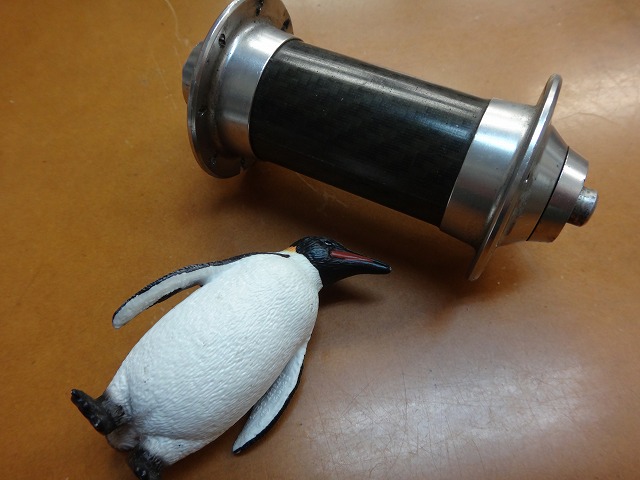

↑This is the 104 front hub.
Specification-wise, it's almost identical to the Ballistic hub.
Next came the 100/217 hub from 1995–1999,
with the flange anodize color the same as the previous model
but a thinner carbon hub body.
The bearing size was significantly reduced,
so the rear hub in particular became much lighter.
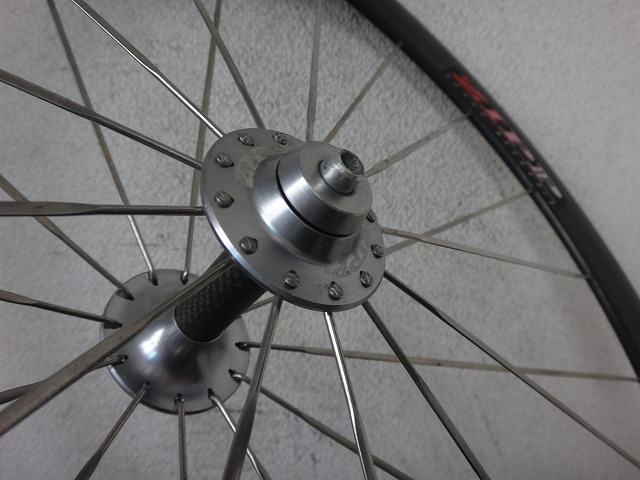
↑This isn't from my collection
but the front wheel brought in by the customer from my previous article,
with a 100 front hub before disassembly.
As a 1998 model, there was a 182/377 hub
with an hourglass-shaped aluminum hub body emphasizing durability, but I rarely see them.
All of these up to this point were hubs for crankset spokes.
The 1999–2001 model was
a straight-spoke hub with black-anodized hub body:
the 102/282.
The rear hub is dedicated to radial lacing on the non-freewheel side.
From 2002–2005 came the 84/202 hub,
with decorative carbon end caps on both sides of the front hub and the left side of the rear hub
that barely function as dust seals.
The hub body became silver-colored.
By this era, ZIPP's rims already had dimple processing,
but when I suggested adding dimples to the hub body too,
ZIPP's worldwide dealers meeting rejected it, saying
"the hub body gets filthy" — so the idea was abandoned.
Concurrent with the 84/202 hub, with the same finish
and compatible hub axles and freewheel bodies,
was the 95/220 hub for crankset spokes.
The front hub has slightly larger flanges,
and the rear hub is high-low flange.
The 2006–2008 model was the 82/182 hub,
which looks almost identical to the previous version with only minor weight savings,
but the freewheel body is incompatible with the previous model (the pawl spring shape differs),
and the freewheel body anodize color became
red anodize for Shimano and blue anodize for Campagnolo.
Concurrent with the 82/182 hub, with the same finish
and compatible hub axles and freewheel bodies,
was the 108/208 hub for crankset spokes.
Why did the front get heavier than before?

↑This is the 208 hub.

There are decorative end caps that barely function as dust seals,
but they're held by the axle nut, so
this cap doesn't rotate along with the wheel.
The gaps in the cap are too large,
but there is one seal ahead of the bearing,
so the bearings aren't completely exposed.
The 2009 model was the 88/188 hub,
with equal-diameter large flanges on both sides
(the rear hub doesn't look particularly large at the spoke root)
and radial lacing on the freewheel side.
Dimensionally it's a problematic hub, and it ended up being incompatible with Shimano 11-speed,
but even aside from that, the rear wheel was often loose,
so customers frequently asked me to rebuild it — that rear hub had a reputation for looseness.
The next model also has the model name 88/188,
so this became distinguished as the V7 88/188 after the fact.
As the flagship road hub excluding models like the 182/377 and the 145 (suspension front hub for MTB※),
it represents Version 7.
※A suspension front hub is something that emerged
when front suspension forks started appearing on MTBs.
There was concern that "the old front hubs won't survive the shock and will break,"
so hubs were made with larger hub bodies, axle diameters, and bearing sizes.
Sunツアー made them too.
If someone unfamiliar hears about them, they might think
"a hub with built-in suspension mechanism" — just to clarify, that's not what it is.
In ZIPP's case, there was a grease port,
allowing the hub to be packed with grease.
As for Sunツアー... even their XC Pro hub (what Shimano calls XTR today),
which isn't a suspension hub,
had a grease port.

↑This is the V7 188 hub.
Just to clarify: I'm not actively hoarding these.
Basically customers take them home,
but I only keep them if the customer says "I don't need it."
So I've actually rebuilt more than what's shown here.
The V7 188 rear hub, by late 2011,
had the non-freewheel bearing width increased (officially 7.5mm),
and besides gray, black hubs also came out.
With the same spoke tension, it had 6% higher stiffness, though I'm not sure how they calculated that 6%,
but it was definitely stronger.
with steel spokes, which is wrong,
and ZIPP itself doesn't use it in current models and has "forgotten" about it.
But if you're going to do it, why not do it from the start?
Despite ZIPP changing hub dimensions and shapes so frequently,
they haven't made improvements that really contribute to wheel stiffness.
Probably because they're too focused on aerodynamics.
In 2013, the V8 88/188 hub came out.
Strictly speaking, only the 188 hub changed,
but the V7 88 front hub had a recall,
and the corrected V7 88 and V8 188 rear hub were paired at that time, so
the corrected V7 88 is essentially V8 88.
The V8 188 became compatible with Shimano 11-speed,
but even then, there were still rebuild requests saying "fix this loose rear wheel,"
so ZIPP rear wheels aren't just rebuilt "because we want to go 11-speed"
— they're genuinely problematic.

This is the V8 188 hub.

The flange width isn't much different from V7, but

the bearing width is different.
This shifts the thread position on the hub axle,
so the hub axles are not compatible.

From V8 onward, Shimano 11-speed compatibility is standard.
In early 2014, only the rear hub became V9 188.
It uses tangent lacing on both sides.
By late 2014, the V9 88 front hub appeared.
This meant that if you bought a complete wheelset in early 2014,
you could get "a corrected V7 88 front hub with a V9 188 rear hub"
— a possibility.

↑This is the V9 188 hub.

V7 and V8 used flange rings that were held in place by spoke tension pressing the flanges outward,
but occasionally they'd pop off from a buckling impact,
and then you'd have to fully release one side's tension just to reinstall it — a troublesome little part.
Because it's a "hook" design rather than a "through" design,
if a spoke broke on the front wheel, for example, and there was no ring,
spokes could cascade off, so it is a functional part.
If this flange had been a through design,
with these dimensions, spokes couldn't pass through,
or at minimum the hub axle would need to be removed,
so maybe that's why they went with hook + flange ring.

With V9, the freewheel side also uses tangent lacing.
It's still a hook design, but the spoke head
seats deeper in the flange.
In 2015, it became the 77/177 hub set,
and from this point, single hub sales ended,
so the model name only exists as the hub designation on complete wheels.
The area around the front hub flanges became extremely robust.
Also, it obviously doesn't look 77g, so I checked and found
the 77 front hub's catalog weight is 110g
and the 177 rear hub is 250g.
Also in 2015, a hub called the Cognition hub
debuted as exclusive to the 808 NSW rim,
and in current models, ZIPP uses a 77/177 hub for Firecrest rim wheels
and the Cognition hub for NSW wheels (rims that look jagged from the side).