I've stocked the Shimano front derailleur band, the SM-AD91.
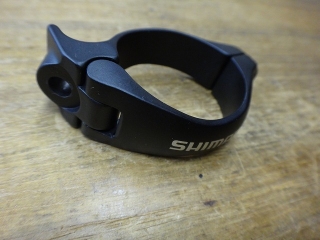
↑This one
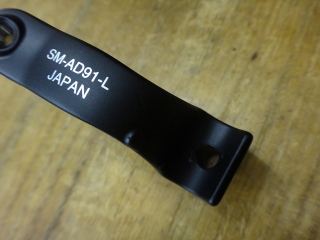
To be precise, it's SM-AD91-L as indicated on the band itself.
The letter at the end comes in three types: S/M/L,
representing seat tube diameters of 28.6mm/31.8mm/34.9mm respectively.
For the 28.6mm case, a spacer is used with the 31.8mm band.
Since electric drivetrains appeared, there are four types of front derailleur bands:
SM-AD79, 67, 90, and 91, but only the first SM-AD79 comes in three types: L, M, and MS.
MS is specified as "31.8mm diameter + spacer for 28.6mm,"
and the M single unit was only sold with the 79—
after that, everything has been sold as either MS or L.
The price difference between MS and L is around 100 yen (MS being more expensive),
but the S spacer has a list price of 465 yen before tax,
so if it comes bundled for about 100 yen... I'd like to say it's a good deal,
but for 99% or more of users it's an unnecessary part, so it's really not a bargain.
For 28.6mm diameter steel frames, direct-mount is pretty much standard,
so there's only use for it on non-standard steel frames or
really old aluminum lug-type carbon frames.
All prices listed are pre-tax list prices:
The SM-AD79 was 4,863 yen for M and L, and 5,095 yen for MS.
An extremely expensive part, but
especially when paired with the electronic FD-7970,
the curves on the mounting section fit perfectly,
so it's definitely better to use the genuine part.
When it comes to Dura-Ace spare parts,
for example, brake shoes with fins are priced significantly higher for Dura-Ace
compared to lower grades, which I believe is because
the surface finish is in Dura-Ace color and done domestically in Japan.
For the same reason, wheel quick-releases were also expensive,
but that's not really the case anymore.
Also, considering that the FD-7970 direct-mount version is 47,260 yen
and the band version is 52,368 yen,
it's not unreasonable that the band alone costs around 5,000 yen.
The SM-AD67 is 1,062 yen for L and 1,118 yen for MS.
A dramatic price drop. This is the only Altus-grade part number.
The SM-AD90 is 3,953 yen for L and 4,174 yen for MS.
It's a bit cheaper, but still feels like Dura-Ace.
There is no SM-AD68.
Now, for this SM-AD91,
L is 1,056 yen and MS is 1,111 yen.
The box has also changed from the Dura-Ace grade fancy packaging
to the blue box used for general spare parts, so
despite being numbered 91, it may no longer be a "Dura-Ace part."
There is no SM-AD80 either.
With the AD91 at this price, it wouldn't be necessary.
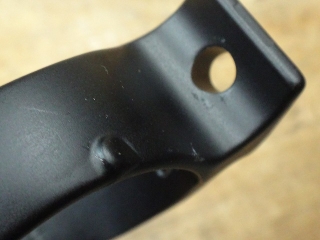
The SM-AD91 has a protrusion on the rear side of the band,
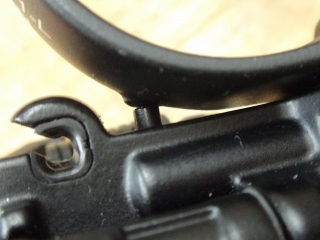
where the support bolt of the R9100-series front derailleur
makes contact perfectly flush.
I personally don't think a support bolt is necessary with direct-mount front derailleurs plus a band,
but if it's designed this way, you might as well use it.
Recent lightweight carbon frames have some direct-mount bosses with low rigidity,
so they require a rather questionable adjustment: the derailleur cage is swung inward and fixed,
then lifted outward with the support bolt until the cage is parallel with the chainring.
Actually, Shimano's manual does it this way too.
It seems wrong to me that the boss is always under tension,
but once you fix the cable to the front derailleur,
there's always tension regardless of direction or magnitude,
so it might not be a problem after all.
※I've phrased it as "some," but this is actually the majority.
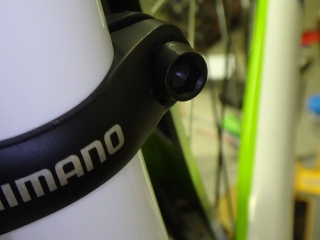
One reason the SM-AD91 became cheaper than before is
the frame mounting bolt.
With the AD79 or 90, this was a titanium bolt.
For the SM-AD67, please see (here).
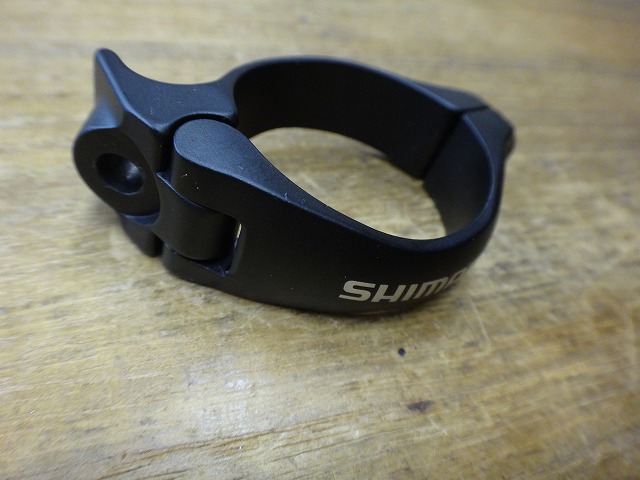

↑This one
To be precise, it's SM-AD91-L as indicated on the band itself.
The letter at the end comes in three types: S/M/L,
representing seat tube diameters of 28.6mm/31.8mm/34.9mm respectively.
For the 28.6mm case, a spacer is used with the 31.8mm band.
Since electric drivetrains appeared, there are four types of front derailleur bands:
SM-AD79, 67, 90, and 91, but only the first SM-AD79 comes in three types: L, M, and MS.
MS is specified as "31.8mm diameter + spacer for 28.6mm,"
and the M single unit was only sold with the 79—
after that, everything has been sold as either MS or L.
The price difference between MS and L is around 100 yen (MS being more expensive),
but the S spacer has a list price of 465 yen before tax,
so if it comes bundled for about 100 yen... I'd like to say it's a good deal,
but for 99% or more of users it's an unnecessary part, so it's really not a bargain.
For 28.6mm diameter steel frames, direct-mount is pretty much standard,
so there's only use for it on non-standard steel frames or
really old aluminum lug-type carbon frames.
All prices listed are pre-tax list prices:
The SM-AD79 was 4,863 yen for M and L, and 5,095 yen for MS.
An extremely expensive part, but
especially when paired with the electronic FD-7970,
the curves on the mounting section fit perfectly,
so it's definitely better to use the genuine part.
When it comes to Dura-Ace spare parts,
for example, brake shoes with fins are priced significantly higher for Dura-Ace
compared to lower grades, which I believe is because
the surface finish is in Dura-Ace color and done domestically in Japan.
For the same reason, wheel quick-releases were also expensive,
but that's not really the case anymore.
Also, considering that the FD-7970 direct-mount version is 47,260 yen
and the band version is 52,368 yen,
it's not unreasonable that the band alone costs around 5,000 yen.
The SM-AD67 is 1,062 yen for L and 1,118 yen for MS.
A dramatic price drop. This is the only Altus-grade part number.
The SM-AD90 is 3,953 yen for L and 4,174 yen for MS.
It's a bit cheaper, but still feels like Dura-Ace.
There is no SM-AD68.
Now, for this SM-AD91,
L is 1,056 yen and MS is 1,111 yen.
The box has also changed from the Dura-Ace grade fancy packaging
to the blue box used for general spare parts, so
despite being numbered 91, it may no longer be a "Dura-Ace part."
There is no SM-AD80 either.
With the AD91 at this price, it wouldn't be necessary.
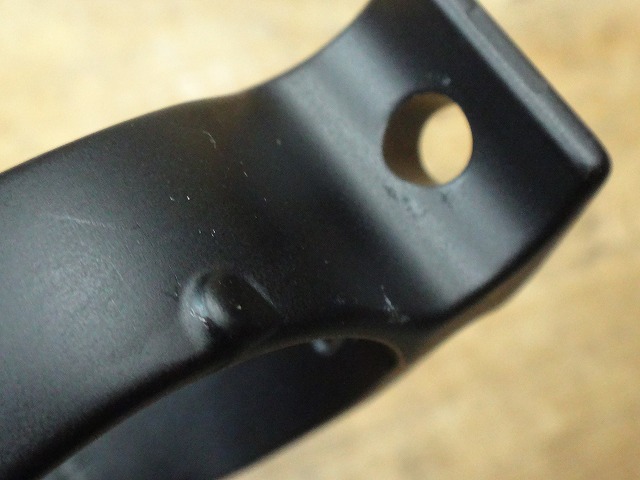
The SM-AD91 has a protrusion on the rear side of the band,

where the support bolt of the R9100-series front derailleur
makes contact perfectly flush.
I personally don't think a support bolt is necessary with direct-mount front derailleurs plus a band,
but if it's designed this way, you might as well use it.
Recent lightweight carbon frames have some direct-mount bosses with low rigidity,
so they require a rather questionable adjustment: the derailleur cage is swung inward and fixed,
then lifted outward with the support bolt until the cage is parallel with the chainring.
Actually, Shimano's manual does it this way too.
It seems wrong to me that the boss is always under tension,
but once you fix the cable to the front derailleur,
there's always tension regardless of direction or magnitude,
so it might not be a problem after all.
※I've phrased it as "some," but this is actually the majority.

One reason the SM-AD91 became cheaper than before is
the frame mounting bolt.
With the AD79 or 90, this was a titanium bolt.
For the SM-AD67, please see (here).