It's time for me to reply to comments on my replies.
There's no set schedule for this, but
it seems like I can manage to answer some questions now.
First, I received a comment about tips for removing cement from tubular rims that have rim cement on them.
"Rim cement removal. Wrap bandage around the rim several times and soak it with toluene.
Leave it sitting while periodically adding toluene to keep it from drying out.
Once the cement gets gummy, scrape it off with a copper pipe fitting—
that's my answer for now."
That's what the comment said.
The key point is constantly keeping it saturated because of the high volatility.
This is a bit of a tangent, but when I was peeling off stickers from the Nomo Lab Wheel No. 2,
I was putting paper towels on the rim and spraying adhesive remover on it.Wet washi paper, wait—let me not use that expression
Anyway, the important thing is to saturate it.
Thank you for the comment.
Also, from another person, regarding carrying a tire with cement applied:
"Once you apply cement and let it dry, if you roll the tire up with the beads together,
won't it peel off when you want to use it?
Or does the cement get pulled to one side?
Would it be okay if you apply it thinly?
In that case you'd re-glue it when you get home, right?"
I received this comment.
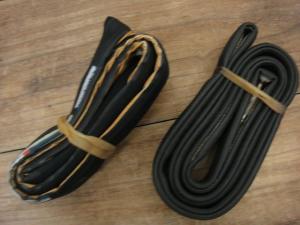
↑On the left is the "under-saddle wrap." The bead touches the tread.
On the right is the "back pocket wrap." The beads touch each other.
In either case, you won't have problems with cement on the bead sticking.
When beads touch beads, they'll stick slightly, but not so much that you can't peel them apart.
The cement doesn't get pulled to one side either.
Apply rim cement to the bead of a new "spare tire born ready" or an old puncture-free tire.
You can apply it generously.
After that, dry it until even when you touch the coated area, it doesn't feel tacky and nothing sticks to your finger.
Then just wrap it however you want, and your spare tire is ready to go.
For a puncture at a roadside stop, I don't carry cement—I just glue on this pre-cemented spare tire.
As long as you pump in plenty of air, it won't peel off easily and won't slip.
(That said, you shouldn't attack descents or corners with it)
Once you get home safely, re-glue the tire.
Even if the spare tire is originally a new tire and you continue using it,
you should re-glue it. Personally, if it's the rear wheel I sometimes think it's okay to leave it as is... but here I have to write something like "re-gluing is absolutely necessary" (laugh) so please re-glue it.
One more thing, but it turns out Lightweight really was "a different breed," and I'm glad to hear it.
There's no measuring stick from normal wheels that applies to those.
Once you get used to using them normally, most other wheels start to look dim.
One more thing. I asked the distributor about it, and
Continental's carbon rim cement supposedly causes less damage to carbon rims.
On the other hand, the adhesive strength itself is apparently weaker than standard cement.
Next. I received a comment asking why I don't use 1.8mm spokes. Compared to 2.0mm spokes they're only 10% thinner, but
for butted spokes especially, they break significantly more than just 10% more often,
so basically I don't use them.
Pre-built wheels (even if they have straight spokes) are almost all 2.0mm.
The nipples that come with ENVE rims are from a certain manufacturer, but
the ENVE nipples that Tri-Sports has are only for 2.0mm spokes.
Since Sapim's CX Super and Super Spokes are 1.8mm,
it's currently difficult to build an ENVE wheel with 1.8mm spokes.
There are various reasons like this, but since there are a lot of negative ones,
I don't use 1.8mm spokes for off-the-shelf builds.
Of course, if a customer requests it, that's different.
Continuing.
"Regarding the article saying Fastforward and Planet X use the same rim,
Fastforward has some brand power, like being used in the Tour,
and I think the risk of producing defective products is incomparable to Planet X.
Even if the manufacturer is the same, if the quality control is completely different,
isn't it wrong to call them the same rim?
I think that's different from Tni putting out Kinlin rims."
I received this comment.
I suggested the same manufacturer and wrote they have the same cross-section shape, but
I didn't write they were the same rim.
I was short on words in that regard.
Let's call the manufacturer of this rim hypothetically Company X.
Company X makes carbon rims with a mix of good and bad, and
FFWD does OEM custom specs focusing on durability,
and during wheel building may reject rims according to internal company standards.
With PLANET X, they might be more careless in that regard.
When comparing the FFWD F2R and PLANET X's 20mm carbon in terms of weight,
there doesn't seem to be any particular difference.
The braking zone finish is different, though—
on the older F2R rim it had a label saying "basalt" (sic).
If PLANET X is different, it's in this point.
I've built F2R rims before, and I've never felt any difference from PLANET X in that
・the braking zone is wavy and I can't dial out lateral runout
・the seams are rough and it's hard to dial out vertical runout
・the rim is weak and I can't increase spoke tension, so I can't build it solid
I've never felt such differences.
Supposing Company X's rims are a mix of good and bad (this is also hypothetical),
I don't think FFWD's rims are the "good" and PLANET X is the "bad."
Quality-wise, aren't both on the "good" side?
At least judging from the feel of building wheels, that's how it is.
Regarding "brand power,"
certainly in the sense of being exposed a lot by being used in the Tour and such,
you could say they have brand power.
And as a reason to "buy FFWD," as for whether there are structural or theoretical advantages
over other companies' specially-designed pre-built wheels,
there really aren't any.
The F2R is a low-profile rim, but unlike Shimano's C24, Mavic's Ksyrium, or
Fulcrum's new Racing 5, it's not an offset rim.
The F6R has rim sides that are rounded and concave, claiming aerodynamic advantage, but
that's about it. That's about all the elements you can call unique to FFWD.
Regarding hubs, they don't use proprietary designs or anything interesting
that tests the superiority of their own philosophy to the world.
High-low flange, 2:1 spoking, aluminum spokes, carbon spokes,
triple flange, low-high flange, radial spoking on the freehub side—
none of these elements are present.
They're just built with DT hubs or normal hubs printed with "FFWD,"
that's all.
About these FFWD-branded hubs—not all of them, but some have
rear hub flange widths of about 50mm.
This is like an Americlassic hub with a small flange, and
like Americlassic, you can't gain lateral stiffness.
Regarding the building method, it's simply equal-diameter spokes, equal-count left and right spoking,
so there's still room to build better by choice of spokes and lacing method.
FFWD is more of a hand-built off-the-shelf wheel than a pre-built wheel.
What's left to sell is the point that "it's hand-built in the Netherlands."
Regarding "brand power," if you strip away the rim labels and names and
look at it objectively, in terms of technique is there anything that
"only FFWD can do?" The answer is zero.
Regarding this point, what would be the ultimate, as I touched on earlier in a personal note,
would be Lightweight.
Wheels don't ride on names.
Looking at it without rose-tinted glasses, FFWD, despite some quality control,
is simply "a wheel built with Company X's rims and butted spokes."
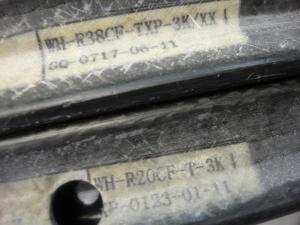
↑Within the label there's a character "3K."
This is the carbon finish.
3K carbon weave pattern.
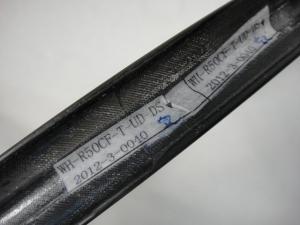
↑This is also Company X's rim.
At 50mm height, "UD" indicates unidirectional pattern.
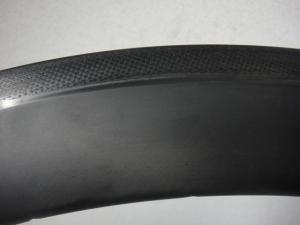
↑That said, I won't say this is the same as the F5R.
From the feel of building it, this one seems harder, so.
There's no set schedule for this, but
it seems like I can manage to answer some questions now.
First, I received a comment about tips for removing cement from tubular rims that have rim cement on them.
"Rim cement removal. Wrap bandage around the rim several times and soak it with toluene.
Leave it sitting while periodically adding toluene to keep it from drying out.
Once the cement gets gummy, scrape it off with a copper pipe fitting—
that's my answer for now."
That's what the comment said.
The key point is constantly keeping it saturated because of the high volatility.
This is a bit of a tangent, but when I was peeling off stickers from the Nomo Lab Wheel No. 2,
I was putting paper towels on the rim and spraying adhesive remover on it.
Anyway, the important thing is to saturate it.
Thank you for the comment.
Also, from another person, regarding carrying a tire with cement applied:
"Once you apply cement and let it dry, if you roll the tire up with the beads together,
won't it peel off when you want to use it?
Or does the cement get pulled to one side?
Would it be okay if you apply it thinly?
In that case you'd re-glue it when you get home, right?"
I received this comment.
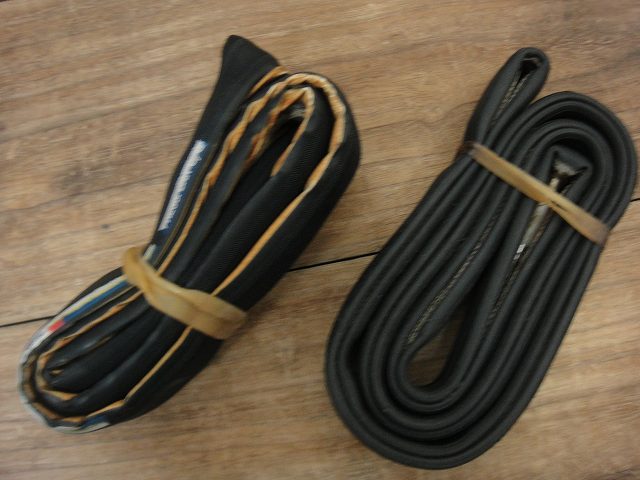
↑On the left is the "under-saddle wrap." The bead touches the tread.
On the right is the "back pocket wrap." The beads touch each other.
In either case, you won't have problems with cement on the bead sticking.
When beads touch beads, they'll stick slightly, but not so much that you can't peel them apart.
The cement doesn't get pulled to one side either.
Apply rim cement to the bead of a new "spare tire born ready" or an old puncture-free tire.
You can apply it generously.
After that, dry it until even when you touch the coated area, it doesn't feel tacky and nothing sticks to your finger.
Then just wrap it however you want, and your spare tire is ready to go.
For a puncture at a roadside stop, I don't carry cement—I just glue on this pre-cemented spare tire.
As long as you pump in plenty of air, it won't peel off easily and won't slip.
(That said, you shouldn't attack descents or corners with it)
Once you get home safely, re-glue the tire.
Even if the spare tire is originally a new tire and you continue using it,
you should re-glue it. Personally, if it's the rear wheel I sometimes think it's okay to leave it as is... but here I have to write something like "re-gluing is absolutely necessary" (laugh) so please re-glue it.
One more thing, but it turns out Lightweight really was "a different breed," and I'm glad to hear it.
There's no measuring stick from normal wheels that applies to those.
Once you get used to using them normally, most other wheels start to look dim.
One more thing. I asked the distributor about it, and
Continental's carbon rim cement supposedly causes less damage to carbon rims.
On the other hand, the adhesive strength itself is apparently weaker than standard cement.
Next. I received a comment asking why I don't use 1.8mm spokes. Compared to 2.0mm spokes they're only 10% thinner, but
for butted spokes especially, they break significantly more than just 10% more often,
so basically I don't use them.
Pre-built wheels (even if they have straight spokes) are almost all 2.0mm.
The nipples that come with ENVE rims are from a certain manufacturer, but
the ENVE nipples that Tri-Sports has are only for 2.0mm spokes.
Since Sapim's CX Super and Super Spokes are 1.8mm,
it's currently difficult to build an ENVE wheel with 1.8mm spokes.
There are various reasons like this, but since there are a lot of negative ones,
I don't use 1.8mm spokes for off-the-shelf builds.
Of course, if a customer requests it, that's different.
Continuing.
"Regarding the article saying Fastforward and Planet X use the same rim,
Fastforward has some brand power, like being used in the Tour,
and I think the risk of producing defective products is incomparable to Planet X.
Even if the manufacturer is the same, if the quality control is completely different,
isn't it wrong to call them the same rim?
I think that's different from Tni putting out Kinlin rims."
I received this comment.
I suggested the same manufacturer and wrote they have the same cross-section shape, but
I didn't write they were the same rim.
I was short on words in that regard.
Let's call the manufacturer of this rim hypothetically Company X.
Company X makes carbon rims with a mix of good and bad, and
FFWD does OEM custom specs focusing on durability,
and during wheel building may reject rims according to internal company standards.
With PLANET X, they might be more careless in that regard.
When comparing the FFWD F2R and PLANET X's 20mm carbon in terms of weight,
there doesn't seem to be any particular difference.
The braking zone finish is different, though—
on the older F2R rim it had a label saying "basalt" (sic).
If PLANET X is different, it's in this point.
I've built F2R rims before, and I've never felt any difference from PLANET X in that
・the braking zone is wavy and I can't dial out lateral runout
・the seams are rough and it's hard to dial out vertical runout
・the rim is weak and I can't increase spoke tension, so I can't build it solid
I've never felt such differences.
Supposing Company X's rims are a mix of good and bad (this is also hypothetical),
I don't think FFWD's rims are the "good" and PLANET X is the "bad."
Quality-wise, aren't both on the "good" side?
At least judging from the feel of building wheels, that's how it is.
Regarding "brand power,"
certainly in the sense of being exposed a lot by being used in the Tour and such,
you could say they have brand power.
And as a reason to "buy FFWD," as for whether there are structural or theoretical advantages
over other companies' specially-designed pre-built wheels,
there really aren't any.
The F2R is a low-profile rim, but unlike Shimano's C24, Mavic's Ksyrium, or
Fulcrum's new Racing 5, it's not an offset rim.
The F6R has rim sides that are rounded and concave, claiming aerodynamic advantage, but
that's about it. That's about all the elements you can call unique to FFWD.
Regarding hubs, they don't use proprietary designs or anything interesting
that tests the superiority of their own philosophy to the world.
High-low flange, 2:1 spoking, aluminum spokes, carbon spokes,
triple flange, low-high flange, radial spoking on the freehub side—
none of these elements are present.
They're just built with DT hubs or normal hubs printed with "FFWD,"
that's all.
About these FFWD-branded hubs—not all of them, but some have
rear hub flange widths of about 50mm.
This is like an Americlassic hub with a small flange, and
like Americlassic, you can't gain lateral stiffness.
Regarding the building method, it's simply equal-diameter spokes, equal-count left and right spoking,
so there's still room to build better by choice of spokes and lacing method.
FFWD is more of a hand-built off-the-shelf wheel than a pre-built wheel.
What's left to sell is the point that "it's hand-built in the Netherlands."
Regarding "brand power," if you strip away the rim labels and names and
look at it objectively, in terms of technique is there anything that
"only FFWD can do?" The answer is zero.
Regarding this point, what would be the ultimate, as I touched on earlier in a personal note,
would be Lightweight.
Wheels don't ride on names.
Looking at it without rose-tinted glasses, FFWD, despite some quality control,
is simply "a wheel built with Company X's rims and butted spokes."

↑Within the label there's a character "3K."
This is the carbon finish.
3K carbon weave pattern.
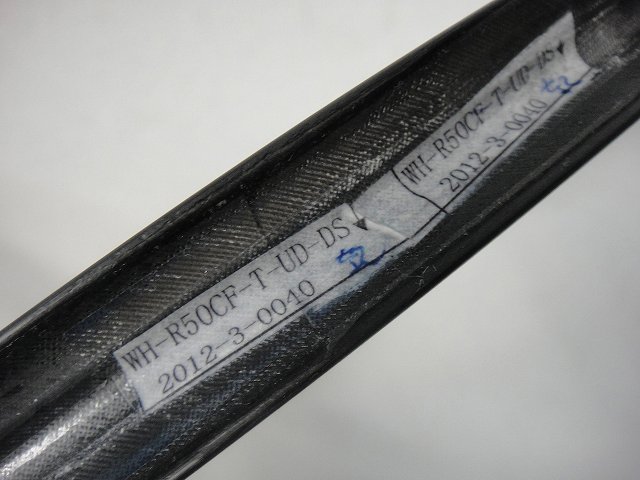
↑This is also Company X's rim.
At 50mm height, "UD" indicates unidirectional pattern.
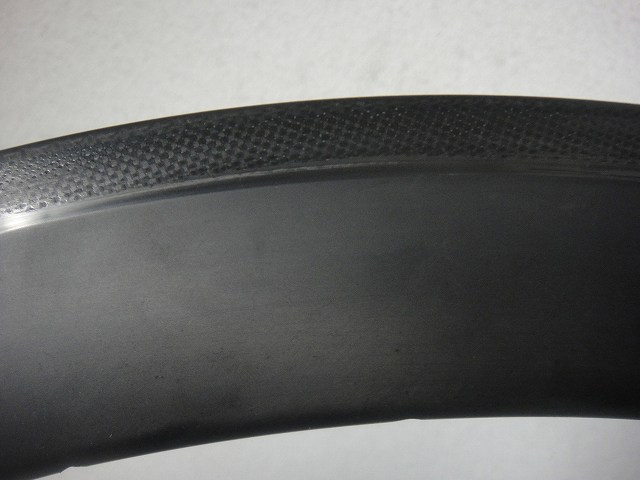
↑That said, I won't say this is the same as the F5R.
From the feel of building it, this one seems harder, so.