The other day, I wrote about Vittoria and TUFO tubular tires where
installing them according to the general convention for tread pattern direction
results in some tires having reversed labels (left-side labels),
and that Vittoria's label orientation varies by lot while
TUFO maintains consistency depending on the model.
But I received a comment stating that with the TUFO S33 PRO,
when both front and rear are mounted in the same direction,
the label left-right orientation reverses — from a reliable source.
Which means TUFO's label orientation is also pretty random.
Once you spot even one white crow in existence,
you can no longer say all crows are black.
Thanks for the comment.

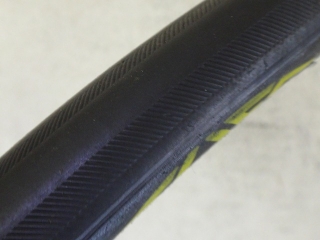
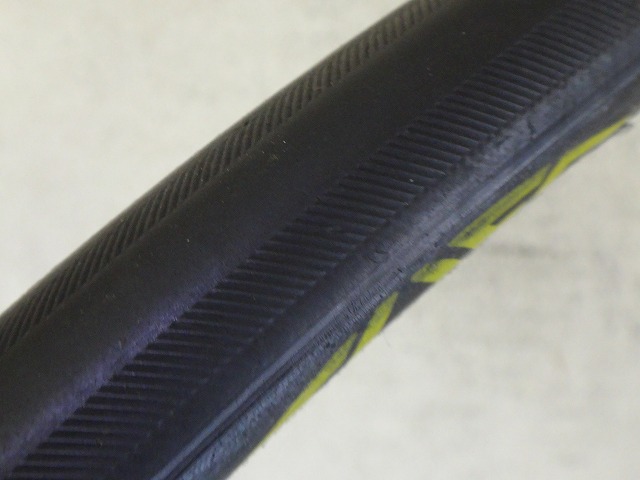
This is a well-worn personal spare tire I keep
— a TUFO Elite Jet under 160 grams —
and it has a reversed label.
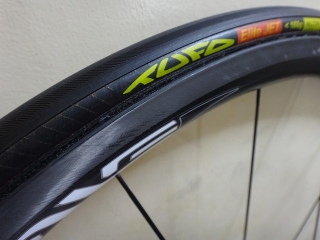
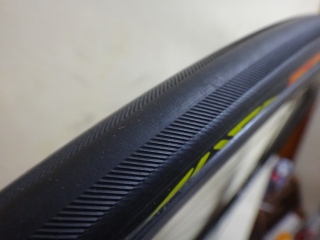
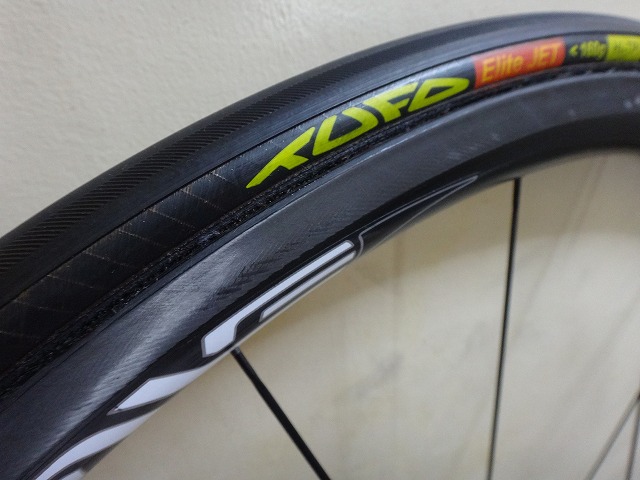
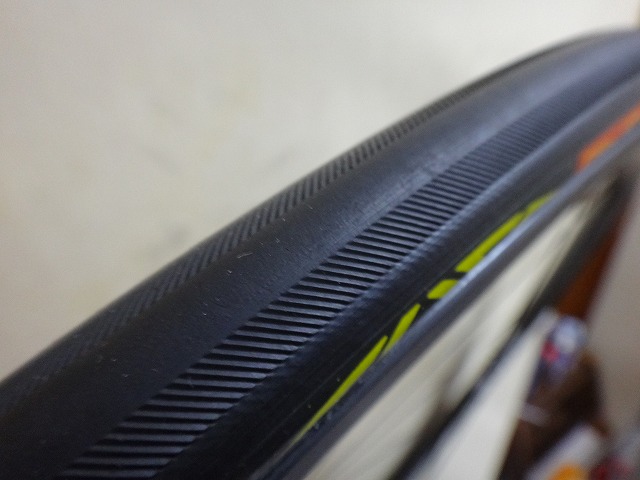
The same tire currently mounted on my wheel also has a reversed label.
So that's just two examples as images,
but so far I haven't seen a normal label (right-side label) on this tire.
Though now I can't rule out the white crow possibility here either,
since I found careless labeling on the same manufacturer's product.
Personally, careless labeling puts me more at ease.
If a tire had 100% reversed labels,
there'd be a possibility that the manufacturer's specification or intention
was actually to install the tread pattern backwards,
but if label orientation is random,
I can comfortably just look at the tread pattern and mount the tire.
On a separate note,
I once wrote about Pirelli slick tires where, despite having no tread pattern,
there's a specified installation direction (→here).
I theorized this might be because they share manufacturing processes
with other models that do have tread patterns,
but someone from a tire distributor (not a Pirelli distributor)
suggested to me that the directional specification might be based on
the angle of the casing's outermost layer on the tire sidewall.
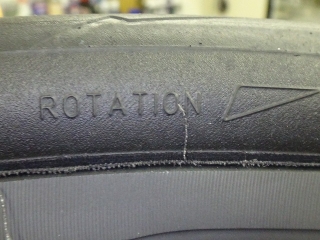
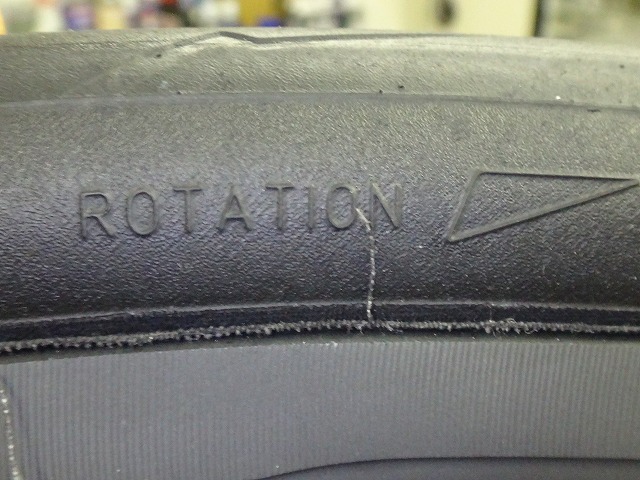
↑This is a Pirelli tire,
and it's a model with tread pattern.
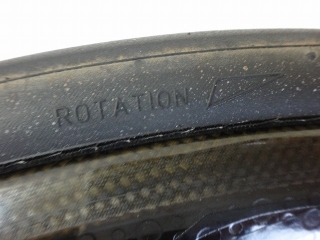
Pirelli tires have rotation direction markings on both sides,
with the arrow pointing right when the wheel rim is at the top —
so let me look at the relationship between the arrow on the tire's right side and the casing.
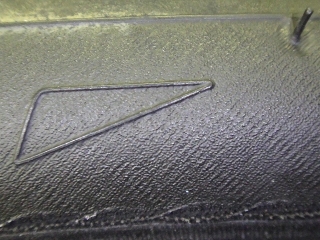
When magnified, the diagonal angle of the outermost casing layer is like this,
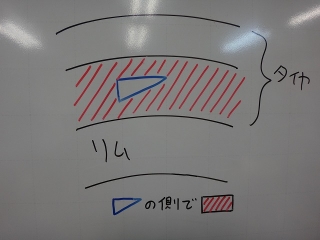
and in diagram form, it looks like this.
A tire with casing orientation opposite to this diagram
would be the white crow in this scenario,
but I'm still investigating whether such a thing actually exists.
The slick tire in the linked article turned out to be a regular black crow.
installing them according to the general convention for tread pattern direction
results in some tires having reversed labels (left-side labels),
and that Vittoria's label orientation varies by lot while
TUFO maintains consistency depending on the model.
But I received a comment stating that with the TUFO S33 PRO,
when both front and rear are mounted in the same direction,
the label left-right orientation reverses — from a reliable source.
Which means TUFO's label orientation is also pretty random.
Once you spot even one white crow in existence,
you can no longer say all crows are black.
Thanks for the comment.
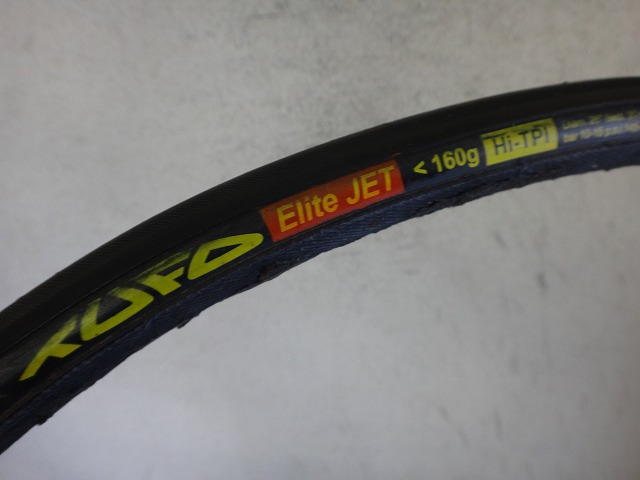
This is a well-worn personal spare tire I keep
— a TUFO Elite Jet under 160 grams —
and it has a reversed label.
The same tire currently mounted on my wheel also has a reversed label.
So that's just two examples as images,
but so far I haven't seen a normal label (right-side label) on this tire.
Though now I can't rule out the white crow possibility here either,
since I found careless labeling on the same manufacturer's product.
Personally, careless labeling puts me more at ease.
If a tire had 100% reversed labels,
there'd be a possibility that the manufacturer's specification or intention
was actually to install the tread pattern backwards,
but if label orientation is random,
I can comfortably just look at the tread pattern and mount the tire.
On a separate note,
I once wrote about Pirelli slick tires where, despite having no tread pattern,
there's a specified installation direction (→here).
I theorized this might be because they share manufacturing processes
with other models that do have tread patterns,
but someone from a tire distributor (not a Pirelli distributor)
suggested to me that the directional specification might be based on
the angle of the casing's outermost layer on the tire sidewall.
↑This is a Pirelli tire,
and it's a model with tread pattern.
Pirelli tires have rotation direction markings on both sides,
with the arrow pointing right when the wheel rim is at the top —
so let me look at the relationship between the arrow on the tire's right side and the casing.
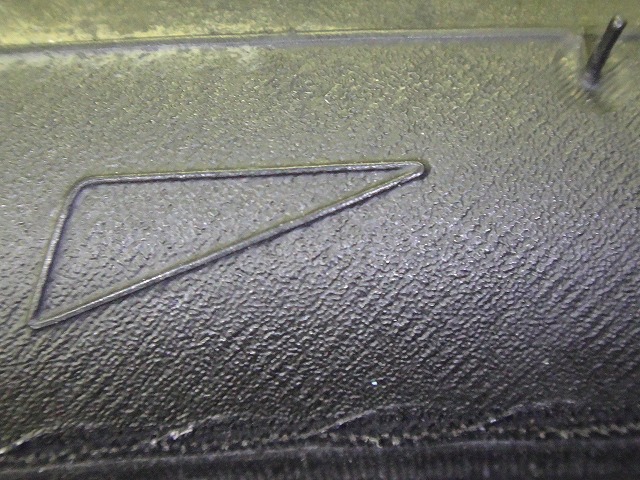
When magnified, the diagonal angle of the outermost casing layer is like this,
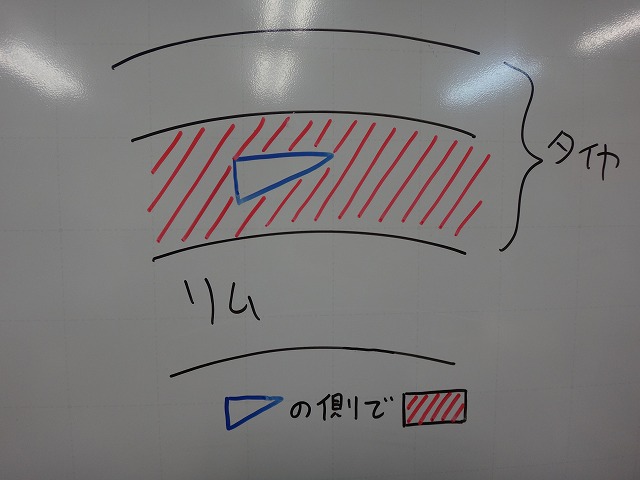
and in diagram form, it looks like this.
A tire with casing orientation opposite to this diagram
would be the white crow in this scenario,
but I'm still investigating whether such a thing actually exists.

The slick tire in the linked article turned out to be a regular black crow.