Another wheel day today (and so on).
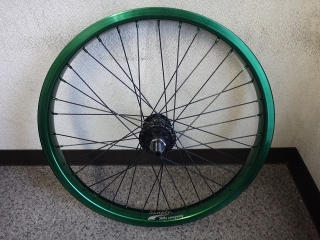
Built a rear wheel for a BMX.

The hub is a CH-MX hub from NYB Japan.
Available in 36H only, hub shell color is either black or polished,
and the overlock nut dimension is nominally 110mm but measured at 111.5mm.
Being about 1.5mm wider—totally unrelated to other hubs—
interestingly, the Evolite hub is the same.
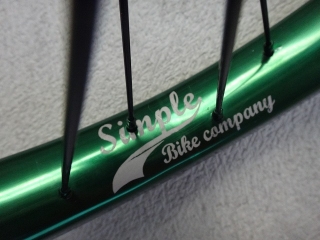
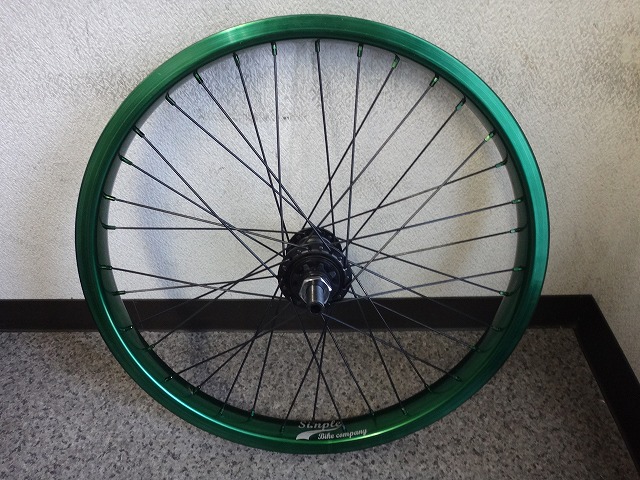
The rim has markings that say Simple Bike Company,
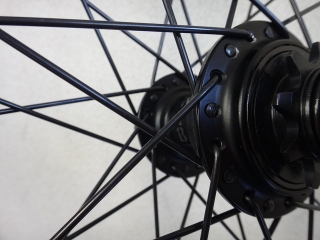
and I built it as a 36H all-black Campagnolo Crux JIS with no crossing tie-ins.
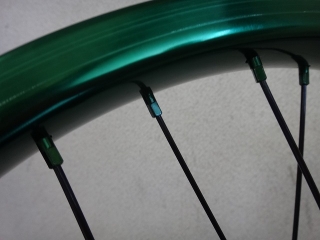
I built it with green aluminum nipples.
The anodize color being nearly identical is purely coincidental.
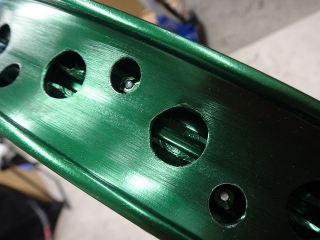
↑The outer circumference looks like this
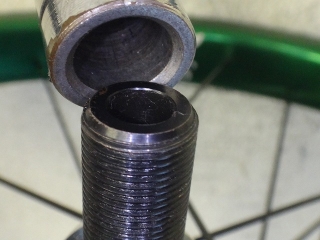
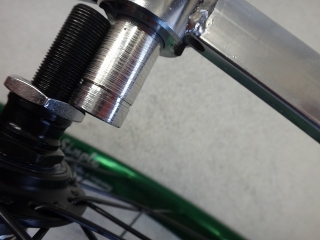
The Hozan center gauge's measuring stem is hollow,
so it's designed to fit over 9mm or 10mm diameter hub axles,
but the company's NK freecoaster hub (← shameless plug), which looks almost identical,
has a 3/8 inch (approximately 9.5mm) diameter axle, and rather than using
sealed cartridge bearings, it deliberately employs angular radial bearings (← shameless plug).
This CH-MX hub, on the other hand, has a 14mm diameter axle,
so the measuring stem doesn't fit over the hub axle.
Since that wasn't going to work, I was planning to use a Park Tool center gauge,
but that thing's reliability is questionable—basically paper-thin.
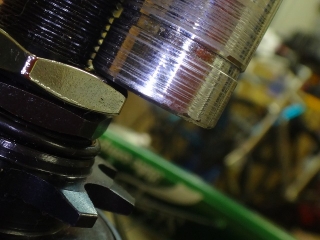
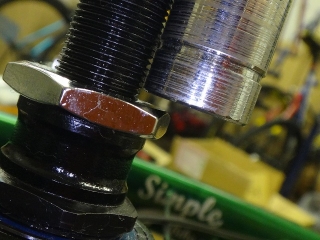
Then I realized I could just do it like this.
By the way, the top image is mid-work, so it's not centered yet.
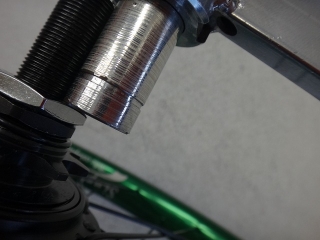
↑Final state.
So, about this hub—if you look at the second image in this post, you can see
it's quite a high-low flange design.
The left-right difference in spoke hole circle diameter is 10mm.
For reference, the FH-9000 is 1mm, and the Evolite hub is 8mm.
The measured flange width (used in spoke calculations) is 54.6mm,
distributed as left side 28.15mm / right side 26.45mm.
In other words, there is some offset, but it's extremely minor.
In Shimano notation, the offset is 0.85mm,
so that's 27.3mm ±0.85mm.
Speaking of this offset dimension, for Shimano hubs:
single-sided pist hubs with small flanges are 2.75mm,
large flange single-sided pist hubs are 5.25mm,
and some utility bike (mama-chari) coaster hubs are 0.3mm.
And none of these are high-low flange hubs.
With an offset of 0.85mm and a flange diameter difference of 10mm,
the latter should definitely have a larger effect,
so if I just do a normal left-right equal diameter equal spoke count build,
it seems unavoidable that the freewheel side will end up with lower tension.
I considered doing a reverse unequal spoke build—specifically a "6-4" pattern—
but I couldn't gauge the effect on such a small diameter wheel, so I ditched it.
(Though I could always build the wheel twice.
Note that the spokes on the 4-spoke side can't be reused as 6-spoke length,
so if I later do a 6-6 build, all the spokes on one side would be wasted.)
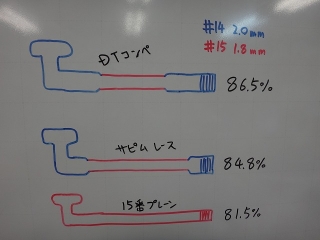
Or I considered something like this.
DT's Comp and Sapim's Race are both 2.0-1.8-2.0mm round butted,
but on the Race, the 2.0mm sections on both ends are shorter,
so it's kind of like "both ends of a #15 plain with just a bit of #14,"
creating a meaningful difference in spoke weight ratio
(though in rough calculations we treat both as 85%).
So I pondered whether I could use a 2-3% spoke weight ratio difference in this range
to create a very subtle reverse unequal diameter build.
However, on this wheel the spoke length is in the 180mm range,
and the only butted spokes (round or flat) that are stably supplied at that length
are CX-RAY.
Some might suggest: why not take a 2.0-1.8-2.0mm double-butted spoke,
cut it at the 2.0-1.8mm point from the head,
thread it for a #15, and make a single-butted spoke?
I've actually done this with my own stuff before.
The conclusion: seriously, don't.
This was essentially a thought experiment—trying to compensate via spoke gauge and spoke count
for the reversal phenomenon caused by the relative magnitudes of micro-offset versus major high-low flanging.
But considering this is a BMX wheel, the impact resistance against landing forces
clearly means I shouldn't be using thin spokes in the first place.
That priority obviously trumps left-right spoke tension differences,
so realistically there was no option other than #14 plain.
The 6-4 pattern is something I might have tried on a personal wheel.
In actual practice, when small diameter wheels are built with decent tension,
left-right spoke deflection differences don't show up much,
so there was barely any felt difference in deflection when I squeezed
the final crossing left and right.
If you squeeze as hard as you can,
the freewheel side deflects slightly more, though...
Built a rear wheel for a BMX.
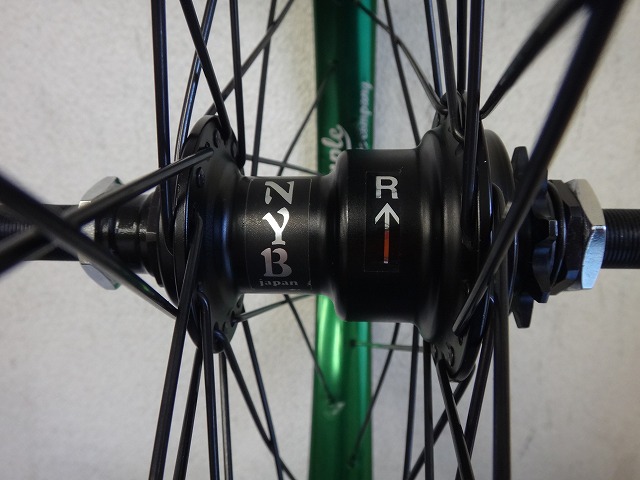
The hub is a CH-MX hub from NYB Japan.
Available in 36H only, hub shell color is either black or polished,
and the overlock nut dimension is nominally 110mm but measured at 111.5mm.
Being about 1.5mm wider—totally unrelated to other hubs—
interestingly, the Evolite hub is the same.
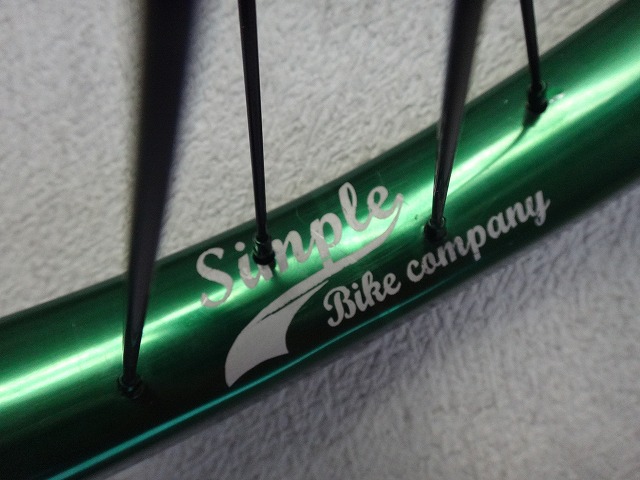
The rim has markings that say Simple Bike Company,
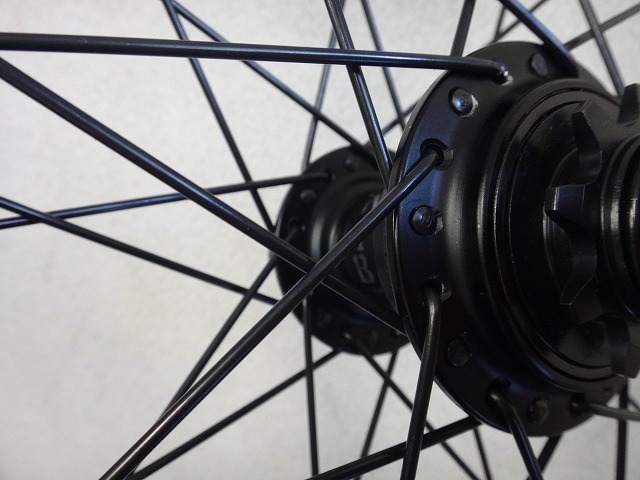
and I built it as a 36H all-black Campagnolo Crux JIS with no crossing tie-ins.
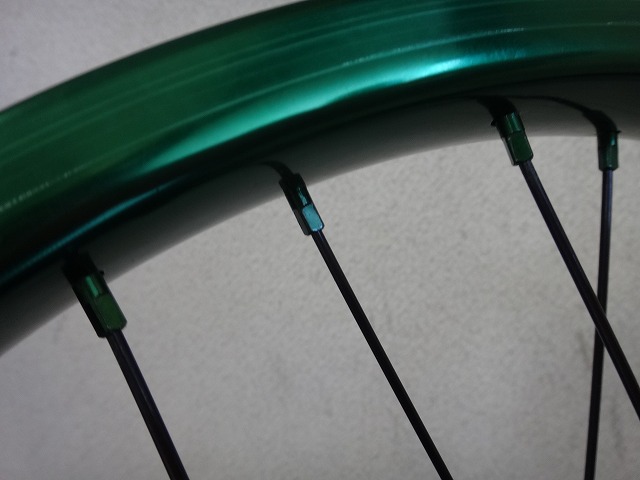
I built it with green aluminum nipples.
The anodize color being nearly identical is purely coincidental.

↑The outer circumference looks like this

The Hozan center gauge's measuring stem is hollow,
so it's designed to fit over 9mm or 10mm diameter hub axles,
but the company's NK freecoaster hub (← shameless plug), which looks almost identical,
has a 3/8 inch (approximately 9.5mm) diameter axle, and rather than using
sealed cartridge bearings, it deliberately employs angular radial bearings (← shameless plug).
This CH-MX hub, on the other hand, has a 14mm diameter axle,
so the measuring stem doesn't fit over the hub axle.
Since that wasn't going to work, I was planning to use a Park Tool center gauge,
but that thing's reliability is questionable—basically paper-thin.
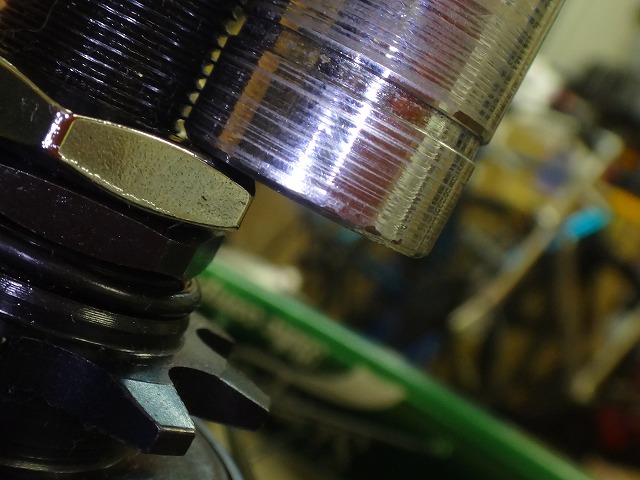

Then I realized I could just do it like this.
By the way, the top image is mid-work, so it's not centered yet.

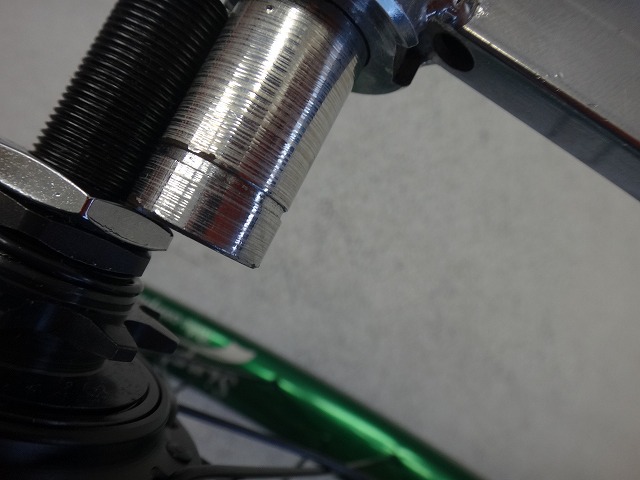
↑Final state.
So, about this hub—if you look at the second image in this post, you can see
it's quite a high-low flange design.
The left-right difference in spoke hole circle diameter is 10mm.
For reference, the FH-9000 is 1mm, and the Evolite hub is 8mm.
The measured flange width (used in spoke calculations) is 54.6mm,
distributed as left side 28.15mm / right side 26.45mm.
In other words, there is some offset, but it's extremely minor.
In Shimano notation, the offset is 0.85mm,
so that's 27.3mm ±0.85mm.
Speaking of this offset dimension, for Shimano hubs:
single-sided pist hubs with small flanges are 2.75mm,
large flange single-sided pist hubs are 5.25mm,
and some utility bike (mama-chari) coaster hubs are 0.3mm.
And none of these are high-low flange hubs.
With an offset of 0.85mm and a flange diameter difference of 10mm,
the latter should definitely have a larger effect,
so if I just do a normal left-right equal diameter equal spoke count build,
it seems unavoidable that the freewheel side will end up with lower tension.
I considered doing a reverse unequal spoke build—specifically a "6-4" pattern—
but I couldn't gauge the effect on such a small diameter wheel, so I ditched it.
(Though I could always build the wheel twice.
Note that the spokes on the 4-spoke side can't be reused as 6-spoke length,
so if I later do a 6-6 build, all the spokes on one side would be wasted.)
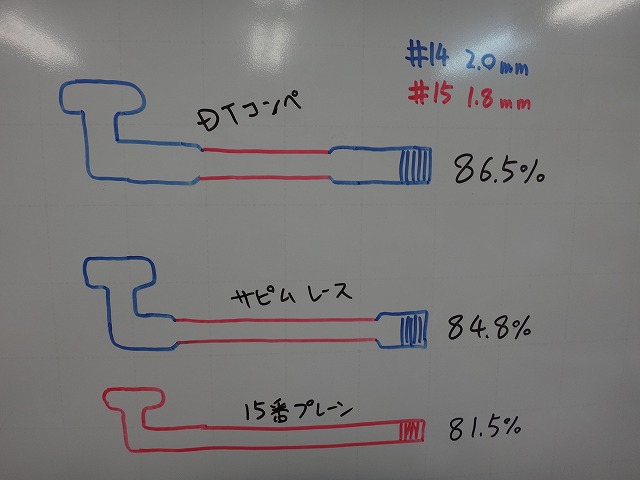
Or I considered something like this.
DT's Comp and Sapim's Race are both 2.0-1.8-2.0mm round butted,
but on the Race, the 2.0mm sections on both ends are shorter,
so it's kind of like "both ends of a #15 plain with just a bit of #14,"
creating a meaningful difference in spoke weight ratio
(though in rough calculations we treat both as 85%).
So I pondered whether I could use a 2-3% spoke weight ratio difference in this range
to create a very subtle reverse unequal diameter build.
However, on this wheel the spoke length is in the 180mm range,
and the only butted spokes (round or flat) that are stably supplied at that length
are CX-RAY.
Some might suggest: why not take a 2.0-1.8-2.0mm double-butted spoke,
cut it at the 2.0-1.8mm point from the head,
thread it for a #15, and make a single-butted spoke?
I've actually done this with my own stuff before.
The conclusion: seriously, don't.
This was essentially a thought experiment—trying to compensate via spoke gauge and spoke count
for the reversal phenomenon caused by the relative magnitudes of micro-offset versus major high-low flanging.
But considering this is a BMX wheel, the impact resistance against landing forces
clearly means I shouldn't be using thin spokes in the first place.
That priority obviously trumps left-right spoke tension differences,
so realistically there was no option other than #14 plain.
The 6-4 pattern is something I might have tried on a personal wheel.
In actual practice, when small diameter wheels are built with decent tension,
left-right spoke deflection differences don't show up much,
so there was barely any felt difference in deflection when I squeezed
the final crossing left and right.
the freewheel side deflects slightly more, though...