Before getting into the main topic.
The other day, I rebuilt the front wheel of a Roval CLX64 Disc that was unusable because the rim was thrashing laterally at around 60 km/h downhill, making the handling feel dangerously unstable. The original wheel was producing 100% reproducible rim vibration, but after the customer used the rebuilt wheel, they reported zero vibration issues.
Well, that's a relief. I had decent confidence it would work, but still.
Conversely, if I were to gradually loosen the nipples on the rebuilt wheel, vibration should appear somewhere, and I have a pretty good idea where that point is.
This isn't something that can be solved by spoke tension alone, so increasing spoke tension while keeping the original wheel's structure wouldn't fix it.
In fact, if it could be solved that way, it would mean "that particular wheel just happened to be abnormally loose"—which it wasn't.
I just wrote "even if spoke tension is increased," but more precisely, "even if nipples are tightened."
Even in the original state, the nipples were already tight enough that further tightening contributed almost nothing to reducing spoke deflection.
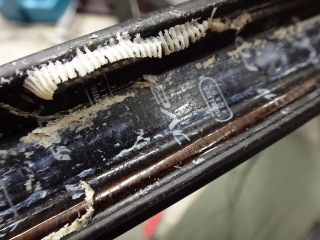
This is partway through that rebuild work, showing a Continental Grand Prix 5000 tubeless tire and sealant from an unknown manufacturer.
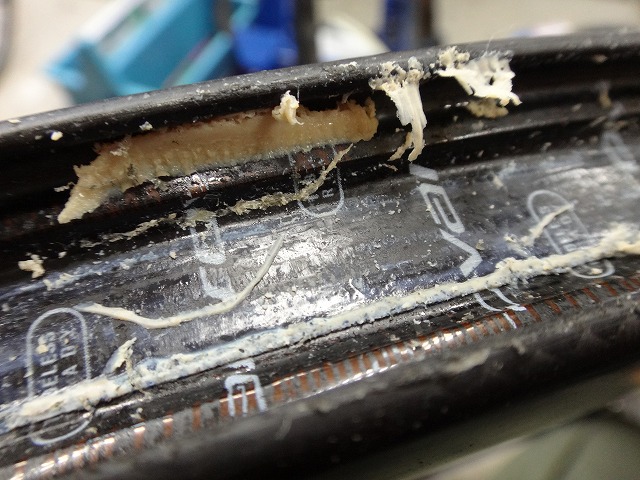
The sealant had completely dried and hardened, with areas that had even picked up the shape of the tire's inner surface.

When sealant hardens and accumulates inside the rim's bead hook or along the tire's bead, on subsequent use that hardened sealant caught in the bead area seems like it might interfere with the rim-tire seal.
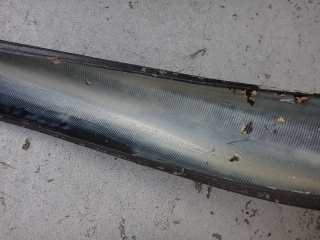
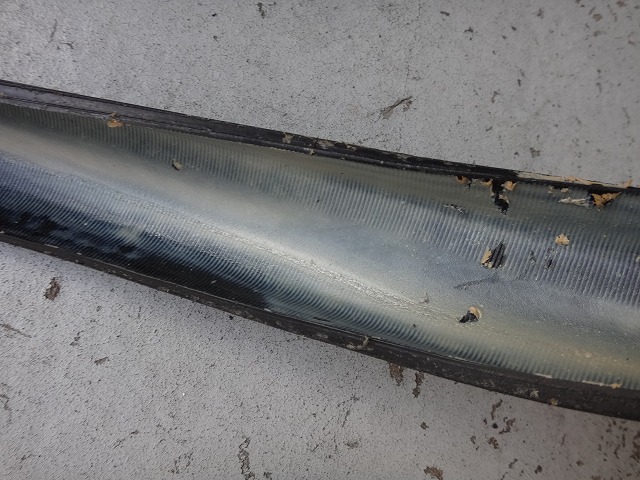
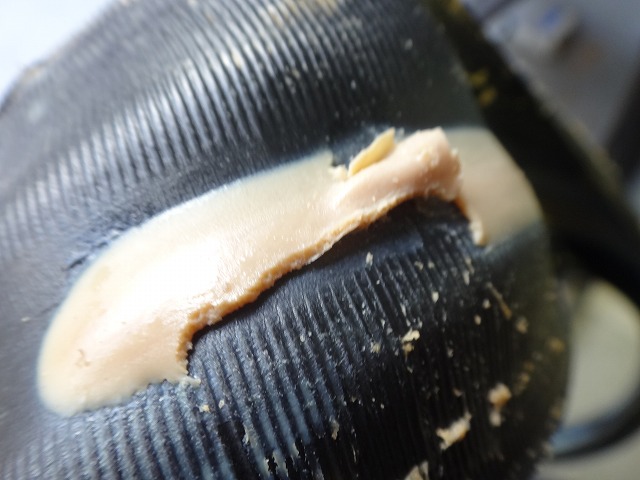
On the tire side, there are areas where it's spread thin like a smoothly drawn line of wax over the whole surface,
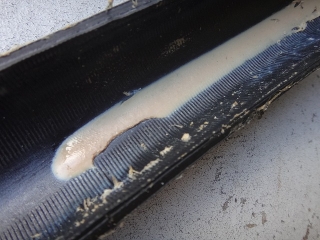
and other areas where sealant that flowed like a stream just hardened in place.
The lump at this tip might be from when the sealant was hardening and the wheel sat for a long time with that spot at the bottom.
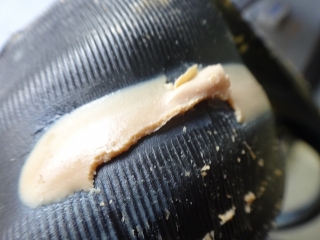
When I tried to peel it off, it was like hardened gum stuck on, and it wasn't easy to remove.
I could scrape it off with the nylon non-woven fabric part of a dish sponge or steel wool (using only the former on rims), but in severe cases it becomes quite tedious work.
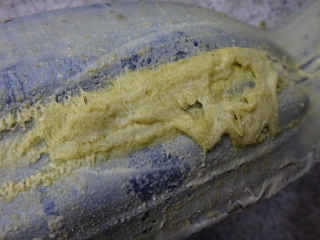
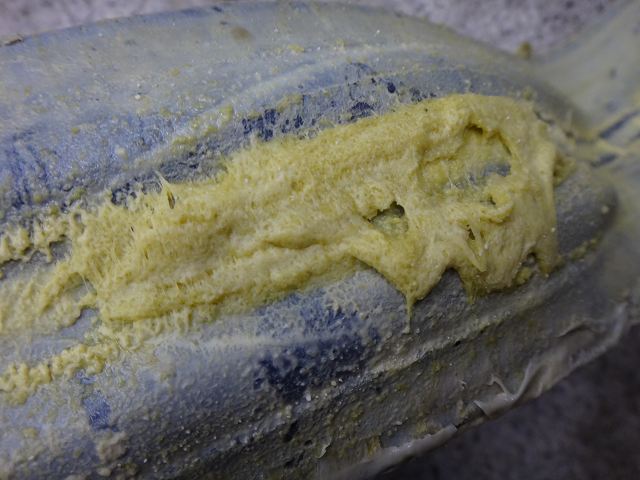
↑This is a separate case—a lump on a Mavic UST tubeless tire.
Since it was a tire I was discarding, I didn't need to remove it, but the lump was stuck quite firmly and when I tried to peel it with my finger, it wouldn't budge at all.
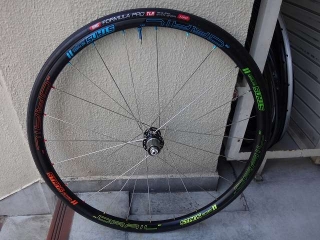
I previously introduced a sealant brand called Imidji here (→here), and while I don't distrust it, it was more of a trial introduction and I'd used it on hardly anything but my personal bikes.
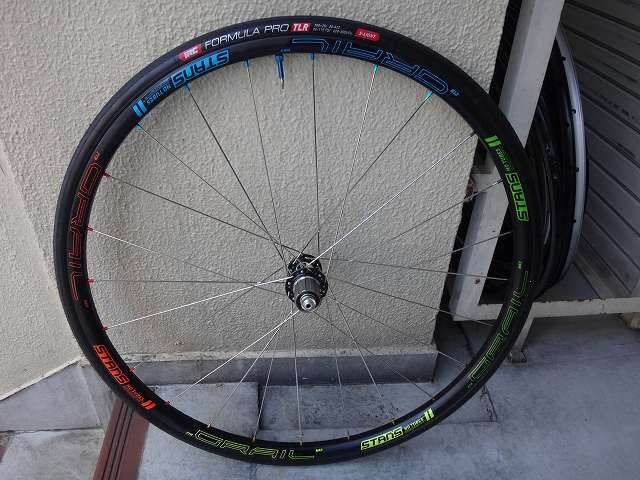
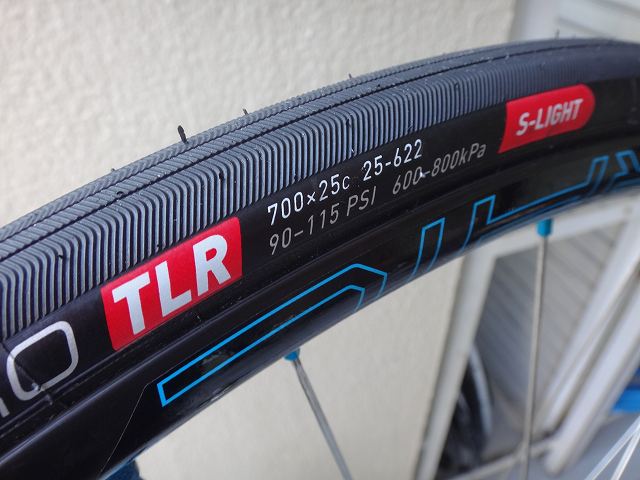
The personal wheel in the image above was built with a Grail CB7 rim, and
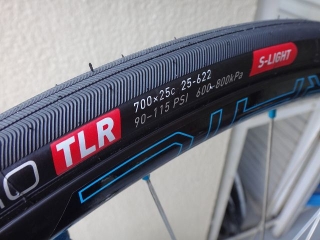
since it's a hookless rim, it can only be used with tubeless or tubeless-ready tires.
From what I've learned, you can apparently use it with tubed tires as long as the tire itself is tubeless-type (otherwise you'd be stranded, and for MTBs with large internal tire volumes, there are also repair kits with string-like adhesive seals you can stab into the tire), but except for extreme cases like polyurethane ultra-lightweight tubes (around 30g), sealant is lighter than tubes, so I use Imidji sealant in mine.
This is just my impression, but sealant seems to have a clear threshold amount below which it does essentially zero work.
In extreme terms, if for a given tire-rim pairing the minimum amount of sealant needed is 30ml or more, then 29ml would do nothing—the same as zero.
In reality it's not quite that extreme, but for example, if 30ml gives a certain natural air loss rate, 15ml wouldn't make the rate twice as fast—with that little sealant, you might as well not have any.
With road bikes, it's not for cost reasons but to reduce rotational weight at the wheel's circumference that sealant often gets stinted on, but if you skimp too much, the sealant doesn't actually work—defeating the purpose.
The wheel and tire in the image above top out at 6 bar of pressure, which I maintain out of caution due to the hookless rim, but the natural air loss is about the same as a lightweight butyl tube or slightly better. For everyday commuting use,
it easily lasted over a week without needing air top-ups.
I built this on September 16th, and after using it for about a month, I hung it and left it alone for about another month.
While it was hanging, I took it down several times to show customers, so no particular spot was always facing downward.
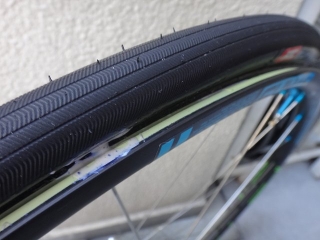
I broke the tire bead.
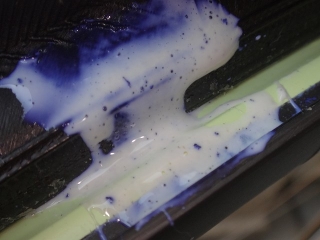
What I was using is the version with microfiber bits like chocolate chips.
In a separate incident with an XR331 rim and an older IRC tire, during a rainy ride home when we got a puncture, I quickly spotted bubbles coming from the tire hole. I pointed that spot downward and shook the wheel, and managed to seal the air leak. But when I tried to pressurize it back up to around 7 bar, I exceeded the pressure at which "sealant-sealed punctures reopen," so the hole opened again. I shook the wheel once more to reseal it and rode home at a moderate pressure (just a few km left, so I improvised; for a longer distance I would've switched to tubed) (Afterward when I checked the tire interior, the microfiber had gathered in the puncture hole, so it seems to play a role in sealing ability).
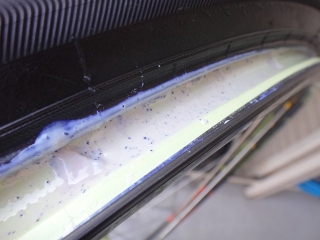
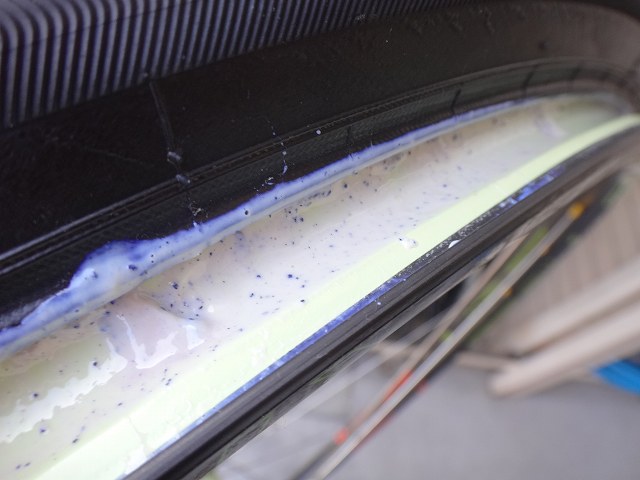
↑Rim side

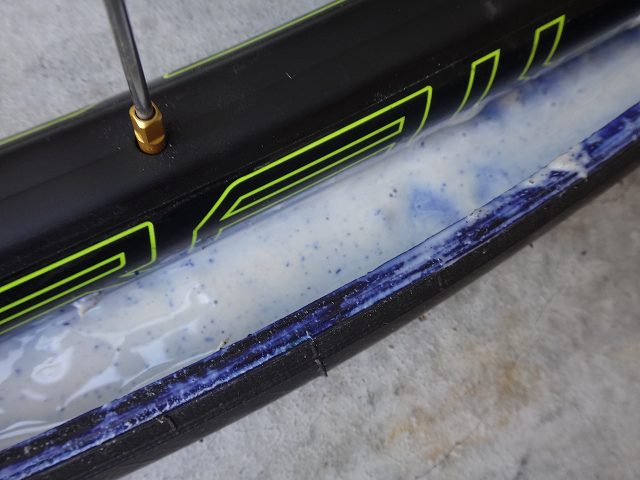
↑Tire side
The liquid volume is less than what was initially installed, but even after two months it remained in a thick, paste-like state throughout the entire circumference.

I removed the tire.
From here on, I'll just rinse with water, without scrubbing with cloth or sponge.
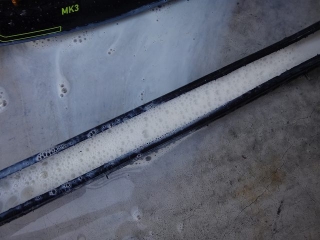
Just a garden hose showerhead, not a pressure washer, just to be clear.
On the tire side, just filling with water and rinsing away
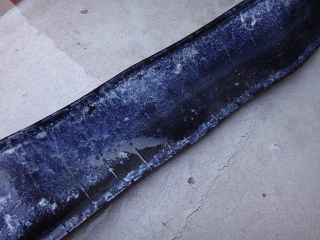
resulted in zero lumps forming inside the tire.
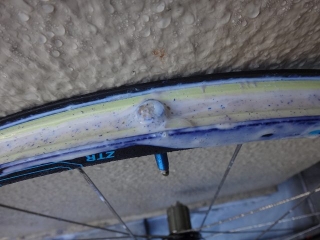
Near the valve hole ↑before
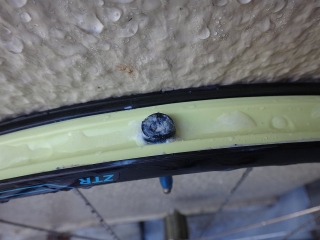
↑after
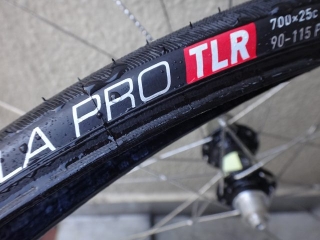
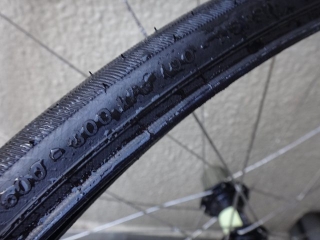
Really just water rinsing.
What's great is that no sealant residue remains on the tire sidewall's bead area at all.
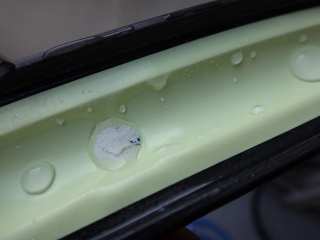
Sealant clumps tend to remain in the tape's indentations, but they came off easily by hand afterward.
Clean cleanup is a characteristic of this sealant, but to be honest—and this is important—its sealing performance is on the weaker side.
Even the microfiber version is clearly weaker than Stans's standard "tire sealant" model.
So when I first started using it, pressure could drop several psi per day.
But keeping in mind that "minimum amount for sealant to actually work" I mentioned earlier, for a tire where I'd normally put 30ml of Stans, with Imidji I go with 40ml-plus, a bit more. That resolved the air loss issue.
I don't put in 50ml with 25C tires, but even at 50ml it would still be lighter than most butyl tubes.
If the quantity is right, it seals air leaks, but its immediate puncture repair performance is still lower than Stans or Effetto Mariposa's Cafelatex.
However, the standout characteristic of producing almost no lumps with age and washing clean with water is definitely real.

↑Oh man! When this shows up it suddenly smells like advertising!
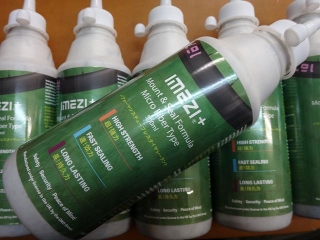
So, I've decided to stock Imidji sealant for inventory and personal use!
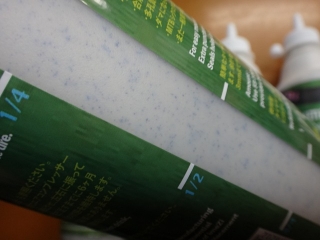
The microfiber-blended version with chocolate-chip-like bits

Imidji Plus is what I've stocked.
I once thought "the strong version should cover everything," and switched Stans sealant to only the higher-performance "Race Sealant"—that was a mistake.
It's true the sealing effect is stronger, but it lumps faster and clogs valves more easily, so I eventually realized you need both versions depending on the application.
With Imidji sealant though, the microfiber presence doesn't seem to matter much for the minimum amount needed to seal air leaks, so I figured: if the stronger version doesn't lump either, why not just use the stronger one?
Both versions with and without microfiber are 500ml at ¥2,500 pre-tax, same unit price.
The other day, I rebuilt the front wheel of a Roval CLX64 Disc that was unusable because the rim was thrashing laterally at around 60 km/h downhill, making the handling feel dangerously unstable. The original wheel was producing 100% reproducible rim vibration, but after the customer used the rebuilt wheel, they reported zero vibration issues.
Well, that's a relief. I had decent confidence it would work, but still.
Conversely, if I were to gradually loosen the nipples on the rebuilt wheel, vibration should appear somewhere, and I have a pretty good idea where that point is.
This isn't something that can be solved by spoke tension alone, so increasing spoke tension while keeping the original wheel's structure wouldn't fix it.
In fact, if it could be solved that way, it would mean "that particular wheel just happened to be abnormally loose"—which it wasn't.
I just wrote "even if spoke tension is increased," but more precisely, "even if nipples are tightened."
Even in the original state, the nipples were already tight enough that further tightening contributed almost nothing to reducing spoke deflection.
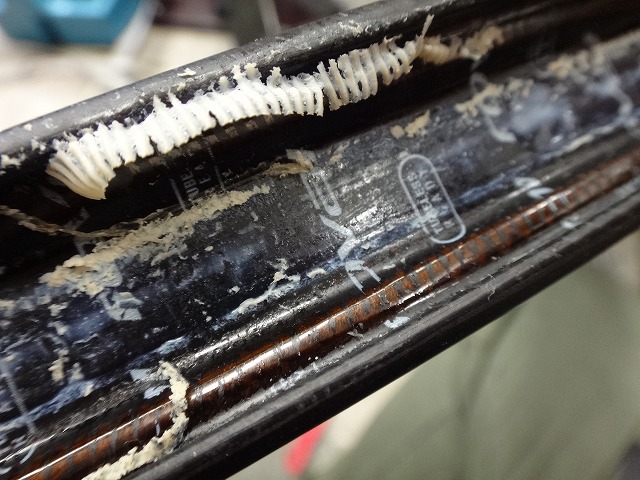
This is partway through that rebuild work, showing a Continental Grand Prix 5000 tubeless tire and sealant from an unknown manufacturer.
The sealant had completely dried and hardened, with areas that had even picked up the shape of the tire's inner surface.
When sealant hardens and accumulates inside the rim's bead hook or along the tire's bead, on subsequent use that hardened sealant caught in the bead area seems like it might interfere with the rim-tire seal.
On the tire side, there are areas where it's spread thin like a smoothly drawn line of wax over the whole surface,

and other areas where sealant that flowed like a stream just hardened in place.
The lump at this tip might be from when the sealant was hardening and the wheel sat for a long time with that spot at the bottom.
When I tried to peel it off, it was like hardened gum stuck on, and it wasn't easy to remove.
I could scrape it off with the nylon non-woven fabric part of a dish sponge or steel wool (using only the former on rims), but in severe cases it becomes quite tedious work.
↑This is a separate case—a lump on a Mavic UST tubeless tire.
Since it was a tire I was discarding, I didn't need to remove it, but the lump was stuck quite firmly and when I tried to peel it with my finger, it wouldn't budge at all.
I previously introduced a sealant brand called Imidji here (→here), and while I don't distrust it, it was more of a trial introduction and I'd used it on hardly anything but my personal bikes.
The personal wheel in the image above was built with a Grail CB7 rim, and
since it's a hookless rim, it can only be used with tubeless or tubeless-ready tires.
From what I've learned, you can apparently use it with tubed tires as long as the tire itself is tubeless-type (otherwise you'd be stranded, and for MTBs with large internal tire volumes, there are also repair kits with string-like adhesive seals you can stab into the tire), but except for extreme cases like polyurethane ultra-lightweight tubes (around 30g), sealant is lighter than tubes, so I use Imidji sealant in mine.
This is just my impression, but sealant seems to have a clear threshold amount below which it does essentially zero work.
In extreme terms, if for a given tire-rim pairing the minimum amount of sealant needed is 30ml or more, then 29ml would do nothing—the same as zero.
In reality it's not quite that extreme, but for example, if 30ml gives a certain natural air loss rate, 15ml wouldn't make the rate twice as fast—with that little sealant, you might as well not have any.
With road bikes, it's not for cost reasons but to reduce rotational weight at the wheel's circumference that sealant often gets stinted on, but if you skimp too much, the sealant doesn't actually work—defeating the purpose.
The wheel and tire in the image above top out at 6 bar of pressure, which I maintain out of caution due to the hookless rim, but the natural air loss is about the same as a lightweight butyl tube or slightly better. For everyday commuting use,
it easily lasted over a week without needing air top-ups.
I built this on September 16th, and after using it for about a month, I hung it and left it alone for about another month.
While it was hanging, I took it down several times to show customers, so no particular spot was always facing downward.

I broke the tire bead.

What I was using is the version with microfiber bits like chocolate chips.
In a separate incident with an XR331 rim and an older IRC tire, during a rainy ride home when we got a puncture, I quickly spotted bubbles coming from the tire hole. I pointed that spot downward and shook the wheel, and managed to seal the air leak. But when I tried to pressurize it back up to around 7 bar, I exceeded the pressure at which "sealant-sealed punctures reopen," so the hole opened again. I shook the wheel once more to reseal it and rode home at a moderate pressure (just a few km left, so I improvised; for a longer distance I would've switched to tubed) (Afterward when I checked the tire interior, the microfiber had gathered in the puncture hole, so it seems to play a role in sealing ability).
↑Rim side
↑Tire side
The liquid volume is less than what was initially installed, but even after two months it remained in a thick, paste-like state throughout the entire circumference.
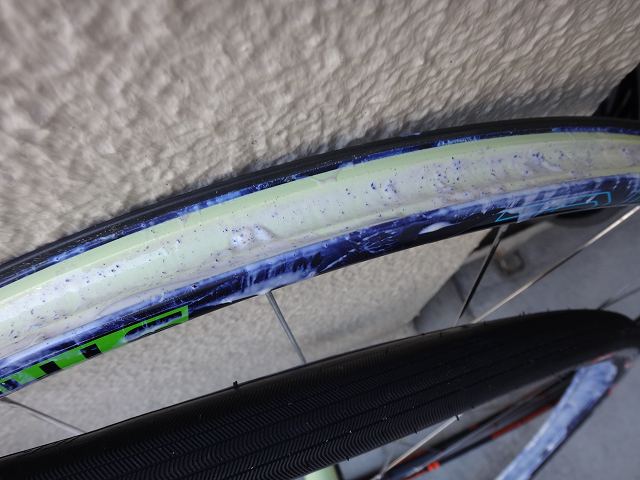
I removed the tire.
From here on, I'll just rinse with water, without scrubbing with cloth or sponge.

Just a garden hose showerhead, not a pressure washer, just to be clear.
On the tire side, just filling with water and rinsing away
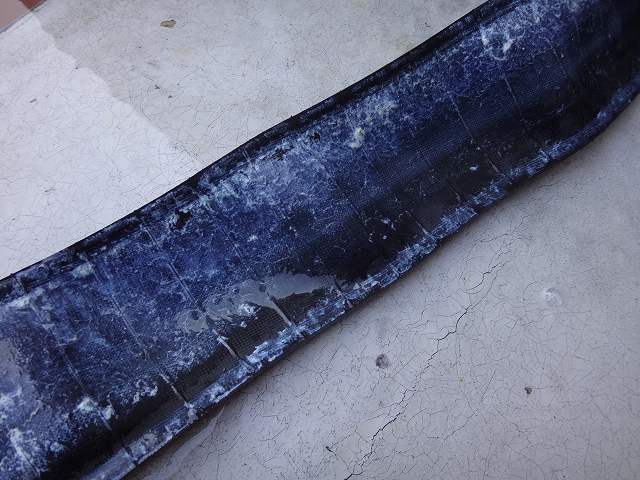
resulted in zero lumps forming inside the tire.

Near the valve hole ↑before
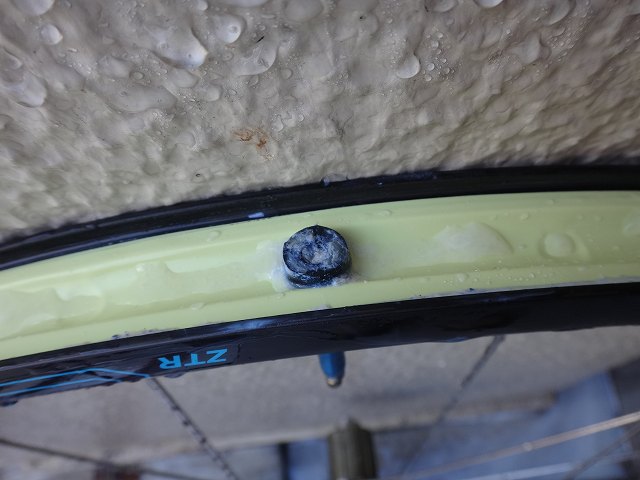
↑after


Really just water rinsing.
What's great is that no sealant residue remains on the tire sidewall's bead area at all.
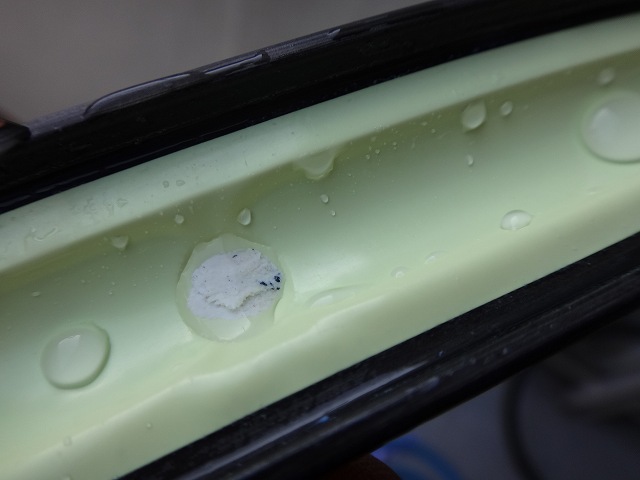
Sealant clumps tend to remain in the tape's indentations, but they came off easily by hand afterward.
Clean cleanup is a characteristic of this sealant, but to be honest—and this is important—its sealing performance is on the weaker side.
Even the microfiber version is clearly weaker than Stans's standard "tire sealant" model.
So when I first started using it, pressure could drop several psi per day.
But keeping in mind that "minimum amount for sealant to actually work" I mentioned earlier, for a tire where I'd normally put 30ml of Stans, with Imidji I go with 40ml-plus, a bit more. That resolved the air loss issue.
I don't put in 50ml with 25C tires, but even at 50ml it would still be lighter than most butyl tubes.
If the quantity is right, it seals air leaks, but its immediate puncture repair performance is still lower than Stans or Effetto Mariposa's Cafelatex.
However, the standout characteristic of producing almost no lumps with age and washing clean with water is definitely real.
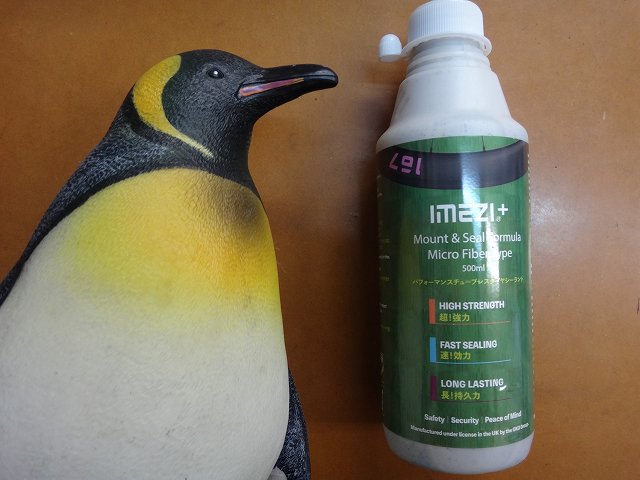
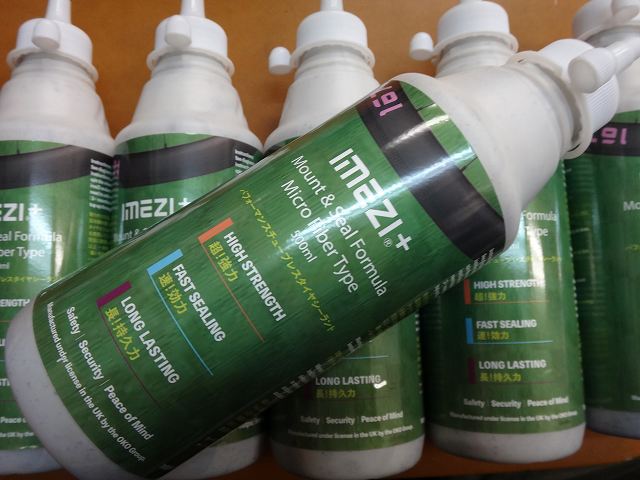
So, I've decided to stock Imidji sealant for inventory and personal use!

The microfiber-blended version with chocolate-chip-like bits

Imidji Plus is what I've stocked.
I once thought "the strong version should cover everything," and switched Stans sealant to only the higher-performance "Race Sealant"—that was a mistake.
It's true the sealing effect is stronger, but it lumps faster and clogs valves more easily, so I eventually realized you need both versions depending on the application.
With Imidji sealant though, the microfiber presence doesn't seem to matter much for the minimum amount needed to seal air leaks, so I figured: if the stronger version doesn't lump either, why not just use the stronger one?
Both versions with and without microfiber are 500ml at ¥2,500 pre-tax, same unit price.