Today another wheel build (and so on).
But before that.
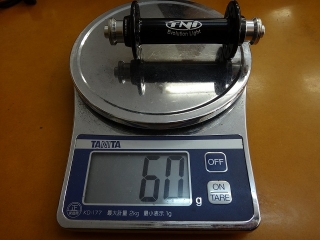
↑This is the measured weight of an Evo Lite front hub,
and the manufacturer spec is also 60g, same as the actual measurement.
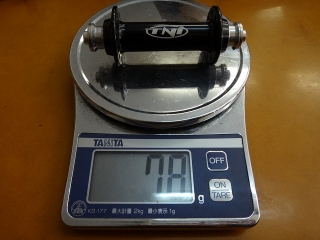
↑This is the measured weight of an Evo front hub,
but to be precise, it's the later Evo Hub II.
The manufacturer spec is 85g, but the 85g spec was just carried over
from the earlier Evo Hub I's weight specification,
and I doubt there's actually an Evo Hub II that weighs 85g in real measurement.
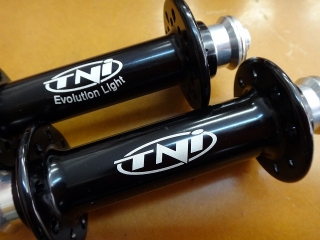
I weighed ones with the same number of spoke holes on the flanges.
18g might seem like a tiny difference,
but as a percentage it's over 20% different.
Even though the hubs look almost identical,
where did they save all that weight?
You can see that the hub body diameter is different,
but that only saves a few grams.
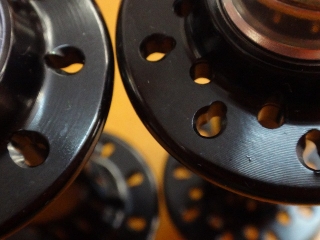
The Evo Lite front hub flanges have lightening holes inside the spoke holes,
except for 28H and 32H,
but even if you add up all the volume removed by these holes,
you'd barely have enough to equal one 1-yen coin.
Even accounting for the difference in specific gravity between pure aluminum and aluminum alloy,
that amount is negligible,
so weight savings from these holes is barely 1g if at all.
So what's the main cause of the weight difference?
It's that the bearings—being iron—are smaller on the Evo Lite hub.
Anyway, on with today's wheel build (and so on).
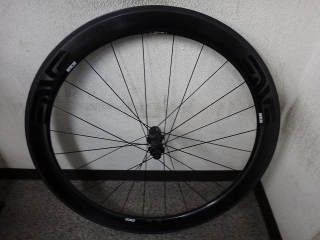
I built a rear wheel with a Smart Envision System 4.5 tubular rim.
The model name for the rim as a standalone unit is A56.
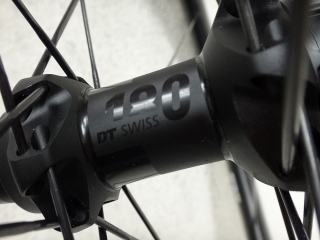
The hub is a new DT180 hub for straight spokes,
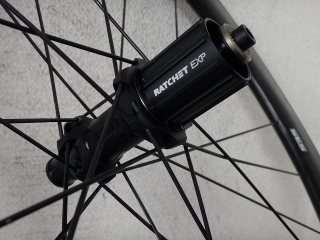
24H black Leader / CX Sprint left and right 2-cross forced JIS lacing.
This hub lets you choose whether to use crossing contact (ayatori) on the final cross or not,
and on Prime pre-built complete wheels with similar flange designs and straight spokes,
they only use ayatori on the freewheel side,
but on this wheel I used ayatori on both sides.
Actually, I do that in almost all cases.
Ayatori is essential if you're going to lace for braking control.
I'll do that lacing later.
This rear hub has had its star ratchet mechanism changed
from a double-spring design to a single-spring design,
and it's a new Ratchet EXP hub with a simplified internal mechanism.
It's like DT copied their own design that Mavic had already copied with Instant Drive,
and they're making noise about improved lateral stiffness because the bearing width got wider,
but the flange width actually got narrower.

The left flange is noticeably narrow,
but it's almost the same width as the model with a disc rotor mounting surface
(specs differ by only 0.1mm),
so the dimensions are weird—it reserves space for a rotor
that can't actually be mounted.
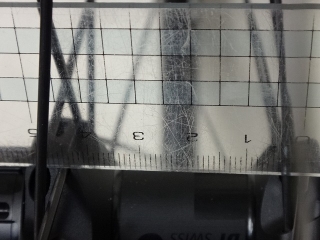
This is a 130mm width quick-release hub,
and the flange width specs were right 15.4mm / left 33.3mm.
The total left and right comes to 48.7mm.
Call it roughly 49mm—I decided to investigate exactly
where and what this width actually measures.
・Distance between the spoke hole centers on the inside of the left and right flanges
・Distance between the midpoints of the spoke holes running parallel on the left and right flanges
・Distance between the spoke hole centers on the outside of the left and right flanges
↑The lower you go, the wider the "defined width" becomes,
so if you want the flange width to look wide,
the 49mm is most convenient if it's using the top definition.
But in reality, as the image shows, it was actually
the distance between the outermost spoke hole centers.
Furthermore, this hub has an annoying issue with a tight fit in the bearing cup.
On the 142mm thru-axle version of this same hub,
the flange width specs are right 17.3mm / left 33.4mm.
That's roughly 2mm wider on the right flange compared to the 130mm version,
which is actually a pretty significant difference.
Say hypothetically there was a hub with right 19mm / left 38mm / total 57mm
(Shimano and Evo Lite hubs are roughly this),
and to get the total down to 55mm,
if you only reduced the left side by 2mm to get right 19mm / left 36mm,
you'd reduce the spoke tension asymmetry on the other hand,
but the flange width loss would be a major negative factor for lateral stiffness
—that's what I'm thinking while building the wheel—
but if the hub had right 17mm / left 38mm instead,
you'd end up with a wheel where no matter what you do,
the freewheel side is pulling hard while the opposite side is slack.
I've mentioned a few times (actually pretty much every time one shows up)
about the Tni Evo disc rear hub,
that because it has reversed high-low flanges,
it's perfect for testing whether a particular wheel builder
can actually build a proper rear wheel,
but this hub also presents difficulty in building a proper rear wheel
under different conditions—the lacing method is forced,
and because they're straight spokes there's not much choice in spoke counts.
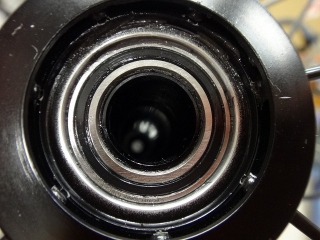
↑This is a Rovaal rear hub,
and on complete wheels using DT "brand" hubs rather than DT originals,
the bearings are almost always smaller than the real DT ones
(GIANT's SLR is similar).
I've replaced bearings on these hubs countless times,
and even when replacement isn't needed, I constantly see hubs
with rough, noisy rotation. But on genuine DT hubs,
I almost never replace bearings.
The larger bearing outer diameter makes them more resistant to damage.
The hub in the image above seems to have room in the hub body
to fit a larger diameter bearing, yet for some reason they don't.
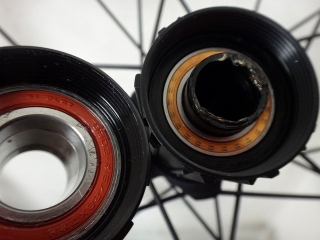
↑Bearings from old and new star ratchet hubs.
The new Ratchet EXP hub is lighter than the previous model,
but the main reason isn't structural simplification—it's bearing size changes
(both the hub shell and the freewheel body).
This is definitely going to mean higher parts replacement frequency... though.
But before that.

↑This is the measured weight of an Evo Lite front hub,
and the manufacturer spec is also 60g, same as the actual measurement.

↑This is the measured weight of an Evo front hub,
but to be precise, it's the later Evo Hub II.
The manufacturer spec is 85g, but the 85g spec was just carried over
from the earlier Evo Hub I's weight specification,
and I doubt there's actually an Evo Hub II that weighs 85g in real measurement.

I weighed ones with the same number of spoke holes on the flanges.
18g might seem like a tiny difference,
but as a percentage it's over 20% different.
Even though the hubs look almost identical,
where did they save all that weight?
You can see that the hub body diameter is different,
but that only saves a few grams.

The Evo Lite front hub flanges have lightening holes inside the spoke holes,
except for 28H and 32H,
but even if you add up all the volume removed by these holes,
you'd barely have enough to equal one 1-yen coin.
Even accounting for the difference in specific gravity between pure aluminum and aluminum alloy,
that amount is negligible,
so weight savings from these holes is barely 1g if at all.
So what's the main cause of the weight difference?
It's that the bearings—being iron—are smaller on the Evo Lite hub.
Anyway, on with today's wheel build (and so on).

I built a rear wheel with a Smart Envision System 4.5 tubular rim.
The model name for the rim as a standalone unit is A56.

The hub is a new DT180 hub for straight spokes,

24H black Leader / CX Sprint left and right 2-cross forced JIS lacing.
This hub lets you choose whether to use crossing contact (ayatori) on the final cross or not,
and on Prime pre-built complete wheels with similar flange designs and straight spokes,
they only use ayatori on the freewheel side,
but on this wheel I used ayatori on both sides.
Actually, I do that in almost all cases.
Ayatori is essential if you're going to lace for braking control.
I'll do that lacing later.
This rear hub has had its star ratchet mechanism changed
from a double-spring design to a single-spring design,
and it's a new Ratchet EXP hub with a simplified internal mechanism.
It's like DT copied their own design that Mavic had already copied with Instant Drive,
and they're making noise about improved lateral stiffness because the bearing width got wider,
but the flange width actually got narrower.

The left flange is noticeably narrow,
but it's almost the same width as the model with a disc rotor mounting surface
(specs differ by only 0.1mm),
so the dimensions are weird—it reserves space for a rotor
that can't actually be mounted.

This is a 130mm width quick-release hub,
and the flange width specs were right 15.4mm / left 33.3mm.
The total left and right comes to 48.7mm.
Call it roughly 49mm—I decided to investigate exactly
where and what this width actually measures.
・Distance between the spoke hole centers on the inside of the left and right flanges
・Distance between the midpoints of the spoke holes running parallel on the left and right flanges
・Distance between the spoke hole centers on the outside of the left and right flanges
↑The lower you go, the wider the "defined width" becomes,
so if you want the flange width to look wide,
the 49mm is most convenient if it's using the top definition.
But in reality, as the image shows, it was actually
the distance between the outermost spoke hole centers.
Furthermore, this hub has an annoying issue with a tight fit in the bearing cup.
On the 142mm thru-axle version of this same hub,
the flange width specs are right 17.3mm / left 33.4mm.
That's roughly 2mm wider on the right flange compared to the 130mm version,
which is actually a pretty significant difference.
Say hypothetically there was a hub with right 19mm / left 38mm / total 57mm
(Shimano and Evo Lite hubs are roughly this),
and to get the total down to 55mm,
if you only reduced the left side by 2mm to get right 19mm / left 36mm,
you'd reduce the spoke tension asymmetry on the other hand,
but the flange width loss would be a major negative factor for lateral stiffness
—that's what I'm thinking while building the wheel—
but if the hub had right 17mm / left 38mm instead,
you'd end up with a wheel where no matter what you do,
the freewheel side is pulling hard while the opposite side is slack.
I've mentioned a few times (actually pretty much every time one shows up)
about the Tni Evo disc rear hub,
that because it has reversed high-low flanges,
it's perfect for testing whether a particular wheel builder
can actually build a proper rear wheel,
but this hub also presents difficulty in building a proper rear wheel
under different conditions—the lacing method is forced,
and because they're straight spokes there's not much choice in spoke counts.

↑This is a Rovaal rear hub,
and on complete wheels using DT "brand" hubs rather than DT originals,
the bearings are almost always smaller than the real DT ones
(GIANT's SLR is similar).
I've replaced bearings on these hubs countless times,
and even when replacement isn't needed, I constantly see hubs
with rough, noisy rotation. But on genuine DT hubs,
I almost never replace bearings.
The larger bearing outer diameter makes them more resistant to damage.
The hub in the image above seems to have room in the hub body
to fit a larger diameter bearing, yet for some reason they don't.

↑Bearings from old and new star ratchet hubs.
The new Ratchet EXP hub is lighter than the previous model,
but the main reason isn't structural simplification—it's bearing size changes
(both the hub shell and the freewheel body).
This is definitely going to mean higher parts replacement frequency... though.