Another day of wheel work (and so on).

A customer brought in the front wheel of a GIANT SLR.
It's a 30mm high carbon tubeless-ready rim.
Compared to the Nomu Lab Wheel #5 front wheel, it lacks stability,
and even before descending, it feels sketchy in criterium corners,
basically feels mushy—so they want it rebuilt.

The spokes are 2.0-1.8-2.0mm round butted black straight spokes,
with the spoke heads crushed into an enoki mushroom shape.
The hub flanges use a hook-style attachment rather than a through-type.
I'm rebuilding with CX Sprint spokes, but
since the current spokes are competition-grade,
the spoke weight ratio will actually decrease with the rebuild.
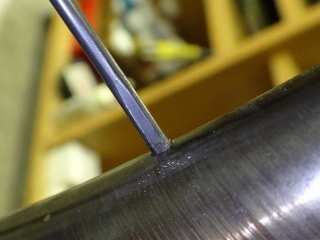
Because the spoke heads have flats, there's no endless rotation,
and even though they're round spokes, they have
square flats on the rim side for gripping with tools, so tensioning is easy.
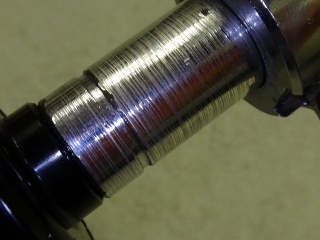
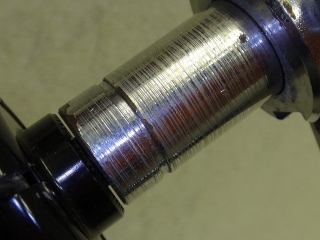
There was a centering issue, but
even when I tried to correct it through tensioning,
it didn't transform much.
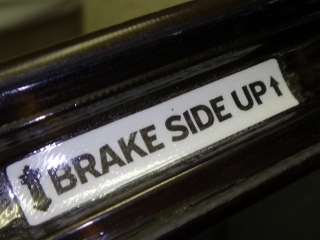
Incidentally—doesn't really matter—this rim
is shared between disc brake and rim brake wheels,
and there were instructions about left-right orientation when building with disc hubs.
This wheel is a rim brake front, so
there's no offset in shape or rim hole positioning.
The real mistake with this front wheel is that it's 16-spoke.
For this spoke length with competition-grade spokes,
going from 16-spoke to 20-spoke (adding four spokes and four nipples)
would only add about 26 grams.
As I always write: except for ultra-deep rims,
the weight savings and aerodynamic advantage of 16-spoke over 20-spoke
in no way outweigh the loss in wheel stiffness that comes from going 16-spoke.
At 26 grams lighter, if this front wheel
was around 680 grams (and in reality it is),
it crosses the boundary between "600g range" and "700g range,"
and for that completely misleading metric of
"combined front and rear wheel weight in the 1100+ gram range"
that tells you nothing real about the wheel,
it's perfect for fooling amateurs.
Even though the original had round spokes that completely eliminate rotation,
building a stiffer wheel with spokes that have less weight ratio than those
is—it depends on how tight the original wheel was tensioned—
extremely difficult.
This becomes a trade secret, but
this time I had grounds for making it work.
If it looked impossible, I'd just find spokes from complete wheels
with the right length and weight ratio.
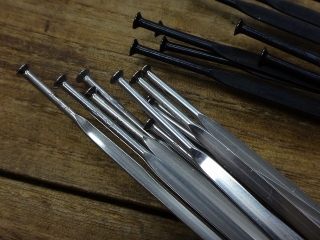
Since I didn't use them this time, I haven't verified it,
but the first-generation Racing 3 spokes (image above)
might fit that bill.
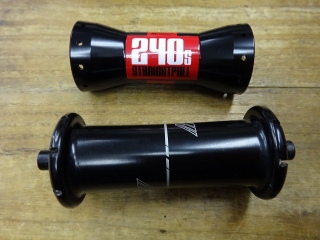
This hub is DT-made, but
it's characterized by having wider flanges than DT's own hubs.
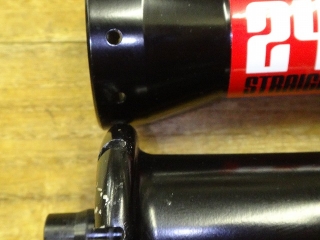
↑If I roughly align the lateral position with this one . . .
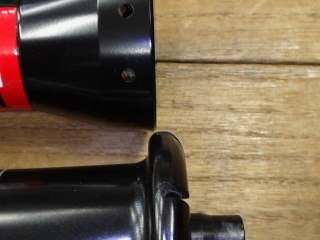
On the opposite side, there's about this much difference.
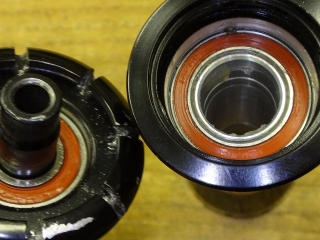
This is also something I always mention, but
DT uses larger bearing sizes.
The SLR hub looks like it could fit even larger bearings,
yet somehow it has small-diameter bearings.
Rival hubs are the same way.
Cartridge-bearing hubs, especially press-fit axle-end hubs,
when used with a skewer, get heavier bearing rotation and wear much faster
compared to quick-release use
(you should use the same tightening as a quick-release,
but most people I see over-tighten with skewers),
but DT hubs use bearing sizes less affected by skewers,
so their skewers don't damage the hubs.
GIANT used to make a DT-made skewer with
a tab on the nut side (opposite the lever) that fits into fork or frame slots,
but aside from 135mm road disc versions,
they've discontinued the road models.
Beyond flange width, the SLR hub also has
wider bearing spacing than DT hubs. That's nice.
Also, DT hub axles end at the bearing face,
with the press-fit axle-end sitting inside the hub axle.
This isn't much of an issue with front hubs
(DT's design anticipates through-axles anyway,
and the larger bearing bore means a thicker axle, so it's less problematic),
but rear hubs where the non-freewheel side ends this way
aren't ideal.
On DT rear hubs, the axle extends well beyond the bearing.
Rear hubs where the left axle side ends at the bearing face
exist on Zcntus and Vision hubs.
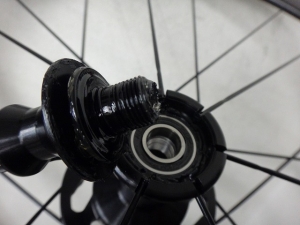
↑This is a Vittoria Corsa—an example of that type of hub.
However, with Zcentus, Vision, and this Vittoria,
the axle-end and hub axle have a threaded relationship
rather than press-fit, so
maybe this structure works.
Looking at GIANT's SLR spare-part
press-fit axle-ends, even the quick-release versions
don't have the type that recesses into the hub axle,
so that seems fine.
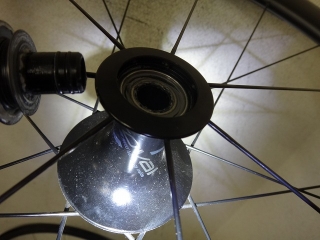
I'll leave the brand name out,
but this is a "rear hub axle left end ending at bearing face
AND press-fit axle-end" hub.
With the left axle-end attached to the hub axle,
if I grab it with my fingers and shake it front-to-back,
it moves sloppily against the hub axle.
In practice, when it's clamped in the frame with a quick-release
or skewer, there's no problem?
If you think that, go ahead and believe it.
There's possibly a related issue: noises thought to come from the pedal or BB
(and that's all they sound like) often turn out to actually be caused by
loose or loosening bolts on the replaceable derailleur hanger
securing the rear derailleur to the frame.
The quick-release clamp can't completely eliminate wobble in the axle-end joint.
Incidentally, the brand in the image above had
a hub axle left end that protruded past the bearing in the previous generation.
Also, disc brake wheels are through-axle spec,
so they don't have recessed press-fit axle-ends.
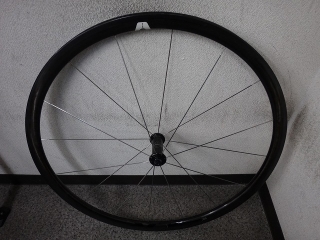
Built.
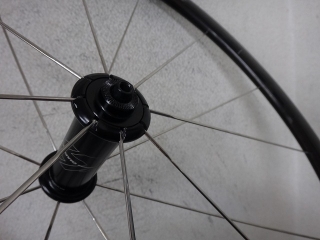
16-spoke CX Sprint straight forced-radial lacing.
The original had black spokes, but I built it with silver spokes
at the customer's request.

A customer brought in the front wheel of a GIANT SLR.
It's a 30mm high carbon tubeless-ready rim.
Compared to the Nomu Lab Wheel #5 front wheel, it lacks stability,
and even before descending, it feels sketchy in criterium corners,
basically feels mushy—so they want it rebuilt.

The spokes are 2.0-1.8-2.0mm round butted black straight spokes,
with the spoke heads crushed into an enoki mushroom shape.
The hub flanges use a hook-style attachment rather than a through-type.
I'm rebuilding with CX Sprint spokes, but
since the current spokes are competition-grade,
the spoke weight ratio will actually decrease with the rebuild.

Because the spoke heads have flats, there's no endless rotation,
and even though they're round spokes, they have
square flats on the rim side for gripping with tools, so tensioning is easy.


There was a centering issue, but
even when I tried to correct it through tensioning,
it didn't transform much.

Incidentally—doesn't really matter—this rim
is shared between disc brake and rim brake wheels,
and there were instructions about left-right orientation when building with disc hubs.
This wheel is a rim brake front, so
there's no offset in shape or rim hole positioning.
The real mistake with this front wheel is that it's 16-spoke.
For this spoke length with competition-grade spokes,
going from 16-spoke to 20-spoke (adding four spokes and four nipples)
would only add about 26 grams.
As I always write: except for ultra-deep rims,
the weight savings and aerodynamic advantage of 16-spoke over 20-spoke
in no way outweigh the loss in wheel stiffness that comes from going 16-spoke.
At 26 grams lighter, if this front wheel
was around 680 grams (and in reality it is),
it crosses the boundary between "600g range" and "700g range,"
and for that completely misleading metric of
"combined front and rear wheel weight in the 1100+ gram range"
that tells you nothing real about the wheel,
it's perfect for fooling amateurs.
Even though the original had round spokes that completely eliminate rotation,
building a stiffer wheel with spokes that have less weight ratio than those
is—it depends on how tight the original wheel was tensioned—
extremely difficult.
This becomes a trade secret, but
this time I had grounds for making it work.
If it looked impossible, I'd just find spokes from complete wheels
with the right length and weight ratio.

Since I didn't use them this time, I haven't verified it,
but the first-generation Racing 3 spokes (image above)
might fit that bill.

This hub is DT-made, but
it's characterized by having wider flanges than DT's own hubs.

↑If I roughly align the lateral position with this one . . .

On the opposite side, there's about this much difference.

This is also something I always mention, but
DT uses larger bearing sizes.
The SLR hub looks like it could fit even larger bearings,
yet somehow it has small-diameter bearings.
Rival hubs are the same way.
Cartridge-bearing hubs, especially press-fit axle-end hubs,
when used with a skewer, get heavier bearing rotation and wear much faster
compared to quick-release use
(you should use the same tightening as a quick-release,
but most people I see over-tighten with skewers),
but DT hubs use bearing sizes less affected by skewers,
so their skewers don't damage the hubs.
GIANT used to make a DT-made skewer with
a tab on the nut side (opposite the lever) that fits into fork or frame slots,
but aside from 135mm road disc versions,
they've discontinued the road models.
Beyond flange width, the SLR hub also has
wider bearing spacing than DT hubs. That's nice.
Also, DT hub axles end at the bearing face,
with the press-fit axle-end sitting inside the hub axle.
This isn't much of an issue with front hubs
(DT's design anticipates through-axles anyway,
and the larger bearing bore means a thicker axle, so it's less problematic),
but rear hubs where the non-freewheel side ends this way
aren't ideal.
On DT rear hubs, the axle extends well beyond the bearing.
Rear hubs where the left axle side ends at the bearing face
exist on Zcntus and Vision hubs.
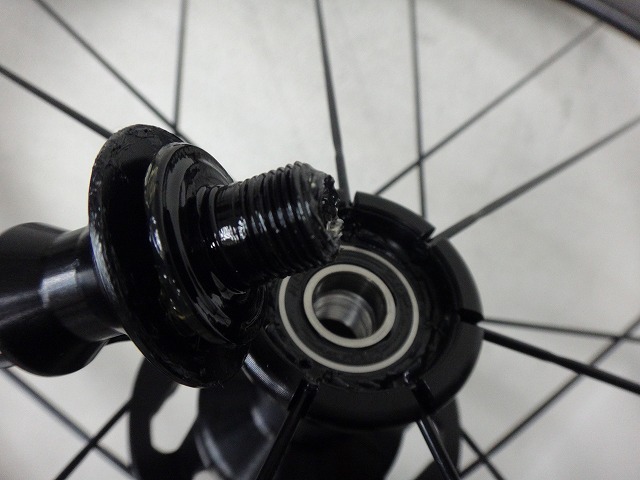
↑This is a Vittoria Corsa—an example of that type of hub.
However, with Zcentus, Vision, and this Vittoria,
the axle-end and hub axle have a threaded relationship
rather than press-fit, so
maybe this structure works.
Looking at GIANT's SLR spare-part
press-fit axle-ends, even the quick-release versions
don't have the type that recesses into the hub axle,
so that seems fine.

I'll leave the brand name out,
but this is a "rear hub axle left end ending at bearing face
AND press-fit axle-end" hub.
With the left axle-end attached to the hub axle,
if I grab it with my fingers and shake it front-to-back,
it moves sloppily against the hub axle.
In practice, when it's clamped in the frame with a quick-release
or skewer, there's no problem?
If you think that, go ahead and believe it.
There's possibly a related issue: noises thought to come from the pedal or BB
(and that's all they sound like) often turn out to actually be caused by
loose or loosening bolts on the replaceable derailleur hanger
securing the rear derailleur to the frame.
The quick-release clamp can't completely eliminate wobble in the axle-end joint.
Incidentally, the brand in the image above had
a hub axle left end that protruded past the bearing in the previous generation.
Also, disc brake wheels are through-axle spec,
so they don't have recessed press-fit axle-ends.

Built.

16-spoke CX Sprint straight forced-radial lacing.
The original had black spokes, but I built it with silver spokes
at the customer's request.