I bought a CatEye GVOLT70.

I know someone will say "didn't you already buy one before?"
but I bought that one just to write an article about it, used it a bit,
and then gave it away as a prize in a year-end raffle.
The reason I bought this one is because I wanted to lighten up the handlebar area.
Honestly, I'd prefer to have nothing on the bars at all.
During the day, if I remove the light bracket entirely
and wear the heart rate monitor on my wrist,
I can recapture that primitive road bike steering feel
that's practically impossible to achieve on modern road bikes
with their typical clutter of accessories on the handlebar.
Since dozens of grams of weight reduction can be felt in the steering,
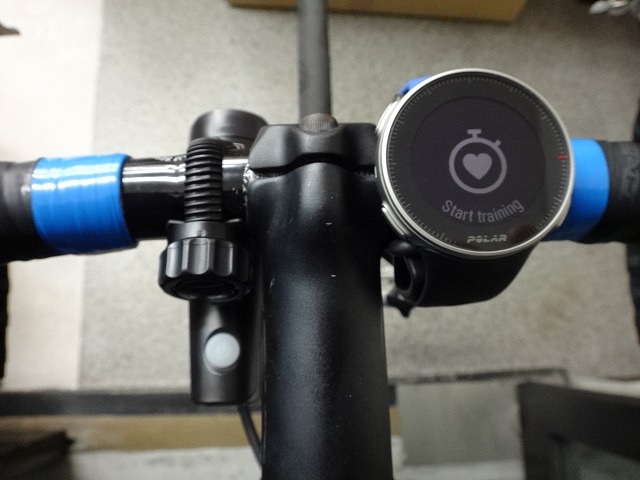
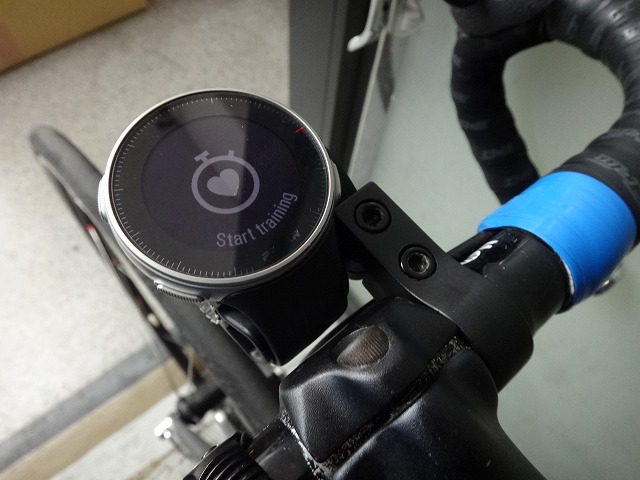
I moved the heart rate monitor from the center-mounted position—which had better visibility—
to the ferrule section alongside the stem,
and changed the light from the VOLT800 to the GVOLT70.
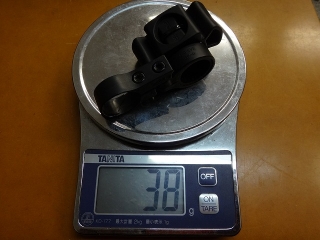
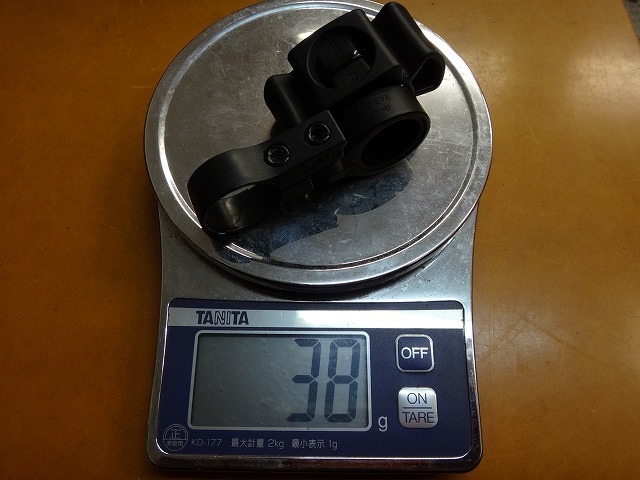
This is my custom-made center-mount bracket,

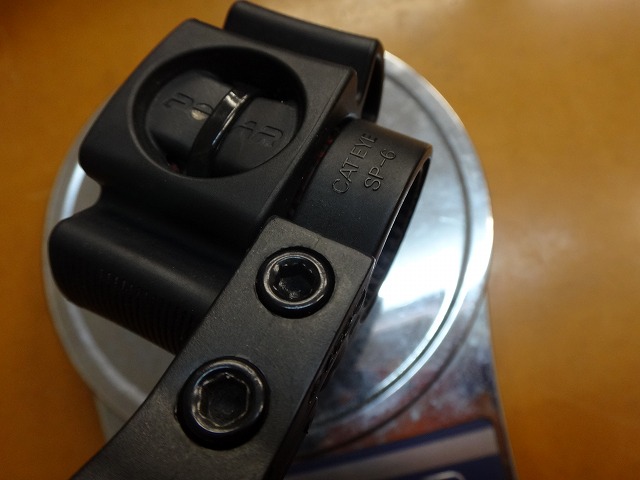
with aluminum bolts,
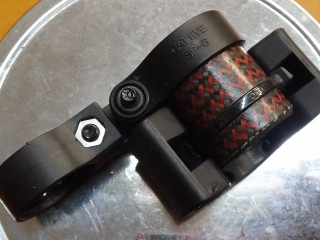
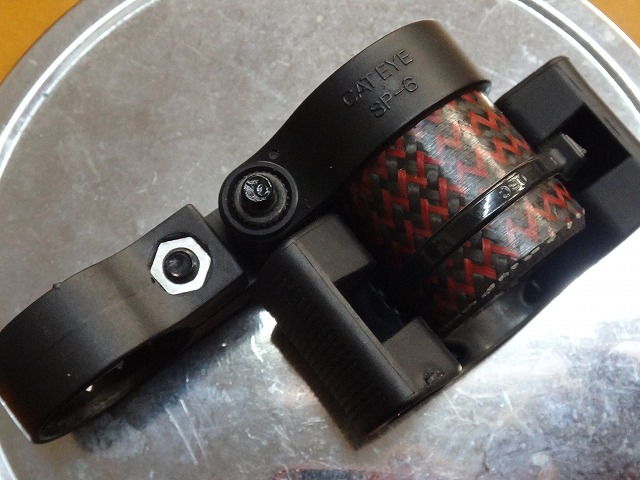
and I've made the generic hex nuts aluminum too,
so it's quite lightweight.
Of the 38g total, about 12g is the weight of the Polar mount,
so the actual weight savings is about 26g.
Once you get used to center-mounting,
if the screen is positioned at the side of the stem,
you notice that even a quick glance requires significant eye movement
and you're looking away for a long time.
It's a bit exaggerated, but it's like when you open the refrigerator door—
you imagine what's inside first, then open and close it quickly like a draw.
In the same way, I need to decide in my head beforehand which part of the screen to look at
and then make eye movements as minimal as possible.
That requires some attention. I might go back to center-mounting because of this.
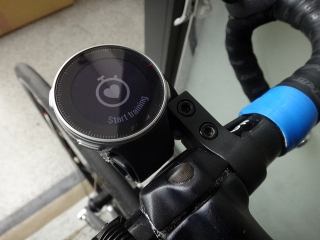
With Polar's traditional wristwatch-style models,
you had to fiddle with the wristband buckle every time to remove it from the mount.
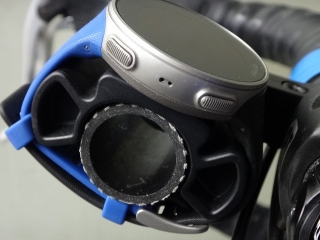
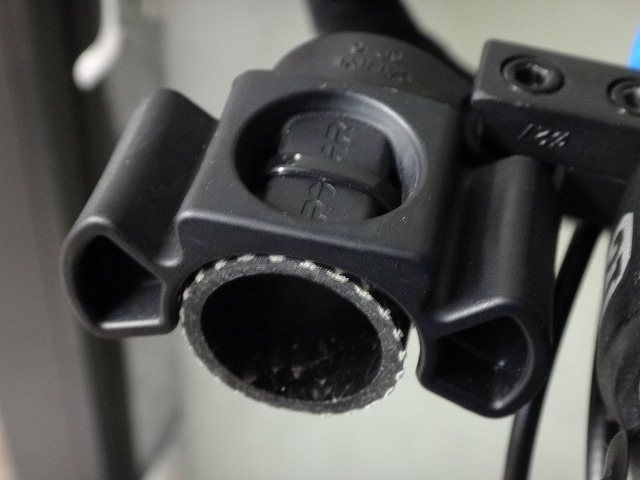
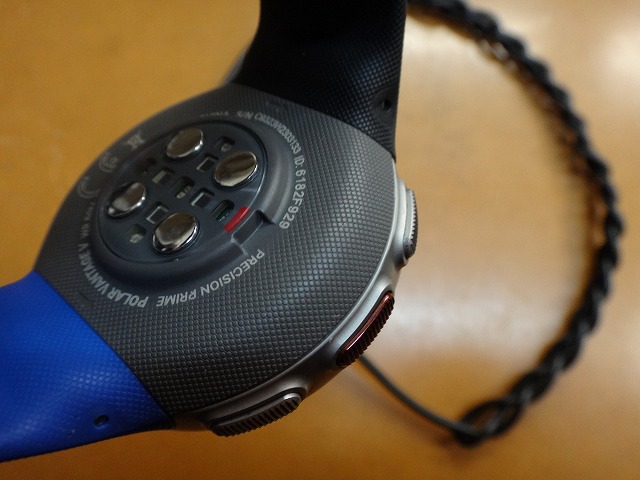
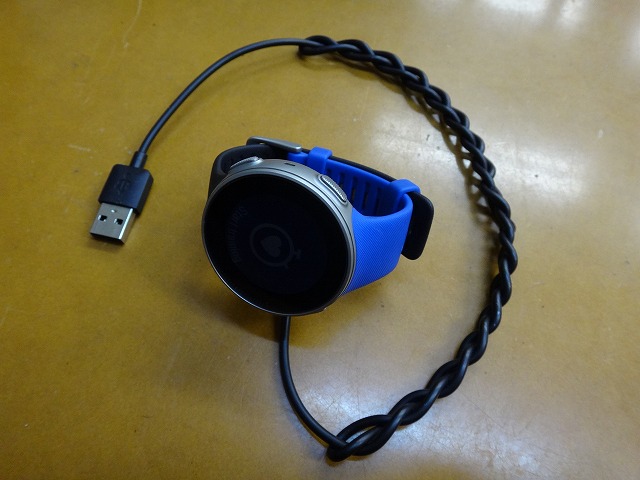
With the VANTAGE-series models and a dedicated mount,
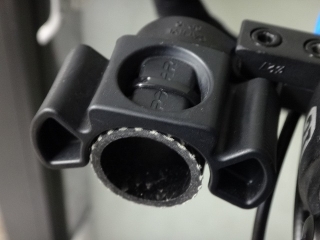
if you have a cantilever-style mount,
you can simply pull it out to the side,
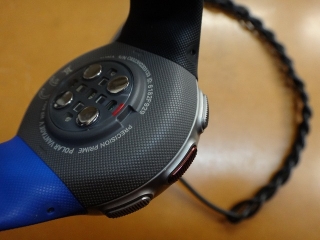

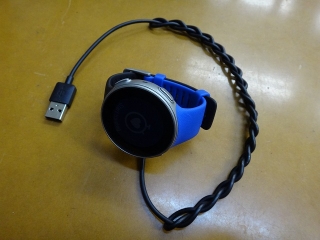
and you can charge it just like that.
Shifting to the light,
by switching from the VOLT800 (rated weight 140g)
to the GVOLT70 (rated weight 96.5g),
I've saved about 40g.
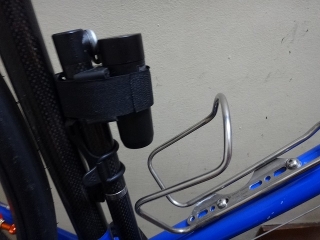
When I was using the VOLT800, I had a spare battery strapped to the seat tube with the inflator,
and I've removed that as well.
When using the VOLT800, having a spare battery meant
I didn't worry much about forgetting to charge it.
But since the GVOLT70 has the battery integrated, I need to be careful about forgetting to charge.
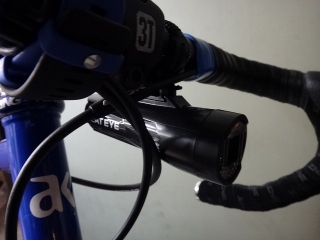
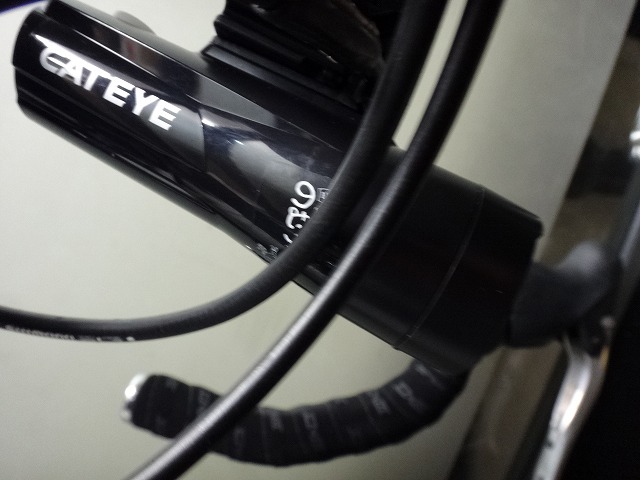
The GVOLT70 is designed exclusively for downward-facing handlebar mounting,
but I've never used spacers below the stem in my entire life
and my handlebar position is low, so no matter which side I install it,

it interferes with the cable somehow,
so I applied stickers to prevent scratching.
The GVOLT70 is a model with the upward light distribution cut off.
Even with the VOLT800 mounted at a sharp downward angle,
blue road signs at traffic light height would reflect and light up,
but with the GVOLT70, that almost never happens.
And here's something that's not CatEye's fault:
in town, the GVOLT70 makes it harder to notice
idiots riding dark without lights going the wrong way at night, so be careful.
I have some questions about the recently released GVOLT100 model, but first.
There's a VOLT1700 model with two lights mounted side-by-side,
and back when its predecessor, the VOLT1600, was still in production,
I asked someone from the manufacturer at a trade show,
"This is just a VOLT800 + VOLT800, right?"
They basically said, "Yeah, that's a fair way to understand it."
The differences from using two VOLT800s side-by-side are that
the battery is bigger and integrated,
and there's no mode to light only one of the two lights.
In other words,
"The lumens of two or more bulbs inside
a single lens housing can be added together
and listed as a single light's lumen rating."
This is something manufacturers other than CatEye do too,
and I'm not questioning the practice itself.
I forget which manufacturer, but there was a dual side-by-side front light
where the left and right lumens were different,
and you could turn either side or both on independently.
So if one was 200 lumens and the other was 500 lumens,
would turning both on equal 700 lumens?
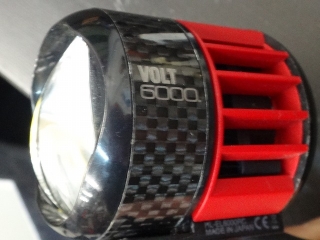
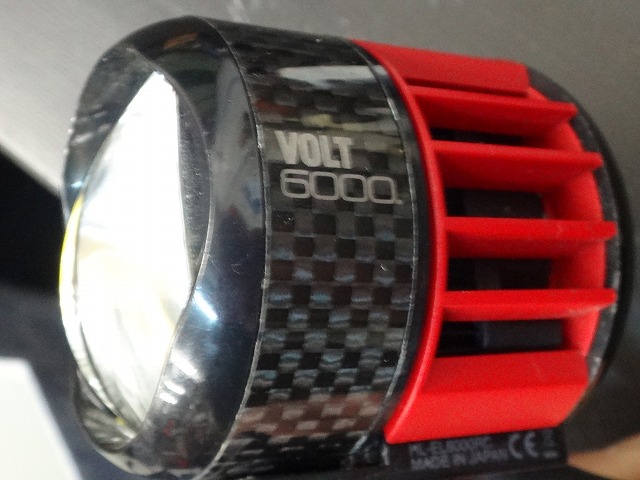
I have a VOLT6000,
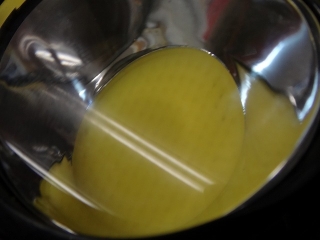
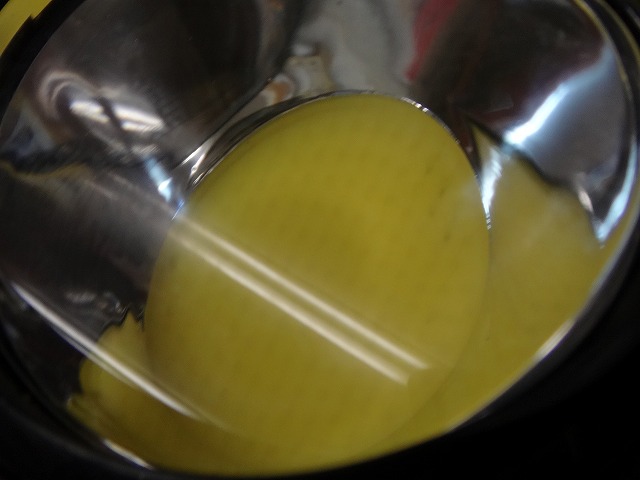
and its bulb section uses COB (Chip On Board) technology,
with LED chips arranged on a board.
I don't know the exact number of chips,
but it's calculated as something like 100 lumens × 60 chips = 6000 lumens.
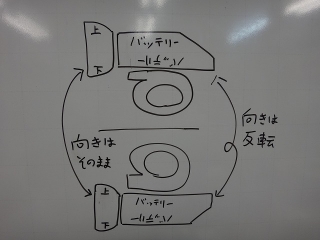
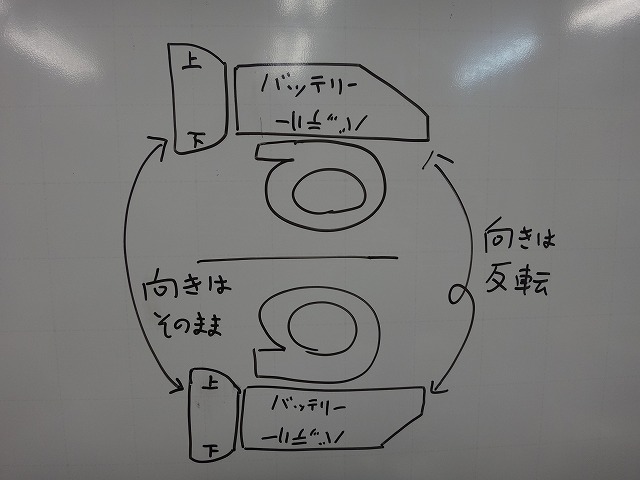
The GVOLT100 is designed so that it maintains
upper-cut light distribution whether mounted above or below the handlebar.
Unlike the GVOLT70, the battery is separate and replaceable.
When screwing the light unit onto the battery,
as long as you don't mix up the orientation, it's fine.
However, the GVOLT100 has a rated weight of 181.5g,
which is another 40g heavier than the VOLT800.
And even though the battery is replaceable,
almost the entire body apart from the light unit is battery,
so it's not particularly portable.
My main objection is the weight,
but I have other concerns as well...
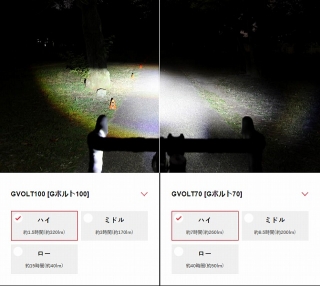
↑This is from the CatEye website—
on the left is the GVOLT100 beam chart, on the right is the GVOLT70, both set to "High" mode.
The GVOLT100's beam axis is further out,
so looking at just the near field, the GVOLT70 appears brighter, which is fine,
but what concerns me is the GVOLT100's
abnormally short runtime.

I've extracted the table from the previous image.
Even accounting for the difference in lumens, this shortness is abnormal.
The number after GVOLT represents
100 lux in High mode for the 100,
and 70 lux in High mode for the 70.
The published brightness specs are lumens for High/Mid/Low modes
and candela only for High mode.
The GVOLT100 may have replaceable batteries,
but with a High mode runtime like that, replacing them every hour and a half for brevets
just isn't practical.
What I really don't understand is that in Mid mode,
the GVOLT70 has higher lumens
but over 3 times the runtime.
My first suspicion was that the battery capacity was different,
but both have 3.6V 3400mAh lithium-ion batteries.
There might be something power-hungry in the GVOLT100's light unit.
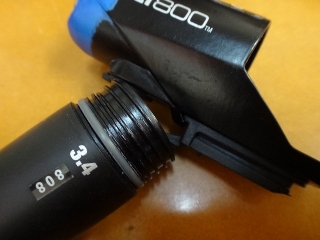
↑This is a VOLT800 battery—
the 3.4 indicates a capacity of 3400mAh.
The battery model name is BA-3.4, and
the previous VOLT700 used the same battery.
The VOLT400 and its predecessor, the VOLT300, come standard with
BA-2.2, which has a capacity of 2200mAh.
Looking at the manufacturer website...
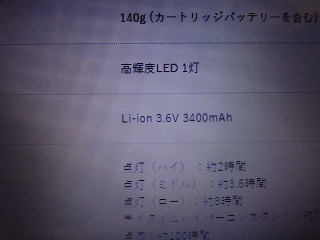
↑VOLT800 lists 3400mAh,

↑VOLT300 lists 2200mAh, but
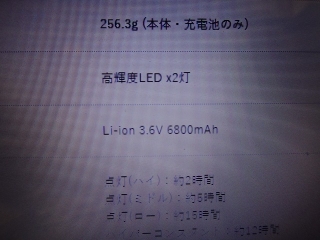
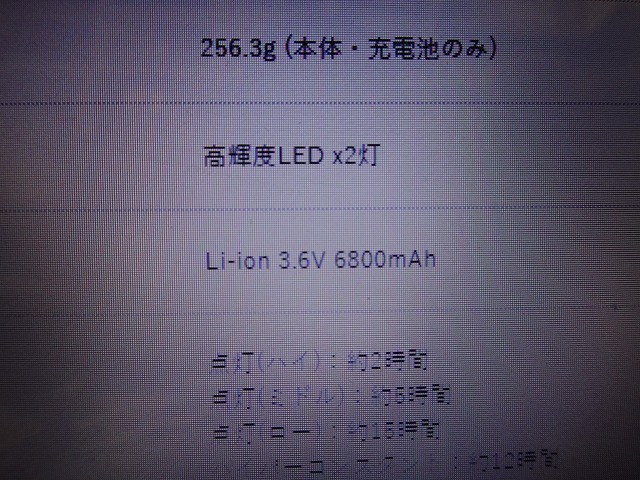
↑VOLT700 lists 6800mAh.
This is a copy-paste error from the VOLT1700 page.
The 256.3g rated weight is from the VOLT1700, after all.
Come to think of it, VOLT1600 and 1700 really are just
two 3400mAh batteries bundled together internally.
I've pulled up the table again.
If I express the number after GVOLT in lumens rather than
High mode candela, the GVOLT100 would be 320
and the GVOLT70 would be 260.
If we allowed combining lumen specs when light sources were placed extremely close together,
two GVOLT70s bundled would be lumen-rated as GVOLT520.
I think it's technically incorrect to simply add candela or lux the way you'd add lumens,
but I've titled this article "GVOLT140" anyway.
Published light weights are for the unit only—
GVOLT100 at 181.5g and two GVOLT70s at 193g.
The bracket weight is about 18g with uncut bands,
bringing the totals to 199.5g and 229g respectively.
At that small a difference, for long events like brevets,
the two GVOLT70s seem more practical when considering runtime.
What do you think?
In my case, since I just needed to lighten the handlebar area,
one GVOLT70 is plenty, so this comparison doesn't affect me.
Also, I don't know about the GVOLT100,
but the GVOLT70 has very little brightness difference between High and Mid modes.
The spec lists 260 and 200 lumens respectively,
but when you switch from High to Mid at night,
it just flickers as if the light went out momentarily—
the brightness change is barely noticeable.
You almost wonder if it actually switched to Mid.
The next step down to Low drops significantly brighter.
Based on feel, if High is a 10,
Mid is about a 9 or 8.5, and Low is about a 2.
Again just from feel, if the GVOLT70's High is 7000 candela,
Mid must be 6000 candela, or conservatively at least 5500 candela.
Comparing via lumens, I'm confident two GVOLT70s in Mid mode
would be brighter than one GVOLT100 in High mode.
The condition being "to get a 10,000-candela-equivalent upper-cut front light
using only CatEye products," I really can't think of a reason to choose
the GVOLT100 over the GVOLT70—one can't have its battery replaced
and only runs for 9.5 hours, while the other has replaceable batteries
but only runs for 1.5 hours with roughly equivalent (probably slightly less) brightness.
I know someone will say "didn't you already buy one before?"
but I bought that one just to write an article about it, used it a bit,
and then gave it away as a prize in a year-end raffle.
The reason I bought this one is because I wanted to lighten up the handlebar area.
Honestly, I'd prefer to have nothing on the bars at all.
During the day, if I remove the light bracket entirely
and wear the heart rate monitor on my wrist,
I can recapture that primitive road bike steering feel
that's practically impossible to achieve on modern road bikes
with their typical clutter of accessories on the handlebar.
Since dozens of grams of weight reduction can be felt in the steering,
I moved the heart rate monitor from the center-mounted position—which had better visibility—
to the ferrule section alongside the stem,
and changed the light from the VOLT800 to the GVOLT70.
This is my custom-made center-mount bracket,
with aluminum bolts,
and I've made the generic hex nuts aluminum too,
so it's quite lightweight.
Of the 38g total, about 12g is the weight of the Polar mount,
so the actual weight savings is about 26g.
Once you get used to center-mounting,
if the screen is positioned at the side of the stem,
you notice that even a quick glance requires significant eye movement
and you're looking away for a long time.
It's a bit exaggerated, but it's like when you open the refrigerator door—
you imagine what's inside first, then open and close it quickly like a draw.
In the same way, I need to decide in my head beforehand which part of the screen to look at
and then make eye movements as minimal as possible.
That requires some attention. I might go back to center-mounting because of this.
With Polar's traditional wristwatch-style models,
you had to fiddle with the wristband buckle every time to remove it from the mount.

With the VANTAGE-series models and a dedicated mount,
if you have a cantilever-style mount,
you can simply pull it out to the side,

and you can charge it just like that.
Shifting to the light,
by switching from the VOLT800 (rated weight 140g)
to the GVOLT70 (rated weight 96.5g),
I've saved about 40g.

When I was using the VOLT800, I had a spare battery strapped to the seat tube with the inflator,
and I've removed that as well.
When using the VOLT800, having a spare battery meant
I didn't worry much about forgetting to charge it.
But since the GVOLT70 has the battery integrated, I need to be careful about forgetting to charge.

The GVOLT70 is designed exclusively for downward-facing handlebar mounting,
but I've never used spacers below the stem in my entire life
and my handlebar position is low, so no matter which side I install it,
it interferes with the cable somehow,
so I applied stickers to prevent scratching.
The GVOLT70 is a model with the upward light distribution cut off.
Even with the VOLT800 mounted at a sharp downward angle,
blue road signs at traffic light height would reflect and light up,
but with the GVOLT70, that almost never happens.
And here's something that's not CatEye's fault:
in town, the GVOLT70 makes it harder to notice
idiots riding dark without lights going the wrong way at night, so be careful.
I have some questions about the recently released GVOLT100 model, but first.
There's a VOLT1700 model with two lights mounted side-by-side,
and back when its predecessor, the VOLT1600, was still in production,
I asked someone from the manufacturer at a trade show,
"This is just a VOLT800 + VOLT800, right?"
They basically said, "Yeah, that's a fair way to understand it."
The differences from using two VOLT800s side-by-side are that
the battery is bigger and integrated,
and there's no mode to light only one of the two lights.
In other words,
"The lumens of two or more bulbs inside
a single lens housing can be added together
and listed as a single light's lumen rating."
This is something manufacturers other than CatEye do too,
and I'm not questioning the practice itself.
I forget which manufacturer, but there was a dual side-by-side front light
where the left and right lumens were different,
and you could turn either side or both on independently.
So if one was 200 lumens and the other was 500 lumens,
would turning both on equal 700 lumens?
I have a VOLT6000,
and its bulb section uses COB (Chip On Board) technology,
with LED chips arranged on a board.
I don't know the exact number of chips,
but it's calculated as something like 100 lumens × 60 chips = 6000 lumens.
The GVOLT100 is designed so that it maintains
upper-cut light distribution whether mounted above or below the handlebar.
Unlike the GVOLT70, the battery is separate and replaceable.
When screwing the light unit onto the battery,
as long as you don't mix up the orientation, it's fine.
However, the GVOLT100 has a rated weight of 181.5g,
which is another 40g heavier than the VOLT800.
And even though the battery is replaceable,
almost the entire body apart from the light unit is battery,
so it's not particularly portable.
My main objection is the weight,
but I have other concerns as well...
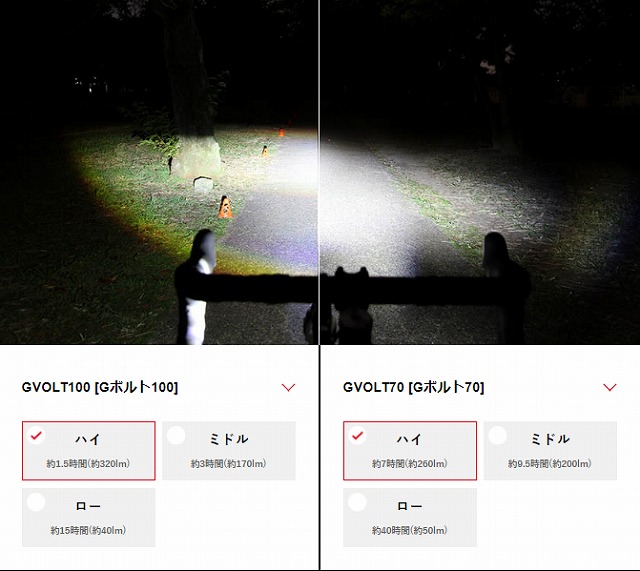
↑This is from the CatEye website—
on the left is the GVOLT100 beam chart, on the right is the GVOLT70, both set to "High" mode.
The GVOLT100's beam axis is further out,
so looking at just the near field, the GVOLT70 appears brighter, which is fine,
but what concerns me is the GVOLT100's
abnormally short runtime.
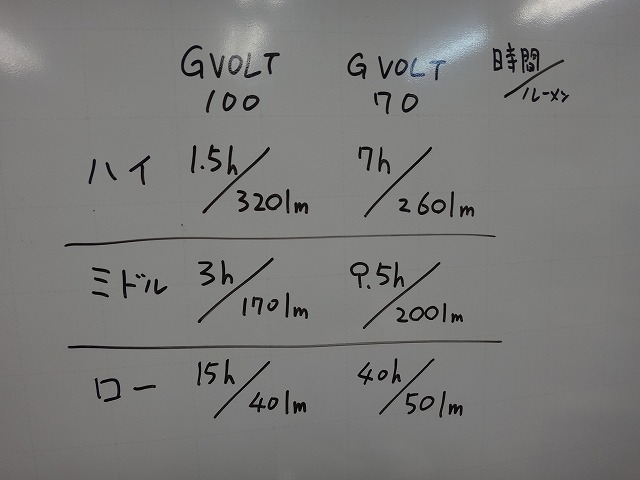
I've extracted the table from the previous image.
Even accounting for the difference in lumens, this shortness is abnormal.
The number after GVOLT represents
100 lux in High mode for the 100,
and 70 lux in High mode for the 70.
The published brightness specs are lumens for High/Mid/Low modes
and candela only for High mode.
The GVOLT100 may have replaceable batteries,
but with a High mode runtime like that, replacing them every hour and a half for brevets
just isn't practical.
What I really don't understand is that in Mid mode,
the GVOLT70 has higher lumens
but over 3 times the runtime.
My first suspicion was that the battery capacity was different,
but both have 3.6V 3400mAh lithium-ion batteries.
There might be something power-hungry in the GVOLT100's light unit.

↑This is a VOLT800 battery—
the 3.4 indicates a capacity of 3400mAh.
The battery model name is BA-3.4, and
the previous VOLT700 used the same battery.
The VOLT400 and its predecessor, the VOLT300, come standard with
BA-2.2, which has a capacity of 2200mAh.
Looking at the manufacturer website...
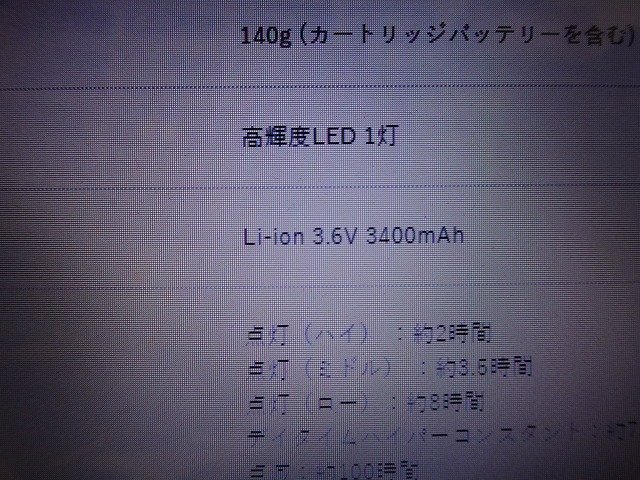
↑VOLT800 lists 3400mAh,
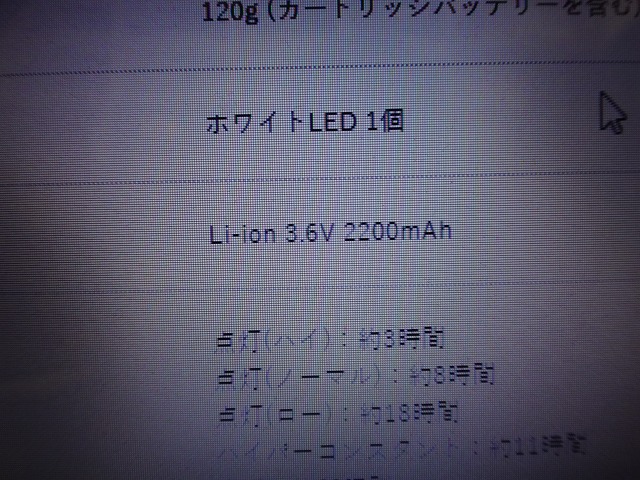
↑VOLT300 lists 2200mAh, but
↑VOLT700 lists 6800mAh.
This is a copy-paste error from the VOLT1700 page.
The 256.3g rated weight is from the VOLT1700, after all.
Come to think of it, VOLT1600 and 1700 really are just
two 3400mAh batteries bundled together internally.
I've pulled up the table again.
If I express the number after GVOLT in lumens rather than
High mode candela, the GVOLT100 would be 320
and the GVOLT70 would be 260.
If we allowed combining lumen specs when light sources were placed extremely close together,
two GVOLT70s bundled would be lumen-rated as GVOLT520.
I think it's technically incorrect to simply add candela or lux the way you'd add lumens,
but I've titled this article "GVOLT140" anyway.
Published light weights are for the unit only—
GVOLT100 at 181.5g and two GVOLT70s at 193g.
The bracket weight is about 18g with uncut bands,
bringing the totals to 199.5g and 229g respectively.
At that small a difference, for long events like brevets,
the two GVOLT70s seem more practical when considering runtime.
What do you think?
In my case, since I just needed to lighten the handlebar area,
one GVOLT70 is plenty, so this comparison doesn't affect me.
Also, I don't know about the GVOLT100,
but the GVOLT70 has very little brightness difference between High and Mid modes.
The spec lists 260 and 200 lumens respectively,
but when you switch from High to Mid at night,
it just flickers as if the light went out momentarily—
the brightness change is barely noticeable.
You almost wonder if it actually switched to Mid.
The next step down to Low drops significantly brighter.
Based on feel, if High is a 10,
Mid is about a 9 or 8.5, and Low is about a 2.
Again just from feel, if the GVOLT70's High is 7000 candela,
Mid must be 6000 candela, or conservatively at least 5500 candela.
Comparing via lumens, I'm confident two GVOLT70s in Mid mode
would be brighter than one GVOLT100 in High mode.
The condition being "to get a 10,000-candela-equivalent upper-cut front light
using only CatEye products," I really can't think of a reason to choose
the GVOLT100 over the GVOLT70—one can't have its battery replaced
and only runs for 9.5 hours, while the other has replaceable batteries
but only runs for 1.5 hours with roughly equivalent (probably slightly less) brightness.