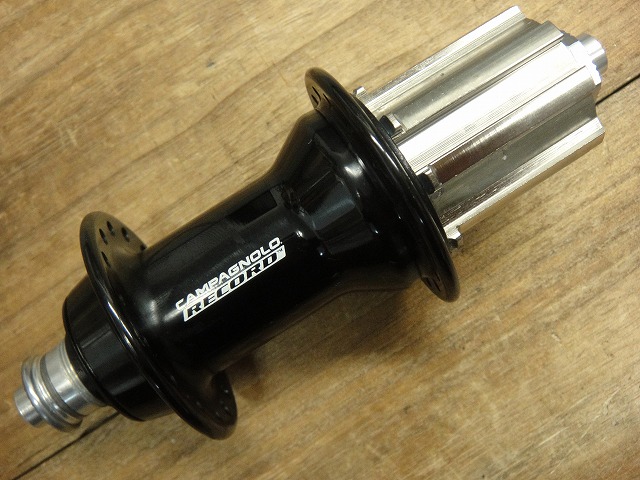
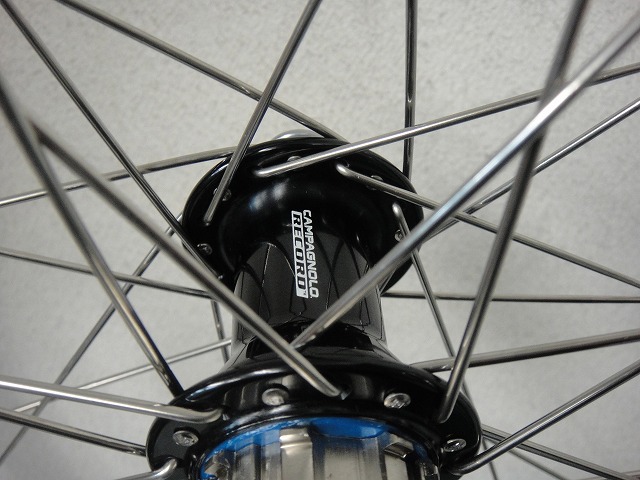
I built a wheel using a customer's Record rear hub.

It's just the rear wheel.
This hub isn't in stock at the distributors right now,
and I need several pairs for another project—it's been a real headache.

Complaints aside, it's built.
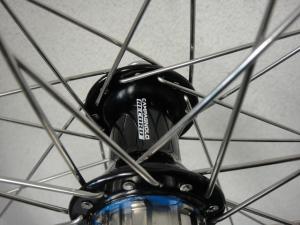
With all-competition spec, the rule is that lacing ties aren't necessary.
That means correcting spoke tension imbalance between sides is only possible with asymmetrical lacing.
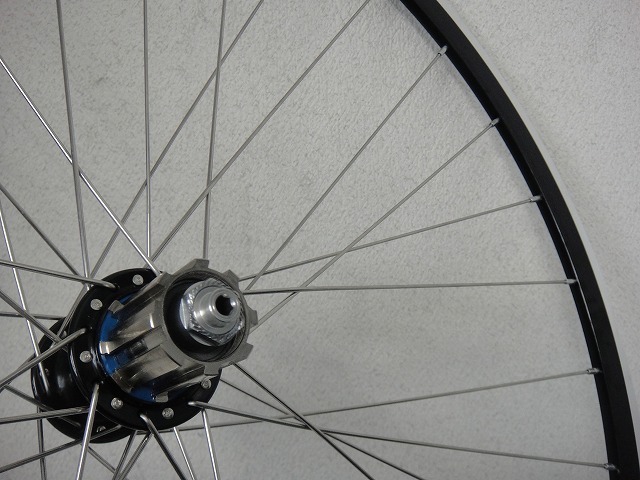
So it's 4-8 lacing.
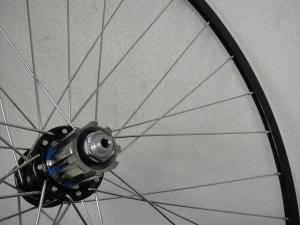
The non-drive side with tangent lacing is fine, but there's a reason the drive side is 4-laced.
I've touched on this many times before, but I'll write it again.
For a wheel with X spokes, if you want to do Y-lacing,
it works if Y≦X/4 holds true.
For 4-lacing, the minimum required is 4≦16/4,
so 16 spokes is the absolute minimum for 4-lacing.
If you want to do 2-lacing, all spokes must be
either inpoke or outpoke, but
this has so many problems that I don't build it for retail.
Building the drive side with radial lacing on hand-built wheels
is also problematic in my view.
There's a spoke breakage risk, and because the spokes are perpendicular
to the tangent direction of the flange, I think there's a significant "loss of engagement feel."
The exception, needless to say, is aluminum spokes—Kyserium.
Aluminum spokes have a rigidity character that can't be put on the same level as steel spokes.
But I do want the drive side to be as close to radial as possible compared to the non-drive side.
Yet I don't want to sacrifice the characteristics of tangent lacing.
That thinking led me to 4-lacing on the drive side.
Since hand-built 16H or fewer rear wheels are hard to imagine,
regardless of how many laces the non-drive side has, "4-XX lacing" is
the fundamental pattern for the rear wheels I build.
If a rim's inner diameter and hub dimensions are the same, no matter how the rim hole count and hub hole count change
(they must be equal in number),
spoke length doesn't change during tangent lacing.
For example, if a particular hub and rim give 299.75mm for 24H 6-lacing,
that same rim and hub with 32H 8-lacing will also be 299.75mm.
The hole positions on both hub and rim have changed,
but mysteriously it works out the same.
In theory, even if that same rim and hub did 360H 90-lacing,
it'd be 299.75mm.
Tangent lacing can only be done when spoke count is a multiple of 8.
In practical terms, 24H and 32H, or rarely 16H.
Spoke length is the same regardless of hole count in those cases.
But on the same hub and same rim, 4-lacing spoke length does change.
In an extreme case with hundreds of spokes,
4-lacing means the spoke angle approaches radial quite closely.
(Though with that many spokes, flange holes would be too close together to even lace.)
The point is:
32H 4-8 lacing creates a larger difference in spoke angles between sides
compared to 24H 4-6 lacing.
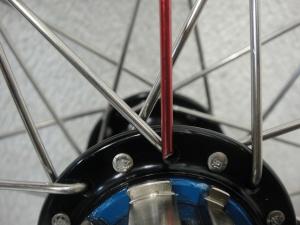
↑Drive side
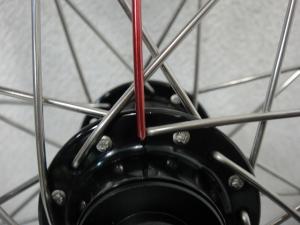
↑Non-drive side
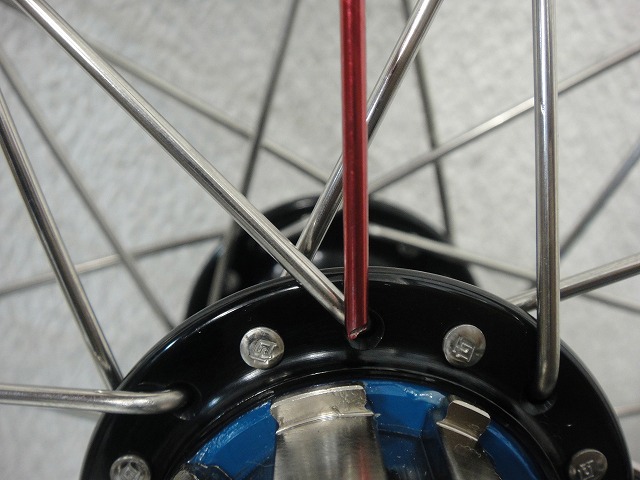
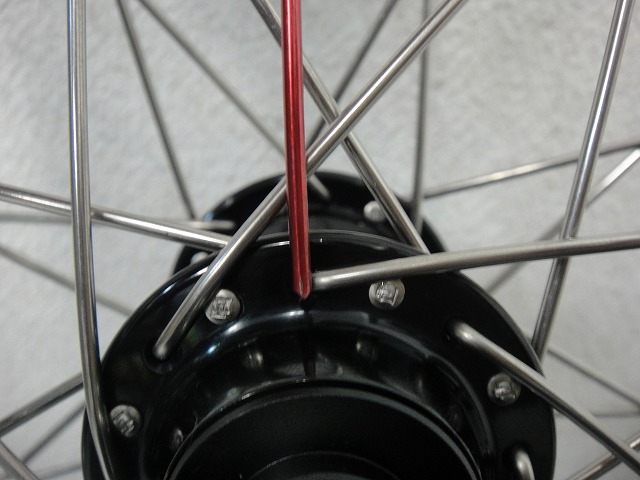
The relationship between inpoke and the radial line.
The spokes painted red show the radial line.
The non-drive side isn't quite perpendicular to the radial line,
but it's pretty close to tangent.
The drive side, roughly speaking, is about 45 degrees.
This gives enough tangent character that engagement feel isn't lost,
and there's also a decent angle difference from the non-drive side—
I think this is the optimal solution for hand-built wheels.
It's just the rear wheel.
This hub isn't in stock at the distributors right now,
and I need several pairs for another project—it's been a real headache.

Complaints aside, it's built.
With all-competition spec, the rule is that lacing ties aren't necessary.
That means correcting spoke tension imbalance between sides is only possible with asymmetrical lacing.
So it's 4-8 lacing.
The non-drive side with tangent lacing is fine, but there's a reason the drive side is 4-laced.
I've touched on this many times before, but I'll write it again.
For a wheel with X spokes, if you want to do Y-lacing,
it works if Y≦X/4 holds true.
For 4-lacing, the minimum required is 4≦16/4,
so 16 spokes is the absolute minimum for 4-lacing.
If you want to do 2-lacing, all spokes must be
either inpoke or outpoke, but
this has so many problems that I don't build it for retail.
Building the drive side with radial lacing on hand-built wheels
is also problematic in my view.
There's a spoke breakage risk, and because the spokes are perpendicular
to the tangent direction of the flange, I think there's a significant "loss of engagement feel."
The exception, needless to say, is aluminum spokes—Kyserium.
Aluminum spokes have a rigidity character that can't be put on the same level as steel spokes.
But I do want the drive side to be as close to radial as possible compared to the non-drive side.
Yet I don't want to sacrifice the characteristics of tangent lacing.
That thinking led me to 4-lacing on the drive side.
Since hand-built 16H or fewer rear wheels are hard to imagine,
regardless of how many laces the non-drive side has, "4-XX lacing" is
the fundamental pattern for the rear wheels I build.
If a rim's inner diameter and hub dimensions are the same, no matter how the rim hole count and hub hole count change
(they must be equal in number),
spoke length doesn't change during tangent lacing.
For example, if a particular hub and rim give 299.75mm for 24H 6-lacing,
that same rim and hub with 32H 8-lacing will also be 299.75mm.
The hole positions on both hub and rim have changed,
but mysteriously it works out the same.
In theory, even if that same rim and hub did 360H 90-lacing,
it'd be 299.75mm.
Tangent lacing can only be done when spoke count is a multiple of 8.
In practical terms, 24H and 32H, or rarely 16H.
Spoke length is the same regardless of hole count in those cases.
But on the same hub and same rim, 4-lacing spoke length does change.
In an extreme case with hundreds of spokes,
4-lacing means the spoke angle approaches radial quite closely.
(Though with that many spokes, flange holes would be too close together to even lace.)
The point is:
32H 4-8 lacing creates a larger difference in spoke angles between sides
compared to 24H 4-6 lacing.
↑Drive side
↑Non-drive side
The relationship between inpoke and the radial line.
The spokes painted red show the radial line.
The non-drive side isn't quite perpendicular to the radial line,
but it's pretty close to tangent.
The drive side, roughly speaking, is about 45 degrees.
This gives enough tangent character that engagement feel isn't lost,
and there's also a decent angle difference from the non-drive side—
I think this is the optimal solution for hand-built wheels.