I mentioned previously that I bought only the crank from Campagnolo's gravel component set,
「Ekar」.
Shimano's GRX has a stated Q-factor of 151mm for both single and double chainring versions,
which is 3mm wider than the company's road cranks.
(Ekar's crank has the same width as the company's road crank).
Also, the higher-end RX810 series doesn't come in a 165mm spec,
and if you want 165mm you're limited to the RX600 series—
that's another reason I didn't go with a GRX crank.
With Ekar's crank, there's a robust dust and water-resistant seal on the bearings attached to the crank arm,
and because of that the traditional Ultegra BB cups won't fit.
I bought the Ekar crank from the first Japanese shipment,
but I forgot about the dedicated BB situation, and when I tried to buy one later
the BSC size had sold out.
Ugh, darn it.
So actually, when I first started using the Ekar crank
I swapped in a standard Ultegra bearing
to make it work.
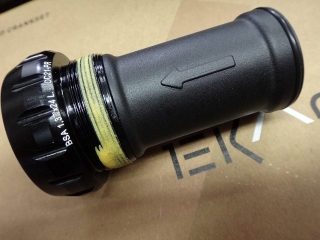
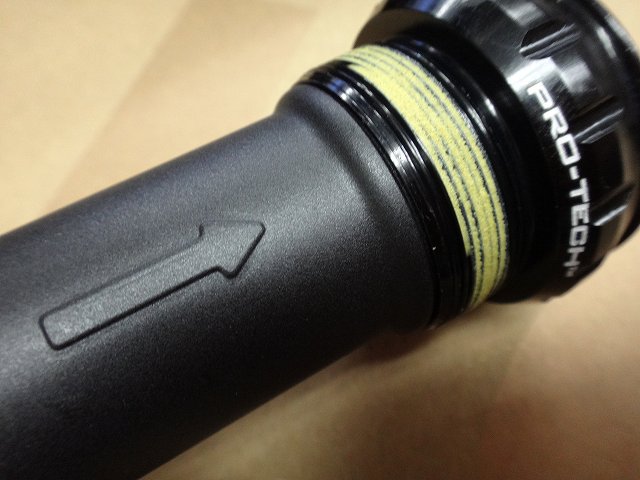
This is the Ekar BB cup.
The water-resistant tube, the water seal,
is different from the one for EPS—
it has no slot holes.
Campagnolo calls the BSC size "BSA,"
but that's not a typo for BSC.
Both start with BS, but
that doesn't mean they're the same thing.
In the early days when bicycle industry standards were being established,
Britain was the country with the most active production.
BSC stands for British Standard Cycle, the standard specification name.
However, this was the official standardization of an existing size from before,
and it originally referred to BSA—Birmingham Small Arms
(a small arms manufacturer)—
a specification for mass-produced parts created using the precision machining techniques
that gunmakers had developed in firearms manufacturing.
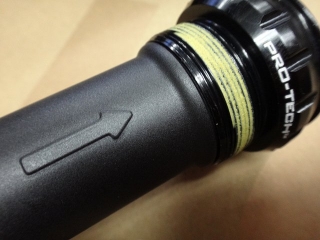
↑The BB cup and
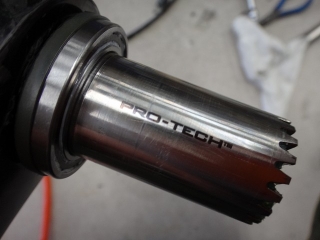
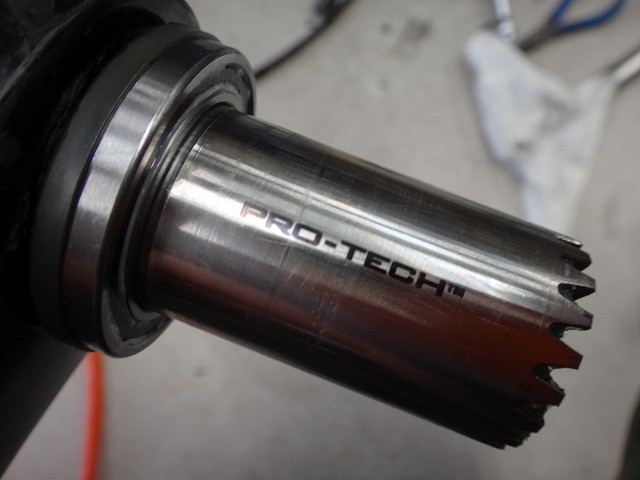
↑"Protec" on the crank shaft
refers to Campagnolo's proprietary sealed bearing
(Ultegra was already proprietary at that point).

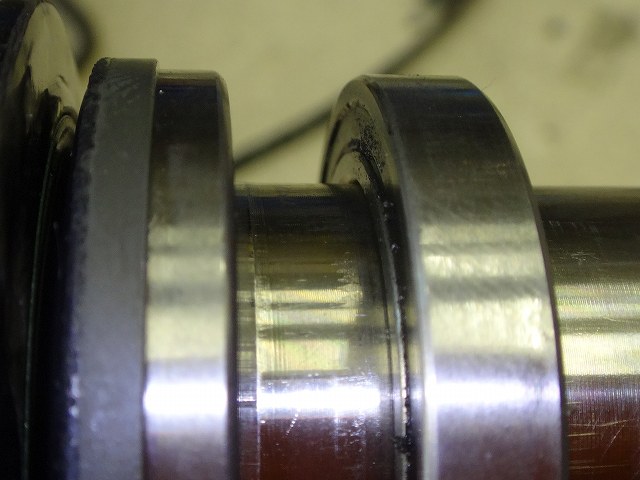
↑Left is Protec, right is traditional Ultegra.
The Protec seal is made of hard material,
bonded to the outer race of the bearing,
and it won't scratch or deform even if you scrape it with your fingernail,
nor can you remove it by hand.
I wrote "robust dust and water-resistant seal" earlier,
but "robust" refers to how the seal is bonded to the bearing—
I don't actually know how good the dust and water resistance performance is.
Well, it seems to do its job adequately, at any rate.
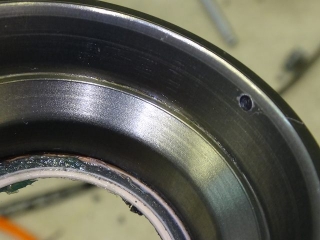
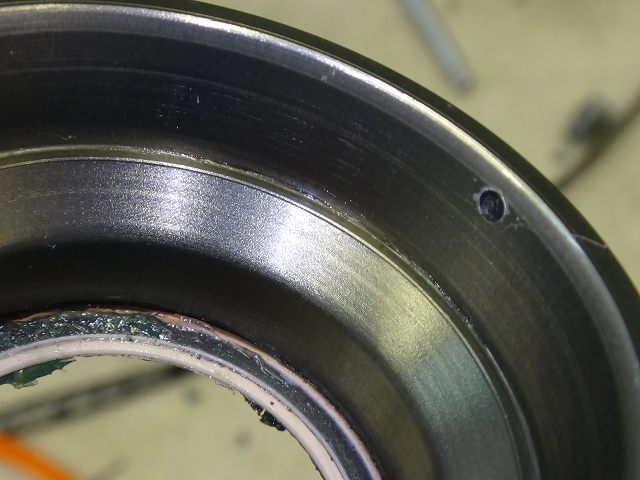
↑The traditional Ultegra BB cup.
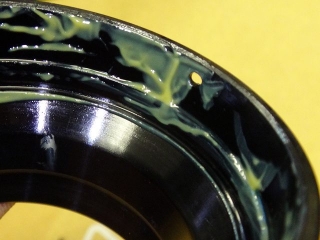
↑The Protec BB cup.
The inside has a stepped design to accommodate the seal portion.
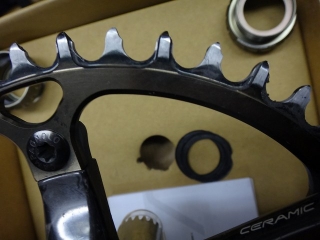
This is a Campagnolo crank with 135mm PCD that I used before Ekar,
and it has an aftermarket narrow-wide chainring installed.
There are very few narrow-wide chainrings with 135mm PCD,
and I only know of two brands,
this is one of them.
The tooth tips are worn, and as I wrote in the previous post,
color fading has also occurred(the inside is still black).
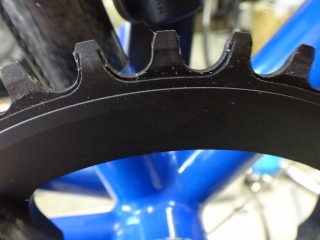
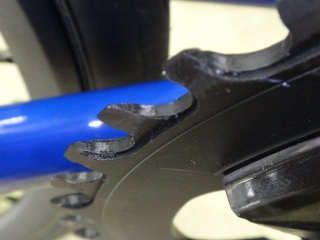
↑This is the Ekar chainring, and
I've used it for several thousand kilometers with a Shimano 11-speed chain,
even replaced the chain once,
but whether the surface treatment is hard or thick or both,
even when I wiped away the chain oil dirt to look,
there was almost no wear marks visible.
Addendum:
"Is it possible to install Ekar bearings and BB cup on a traditional Ultegra crank?"
Yes, it is possible.
I've actually done the reverse, so.
「Ekar」.
Shimano's GRX has a stated Q-factor of 151mm for both single and double chainring versions,
which is 3mm wider than the company's road cranks.
(Ekar's crank has the same width as the company's road crank).
Also, the higher-end RX810 series doesn't come in a 165mm spec,
and if you want 165mm you're limited to the RX600 series—
that's another reason I didn't go with a GRX crank.
With Ekar's crank, there's a robust dust and water-resistant seal on the bearings attached to the crank arm,
and because of that the traditional Ultegra BB cups won't fit.
I bought the Ekar crank from the first Japanese shipment,
but I forgot about the dedicated BB situation, and when I tried to buy one later
the BSC size had sold out.
Ugh, darn it.
So actually, when I first started using the Ekar crank
I swapped in a standard Ultegra bearing
to make it work.

This is the Ekar BB cup.
The water-resistant tube, the water seal,
is different from the one for EPS—
it has no slot holes.
Campagnolo calls the BSC size "BSA,"
but that's not a typo for BSC.
Both start with BS, but
that doesn't mean they're the same thing.
In the early days when bicycle industry standards were being established,
Britain was the country with the most active production.
BSC stands for British Standard Cycle, the standard specification name.
However, this was the official standardization of an existing size from before,
and it originally referred to BSA—Birmingham Small Arms
(a small arms manufacturer)—
a specification for mass-produced parts created using the precision machining techniques
that gunmakers had developed in firearms manufacturing.
↑The BB cup and
↑"Protec" on the crank shaft
refers to Campagnolo's proprietary sealed bearing
(Ultegra was already proprietary at that point).
↑Left is Protec, right is traditional Ultegra.
The Protec seal is made of hard material,
bonded to the outer race of the bearing,
and it won't scratch or deform even if you scrape it with your fingernail,
nor can you remove it by hand.
I wrote "robust dust and water-resistant seal" earlier,
but "robust" refers to how the seal is bonded to the bearing—
I don't actually know how good the dust and water resistance performance is.
Well, it seems to do its job adequately, at any rate.
↑The traditional Ultegra BB cup.
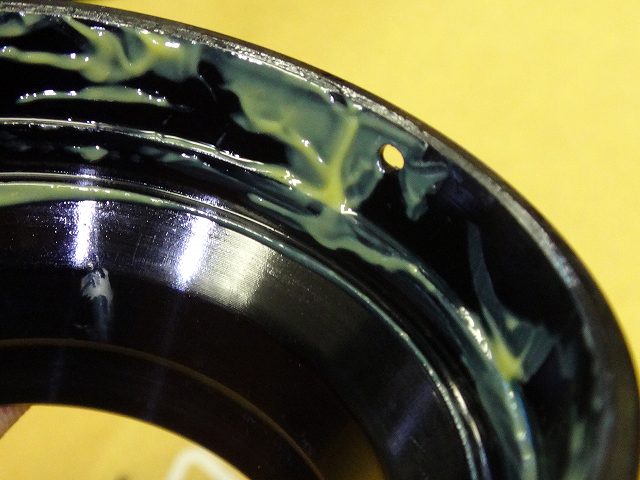
↑The Protec BB cup.
The inside has a stepped design to accommodate the seal portion.
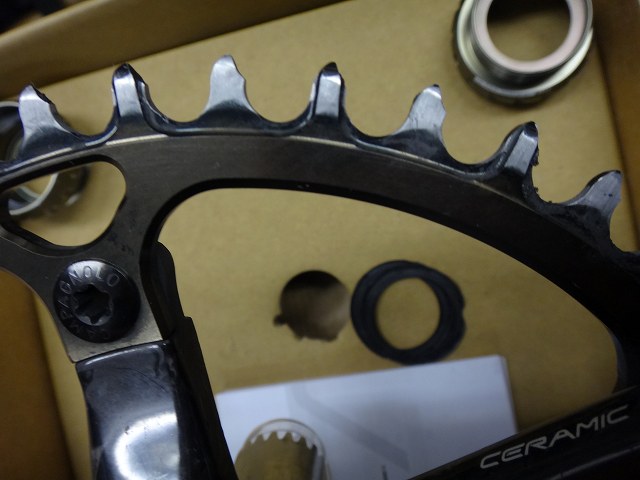
This is a Campagnolo crank with 135mm PCD that I used before Ekar,
and it has an aftermarket narrow-wide chainring installed.
There are very few narrow-wide chainrings with 135mm PCD,
and I only know of two brands,
this is one of them.
The tooth tips are worn, and as I wrote in the previous post,
color fading has also occurred(the inside is still black).
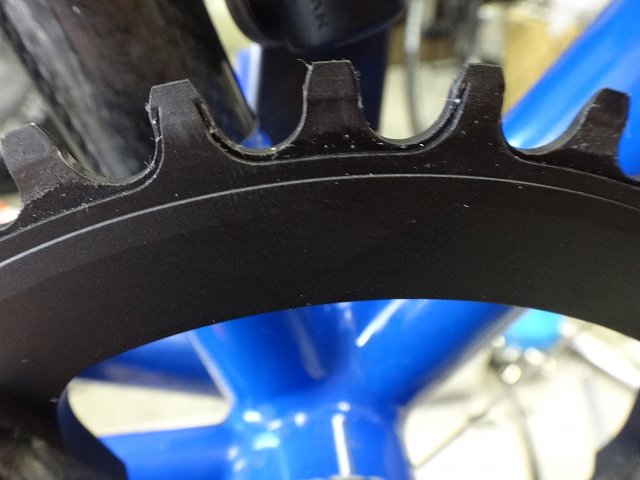
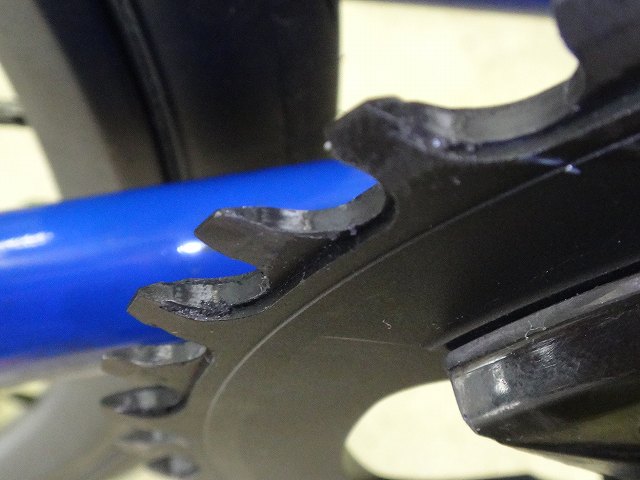
↑This is the Ekar chainring, and
I've used it for several thousand kilometers with a Shimano 11-speed chain,
even replaced the chain once,
but whether the surface treatment is hard or thick or both,
even when I wiped away the chain oil dirt to look,
there was almost no wear marks visible.
Addendum:
"Is it possible to install Ekar bearings and BB cup on a traditional Ultegra crank?"
Yes, it is possible.
I've actually done the reverse, so.