I received a rear wheel from a customer — a Racing Zero Night.
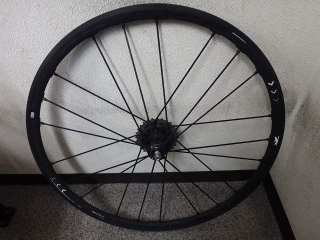
Shot from the non-freehub side.
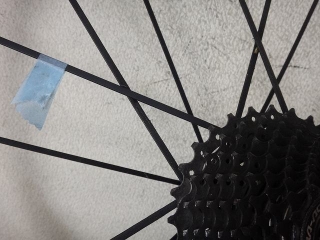
The rear derailleur got caught up, bending a spoke,
and now there's runout.

↑There it is
It happened during low-speed riding, and the customer stopped pedaling right away,
so only one spoke was deformed.
On the partner spoke at the final crossing of the bent spoke,
there were marks where the chain had slid, leaving dirt.
When I wiped away the dirt, there was slight paint damage,
but no deformation, so I didn't replace it.
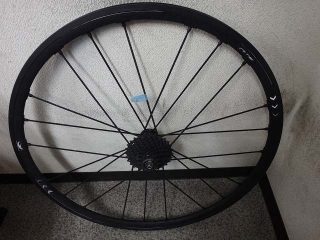
Shot from the freehub side.
Fixed.
As I always say,
you can't touch any other nipples
until the runout at the point of maximum deflection of the replaced spoke is eliminated.
When it first arrived, there was significant lateral runout on both sides,
and I wondered if just one bent spoke
could really cause such wild swinging side-to-side runout instead of just going out in one spot,
or if there might be other bent spokes I hadn't noticed.
But by adjusting only the replaced spoke's nipple,
the lateral runout almost completely disappeared.
At this point, it should be nearly the same as it was one second before the derailleur got caught.
After that, I did the runout truing, but aside from the replaced spoke's nipple,
I only touched about five other places, and the nipple rotation was minimal—
none of them turned even 1/16th of a revolution.
This is pretty much the same as what I'd do on a normal rear wheel truing
that hadn't suffered a derailleur strike.
Only then did I apply the centering gauge.
When it first arrived, the localized lateral runout was so severe
that checking the temporary center made no sense.
With no lateral runout, the rim was offset about two sheets of paper toward the freehub side.
This seems like a mix of what was originally about one sheet of paper offset freehub-side
plus wear from years of use.
That's assuming there's no truing history before this.

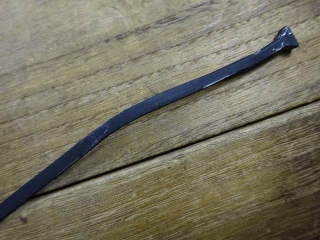
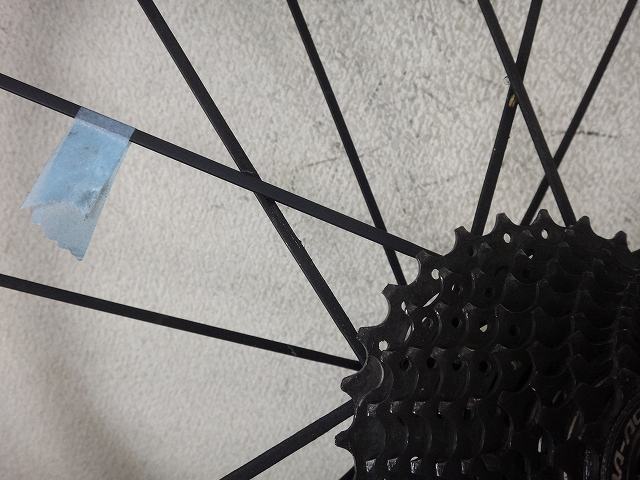
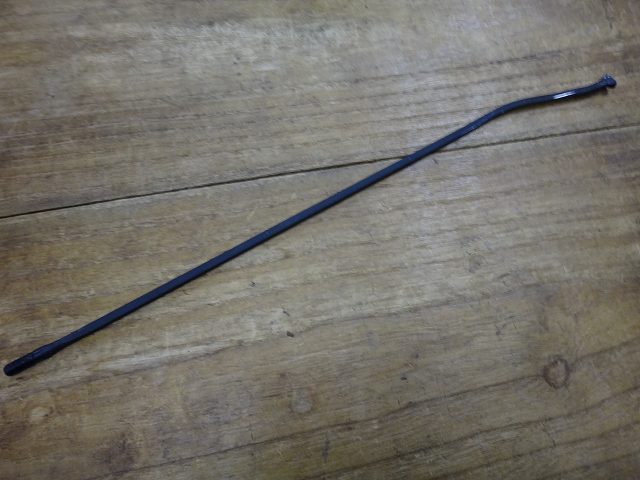
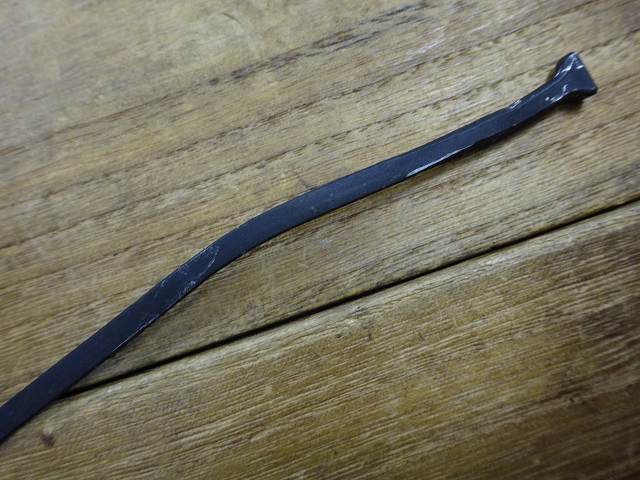
↑The replaced spoke
Actually, there was frame work I did separately from the wheel work
that would have more value as a blog post,
but I can't write about that for certain reasons.
I even bought a special tool to solve that problem.
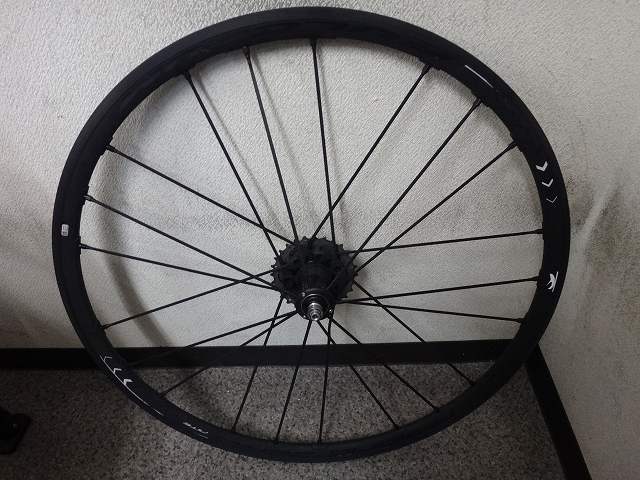
Shot from the non-freehub side.
The rear derailleur got caught up, bending a spoke,
and now there's runout.
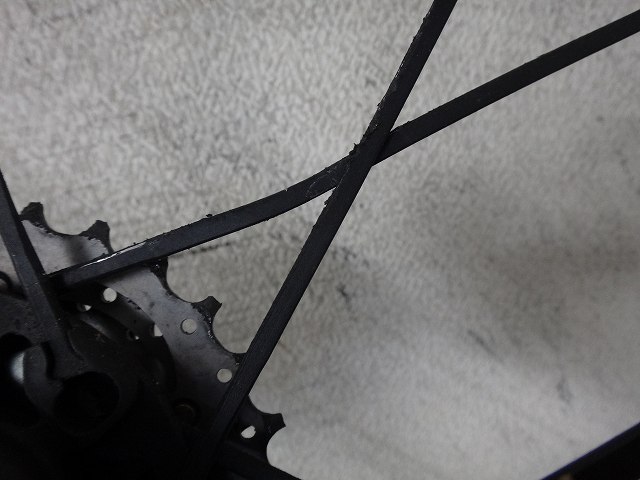
↑There it is
It happened during low-speed riding, and the customer stopped pedaling right away,
so only one spoke was deformed.
On the partner spoke at the final crossing of the bent spoke,
there were marks where the chain had slid, leaving dirt.
When I wiped away the dirt, there was slight paint damage,
but no deformation, so I didn't replace it.
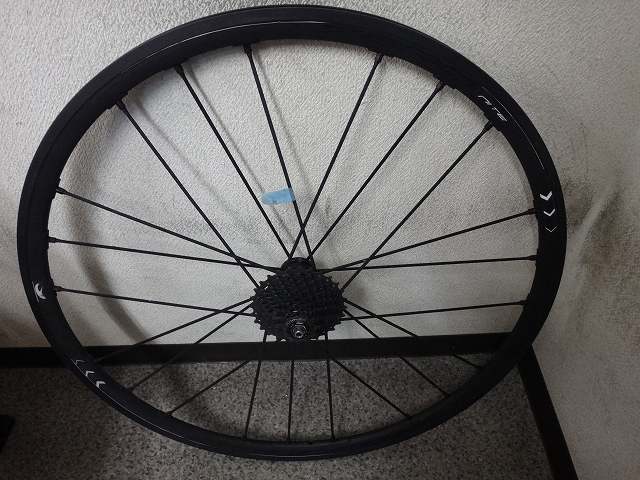
Shot from the freehub side.
Fixed.
As I always say,
you can't touch any other nipples
until the runout at the point of maximum deflection of the replaced spoke is eliminated.
When it first arrived, there was significant lateral runout on both sides,
and I wondered if just one bent spoke
could really cause such wild swinging side-to-side runout instead of just going out in one spot,
or if there might be other bent spokes I hadn't noticed.
But by adjusting only the replaced spoke's nipple,
the lateral runout almost completely disappeared.
At this point, it should be nearly the same as it was one second before the derailleur got caught.
After that, I did the runout truing, but aside from the replaced spoke's nipple,
I only touched about five other places, and the nipple rotation was minimal—
none of them turned even 1/16th of a revolution.
This is pretty much the same as what I'd do on a normal rear wheel truing
that hadn't suffered a derailleur strike.
Only then did I apply the centering gauge.
When it first arrived, the localized lateral runout was so severe
that checking the temporary center made no sense.
With no lateral runout, the rim was offset about two sheets of paper toward the freehub side.
This seems like a mix of what was originally about one sheet of paper offset freehub-side
plus wear from years of use.
That's assuming there's no truing history before this.
↑The replaced spoke
Actually, there was frame work I did separately from the wheel work
that would have more value as a blog post,
but I can't write about that for certain reasons.
I even bought a special tool to solve that problem.