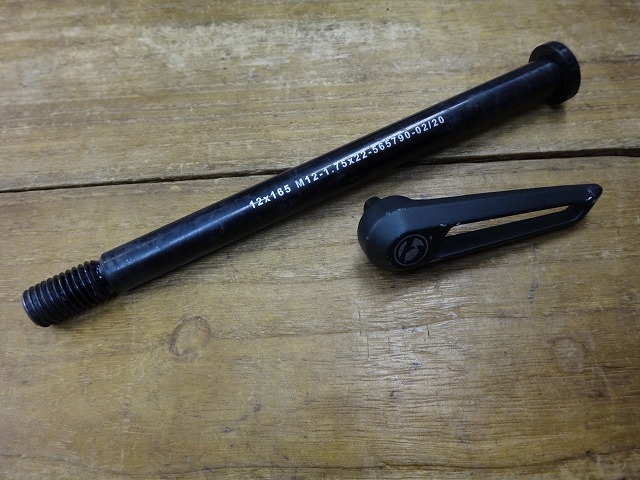
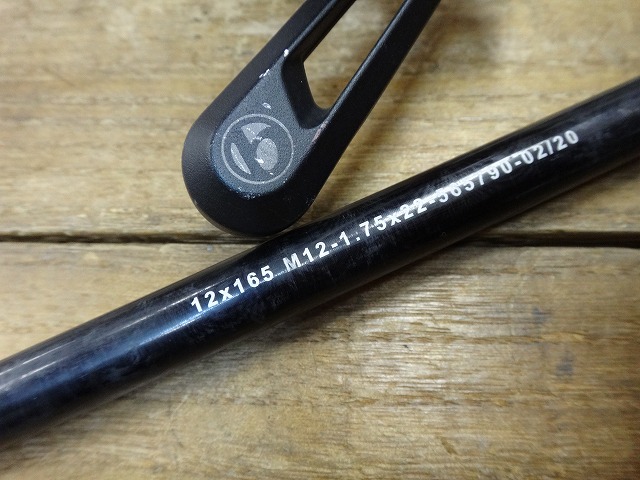
In my recent article about through-axles, I posted an image of a 1.75mm pitch axle that DT doesn't carry
but I'd completely forgotten which brand it was from.
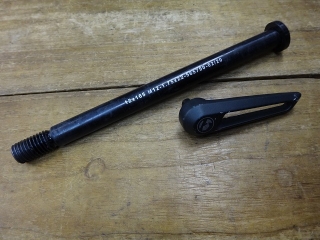
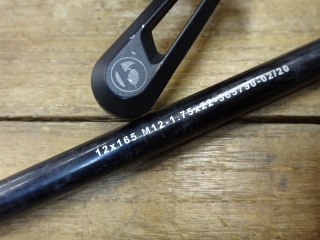
but then today when I replaced the tires on an Emonda complete bike for another job,
it turned out to be a Trek specification.
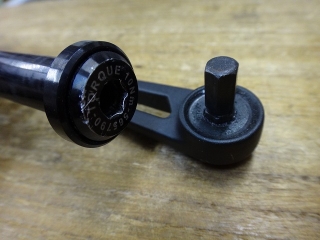
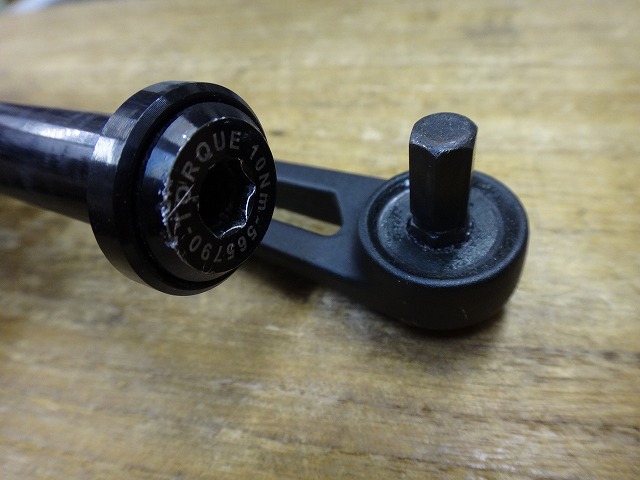
You can remove and install it with an Allen key,
but there's also a lever-type plug-in version like what DT has,
and since the bottom of the hexagonal socket in the axle is magnetic,
you won't drop it and lose it during normal riding.
The customer's bike only had the add-on lever on the front axle,
but whether that's the intended spec or if they just lost the rear one is unclear.
On a different note, the "Madone" in Trek's road bike model names
is the name of a climb in France.
Since the road is narrow, it's never been selected for high-category races like the Tour de France,
but it's a climb that Lance Armstrong used as a training route
when he was living in Nice.
There was a famous rider who used Madone regularly as a daily training climb
and used his climbing time there as an indicator of fitness,
and the first clearly documented example is
Tony Rominger (Rominger).
Rominger's record was 31 minutes 30 seconds, and while this record stood for a long time,
it wasn't untouchable—it's just that Madone time trials weren't as common an activity back then as they are now.
As a side note, I hold the world record for the commute between the Nomu Lab and my house.
Unless someone appears who sees value in breaking it,
this record will never be broken for all eternity.
I am definitely a world record holder,
but I have no idea what the time was or when I set it.
Armstrong broke Rominger's record just before the 1999 Tour de France,
clocking 30 minutes 47 seconds,
and the frame he was developing at the time, which later became commercially available,
was named Madone after that climb.
Long ago, Nike released shoes and watches with Lance's name on them,
but since Armstrong's image was dragged through the mud by doping,
they've been discontinued and treated as if they "never existed."
It should have been an extremely profitable product,
so if not for the doping scandal, even after his retirement
there likely would have been continued merchandise like signature models.
While Madone is indeed a French place name,
it's still perceived as "Armstrong's vestigial legacy,"
but Trek shows no signs of changing the model name.
Returning to the Madone climb story, there actually isn't clear consensus on
where to start, though the finish is established,
so it's actually unknown whether Rominger and Armstrong covered
exactly the same route.
But as long as they're not wildly different, and with a 43-second gap,
it's generally accepted that he definitely broke the course record.
After that, Madone time trials became famous,
and people—both pros and amateurs—started trying to break it.
Between 2005 and 2007, with Discovery Channel
(for some reason hiragana converts preferentially...),
Tom Danielson, who had been teammates with Armstrong,
recorded 30 minutes 24 seconds.
While Danielson is American,
he holds course records on several climbs back home in America.
In other words, he's the type who enjoys doing this sort of thing.
From what I've been able to track, around 2015
Chris Froome put down 30 minutes 9 seconds, and then shortly after
Richie Porte, Froome's teammate at the time,
recorded 29 minutes 40 seconds.
Since Madone, Trek's road frame model names—
both Emonda and Domane—are anagrams of Madone
(MADONE・EMONDA・DOMANE).
Following this pattern, the future model names I can think of that fit
are MODENA and DAEMON.
This is pure speculation on my part, but regarding MODENA,
it supposedly came up as a candidate during Emonda's development,
but it was EMONDA that got adopted in the internal meeting,
and I get the sense that the faction pushing for MODENA
still mutters complaints called "the MODENA incident."
DAEMON uses the same letters as "daemon" but spelled DAEMON,
the non-DEMON spelling that means demon.
DAEMON is currently a demon living in the electronic world,
tasked with dutifully returning to senders notification that
their emails failed to reach the recipient.

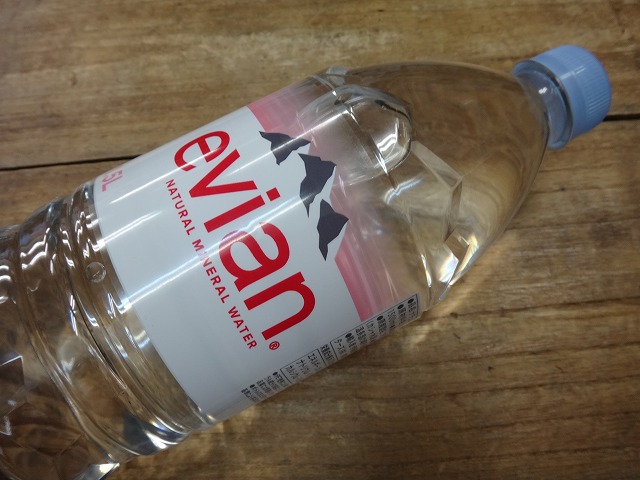
↑This is reference material I prepared for a segment on multi-start threads,
and it seems a shame to scrap it, so I'll use it anyway.
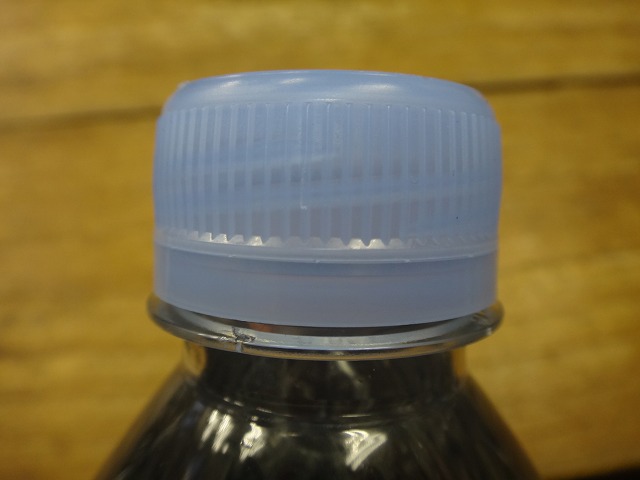
Plastic bottle caps use multi-start threads,
but they're not a unified standard.
That said, bottle cap manufacturing is
a niche oligopolistic market, so
there aren't dozens of different dimensions in circulation
(I'd bet there are fewer than the number of press-fit BB standards.
Frame manufacturers really need to think about this stuff, seriously).
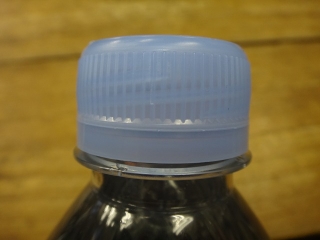
Unlike sports bike components,
bottle caps aren't mixed and matched non-OEM with bottles,
so it goes largely unnoticed, but
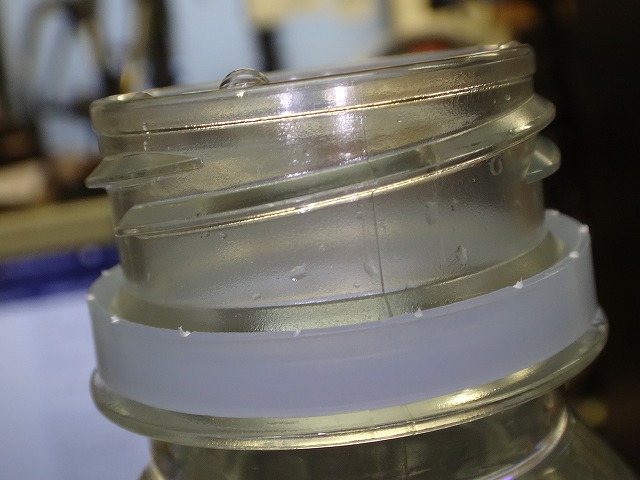
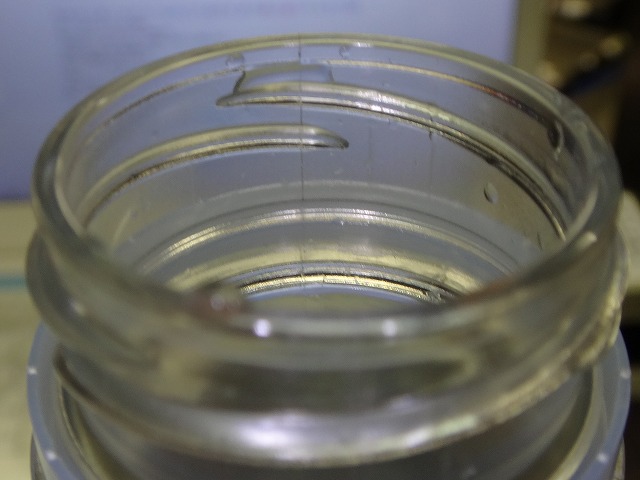
Evian bottle caps
use a multi-start thread with a very steep lead angle.


and the cap comes off in just half a turn.
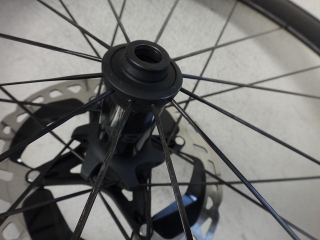
This is a different job from the Emonda with the through-axle at the top,
but the front wheel of a Bontrager disc brake
that I got to photograph for an article.
It's a 26-inch HE rim MTB, and during the early days of disc brakes,
radial lacing on the non-rotor side was trendy,
but if you're doing this with equal numbers on both sides, you'd want at least 32H.
Plus, this hub uses straight spokes, so
you can't change the lacing pattern.
That's not actually the most valuable aspect of writing about this wheel though...
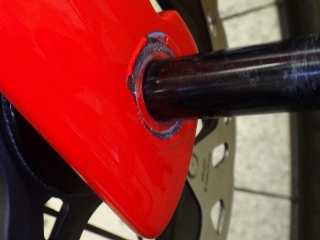
It's an axle with a flat contact surface with the fork instead of tapered.
With 1.75mm pitch, once the flange with serrations on the axle contacts the fork,
you can't tighten it more than half a turn.
You can't advance the threads by 0.875mm, which is half of 1.75mm.
The X-12 standard is 1mm pitch, but
from where you feel the same kind of contact on the tapered section,
depending on the frame or fork, you can easily tighten more than a full turn.
Anyway, this fork
has paint over the area where the serrations contact, so
the paint is cracking like eggshell
and spreading beyond the contact surface with the axle flange.
That's not good.
But that's not the most valuable aspect of this wheel either.
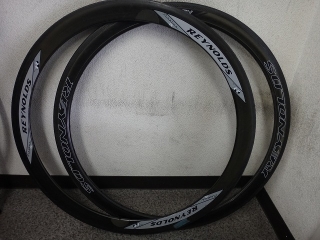
↑These are both Reynolds rims—
the left is Stratos DV and the right is Assault SLG.
The rim graphics are completely different and they're quite far apart in age,
but on the Stratos, the "gravity" of the Reynolds lettering
points toward the wheel's interior.
On the Assault, the letter gravity points outward.
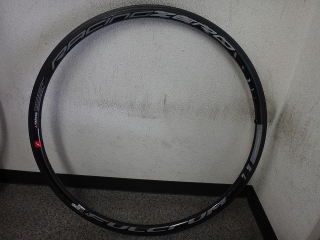
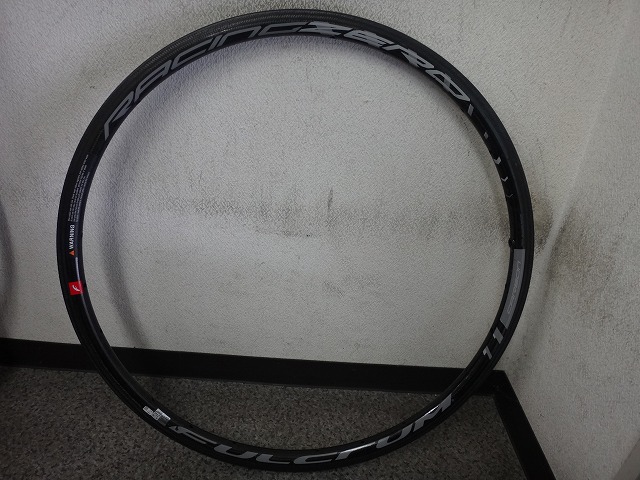
This is a Racing Zero Carbon rim, and
Campagnolo and Fulcrum rims both have
letter gravity pointing in one direction.
In the state shown in the image above, the letter gravity points downward, so
both the Racing Zero and Fulcrum read correctly in the normal direction,
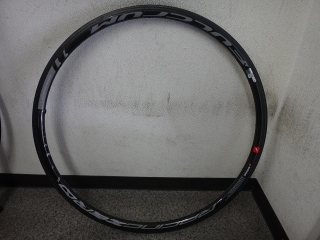
but when the rim rotates, neither reads correctly anymore.
On rims versus tire labeling and such,
the letter gravity almost always points toward the wheel's interior.
The exception is that some Schwalbe tires from a certain period had
unidirectional letter gravity, so
when pairing them with Fulcrum and similar rims that also go one direction,
aligning the letter gravity makes it look better.
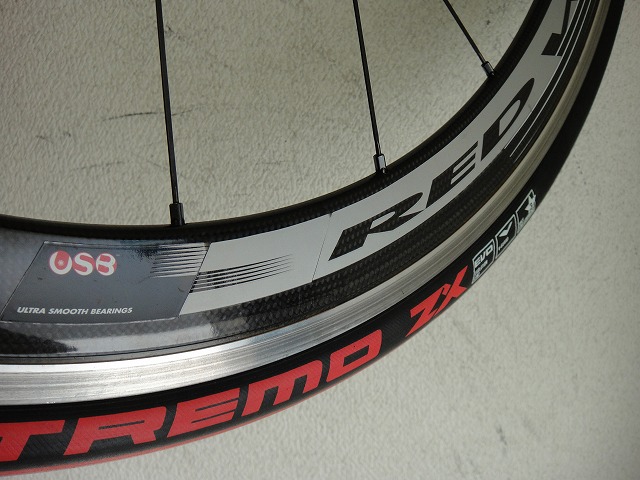
As an example, here's a combination of Fulcrum Red Wind XLR50 and
Schwalbe Altremo ZX:
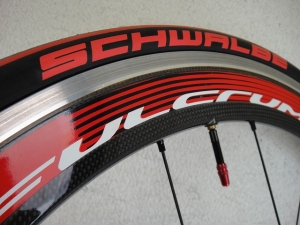
the letter gravity aligns between Schwalbe and Fulcrum, and
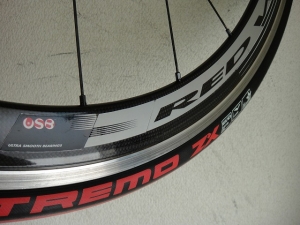
the letter gravity aligns between Red Wind and Altremo.
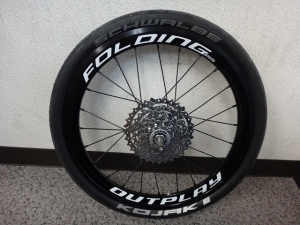
Here's another similar example. The valve hole is on the bottom of the image,
and since I centered the rim and tire labels at the valve hole,
they're slightly off on the top side.
Normally, with tire labels, I position the model name
rather than the manufacturer name directly below the valve hole.
For example, with Continental's Grand Prix 5000,
I put the Grand Prix 5000 marking at the valve hole.
When checking a customer's wheel, if the
manufacturer name is at the valve hole,
I leave it that way when reinstalling,
but when installing tires fresh on both wheels,
I put the model name label at the valve hole.
The exceptions are cases like the earlier examples where
letter gravity works in one direction on both rim and tire, or
cases like Mavic's factory setup where there's a clear rule—
in those cases I don't deliberately go against it.
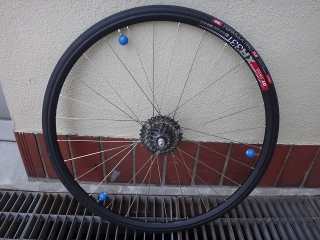
My everyday bike's rear wheel has
a DT XR331 rim in triple-valve configuration.
The XR331 has the same sticker
at two spots 180° apart, with
the other side's phase offset by 90°.
Of those four total, I removed three—
all except the one on the freewheel side—
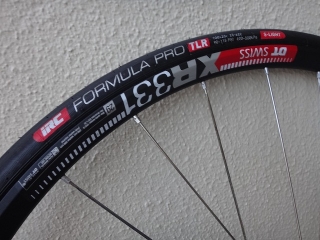
and I align the tire label
with the single rim sticker I left.
If there's anyone out there thinking "I also use a triple-valve wheel and do the same,"
I'd love to hear about it.
Now, tire labels usually have
letter gravity toward the wheel interior, with
unidirectional gravity being rare,
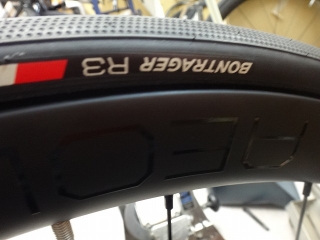
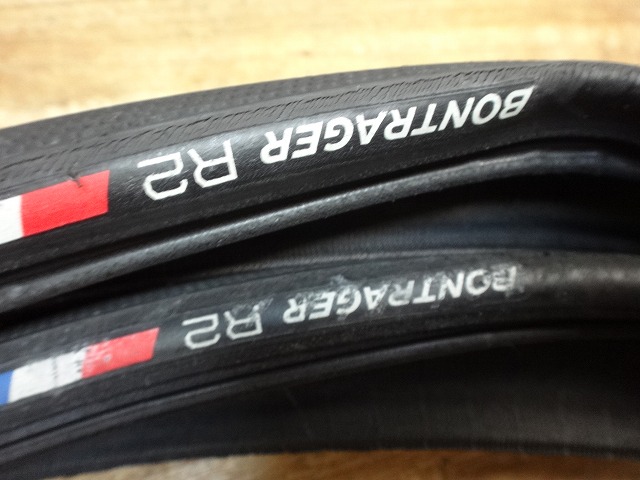
but on recent Bontrager tires,
the letter gravity points outward.
This feels incredibly strange to me.
It's possible I'm mistaken, and this label might actually have
Eᖈ ᖈヨ9∀ᖈ⊥NO8
letter gravity pointing inward toward the wheel.
If that's the case, then the Emonda
from which I took the through-axle photos at the top
had Grand Prix 5000 installed on Nomu Lab wheel number 8, and
the tire it had before was
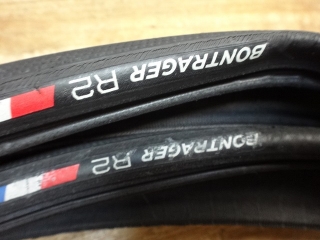
乙ᖈ ᖈヨ9∀ᖈ⊥NO8
which would be the case.
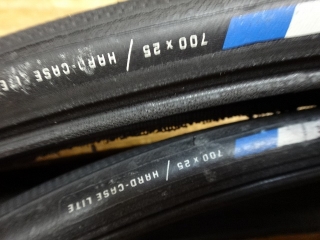
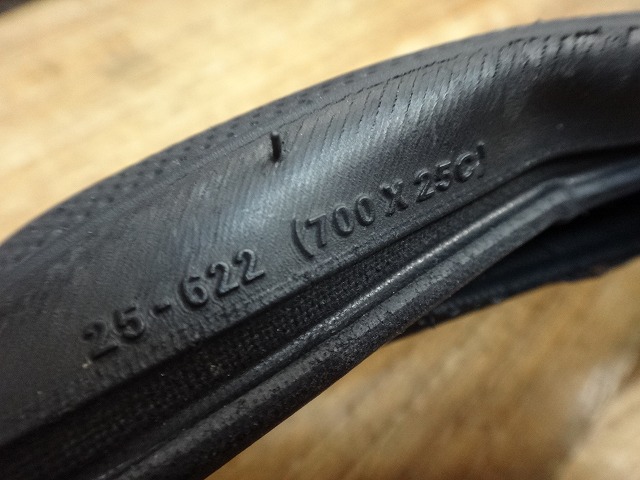
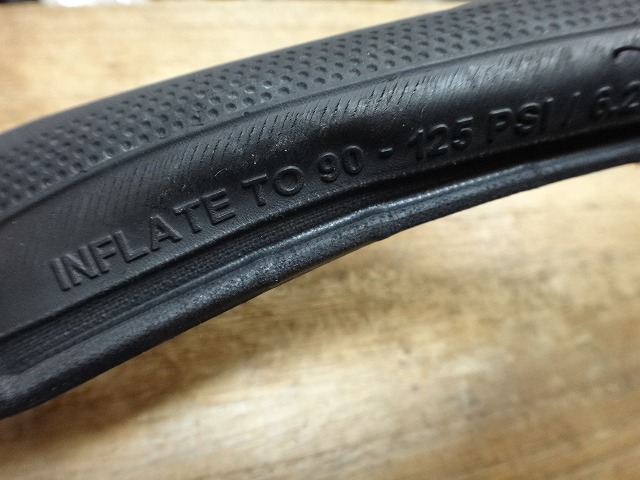
No, the tire size marking also points outward, so
while I can't fathom the intent, it seems that currently Trek
has some kind of strong commitment to having
tire letter gravity point toward the wheel exterior.
Since it doesn't affect tire performance,
it's not like it's bad, but
it feels so incredibly strange to me that
I can't understand why they'd deliberately do this,
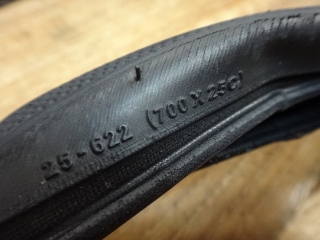
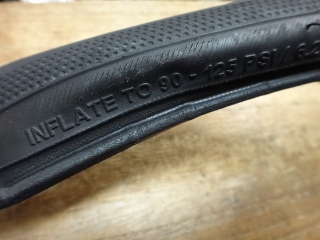
and the OEM manufacturers contracted for tire production
apparently didn't go along with it either.
but I'd completely forgotten which brand it was from.
but then today when I replaced the tires on an Emonda complete bike for another job,
it turned out to be a Trek specification.
You can remove and install it with an Allen key,
but there's also a lever-type plug-in version like what DT has,
and since the bottom of the hexagonal socket in the axle is magnetic,
you won't drop it and lose it during normal riding.
The customer's bike only had the add-on lever on the front axle,
but whether that's the intended spec or if they just lost the rear one is unclear.
On a different note, the "Madone" in Trek's road bike model names
is the name of a climb in France.
Since the road is narrow, it's never been selected for high-category races like the Tour de France,
but it's a climb that Lance Armstrong used as a training route
when he was living in Nice.
There was a famous rider who used Madone regularly as a daily training climb
and used his climbing time there as an indicator of fitness,
and the first clearly documented example is
Tony Rominger (Rominger).
Rominger's record was 31 minutes 30 seconds, and while this record stood for a long time,
it wasn't untouchable—it's just that Madone time trials weren't as common an activity back then as they are now.
Unless someone appears who sees value in breaking it,
this record will never be broken for all eternity.
I am definitely a world record holder,
but I have no idea what the time was or when I set it.
Armstrong broke Rominger's record just before the 1999 Tour de France,
clocking 30 minutes 47 seconds,
and the frame he was developing at the time, which later became commercially available,
was named Madone after that climb.
Long ago, Nike released shoes and watches with Lance's name on them,
but since Armstrong's image was dragged through the mud by doping,
they've been discontinued and treated as if they "never existed."
It should have been an extremely profitable product,
so if not for the doping scandal, even after his retirement
there likely would have been continued merchandise like signature models.
While Madone is indeed a French place name,
it's still perceived as "Armstrong's vestigial legacy,"
but Trek shows no signs of changing the model name.
Returning to the Madone climb story, there actually isn't clear consensus on
where to start, though the finish is established,
so it's actually unknown whether Rominger and Armstrong covered
exactly the same route.
But as long as they're not wildly different, and with a 43-second gap,
it's generally accepted that he definitely broke the course record.
After that, Madone time trials became famous,
and people—both pros and amateurs—started trying to break it.
Between 2005 and 2007, with Discovery Channel
(for some reason hiragana converts preferentially...),
Tom Danielson, who had been teammates with Armstrong,
recorded 30 minutes 24 seconds.
While Danielson is American,
he holds course records on several climbs back home in America.
In other words, he's the type who enjoys doing this sort of thing.
From what I've been able to track, around 2015
Chris Froome put down 30 minutes 9 seconds, and then shortly after
Richie Porte, Froome's teammate at the time,
recorded 29 minutes 40 seconds.
Since Madone, Trek's road frame model names—
both Emonda and Domane—are anagrams of Madone
(MADONE・EMONDA・DOMANE).
Following this pattern, the future model names I can think of that fit
are MODENA and DAEMON.
This is pure speculation on my part, but regarding MODENA,
it supposedly came up as a candidate during Emonda's development,
but it was EMONDA that got adopted in the internal meeting,
and I get the sense that the faction pushing for MODENA
still mutters complaints called "the MODENA incident."
DAEMON uses the same letters as "daemon" but spelled DAEMON,
the non-DEMON spelling that means demon.
DAEMON is currently a demon living in the electronic world,
tasked with dutifully returning to senders notification that
their emails failed to reach the recipient.
↑This is reference material I prepared for a segment on multi-start threads,
and it seems a shame to scrap it, so I'll use it anyway.
Plastic bottle caps use multi-start threads,
but they're not a unified standard.
That said, bottle cap manufacturing is
a niche oligopolistic market, so
there aren't dozens of different dimensions in circulation
(I'd bet there are fewer than the number of press-fit BB standards.
Frame manufacturers really need to think about this stuff, seriously).
Unlike sports bike components,
bottle caps aren't mixed and matched non-OEM with bottles,
so it goes largely unnoticed, but
Evian bottle caps
use a multi-start thread with a very steep lead angle.
and the cap comes off in just half a turn.

This is a different job from the Emonda with the through-axle at the top,
but the front wheel of a Bontrager disc brake
that I got to photograph for an article.
It's a 26-inch HE rim MTB, and during the early days of disc brakes,
radial lacing on the non-rotor side was trendy,
but if you're doing this with equal numbers on both sides, you'd want at least 32H.
Plus, this hub uses straight spokes, so
you can't change the lacing pattern.
That's not actually the most valuable aspect of writing about this wheel though...

It's an axle with a flat contact surface with the fork instead of tapered.
With 1.75mm pitch, once the flange with serrations on the axle contacts the fork,
you can't tighten it more than half a turn.
You can't advance the threads by 0.875mm, which is half of 1.75mm.
The X-12 standard is 1mm pitch, but
from where you feel the same kind of contact on the tapered section,
depending on the frame or fork, you can easily tighten more than a full turn.
Anyway, this fork
has paint over the area where the serrations contact, so
the paint is cracking like eggshell
and spreading beyond the contact surface with the axle flange.
That's not good.
But that's not the most valuable aspect of this wheel either.

↑These are both Reynolds rims—
the left is Stratos DV and the right is Assault SLG.
The rim graphics are completely different and they're quite far apart in age,
but on the Stratos, the "gravity" of the Reynolds lettering
points toward the wheel's interior.
On the Assault, the letter gravity points outward.
This is a Racing Zero Carbon rim, and
Campagnolo and Fulcrum rims both have
letter gravity pointing in one direction.
In the state shown in the image above, the letter gravity points downward, so
both the Racing Zero and Fulcrum read correctly in the normal direction,

but when the rim rotates, neither reads correctly anymore.
On rims versus tire labeling and such,
the letter gravity almost always points toward the wheel's interior.
The exception is that some Schwalbe tires from a certain period had
unidirectional letter gravity, so
when pairing them with Fulcrum and similar rims that also go one direction,
aligning the letter gravity makes it look better.
As an example, here's a combination of Fulcrum Red Wind XLR50 and
Schwalbe Altremo ZX:

the letter gravity aligns between Schwalbe and Fulcrum, and
the letter gravity aligns between Red Wind and Altremo.
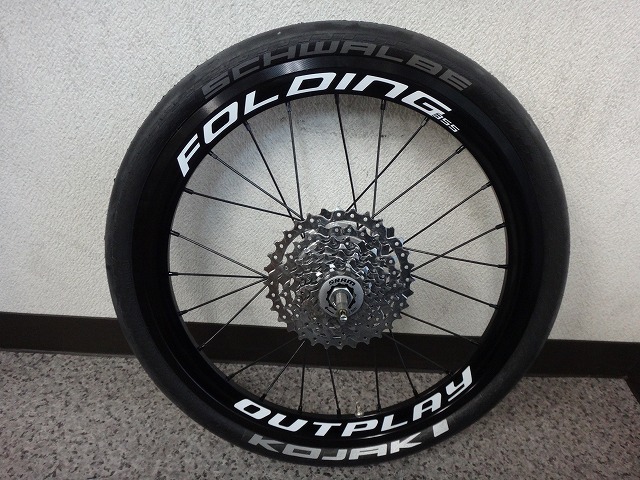
Here's another similar example. The valve hole is on the bottom of the image,
and since I centered the rim and tire labels at the valve hole,
they're slightly off on the top side.
Normally, with tire labels, I position the model name
rather than the manufacturer name directly below the valve hole.
For example, with Continental's Grand Prix 5000,
I put the Grand Prix 5000 marking at the valve hole.
When checking a customer's wheel, if the
manufacturer name is at the valve hole,
I leave it that way when reinstalling,
but when installing tires fresh on both wheels,
I put the model name label at the valve hole.
The exceptions are cases like the earlier examples where
letter gravity works in one direction on both rim and tire, or
cases like Mavic's factory setup where there's a clear rule—
in those cases I don't deliberately go against it.
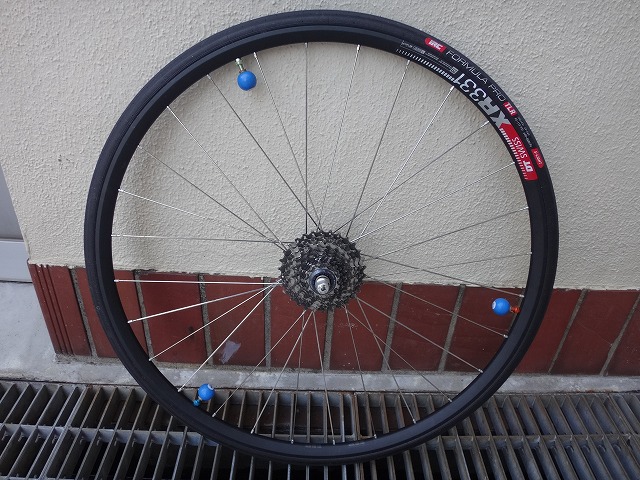
My everyday bike's rear wheel has
a DT XR331 rim in triple-valve configuration.
The XR331 has the same sticker
at two spots 180° apart, with
the other side's phase offset by 90°.
Of those four total, I removed three—
all except the one on the freewheel side—
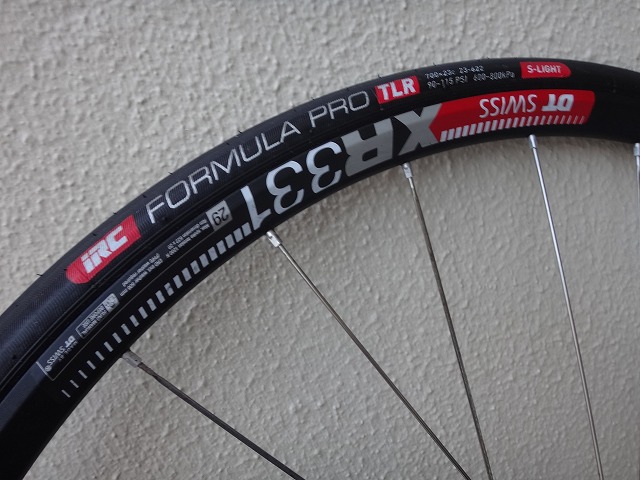
and I align the tire label
with the single rim sticker I left.
If there's anyone out there thinking "I also use a triple-valve wheel and do the same,"
I'd love to hear about it.
Now, tire labels usually have
letter gravity toward the wheel interior, with
unidirectional gravity being rare,
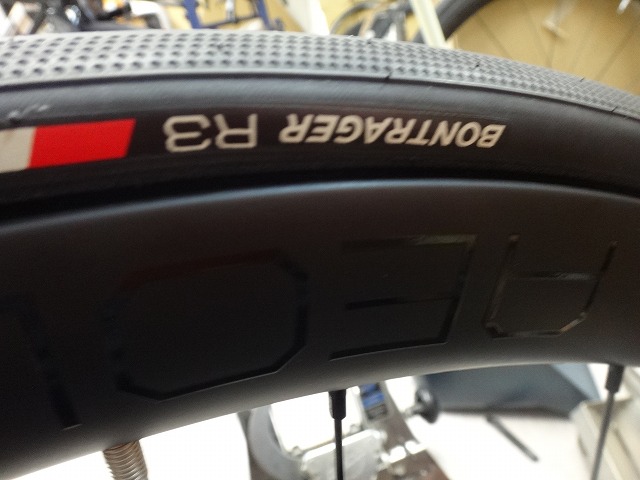
but on recent Bontrager tires,
the letter gravity points outward.
This feels incredibly strange to me.
It's possible I'm mistaken, and this label might actually have
Eᖈ ᖈヨ9∀ᖈ⊥NO8
letter gravity pointing inward toward the wheel.
If that's the case, then the Emonda
from which I took the through-axle photos at the top
had Grand Prix 5000 installed on Nomu Lab wheel number 8, and
the tire it had before was
乙ᖈ ᖈヨ9∀ᖈ⊥NO8
which would be the case.

No, the tire size marking also points outward, so
while I can't fathom the intent, it seems that currently Trek
has some kind of strong commitment to having
tire letter gravity point toward the wheel exterior.
Since it doesn't affect tire performance,
it's not like it's bad, but
it feels so incredibly strange to me that
I can't understand why they'd deliberately do this,
and the OEM manufacturers contracted for tire production
apparently didn't go along with it either.