I had stocked this while planning to write an article about bottles
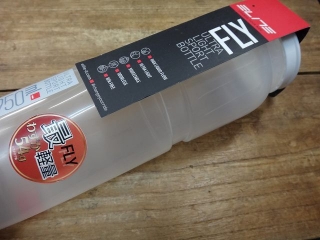
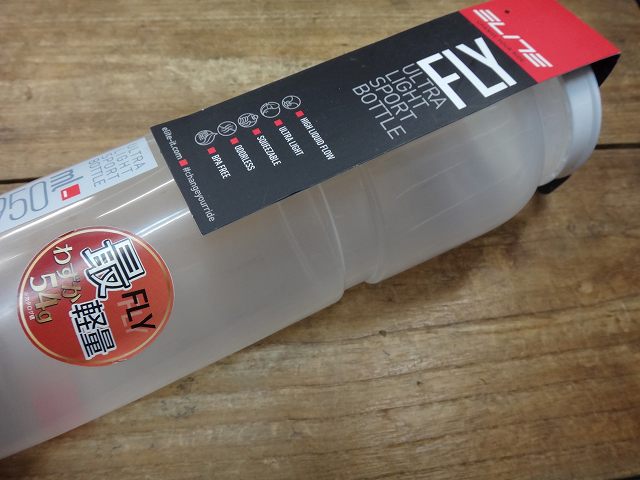
It's the long version of Elite's FLY, a lightweight bottle.
Recently, a more affordable model called JET has been added below the FLY.
Both are made from biodegradable plastic.
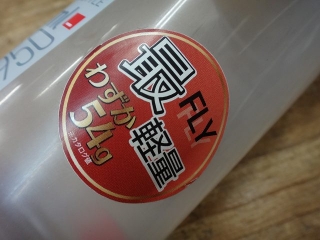
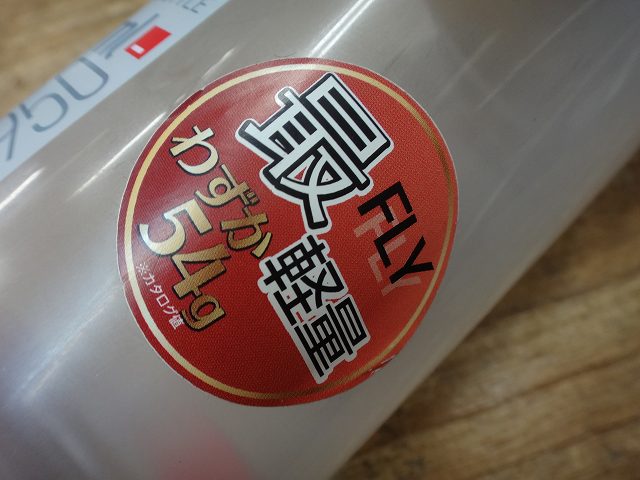
This one was sourced from a distributor, and the distributor has applied Japanese-language stickers to it
(the 54g refers to the short bottle version of 550ml).
Elite makes bottle cages, bottle cages with maintenance stands and rollers.
There was a time when the brand was handled by multiple distributors,
but now some distributors only handle bottle cages,
and even more narrowly, only custom race models or Chiussi-type standard models.
I've made it a point to buy from distributors that handle bottles as well.
The reason is that bottles are classified as imported food containers,
so they need to pass quarantine inspection once a year, which costs tens of thousands of yen annually.
There's also paperwork involved.
With the FLY, regular color schemes cost just a few hundred yen,
and even team colors or special order models without insulation features cost just over 1,000 yen including tax,
but when you consider the difference in price between what distributors buy from manufacturers
and what they wholesale to shops (their profit), bottles are actually quite difficult to use just to cover quarantine costs.
Beyond that, bottles aren't just thin-margin products—
Elite offers many varieties, they take up warehouse space,
and due to the product shape (in Elite's case), they're shipping fresh air from Italy,
meaning they take up a lot of shipping space.
With the same size box, if it contained frames or wheels,
the profit per volume or per shipping cost would be incomparably larger.
Among distributors that stock bottle brands with full product lines including bottles,
some only stock bottle cages,
but if everyone did that, bottles would stop entering Japan.
So, unrelated to and unknown to customers,
I've made a policy of sourcing bottle cages only from distributors that maintain abundant bottle inventory
except in cases of unavoidable stockouts.
For Elite, it seems the distributor has been narrowed down to just one company,
but it's a distributor that has consistently offered abundant bottle selection.
Anyway, I still haven't gotten to the main point of the title,
but does a sticker saying something like "Lightweight bottle!" in Japanese
actually change how often customers pick it up or how many sell?
And if it does, is there an advertising effect that exceeds the cost of manufacturing the sticker and the labor to apply it?
Besides, Elite is a standard bottle brand and top name in the market,
and especially since the FLY came out, there are plenty of people who won't use anything else for bottles.

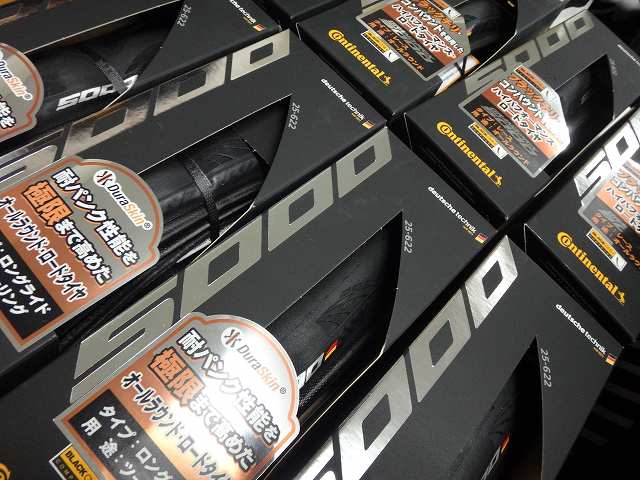
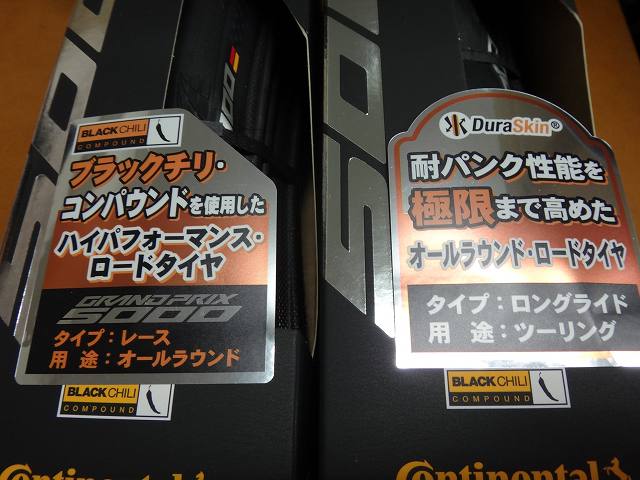
This is Continental's Grand Prix 5000, and it has a Japanese-language sticker on the box.
Looking at both our sales records and the wheels we receive for service,
the Grand Prix 5000 is currently the most supported clincher tire.
So whether or not there's a sticker,
there are plenty of people who will only pick up this tire anyway,
so what's the point in going through all this effort?
With these kinds of stickers, there's meaning in clearly showing that it came through Japan's official distributor.
I won't name names, but there have been shops that source products from official distributors while mixing in parallel imports from other trading companies
and putting them on the shelves together
(by the way, those products aren't Continental tires).
When someone from a distributor visits a shop on sales calls and walks around,
if the distributor has no record of supplying that product, they'll be caught,
but if there's even a small history of it, it's impossible to tell the difference
(which is why they'll buy just a small amount).
And if a product is defective, such shops will
even if the defect came from the parallel import version
(and the selling shop often can't tell the difference anymore either),
send it back to the official distributor saying "replace it!"
For high-value items like frames, wheels, or front suspension forks,
distributors do keep track of serial numbers,
but for consumables that aren't that expensive,
since most shops aren't doing anything improper,
it's not practical to embed individual product traceability.
However, applying a distributor-original recommendation sticker
might actually be worth it when you factor in sticker and labor costs.
Even if the original purpose was to catch parallel imports,
the sticker only needs to describe the product rather than write something ominous like "buy genuine!"
—which is actually a win-win.
If a shop mixing in parallel imports wanted to counter this,
they'd have to forge the sticker,
but it's hard to imagine them going through that trouble and expense.
With the Grand Prix 5000, some time has passed since stickers started being applied,
and with the current trend of long-term stockouts,
newly arrived Grand Prix 5000s after the shortage
all have this sticker on every box.
The sticker on the bottle from the beginning
is applied directly to the product, so it's easy to peel off,
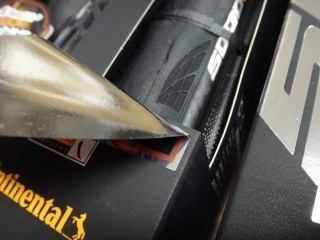
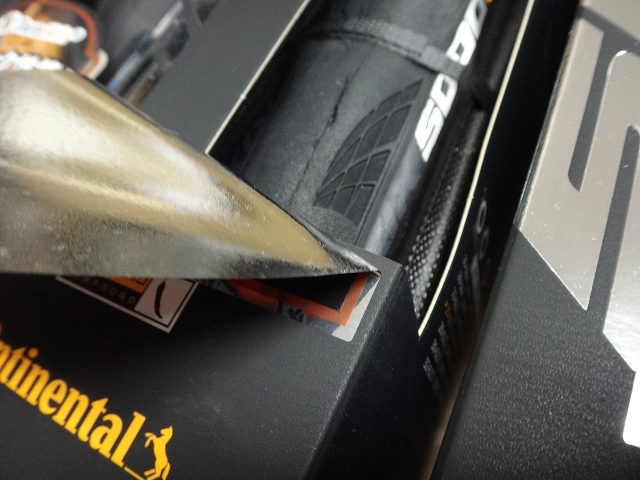
but the Grand Prix 5000 sticker is applied with extremely strong adhesive,
and if you try to peel it off forcefully, the box cardboard rips
(the part that's curled up in the image is the non-adhesive section).
You can say with absolute certainty it will never peel off naturally.
From the strength of this adhesive alone,
I sense some kind of firm resolve, but am I imagining things?
Also, a business announcement.
I know the person from the Continental tire distributor reads this,
so I'm writing this as a heads up:
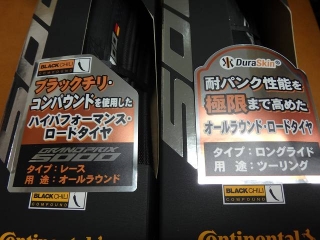
there's a sticker that should go on Grand Prix 4-Season or Gator Skin
being applied to Grand Prix 5000 instead (top image, right).
It's not just one or two—it's an entire lot.
To our blog readers:
The rare Grand Prix 5000 with the wrong sticker—
distribution inventory is limited, so if you managed to buy one, you're lucky!
(shameless advertising)
It's the long version of Elite's FLY, a lightweight bottle.
Recently, a more affordable model called JET has been added below the FLY.
Both are made from biodegradable plastic.
This one was sourced from a distributor, and the distributor has applied Japanese-language stickers to it
(the 54g refers to the short bottle version of 550ml).
Elite makes bottle cages, bottle cages with maintenance stands and rollers.
There was a time when the brand was handled by multiple distributors,
but now some distributors only handle bottle cages,
and even more narrowly, only custom race models or Chiussi-type standard models.
I've made it a point to buy from distributors that handle bottles as well.
The reason is that bottles are classified as imported food containers,
so they need to pass quarantine inspection once a year, which costs tens of thousands of yen annually.
There's also paperwork involved.
With the FLY, regular color schemes cost just a few hundred yen,
and even team colors or special order models without insulation features cost just over 1,000 yen including tax,
but when you consider the difference in price between what distributors buy from manufacturers
and what they wholesale to shops (their profit), bottles are actually quite difficult to use just to cover quarantine costs.
Beyond that, bottles aren't just thin-margin products—
Elite offers many varieties, they take up warehouse space,
and due to the product shape (in Elite's case), they're shipping fresh air from Italy,
meaning they take up a lot of shipping space.
With the same size box, if it contained frames or wheels,
the profit per volume or per shipping cost would be incomparably larger.
Among distributors that stock bottle brands with full product lines including bottles,
some only stock bottle cages,
but if everyone did that, bottles would stop entering Japan.
So, unrelated to and unknown to customers,
I've made a policy of sourcing bottle cages only from distributors that maintain abundant bottle inventory
except in cases of unavoidable stockouts.
For Elite, it seems the distributor has been narrowed down to just one company,
but it's a distributor that has consistently offered abundant bottle selection.
Anyway, I still haven't gotten to the main point of the title,
but does a sticker saying something like "Lightweight bottle!" in Japanese
actually change how often customers pick it up or how many sell?
And if it does, is there an advertising effect that exceeds the cost of manufacturing the sticker and the labor to apply it?
Besides, Elite is a standard bottle brand and top name in the market,
and especially since the FLY came out, there are plenty of people who won't use anything else for bottles.
This is Continental's Grand Prix 5000, and it has a Japanese-language sticker on the box.
Looking at both our sales records and the wheels we receive for service,
the Grand Prix 5000 is currently the most supported clincher tire.
So whether or not there's a sticker,
there are plenty of people who will only pick up this tire anyway,
so what's the point in going through all this effort?
With these kinds of stickers, there's meaning in clearly showing that it came through Japan's official distributor.
I won't name names, but there have been shops that source products from official distributors while mixing in parallel imports from other trading companies
and putting them on the shelves together
(by the way, those products aren't Continental tires).
When someone from a distributor visits a shop on sales calls and walks around,
if the distributor has no record of supplying that product, they'll be caught,
but if there's even a small history of it, it's impossible to tell the difference
(which is why they'll buy just a small amount).
And if a product is defective, such shops will
even if the defect came from the parallel import version
(and the selling shop often can't tell the difference anymore either),
send it back to the official distributor saying "replace it!"
For high-value items like frames, wheels, or front suspension forks,
distributors do keep track of serial numbers,
but for consumables that aren't that expensive,
since most shops aren't doing anything improper,
it's not practical to embed individual product traceability.
However, applying a distributor-original recommendation sticker
might actually be worth it when you factor in sticker and labor costs.
Even if the original purpose was to catch parallel imports,
the sticker only needs to describe the product rather than write something ominous like "buy genuine!"
—which is actually a win-win.
If a shop mixing in parallel imports wanted to counter this,
they'd have to forge the sticker,
but it's hard to imagine them going through that trouble and expense.
With the Grand Prix 5000, some time has passed since stickers started being applied,
and with the current trend of long-term stockouts,
newly arrived Grand Prix 5000s after the shortage
all have this sticker on every box.
The sticker on the bottle from the beginning
is applied directly to the product, so it's easy to peel off,
but the Grand Prix 5000 sticker is applied with extremely strong adhesive,
and if you try to peel it off forcefully, the box cardboard rips
(the part that's curled up in the image is the non-adhesive section).
You can say with absolute certainty it will never peel off naturally.
From the strength of this adhesive alone,
I sense some kind of firm resolve, but am I imagining things?
Also, a business announcement.
I know the person from the Continental tire distributor reads this,
so I'm writing this as a heads up:
there's a sticker that should go on Grand Prix 4-Season or Gator Skin
being applied to Grand Prix 5000 instead (top image, right).
It's not just one or two—it's an entire lot.
To our blog readers:
The rare Grand Prix 5000 with the wrong sticker—
distribution inventory is limited, so if you managed to buy one, you're lucky!
(shameless advertising)