Another day on wheels (and so on).

Built a front wheel with a DT XR331 rim.
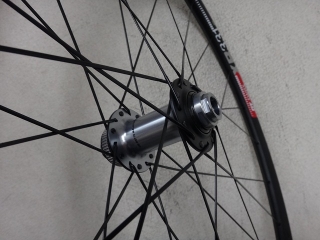
HB-RS770 hub, 28H, black half CX Sprint 64-spoke lacing, reverse Italian-style. I'll do the nipple lacing later.
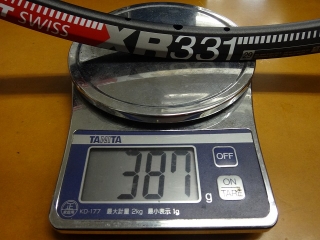
About the XR331 rim — including the one I currently use in my personal collection (375g), the early batches had rims scattered in the 370g range, but lately I'm seeing ones over 400g. For instance, a customer (sort of) brought in two rims a while back that were both 407g. Oh man. So 387g is still on the lighter side.
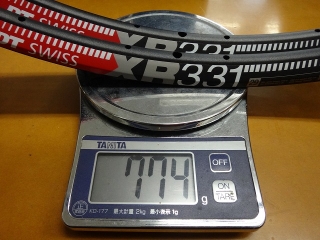
The other rim for the rear wheel was also 387g. I was planning to use whichever one was 1g lighter for the rear. When I weighed two 387g rims together on a 1g resolution scale, I thought the fractional remainders would add up to give me a plus-1g result, but 387 + 387 came out to exactly 774g.
The XR331 is an MTB rim, so the numbers and weight are unrelated. But for road rims, ever since DT started their rim business with the first two models RR1.1 and RR1.2, which were later renamed to RR415 and RR585 respectively, there's been a rule: "the numbers equal the catalog weight."
So the RR411db rim should theoretically be 411g, but in reality it's more like 421–425g. However, the original RR411 rim brake rim comes in two types — non-offset and offset — whereas the RR411db rim only comes in offset spec. Since offset rims tend to be a bit heavier, if we consider that an offset version of the 411g rim would add around 15g, you could actually say it's relatively light.
I've mentioned this before, but DT doesn't separate maximum air pressure limits between road and MTB rims — they only differentiate based on tire width and whether the tire is tubetype or tubeless. In fact, the rim sticker (early models don't have this sticker) lists minimum/maximum tire widths of 25C/64C, with maximum pressures of 123psi (8.4 bar) for 25C tubetype and 102psi (7.0 bar) for 25C tubeless. That completely exceeds what you'd expect from an MTB rim spec.
After the XR331, the next heavier rim is the XR361, which suddenly gets much wider. That's because the XR331 is honestly too narrow for an MTB rim (even Stans' lightest aluminum MTB rim, the Crest, is much wider than the XR331). So while it's classified as an MTB rim on paper, the XR331 in practice serves as a lightweight rim for disc road and cyclocross bikes. Since it's not very wide, even if you inflate IRC Syra CX tubeless (nominally 32C) to 2 bar, the width doesn't exceed 33mm. However, since it's technically classified as an MTB rim, it doesn't come in 24H — the minimum is 28H. So when it comes to finding a good hub that isn't too pricey, Tnni's Revo disc hubs only come in 24H front and rear, which makes Shimano's RS770 hub about the only realistic option.
This post is overwriting a previous post that was up before this, so the applause count looks weird — please ignore that. It's the aftermath of a one-day festival (though I never said it would burn out in one day).
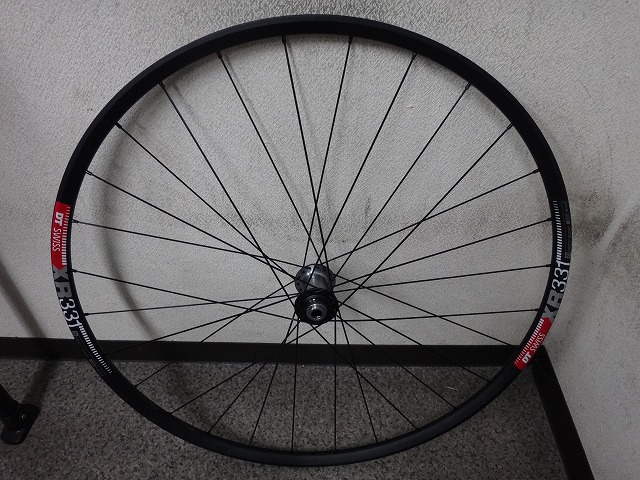
Built a front wheel with a DT XR331 rim.

HB-RS770 hub, 28H, black half CX Sprint 64-spoke lacing, reverse Italian-style. I'll do the nipple lacing later.
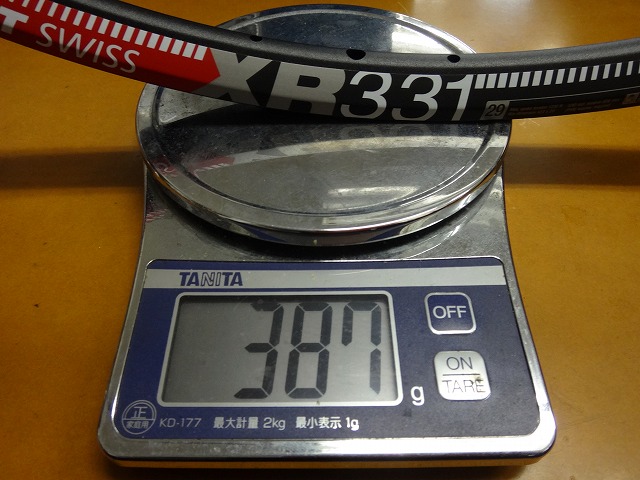
About the XR331 rim — including the one I currently use in my personal collection (375g), the early batches had rims scattered in the 370g range, but lately I'm seeing ones over 400g. For instance, a customer (sort of) brought in two rims a while back that were both 407g. Oh man. So 387g is still on the lighter side.
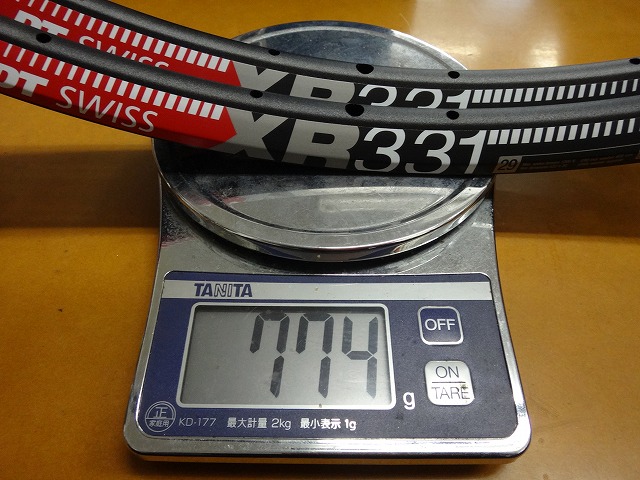
The other rim for the rear wheel was also 387g. I was planning to use whichever one was 1g lighter for the rear. When I weighed two 387g rims together on a 1g resolution scale, I thought the fractional remainders would add up to give me a plus-1g result, but 387 + 387 came out to exactly 774g.
The XR331 is an MTB rim, so the numbers and weight are unrelated. But for road rims, ever since DT started their rim business with the first two models RR1.1 and RR1.2, which were later renamed to RR415 and RR585 respectively, there's been a rule: "the numbers equal the catalog weight."
So the RR411db rim should theoretically be 411g, but in reality it's more like 421–425g. However, the original RR411 rim brake rim comes in two types — non-offset and offset — whereas the RR411db rim only comes in offset spec. Since offset rims tend to be a bit heavier, if we consider that an offset version of the 411g rim would add around 15g, you could actually say it's relatively light.
I've mentioned this before, but DT doesn't separate maximum air pressure limits between road and MTB rims — they only differentiate based on tire width and whether the tire is tubetype or tubeless. In fact, the rim sticker (early models don't have this sticker) lists minimum/maximum tire widths of 25C/64C, with maximum pressures of 123psi (8.4 bar) for 25C tubetype and 102psi (7.0 bar) for 25C tubeless. That completely exceeds what you'd expect from an MTB rim spec.
After the XR331, the next heavier rim is the XR361, which suddenly gets much wider. That's because the XR331 is honestly too narrow for an MTB rim (even Stans' lightest aluminum MTB rim, the Crest, is much wider than the XR331). So while it's classified as an MTB rim on paper, the XR331 in practice serves as a lightweight rim for disc road and cyclocross bikes. Since it's not very wide, even if you inflate IRC Syra CX tubeless (nominally 32C) to 2 bar, the width doesn't exceed 33mm. However, since it's technically classified as an MTB rim, it doesn't come in 24H — the minimum is 28H. So when it comes to finding a good hub that isn't too pricey, Tnni's Revo disc hubs only come in 24H front and rear, which makes Shimano's RS770 hub about the only realistic option.
This post is overwriting a previous post that was up before this, so the applause count looks weird — please ignore that. It's the aftermath of a one-day festival (though I never said it would burn out in one day).