Today, it's wheel-building again (and so on)... but before that.
Yesterday I rebuilt the front wheel of the CL50, and I wrote: "I don't think it's worth changing the high spoke count side to CX Sprint and the low spoke count side to #14 plain,"
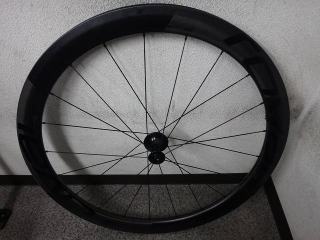
but I spent the whole night fretting over it,
decided I wasn't happy with it, and rebuilt it again.
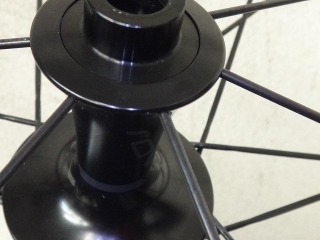
Changed the right side from CX Sprint to Champion #14,
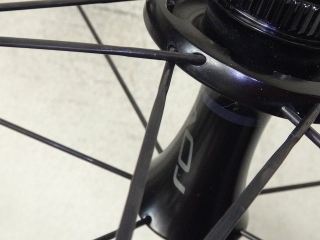
and changed the left side from CX-RAY to CX Sprint,
and rebuilt it.
This matches the customer's original preference.
It's not a spec I'd recommend to everyone,
but if you want something stiff, this is probably the optimal solution.
The front hub is 21H and the rim has eyelets for 2:1 lacing,
so there's no way to change the hub.
On a different note, LOOK makes an R96, which is
a pure competition track frame set,
and its front fork is a 100×12mm thru-axle spec.
For rim brake use—or more precisely, brakes are irrelevant, but anyway—
through-axle front hubs without disc rotor mounts
don't generally exist in the market.
In practice, for the R96, Colima produces
5-spoke laced wheels and disc wheels as front wheels in thru-axle spec.
This is confusing, but the "disc wheel" here
has nothing to do with disc brakes—
it just means a wheel in a disc shape.
Colima also makes 3-spoke and 4-spoke front wheels,
but those currently only come with threaded hub specs.
Mavic also produces 5-spoke laced wheels called Elio and front disc wheels
compatible with the R96.
Both are French manufacturers, and
actually Colima is now under LOOK, so
producing compatible wheels is only natural in a way.
To my knowledge, there are about 2 other makers
producing compatible wheels.
The R96 comes with some front wheels that have hollow axles despite threaded ends,
with M6 threads cut not only on the outside but also on the inside.
It comes with an adapter to fix those with cap screws and an Allen key,
and using that adapter, you can mount certain
Mavic Ellipse front wheels from certain eras.
I haven't written about it here, but I've modified non-compatible front wheels
for mounting on R96 forks several times in the past.
Recently, a customer came to me with exactly this issue—
they brought in an R96 and a wheel that was originally incompatible,
and when I asked how they've been managing,
they said they've been riding with a Rovéal CL50 front wheel
with the disc rotor removed, and they said it was surprisingly loose
and didn't go well at all.
I've used laced wheels on track bikes other than an R96,
so compared to that, spoked wheels obviously can't win,
but if it were this front wheel I built today,
it wouldn't match a laced wheel in stiffness or aerodynamics,
but at least on the stiffness side alone,
I think it's built to a level where no complaints should come up.
Anyway, on to today's wheel-building.
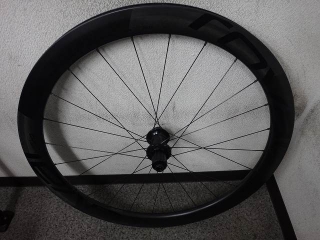
Rebuilding the rear wheel of the CL50.
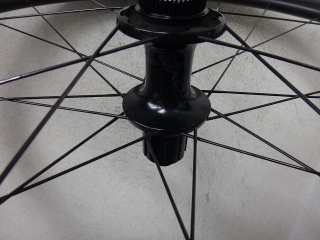
All Campagnolo Record, 24H with 2:1 lacing,
and the non-drive side is tangent laced.
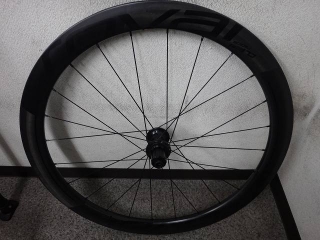
Built.
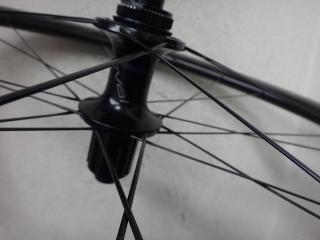
Drive side with CX-RAY, non-drive side with CX Sprint.
The customer asked if possible to raise the spoke weight ratio
one more level on the rear wheel, but
if I do that with the non-drive side tangent laced in 2:1 lacing,
the drive side would be so loaded it'd be scary, so I gave up.
I'll do the stress-relieving later.
About spoke lengths on the CL or CLX 50:
high spoke count side: front wheel left side > rear wheel right side,
low spoke count side: front wheel right side > rear wheel left side,
and the difference is just a few mm on both sides, so
for the rear wheel's drive side 14 out of 16 CX-RAY
and non-drive side 7 out of 8 CX Sprint,
I was able to reuse spokes from the disassembled front wheel.
About the low spoke count side:
the rear wheel's left side (non-drive side) is tangent laced
while the front wheel's right side is radially laced, so
it seems odd that tangent laced is shorter,
but the rear hub has a larger flange diameter, so
in practice it's front wheel right side > rear wheel left side.
Rovéal supplies spare spokes, but the lengths aren't public I believe,
though for wheels I've disassembled before,
I have all the specs memorized.
Information for fellow professionals below:
Rovéal wheels use nipples that can be turned from the rim side,
but only the CL50 uses brass nipples,
so you might replace these with universal aluminum nipples.
If you do, be aware you need to correct spoke length
(whether to make them longer or shorter, and
by how much—figure that out yourself).
Yesterday I rebuilt the front wheel of the CL50, and I wrote: "I don't think it's worth changing the high spoke count side to CX Sprint and the low spoke count side to #14 plain,"

but I spent the whole night fretting over it,
decided I wasn't happy with it, and rebuilt it again.
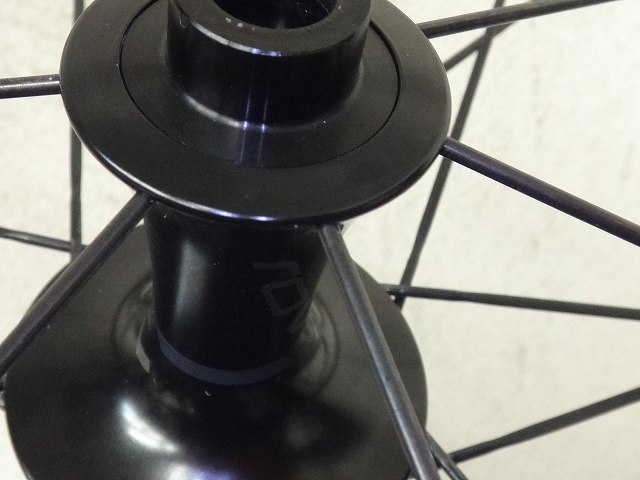
Changed the right side from CX Sprint to Champion #14,
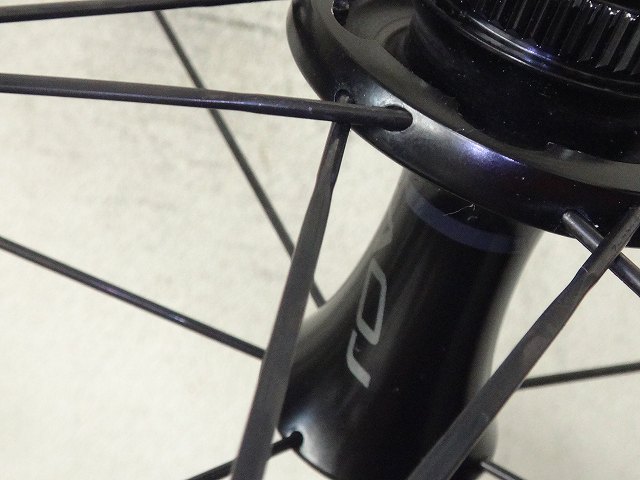
and changed the left side from CX-RAY to CX Sprint,
and rebuilt it.
This matches the customer's original preference.
It's not a spec I'd recommend to everyone,
but if you want something stiff, this is probably the optimal solution.
The front hub is 21H and the rim has eyelets for 2:1 lacing,
so there's no way to change the hub.
On a different note, LOOK makes an R96, which is
a pure competition track frame set,
and its front fork is a 100×12mm thru-axle spec.
For rim brake use—or more precisely, brakes are irrelevant, but anyway—
through-axle front hubs without disc rotor mounts
don't generally exist in the market.
In practice, for the R96, Colima produces
5-spoke laced wheels and disc wheels as front wheels in thru-axle spec.
This is confusing, but the "disc wheel" here
has nothing to do with disc brakes—
it just means a wheel in a disc shape.
Colima also makes 3-spoke and 4-spoke front wheels,
but those currently only come with threaded hub specs.
Mavic also produces 5-spoke laced wheels called Elio and front disc wheels
compatible with the R96.
Both are French manufacturers, and
actually Colima is now under LOOK, so
producing compatible wheels is only natural in a way.
To my knowledge, there are about 2 other makers
producing compatible wheels.
The R96 comes with some front wheels that have hollow axles despite threaded ends,
with M6 threads cut not only on the outside but also on the inside.
It comes with an adapter to fix those with cap screws and an Allen key,
and using that adapter, you can mount certain
Mavic Ellipse front wheels from certain eras.
I haven't written about it here, but I've modified non-compatible front wheels
for mounting on R96 forks several times in the past.
Recently, a customer came to me with exactly this issue—
they brought in an R96 and a wheel that was originally incompatible,
and when I asked how they've been managing,
they said they've been riding with a Rovéal CL50 front wheel
with the disc rotor removed, and they said it was surprisingly loose
and didn't go well at all.
I've used laced wheels on track bikes other than an R96,
so compared to that, spoked wheels obviously can't win,
but if it were this front wheel I built today,
it wouldn't match a laced wheel in stiffness or aerodynamics,
but at least on the stiffness side alone,
I think it's built to a level where no complaints should come up.
Anyway, on to today's wheel-building.
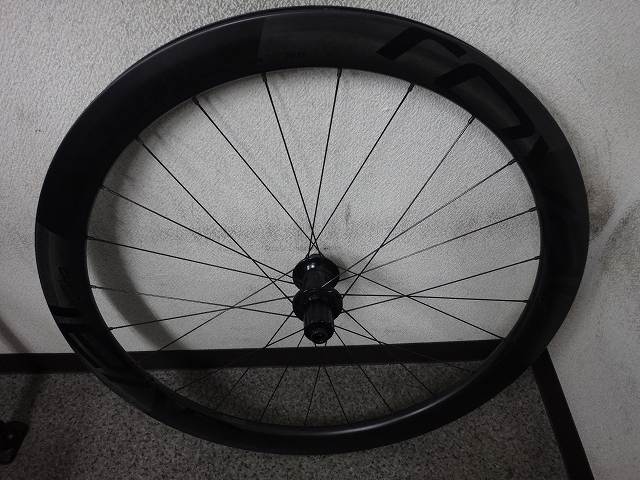
Rebuilding the rear wheel of the CL50.
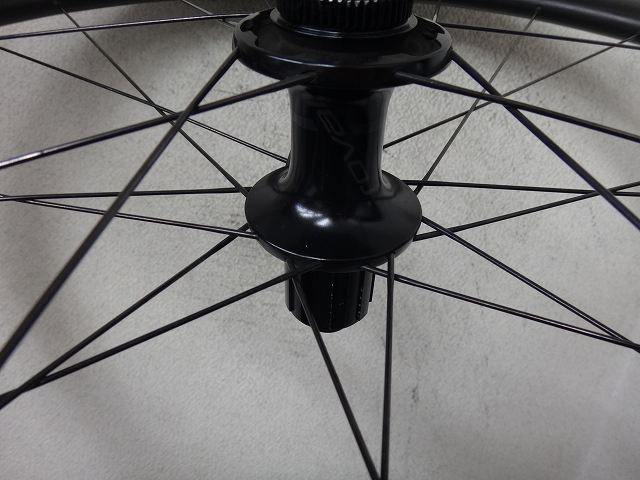
All Campagnolo Record, 24H with 2:1 lacing,
and the non-drive side is tangent laced.
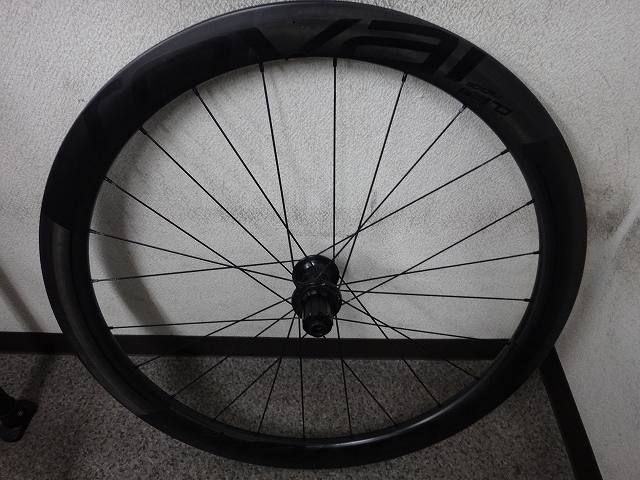
Built.

Drive side with CX-RAY, non-drive side with CX Sprint.
The customer asked if possible to raise the spoke weight ratio
one more level on the rear wheel, but
if I do that with the non-drive side tangent laced in 2:1 lacing,
the drive side would be so loaded it'd be scary, so I gave up.
I'll do the stress-relieving later.
About spoke lengths on the CL or CLX 50:
high spoke count side: front wheel left side > rear wheel right side,
low spoke count side: front wheel right side > rear wheel left side,
and the difference is just a few mm on both sides, so
for the rear wheel's drive side 14 out of 16 CX-RAY
and non-drive side 7 out of 8 CX Sprint,
I was able to reuse spokes from the disassembled front wheel.
About the low spoke count side:
the rear wheel's left side (non-drive side) is tangent laced
while the front wheel's right side is radially laced, so
it seems odd that tangent laced is shorter,
but the rear hub has a larger flange diameter, so
in practice it's front wheel right side > rear wheel left side.
Rovéal supplies spare spokes, but the lengths aren't public I believe,
though for wheels I've disassembled before,
I have all the specs memorized.
Information for fellow professionals below:
Rovéal wheels use nipples that can be turned from the rim side,
but only the CL50 uses brass nipples,
so you might replace these with universal aluminum nipples.
If you do, be aware you need to correct spoke length
(whether to make them longer or shorter, and
by how much—figure that out yourself).