This morning, I knew it would rain but I went out riding around the Mizuma area,
before that.
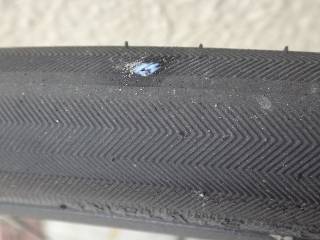
On the third day after mounting the wheel,
the IRC tubeless tire got a puncture.
The image data is from July 8th, so I installed it on July 6th.
The tire's center line is still visible
and the tread hasn't worn at all.
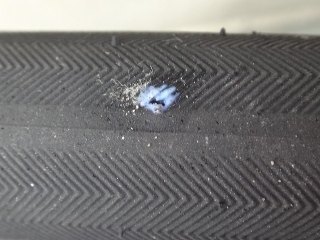
Sealant was seeping out from the hole.
I noticed this at home,
the air pressure was so low it could've caused rim strikes on bumps
but pumping air carelessly would open the wound further and cause trouble,
so I just rode gently to my commute like that.

As I added air, just before reaching 4 bar,
the wound opened up and air started leaking dramatically.

↑This is what it looked like when I sprayed water on it
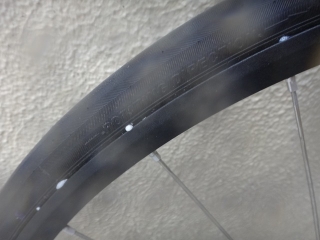
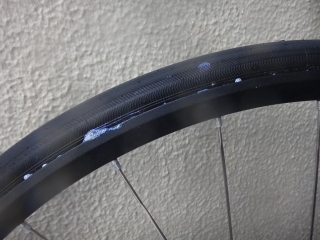
Water got on my camera lens.
After pumping so much air that the wound opened,
I lost even the pressure it was holding,
the bead seal released,
and sealant started seeping from between the rim and tire.
This is scary, so at the shop when the sealant is doing its job
on a tire experiencing a slow leak,
I can't pump it up to my normal operating pressure.

I removed the tire and rinsed off the sealant.
In the center of the image is the puncture hole.
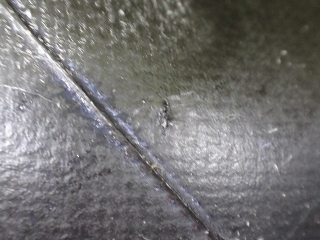
↑There it is
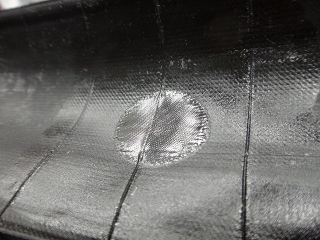
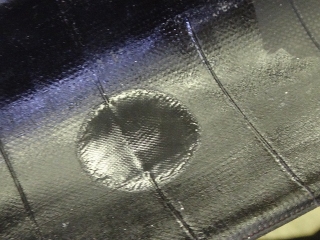
I applied an ultra-thin patch from the inside.
After that, there hasn't been any air leakage from that spot,
nor any significant air leakage as a tubeless tire.
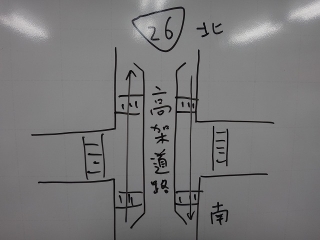
Changing the subject, south of Izumi-Otsu on Route 26,
there's an automobile-only elevated highway of almost identical shape
running north-south,
and at the surface road intersections I usually hit traffic lights.
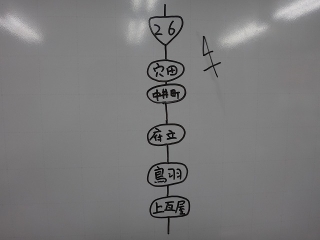
From north to south, the intersection names are
Anada, Nakaichō,
Prefectural Izumi High School East, Toba,
and Kamikawaya.
There are no elevated highways of this shape south of here.
Anada and Nakaichō are close together,
but between Anada, Prefectural, Toba, and Kamikawaya
I don't know the distances, but timewise it's about 10-15 minutes,
and almost certainly I'll hit red lights,
giving me the sensation of train stations.

The old Route 26 south of Ōhama intersection in Sakai
is now Prefectural Road 204, running almost parallel to Route 26.
The major intersections on Route 26 are usually connected to Road 204 by east-west roads
in a ladder pattern,
and the intersection on Road 204 connected to Prefectural Izumi High School is Sakaimachi,
and from the lack of traffic signals and the width and condition of the road,
when I go back and forth between Road 204 and Route 26,
I often pass through the Sakaimachi-Prefectural section.
On my commute home when I want to cover distance with almost no elevation gain
and take a longer route,
I turn at Sakaimachi from Road 204,
turn again at Prefectural, and head home by this route,
often riding it late at night.
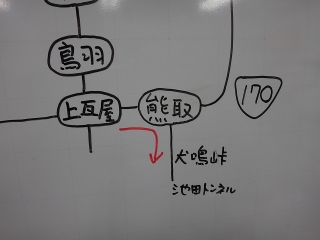
At Kamikawaya I turn left onto Route 170 (outer ring),
and at the Kumatori intersection right after,
if I turn right, there's a pass with Inunaki hot spring and Jintsū hot spring.
It's sometimes called Inunaki Pass, but that's not an official name.
The highest elevation is basically at the Ikeda Tunnel,
and after passing through it you're in Wakayama Prefecture, but the prefectural border
is actually about 2 km before the tunnel.
This is a pass I climb often,

July 20th (Wed) around 11 PM
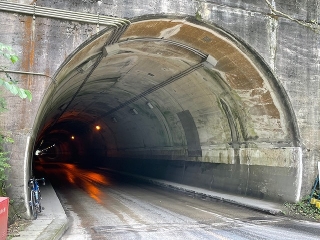
July 27th (Wed) around 11 AM
At this time it was drizzling on the Osaka side
and the road was wet,
but it seemed to be raining harder on the Wakayama side, with oncoming traffic wet from rain,
and the tunnel exit from the Wakayama side
had a wetter road, so I didn't descend to the other side and returned.
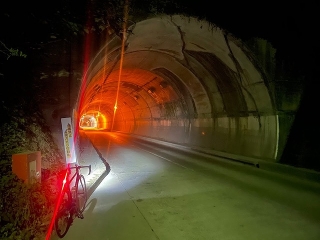
August 11th (Thu) around 12:30 AM
More so a matter of the date changing while I was riding than actually Thursday,
I left home Wednesday.
This time I entered Wakayama Prefecture from the Fukibuki Pass
and returned to Osaka from the Ikeda Tunnel. The image above is from the Wakayama side.
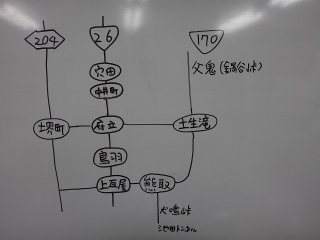
Heading east from the Prefectural intersection,
I cross the outer ring at the Habutaki intersection.
Turning left here, in about 15 minutes I reach the base of the Nabeya Pass,
and I can also return to Sakai through the Izumi-North area.
I sometimes make this the Habutaki route for what I call night practice, my long way home.
This is the map in my head, but
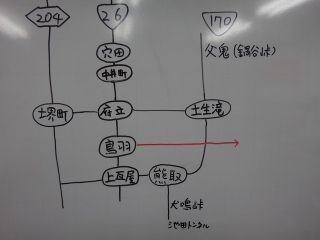
Today I rode from Toba toward the outer ring.
Only the Toba elevated section doesn't go directly over the intersection,
so from the north it's a left turn before the overpass.
I knew this road passes by the Mizuma athletic field
and connects to places like Katsuragi Mountain,
but I just followed the road
(there's a spot to turn left because the front is a highway entrance,
and a spot to turn left toward Kishiwada because turning right goes to Katsuragi Mountain)
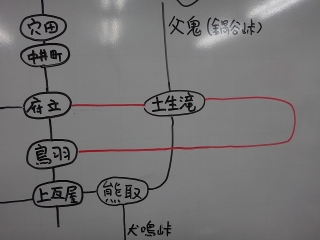
and discovered today for the first time that it comes out at Habutaki!
When I looked at the red line section in the image above
on POLAR's analysis software map,
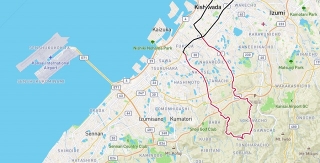
↑this is it.
The black line section is Route 26 on the way there,
and on the way back I turn at Prefectural and take Road 204 from Sakaimachi.
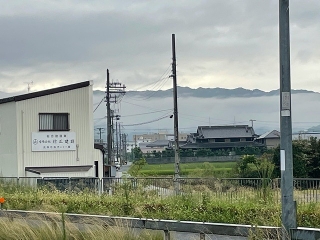
↑just after turning at Toba
The mist on the mountain
sits like the cloud layer has lowered.
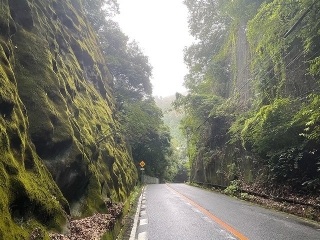
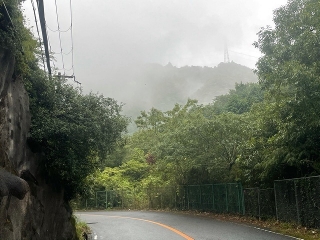
Maybe because the weather was bad,
I barely passed any cars.
With just over an hour from home, there's such a nice-atmosphere road.
Well, the time from home to here is about the same as reaching the base of the Nabeya Pass or the Ikeda Tunnel,
so it's similar.
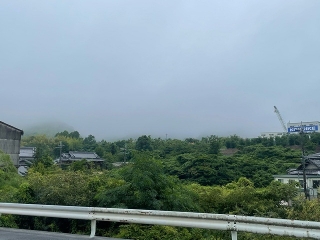
↑The mountain ridgeline was barely visible to the naked eye,
but in the image you can barely make it out.
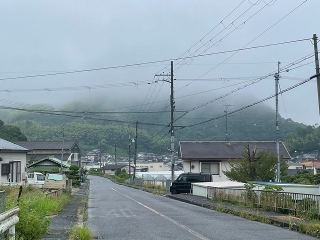
It was constant light rain and mist.
Along the way there were basically no grades clearly over 10%,
and the climbing was a repeating pattern of 10 up, 3 down,
with overall gentle climbing but also a lot of descending,
I couldn't even tell where the highest point was.
So anyway, the tire from the beginning punctured during this ride.
I felt a slow leak, so at a traffic light
when I pressed the rear tire it was estimated at just under 5 bar (originally 7 bar),
but the sealant sealed the hole, so from there for a while it
barely leaked, then if I'd kept riding
the air suddenly dropped to about 2 bar,
and I pumped it up once with an inflator to about 5 bar (probably).
After that, I didn't add any air all the way home and to the shop.
I run tubeless only on the rear wheel,
but from experience, punctures almost always happen when it's raining.
In my impression, 9 out of 10 times are in rain.
There's a possibility that "the tire actually punctured before, but the Imaje sealant sealed the hole,
and the water from rain dissolved the sealant and the wound reopened."
When the air suddenly dropped hard today, the rain was heavy
and the road was completely wet.
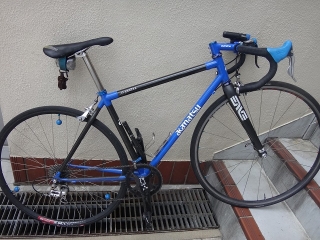
I made it to the shop.
Oh, I changed to a custom stem recently
and it's amazing.
The frame is actually off-the-shelf (not custom-ordered),
so I can't get the handlebar drop I want,
and even with a stem with negative rise, I
can't match other bikes I custom-ordered,
but it's much better.
Before this I had a
73° so-called level stem.
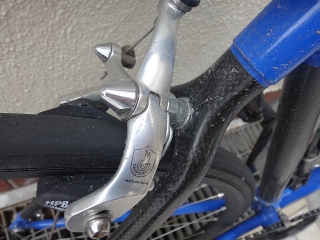
↑the characteristic dirtiness after riding in rain
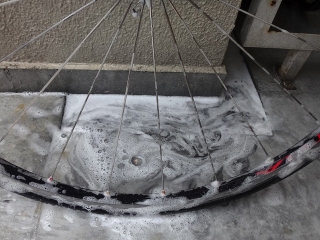
I also washed the bike while I was at it.
Since I only brake with the front,
only the front wheel gets really dirty.
It's a disc brake with a 630mm rotor gripped by rubber pads,
and I like that it doesn't have ugly features like a front wheel cup or holes drilled in the left fork blade.

I pumped up the wet rear wheel with a floor pump
and located the puncture.
I could hear air leaking.
The hole was small, the wound opened at about 6 bar.
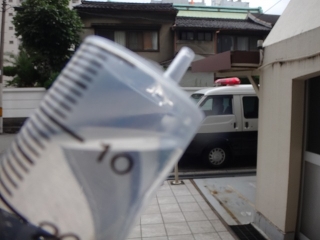
I prepared to get a shot of syringe water hitting the air from the puncture,
but the image above
probably shouldn't show off a syringe so obviously.

Whoosh!
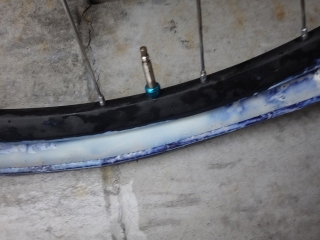
I pulled the tire halfway off the rim.
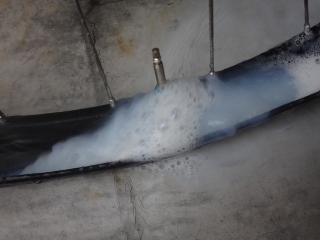
Imaje sealant can be rinsed off with water,
like I always say.
Since I'm throwing out the tire anyway,
but the rim obviously continues to be used,
so there's a point to the fact that sticky gum-like clumps
don't remain on the rim side,
or so I'd like to say, but the rim tape partially peeled when I fully removed the tire,
so the rim tape needs replacing.
Even so, there are no clumps inside the bead hook,
so there's almost no accumulation of sealant residue on the rim,
which matters for long-term use.
With DT rims, what determines the allowable air pressure is
only one thing: "the rim's inner width."
The rim's intended use doesn't matter.
If the inner width is the same, whether road or MTB,
one single sheet from the manufacturer determines
the allowable air pressure.
So my rear wheel's XR331 rim
is intended for MTB use by the manufacturer,
but has almost the same inner width as road rims,
so the sticker on the rim says
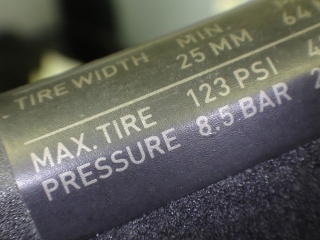
↑for tubular with 25C tire maximum 8.5 bar,
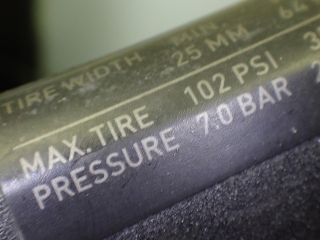
↑for tubeless it says 7 bar.
I don't make decisions like "it's an MTB rim so let's max it at 4 bar,"
so I appreciate it for that.
Actually, I operate it at exactly 7 bar.
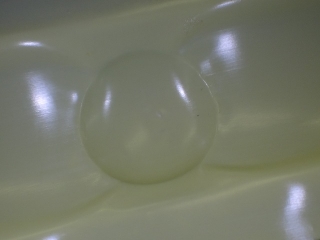
As I've written before,
the XR331 rim's rim tape depresses under air pressure,
and the outer reverse Torx shape on the ends of the Squolx nipples
specified for use with the rim will contact it.
If the rim tape is a single wrap, the tape tears,
so for XR331 rims, with Stans rim tape, a
double wrap is essential.
Even then, the tape contacts the nipple when depressed like in the image above,
but the tape doesn't tear.
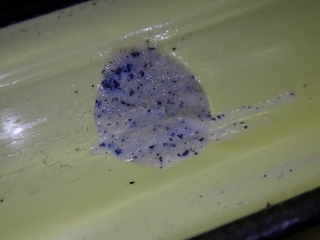
Imaje sealant sometimes enters this depression and hardens.
I've wondered if the nipple is puncturing it and the hole-sealing is working,
but this happens on about 4 rim holes continuously
and not on the others, so
the sealant might drip into the rim tape depression during a specific phase when hardening begins (maybe when facing up?)
and cause this.
It's possible that the sealant hardening begins before the rim tape depresses,
but we could also be reusing rim tape with existing depressions
while replacing the tire and sealant.
However, based on the mechanism of sealant action, if there's no hole,
it shouldn't harden.
But then I can't explain why this happens on about 4 holes continuously.
I haven't been careless enough to do a double wrap and miss wrapping 5/6 of the second round,
leaving 4H of the 24H as a single wrap.
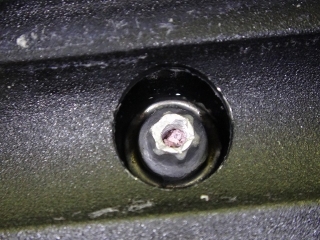
Even looking at rim holes where sealant hardened in the rim tape depression,
sealant hasn't leaked into the rim.
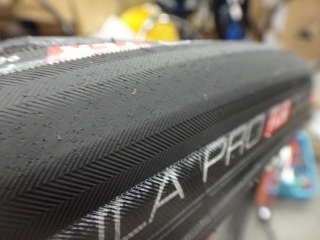
As for the tire, as I mentioned at the beginning,
I could patch the puncture from inside,
but since the tread is wearing down, I decided to replace it.
This tire is an IRC Formula Pro Tubeless Ready S-Light,
with a 23C version exclusive to S-Light.
Nominally 205g,
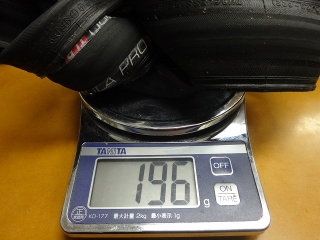
↑the old one
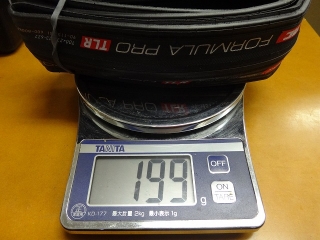
↑the new one
I happened to get two light units in a row.
Even at 205g, if I keep sealant to about 40ml,
I can keep tire plus sealant under 250g.
This is lighter than most tubular WOs,
and though a lightweight WO tire plus polyurethane tube combination can be under 250g,
a combination with a corner limit I trust more than this tire
doesn't exist, as far as I know.
Plus, if you don't want to have a bad experience with problems specific to tubeless tires
like air leakage or bead lift issues,
IRC is the only choice for tires.
I can't say that air leakage never happens or the bead always lifts smoothly,
but I've never had an extremely bad experience with it.
Plus, it's easy to mount and dismount.
This is beside the point, but regarding a certain maker's recently released
tubeless tire,
I was thinking "why does everyone buy it?
That maker has never released a decent tire, let alone one that dominates the market share,
not even once in the past"
but when I talked on the phone with a veteran in the industry recently,
I said "however you look at it, that's a terrible tire, right?",
and he said "it's definitely a shit tire, but I was surprised
that just the initial sales were so high from SNS promotion and
distribution to high amateurs."
Oh, when someone tells me to explain what a "dominant tire" is with examples,
Michelin's PRO2 Race, Schwalbe's Allrounder,
Continental's Grand Prix 4000, 4000S, and 4000S II,
and currently the Grand Prix 5000 fit that description.
Purely my opinion.
So that certain tire is often said to flat and sidecut easily,
and the weight is light but the ride is unexpectedly heavy and such,
but when inspecting a wheel and removing the tire to use a high-precision center gauge,
when I went to remount the tire on the rim,
"you don't need to put that tire back on; I'm thinking of going back to Grand Prix 5000 plus tube,"
I've been told this recently by two different customers.
Both previously had Grand Prix 5000,
and when I asked the second customer what the problem was,
they said what I mentioned earlier: "it feels light to hold but rides heavy."
The initial sales are strong but repeaters might be few.
I've only ever thought of it as a rim cement company anyway.
Even the supplied athletes aren't saying good things about it behind the scenes.

On the discarded tire, the patch I applied showed no issues.
This and the puncture location today are completely different.
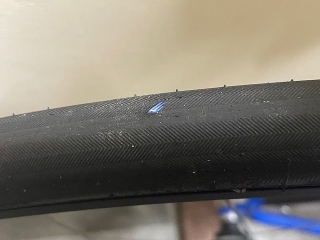
Going back in the timeline, this is the puncture from the tire at the beginning.
The image at the beginning was after riding to the shop,
but this is from when I noticed the puncture at home.
Since I was riding for a time with sealant seeping out,
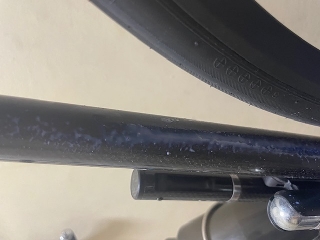
sealant had splattered on the back of the seat tube.
aaabbbaabaaabbaaabaaaa
If you leave this, cleaning becomes a real pain,
so I strongly recommend washing it as soon as you notice it.
before that.

On the third day after mounting the wheel,
the IRC tubeless tire got a puncture.
The image data is from July 8th, so I installed it on July 6th.
The tire's center line is still visible
and the tread hasn't worn at all.

Sealant was seeping out from the hole.
I noticed this at home,
the air pressure was so low it could've caused rim strikes on bumps
but pumping air carelessly would open the wound further and cause trouble,
so I just rode gently to my commute like that.

As I added air, just before reaching 4 bar,
the wound opened up and air started leaking dramatically.

↑This is what it looked like when I sprayed water on it


Water got on my camera lens.
After pumping so much air that the wound opened,
I lost even the pressure it was holding,
the bead seal released,
and sealant started seeping from between the rim and tire.
This is scary, so at the shop when the sealant is doing its job
on a tire experiencing a slow leak,
I can't pump it up to my normal operating pressure.

I removed the tire and rinsed off the sealant.
In the center of the image is the puncture hole.

↑There it is


I applied an ultra-thin patch from the inside.
After that, there hasn't been any air leakage from that spot,
nor any significant air leakage as a tubeless tire.

Changing the subject, south of Izumi-Otsu on Route 26,
there's an automobile-only elevated highway of almost identical shape
running north-south,
and at the surface road intersections I usually hit traffic lights.

From north to south, the intersection names are
Anada, Nakaichō,
Prefectural Izumi High School East, Toba,
and Kamikawaya.
There are no elevated highways of this shape south of here.
Anada and Nakaichō are close together,
but between Anada, Prefectural, Toba, and Kamikawaya
I don't know the distances, but timewise it's about 10-15 minutes,
and almost certainly I'll hit red lights,
giving me the sensation of train stations.

The old Route 26 south of Ōhama intersection in Sakai
is now Prefectural Road 204, running almost parallel to Route 26.
The major intersections on Route 26 are usually connected to Road 204 by east-west roads
in a ladder pattern,
and the intersection on Road 204 connected to Prefectural Izumi High School is Sakaimachi,
and from the lack of traffic signals and the width and condition of the road,
when I go back and forth between Road 204 and Route 26,
I often pass through the Sakaimachi-Prefectural section.
On my commute home when I want to cover distance with almost no elevation gain
and take a longer route,
I turn at Sakaimachi from Road 204,
turn again at Prefectural, and head home by this route,
often riding it late at night.

At Kamikawaya I turn left onto Route 170 (outer ring),
and at the Kumatori intersection right after,
if I turn right, there's a pass with Inunaki hot spring and Jintsū hot spring.
It's sometimes called Inunaki Pass, but that's not an official name.
The highest elevation is basically at the Ikeda Tunnel,
and after passing through it you're in Wakayama Prefecture, but the prefectural border
is actually about 2 km before the tunnel.
This is a pass I climb often,

July 20th (Wed) around 11 PM

July 27th (Wed) around 11 AM
At this time it was drizzling on the Osaka side
and the road was wet,
but it seemed to be raining harder on the Wakayama side, with oncoming traffic wet from rain,
and the tunnel exit from the Wakayama side
had a wetter road, so I didn't descend to the other side and returned.

August 11th (Thu) around 12:30 AM
More so a matter of the date changing while I was riding than actually Thursday,
I left home Wednesday.
This time I entered Wakayama Prefecture from the Fukibuki Pass
and returned to Osaka from the Ikeda Tunnel. The image above is from the Wakayama side.

Heading east from the Prefectural intersection,
I cross the outer ring at the Habutaki intersection.
Turning left here, in about 15 minutes I reach the base of the Nabeya Pass,
and I can also return to Sakai through the Izumi-North area.
I sometimes make this the Habutaki route for what I call night practice, my long way home.
This is the map in my head, but

Today I rode from Toba toward the outer ring.
Only the Toba elevated section doesn't go directly over the intersection,
so from the north it's a left turn before the overpass.
I knew this road passes by the Mizuma athletic field
and connects to places like Katsuragi Mountain,
but I just followed the road
(there's a spot to turn left because the front is a highway entrance,
and a spot to turn left toward Kishiwada because turning right goes to Katsuragi Mountain)

and discovered today for the first time that it comes out at Habutaki!
When I looked at the red line section in the image above
on POLAR's analysis software map,

↑this is it.
The black line section is Route 26 on the way there,
and on the way back I turn at Prefectural and take Road 204 from Sakaimachi.

↑just after turning at Toba
The mist on the mountain
sits like the cloud layer has lowered.


Maybe because the weather was bad,
I barely passed any cars.
With just over an hour from home, there's such a nice-atmosphere road.
Well, the time from home to here is about the same as reaching the base of the Nabeya Pass or the Ikeda Tunnel,
so it's similar.

↑The mountain ridgeline was barely visible to the naked eye,
but in the image you can barely make it out.

It was constant light rain and mist.
Along the way there were basically no grades clearly over 10%,
and the climbing was a repeating pattern of 10 up, 3 down,
with overall gentle climbing but also a lot of descending,
I couldn't even tell where the highest point was.
So anyway, the tire from the beginning punctured during this ride.
I felt a slow leak, so at a traffic light
when I pressed the rear tire it was estimated at just under 5 bar (originally 7 bar),
but the sealant sealed the hole, so from there for a while it
barely leaked, then if I'd kept riding
the air suddenly dropped to about 2 bar,
and I pumped it up once with an inflator to about 5 bar (probably).
After that, I didn't add any air all the way home and to the shop.
I run tubeless only on the rear wheel,
but from experience, punctures almost always happen when it's raining.
In my impression, 9 out of 10 times are in rain.
There's a possibility that "the tire actually punctured before, but the Imaje sealant sealed the hole,
and the water from rain dissolved the sealant and the wound reopened."
When the air suddenly dropped hard today, the rain was heavy
and the road was completely wet.

I made it to the shop.
Oh, I changed to a custom stem recently
and it's amazing.
The frame is actually off-the-shelf (not custom-ordered),
so I can't get the handlebar drop I want,
and even with a stem with negative rise, I
can't match other bikes I custom-ordered,
but it's much better.
Before this I had a
73° so-called level stem.

↑the characteristic dirtiness after riding in rain

I also washed the bike while I was at it.
Since I only brake with the front,
only the front wheel gets really dirty.
It's a disc brake with a 630mm rotor gripped by rubber pads,
and I like that it doesn't have ugly features like a front wheel cup or holes drilled in the left fork blade.

I pumped up the wet rear wheel with a floor pump
and located the puncture.
I could hear air leaking.
The hole was small, the wound opened at about 6 bar.

I prepared to get a shot of syringe water hitting the air from the puncture,
but the image above
probably shouldn't show off a syringe so obviously.

Whoosh!

I pulled the tire halfway off the rim.

Imaje sealant can be rinsed off with water,
like I always say.
Since I'm throwing out the tire anyway,
but the rim obviously continues to be used,
so there's a point to the fact that sticky gum-like clumps
don't remain on the rim side,
or so I'd like to say, but the rim tape partially peeled when I fully removed the tire,
so the rim tape needs replacing.
Even so, there are no clumps inside the bead hook,
so there's almost no accumulation of sealant residue on the rim,
which matters for long-term use.
With DT rims, what determines the allowable air pressure is
only one thing: "the rim's inner width."
The rim's intended use doesn't matter.
If the inner width is the same, whether road or MTB,
one single sheet from the manufacturer determines
the allowable air pressure.
So my rear wheel's XR331 rim
is intended for MTB use by the manufacturer,
but has almost the same inner width as road rims,
so the sticker on the rim says

↑for tubular with 25C tire maximum 8.5 bar,

↑for tubeless it says 7 bar.
I don't make decisions like "it's an MTB rim so let's max it at 4 bar,"
so I appreciate it for that.
Actually, I operate it at exactly 7 bar.

As I've written before,
the XR331 rim's rim tape depresses under air pressure,
and the outer reverse Torx shape on the ends of the Squolx nipples
specified for use with the rim will contact it.
If the rim tape is a single wrap, the tape tears,
so for XR331 rims, with Stans rim tape, a
double wrap is essential.
Even then, the tape contacts the nipple when depressed like in the image above,
but the tape doesn't tear.

Imaje sealant sometimes enters this depression and hardens.
I've wondered if the nipple is puncturing it and the hole-sealing is working,
but this happens on about 4 rim holes continuously
and not on the others, so
the sealant might drip into the rim tape depression during a specific phase when hardening begins (maybe when facing up?)
and cause this.
It's possible that the sealant hardening begins before the rim tape depresses,
but we could also be reusing rim tape with existing depressions
while replacing the tire and sealant.
However, based on the mechanism of sealant action, if there's no hole,
it shouldn't harden.
But then I can't explain why this happens on about 4 holes continuously.
I haven't been careless enough to do a double wrap and miss wrapping 5/6 of the second round,
leaving 4H of the 24H as a single wrap.

Even looking at rim holes where sealant hardened in the rim tape depression,
sealant hasn't leaked into the rim.

As for the tire, as I mentioned at the beginning,
I could patch the puncture from inside,
but since the tread is wearing down, I decided to replace it.
This tire is an IRC Formula Pro Tubeless Ready S-Light,
with a 23C version exclusive to S-Light.
Nominally 205g,

↑the old one

↑the new one
I happened to get two light units in a row.
Even at 205g, if I keep sealant to about 40ml,
I can keep tire plus sealant under 250g.
This is lighter than most tubular WOs,
and though a lightweight WO tire plus polyurethane tube combination can be under 250g,
a combination with a corner limit I trust more than this tire
doesn't exist, as far as I know.
Plus, if you don't want to have a bad experience with problems specific to tubeless tires
like air leakage or bead lift issues,
IRC is the only choice for tires.
I can't say that air leakage never happens or the bead always lifts smoothly,
but I've never had an extremely bad experience with it.
Plus, it's easy to mount and dismount.
This is beside the point, but regarding a certain maker's recently released
tubeless tire,
I was thinking "why does everyone buy it?
That maker has never released a decent tire, let alone one that dominates the market share,
not even once in the past"
but when I talked on the phone with a veteran in the industry recently,
I said "however you look at it, that's a terrible tire, right?",
and he said "it's definitely a shit tire, but I was surprised
that just the initial sales were so high from SNS promotion and
distribution to high amateurs."
Oh, when someone tells me to explain what a "dominant tire" is with examples,
Michelin's PRO2 Race, Schwalbe's Allrounder,
Continental's Grand Prix 4000, 4000S, and 4000S II,
and currently the Grand Prix 5000 fit that description.
Purely my opinion.
So that certain tire is often said to flat and sidecut easily,
and the weight is light but the ride is unexpectedly heavy and such,
but when inspecting a wheel and removing the tire to use a high-precision center gauge,
when I went to remount the tire on the rim,
"you don't need to put that tire back on; I'm thinking of going back to Grand Prix 5000 plus tube,"
I've been told this recently by two different customers.
Both previously had Grand Prix 5000,
and when I asked the second customer what the problem was,
they said what I mentioned earlier: "it feels light to hold but rides heavy."
The initial sales are strong but repeaters might be few.
I've only ever thought of it as a rim cement company anyway.
Even the supplied athletes aren't saying good things about it behind the scenes.

On the discarded tire, the patch I applied showed no issues.
This and the puncture location today are completely different.

Going back in the timeline, this is the puncture from the tire at the beginning.
The image at the beginning was after riding to the shop,
but this is from when I noticed the puncture at home.
Since I was riding for a time with sealant seeping out,

sealant had splattered on the back of the seat tube.
aaabbbaabaaabbaaabaaaa
If you leave this, cleaning becomes a real pain,
so I strongly recommend washing it as soon as you notice it.
Products Mentioned in This Article
* Amazon affiliate links — prices may vary
Original Japanese post: のむラボ日記 #6357