A customer brought me a rear wheel built with an ENVE 25 rim.
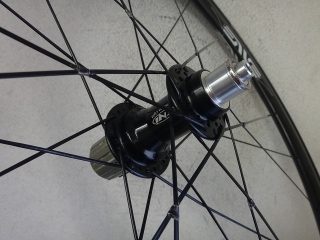
Evolight hub, 24H, black, half-comp, 46-spoke lacing with spoke nipple tension connections.
I built this one back in the day,
but the customer is the second owner.
When they took it to their regular shop,
they were told the freewheel body had corroded and wasn't spinning,
so it needed to be replaced,
and that even though the wheel had only slight runout,
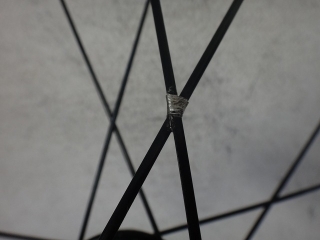
a tensioned wheel can't be trued without releasing the spoke nipple tension—
so they brought it to me.
"A tensioned wheel can't be trued"—
that's the standard excuse of shops with zero skill and knowledge.
I mean, they've probably never even done spoke nipple tensioning.
This time I got the name of the shop that spouted this nonsense out of the customer,
on the condition I wouldn't publish it here,
but it turns out this is the same place that butchered a wheel I'd built before
with their amateur "truing" attempts, and I ended up having to fix it.
All talk, no substance—that place is a joke.
Next time, just say it straight: "We don't have the skill to true wheels, so we can't do it"
or "We're intimidated by the Nomu Lab, so we can't do it."
Be honest, you hacks.
If anything, I could have used desoldering braid to cleanly remove the solder from the spoke nipple connections—something I normally say is "practically impossible"—unwound the steel wires, and told them: "The tension is released, so go ahead and true it. The Nomu Lab will cover the cost, and we'll check your work afterward, so do it right."
But I doubt they'd have the guts to touch it.
I actually considered doing exactly that,
but that would've put extra burden on the customer with having to transport the wheel back and forth,
so I went ahead and trued it right there.
This doesn't prove whether "that certain hack shop" can properly true a non-tensioned wheel,
but it does prove
that "truing a tensioned wheel is possible."
And like I always say anyway,
if a rim replacement is possible, then truing—which is a simpler job than that—has no reason to be impossible.
The diagnosis about needing a freewheel body replacement or freewheel bearing replacement was also wrong.
When the quick-release is tightened and the freewheel body locks up like a fixed gear,
it's because "the seal ring stayed on the hub body after the old freewheel was removed,
and then a new freewheel body—which also came with its own seal ring—was installed on top,
creating a double seal."
I predicted this before removing the freewheel body, and removed it in front of the customer
so they could see the two seal rings stacked together.
The customer said they'd never replaced the freewheel body,
so the original owner must have done it.
Also, if that certain hack shop had done the freewheel replacement,
fixing this would've been impossible.
We've bought up all the freewheel bodies of this type.
I did true the wheel, but it wasn't badly out of true.
There was just slight lateral runout in a couple of spots.
Since it's a tubular rim with internal nipples,
it's the kind of thing you could just fix while changing the tire,
and if this were my own bike, I'd honestly just ride it as-is—
the runout was that minor. But since the customer went to the trouble of bringing it in,
I trued it.
I didn't replace the freewheel body or its bearings,
but the bearing on the left side of the hub body
was a bit gritty when spinning, so I replaced that.
This isn't something I've written down anywhere,
but wheels I build are free to true, even for second owners
(though if you ship it, shipping costs are your responsibility).
So this time, the only cost was the bearing itself.

Evolight hub, 24H, black, half-comp, 46-spoke lacing with spoke nipple tension connections.
I built this one back in the day,
but the customer is the second owner.
When they took it to their regular shop,
they were told the freewheel body had corroded and wasn't spinning,
so it needed to be replaced,
and that even though the wheel had only slight runout,
a tensioned wheel can't be trued without releasing the spoke nipple tension—
so they brought it to me.

"A tensioned wheel can't be trued"—
that's the standard excuse of shops with zero skill and knowledge.
I mean, they've probably never even done spoke nipple tensioning.
This time I got the name of the shop that spouted this nonsense out of the customer,
on the condition I wouldn't publish it here,
but it turns out this is the same place that butchered a wheel I'd built before
with their amateur "truing" attempts, and I ended up having to fix it.
All talk, no substance—that place is a joke.
Next time, just say it straight: "We don't have the skill to true wheels, so we can't do it"
or "We're intimidated by the Nomu Lab, so we can't do it."
Be honest, you hacks.
If anything, I could have used desoldering braid to cleanly remove the solder from the spoke nipple connections—something I normally say is "practically impossible"—unwound the steel wires, and told them: "The tension is released, so go ahead and true it. The Nomu Lab will cover the cost, and we'll check your work afterward, so do it right."
But I doubt they'd have the guts to touch it.
I actually considered doing exactly that,
but that would've put extra burden on the customer with having to transport the wheel back and forth,
so I went ahead and trued it right there.
This doesn't prove whether "that certain hack shop" can properly true a non-tensioned wheel,
but it does prove
that "truing a tensioned wheel is possible."
And like I always say anyway,
if a rim replacement is possible, then truing—which is a simpler job than that—has no reason to be impossible.
The diagnosis about needing a freewheel body replacement or freewheel bearing replacement was also wrong.
When the quick-release is tightened and the freewheel body locks up like a fixed gear,
it's because "the seal ring stayed on the hub body after the old freewheel was removed,
and then a new freewheel body—which also came with its own seal ring—was installed on top,
creating a double seal."
I predicted this before removing the freewheel body, and removed it in front of the customer
so they could see the two seal rings stacked together.
The customer said they'd never replaced the freewheel body,
so the original owner must have done it.
fixing this would've been impossible.
We've bought up all the freewheel bodies of this type.
I did true the wheel, but it wasn't badly out of true.
There was just slight lateral runout in a couple of spots.
Since it's a tubular rim with internal nipples,
it's the kind of thing you could just fix while changing the tire,
and if this were my own bike, I'd honestly just ride it as-is—
the runout was that minor. But since the customer went to the trouble of bringing it in,
I trued it.
I didn't replace the freewheel body or its bearings,
but the bearing on the left side of the hub body
was a bit gritty when spinning, so I replaced that.
This isn't something I've written down anywhere,
but wheels I build are free to true, even for second owners
(though if you ship it, shipping costs are your responsibility).
So this time, the only cost was the bearing itself.