Another wheel day (etc.).
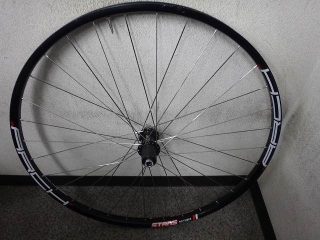
Continuing from yesterday. I'm rebuilding the rear wheel
on this Stans arch rim with a
BOOST hub.
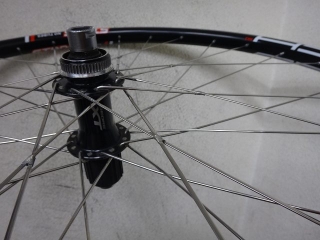
The original setup was FH-M8010 32H
with semi-comp 46-spoke JIS lacing and nipple wrapping.
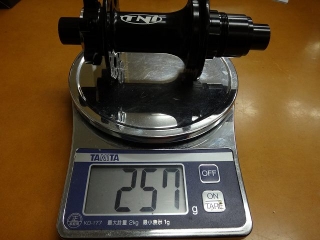
The BOOST hub I'm using for the rebuild is
the same REVO MTB hub as the front wheel.
Unlike the Evo disc hub, it doesn't have
inverted high-low flanges—
both flanges are the same diameter.

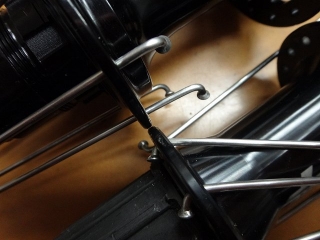
Just like the front wheel, the comp spokes on the unwrapped side—
the freehub side—get cut and reused.
I pulled the inpokes from the XT hub,
cut them, and then transferred them to the
REVO MTB hub. That's what you see in the image above.
When I line up the freehub-side flanges,
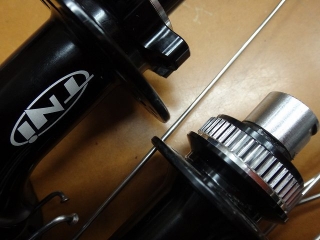
the non-freehub side flange is this much different.
Since I'm comparing a non-BOOST hub to a BOOST hub,
it's what you'd expect, but
I was worried it might turn out to be something like
"the REVO MTB is wider, but the flange thickness
only differs by about one layer."
I could've just gone with the same XT BOOST hub
with a "–B" suffix added to the model number if I just wanted BOOST conversion.
The rotor interface standard didn't change either—
it's centerlock both before and after the rebuild. That's what people would say, but

the customer also wanted to switch to a
SRAM XD freehub body as part of the BOOST conversion,
so I went with this hub.
This hub's manufacturer didn't initially receive
a license from Shimano to produce
microspline freehub bodies
(this was a terrible strategic move, and as a result
it accelerated the shift to SRAM among racing enthusiasts)
so the REVO MTB rear hub comes in two versions:
one with a Shimano HG 11-speed freehub body
and one with a SRAM XD 12-speed freehub body.
When I say "Shimano 11-speed" here, I don't mean
an "11-speed freehub body with the same width as a 10-speed"
(which only applies to the 11–34T variants in both MTB and road).
Rather, it's the same freehub body as road REVO hubs and such,
so it's an "11-speed freehub body that accepts road 11-speed sprockets."
As for the SRAM version, the distributor's site lists it as
"SRAM XD 12-speed," but when I saw the actual unit, it was XDR.
If you want to use XD, you need an 1.85mm spacer,
but it doesn't come with the rear hub.
The spline geometry on the back of the XDR
matches Shimano's HG freehub body—apparently out of respect for the pioneers—
so you can also use the so-called 11-speed to 8/9/10-speed conversion
1.85mm spacer made by Shimano OEM or aftermarket suppliers.
There are two types of freehub bodies for this rear hub,
and they're not compatible with each other, as announced beforehand.
For example, if you have a REVO MTB hub for Shimano 11-speed,
you cannot later convert it to XDR 12-speed
by swapping out the freehub body.
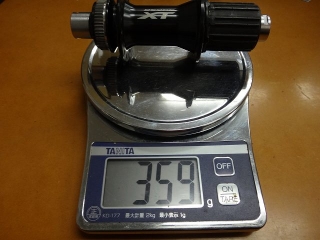
By the way, the weight of the original rear hub.
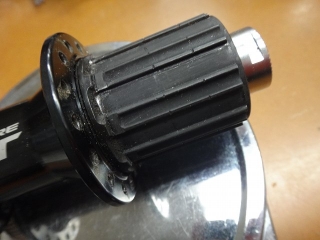
Shimano's traditional-style freehub body
for cassette sprockets is essentially an expansion of
the left-right bearing spacing from the boss freewheel hubs
that used to be the universal standard.
So the bearings actually supporting the hub load
are only at the left end of the hub body and the right end of the freehub body
(there are tiny ball bearings inside the freehub body,
but they're minimal).
This means that with this style of rear hub,
if you remove the freehub body,
the wheel can no longer rotate as a wheel.
For example, whether you'd actually do it or not,
if you were descending a pass
where you don't need to pedal and can coast down using only steering and brakes—
with a Fulcrum rear wheel, you could remove the freehub body
and mount it to the frame and ride.
But with a Shimano traditional-style freehub-body rear wheel, that's impossible.
And because of this structure, the spline section
of this style of freehub body cannot be made from aluminum.
That's why Dura-Ace and XTR hubs or wheels use titanium.
Someone might say, "But 7800-era Dura-Ace had an aluminum freehub body!"
You're right about that—but that rear hub alone,
for some reason, doesn't use Shimano's traditional freehub-body design.
Instead, it uses three claw pawls with coil springs,
plus bearings on the left and right of the hub body,
and two cartridge bearings in the freehub body as well.
While there's no dimensional compatibility, the structure is the same as Campagnolo and others.
So the WH-7800 and 7801 rear wheels
can actually be ridden downhill in that freewheel-body-removed situation I described earlier.
For more on 7800 and 7801, check (→here), (→here), and (→here).
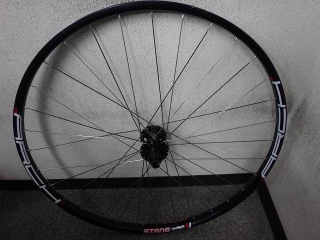
It's built.
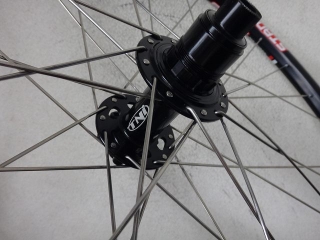
REVO MTB hub, 32H, semi-comp 46-spoke JIS lacing.
I'll do the nipple wrapping later.
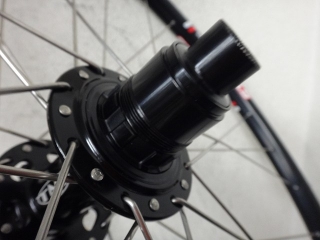
I haven't disassembled it, but this freehub body apparently has
72 notches per ratchet rotation.
More notches naturally means each tooth gets lower,
and I wonder if that's related, but the mechanical drag during freewheeling
is remarkably minimal.
To put it another way, the resistance when hand-turning the freehub body backward
is very light.
If you put the wheel on a truing stand, and with no load other than the wheel's own weight,
you spin the rear wheel and measure the time from a certain rotation speed
until it stops—using methods like ceramic bearing balls can give you longer coasting times—
but if you add the condition of "hand-holding the freehub body in constant freewheeling"
to that test, the ratchet drag should drastically reduce the spin time.
Among all this, this rear hub has
such minimal mechanical drag during freewheeling that
depending on whether you hand-hold the freehub body or not,
test results could flip compared to a comparison wheel.
That oddly smooth, light feel of this freehub body—you'll probably feel it in actual riding.

Continuing from yesterday. I'm rebuilding the rear wheel
on this Stans arch rim with a
BOOST hub.

The original setup was FH-M8010 32H
with semi-comp 46-spoke JIS lacing and nipple wrapping.

The BOOST hub I'm using for the rebuild is
the same REVO MTB hub as the front wheel.
Unlike the Evo disc hub, it doesn't have
inverted high-low flanges—
both flanges are the same diameter.

Just like the front wheel, the comp spokes on the unwrapped side—
the freehub side—get cut and reused.
I pulled the inpokes from the XT hub,
cut them, and then transferred them to the
REVO MTB hub. That's what you see in the image above.

When I line up the freehub-side flanges,

the non-freehub side flange is this much different.
Since I'm comparing a non-BOOST hub to a BOOST hub,
it's what you'd expect, but
I was worried it might turn out to be something like
"the REVO MTB is wider, but the flange thickness
only differs by about one layer."
I could've just gone with the same XT BOOST hub
with a "–B" suffix added to the model number if I just wanted BOOST conversion.
The rotor interface standard didn't change either—
it's centerlock both before and after the rebuild. That's what people would say, but

the customer also wanted to switch to a
SRAM XD freehub body as part of the BOOST conversion,
so I went with this hub.
This hub's manufacturer didn't initially receive
a license from Shimano to produce
microspline freehub bodies
it accelerated the shift to SRAM among racing enthusiasts)
so the REVO MTB rear hub comes in two versions:
one with a Shimano HG 11-speed freehub body
and one with a SRAM XD 12-speed freehub body.
When I say "Shimano 11-speed" here, I don't mean
an "11-speed freehub body with the same width as a 10-speed"
(which only applies to the 11–34T variants in both MTB and road).
Rather, it's the same freehub body as road REVO hubs and such,
so it's an "11-speed freehub body that accepts road 11-speed sprockets."
As for the SRAM version, the distributor's site lists it as
"SRAM XD 12-speed," but when I saw the actual unit, it was XDR.
If you want to use XD, you need an 1.85mm spacer,
but it doesn't come with the rear hub.
The spline geometry on the back of the XDR
matches Shimano's HG freehub body—apparently out of respect for the pioneers—
so you can also use the so-called 11-speed to 8/9/10-speed conversion
1.85mm spacer made by Shimano OEM or aftermarket suppliers.
There are two types of freehub bodies for this rear hub,
and they're not compatible with each other, as announced beforehand.
For example, if you have a REVO MTB hub for Shimano 11-speed,
you cannot later convert it to XDR 12-speed
by swapping out the freehub body.

By the way, the weight of the original rear hub.

Shimano's traditional-style freehub body
for cassette sprockets is essentially an expansion of
the left-right bearing spacing from the boss freewheel hubs
that used to be the universal standard.
So the bearings actually supporting the hub load
are only at the left end of the hub body and the right end of the freehub body
(there are tiny ball bearings inside the freehub body,
but they're minimal).
This means that with this style of rear hub,
if you remove the freehub body,
the wheel can no longer rotate as a wheel.
For example, whether you'd actually do it or not,
if you were descending a pass
where you don't need to pedal and can coast down using only steering and brakes—
with a Fulcrum rear wheel, you could remove the freehub body
and mount it to the frame and ride.
But with a Shimano traditional-style freehub-body rear wheel, that's impossible.
And because of this structure, the spline section
of this style of freehub body cannot be made from aluminum.
That's why Dura-Ace and XTR hubs or wheels use titanium.
Someone might say, "But 7800-era Dura-Ace had an aluminum freehub body!"
You're right about that—but that rear hub alone,
for some reason, doesn't use Shimano's traditional freehub-body design.
Instead, it uses three claw pawls with coil springs,
plus bearings on the left and right of the hub body,
and two cartridge bearings in the freehub body as well.
While there's no dimensional compatibility, the structure is the same as Campagnolo and others.
So the WH-7800 and 7801 rear wheels
can actually be ridden downhill in that freewheel-body-removed situation I described earlier.
For more on 7800 and 7801, check (→here), (→here), and (→here).

It's built.

REVO MTB hub, 32H, semi-comp 46-spoke JIS lacing.
I'll do the nipple wrapping later.

I haven't disassembled it, but this freehub body apparently has
72 notches per ratchet rotation.
More notches naturally means each tooth gets lower,
and I wonder if that's related, but the mechanical drag during freewheeling
is remarkably minimal.
To put it another way, the resistance when hand-turning the freehub body backward
is very light.
If you put the wheel on a truing stand, and with no load other than the wheel's own weight,
you spin the rear wheel and measure the time from a certain rotation speed
until it stops—using methods like ceramic bearing balls can give you longer coasting times—
but if you add the condition of "hand-holding the freehub body in constant freewheeling"
to that test, the ratchet drag should drastically reduce the spin time.
Among all this, this rear hub has
such minimal mechanical drag during freewheeling that
depending on whether you hand-hold the freehub body or not,
test results could flip compared to a comparison wheel.
That oddly smooth, light feel of this freehub body—you'll probably feel it in actual riding.