Another day of wheel building (abbreviation follows).
But before that.
A customer brought in a super-lightweight carbon rigid MTB frame from a certain brand
(well, what's left of one) some time ago.
When I looked at it, only the rear triangle remained.
From the rear triangle, the top tube and down tube were sticking out
with explosive fractured cross-sections,
and touching the fracture felt like I'd get cut by carbon splinters.
It didn't happen while riding—
the frame was on a car roof rack,
and they made an unexpected drive-through stop
and hit a low ceiling with a big CRUNCH.
The request for "just" the frame itself was
to recover the press-fit BB components from the rear triangle,
but there was a related issue:
"Lately, even XC frames have BOOST standard as the complete mainstream,
and this broken frame was the last non-BOOST frame they owned.
So I'd like the front and rear wheels that were on this to be rebuilt
with BOOST hubs."
So I was asked to rebuild wheels.
Another day of wheel building (abbreviation follows).
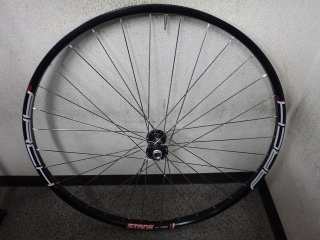
This is the front wheel of the pair.
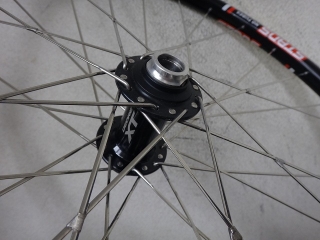
HB-M8010 32H all CX-RAY
64 spoke reverse Italian laced with rim tape,
built by me back then.
BOOST standard has overlock nut dimensions that are 10mm wider in front
and 6mm wider in rear compared to the previous thru-axle standard,
but hubs like those with interchangeable end pieces
don't actually change the flange width of the hub body itself
so I think, "That wheel structure-wise probably doesn't change performance much."
In the case of Shimano hubs, BOOST hubs are purpose-designed
and are a different hub body with wider flanges
than non-BOOST hubs.
On front hubs, this reflects the full 10mm difference
directly in flange width.
By spec, current XTRM and XT are both 60.2mm → 70.2mm.
Rear hubs reflect the 6mm difference... or rather,
XTRM achieves +7.17mm and XT achieves +6.99mm (→here)
and somehow they've managed to widen the flange width by about 7mm.
This might be related to the freebody being Micro Spline.
On the other hand, as I wrote in the linked article,
converting non-BOOST Shimano hubs to BOOST via parts replacement
isn't possible,
so there's no flexibility in that regard.
So this front wheel also required hub replacement—
in other words, complete wheel rebuilding.
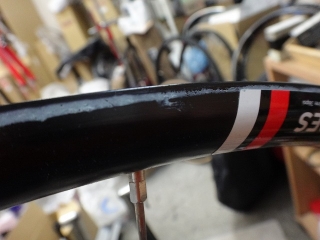
Oh nooooooooo
Something seems to have splattered on the rim
and it's all whitened uuuuuugh!!
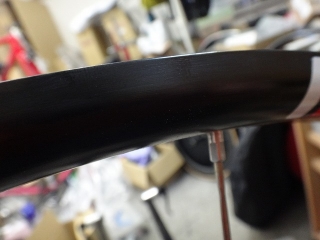
Oh, it was just sealant that leaked out when the tire bead seated
and hardened,
so it came right off with some rubbing between my fingers.
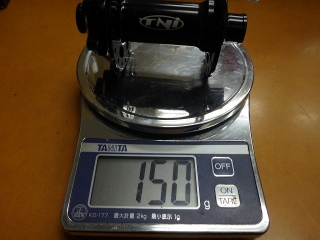
The hub will be a Tni REVO MTB hub.
Confusingly, this is a different thing from the Evo Disc hub.
The Evo Disc hub comes stock in 100mm and 135mm quick-release versions,
and via parts replacement, the front can be converted to either 100×12mm or 100×15mm,
and the rear to 142×12mm thru-axle.
Current models are technically Evo Disc Hub II,
and the shape of the front hub thru-axle adapter is different,
so heads up.
And Evo Disc hubs can't be converted to BOOST.
In contrast, the REVO MTB hub is BOOST standard only, both front and rear
(for the record: front is 110×15mm, rear is 148×12mm),
and comes only in 32H configuration.
Recent lightweight XC rims (especially carbon rims)
are often 28H,
but in this case the wheels being rebuilt are 32H,
so that worked out perfectly.
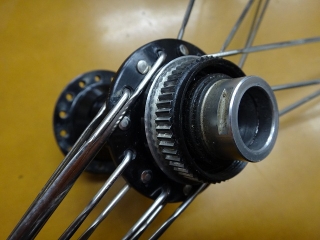
I disassembled the wheel.
The six-spoke laced side I removed the tension from and cut up for disposal,
but the four-spoke unlaced side I could reuse if I shortened the spokes slightly,
so I took it apart carefully.
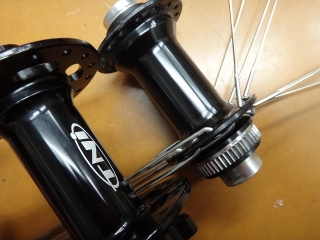
As for the hub flange width,
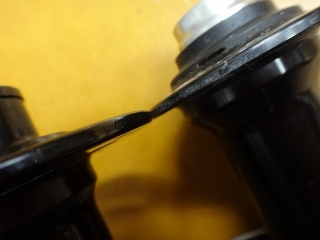
aligning this side,
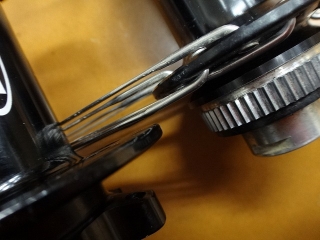
the REVO MTB is clearly wider,
so it does appear to be BOOST-specific design.
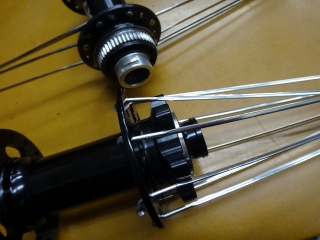
I pulled out only the inpokes from the old hub,
cut them to length, and threaded them through as inpokes for the new hub.
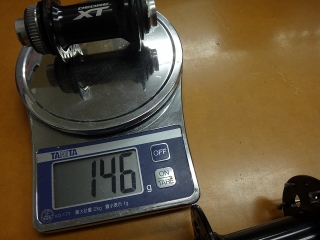
The XT hub was lighter than I expected.
It's hard to make cup-and-cone hubs light,
but I guess it's because they've thinned the hub body
and the rotor mounting is centerlock.

Built.
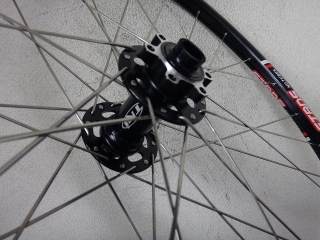
REVO MTB 32H (only that configuration available)
64 spoke reverse Italian laced.
I'll do the rim tape later.
But before that.
A customer brought in a super-lightweight carbon rigid MTB frame from a certain brand
(well, what's left of one) some time ago.
When I looked at it, only the rear triangle remained.
From the rear triangle, the top tube and down tube were sticking out
with explosive fractured cross-sections,
and touching the fracture felt like I'd get cut by carbon splinters.
It didn't happen while riding—
the frame was on a car roof rack,
and they made an unexpected drive-through stop
and hit a low ceiling with a big CRUNCH.
The request for "just" the frame itself was
to recover the press-fit BB components from the rear triangle,
but there was a related issue:
"Lately, even XC frames have BOOST standard as the complete mainstream,
and this broken frame was the last non-BOOST frame they owned.
So I'd like the front and rear wheels that were on this to be rebuilt
with BOOST hubs."
So I was asked to rebuild wheels.
Another day of wheel building (abbreviation follows).

This is the front wheel of the pair.

HB-M8010 32H all CX-RAY
64 spoke reverse Italian laced with rim tape,
built by me back then.
BOOST standard has overlock nut dimensions that are 10mm wider in front
and 6mm wider in rear compared to the previous thru-axle standard,
but hubs like those with interchangeable end pieces
don't actually change the flange width of the hub body itself
so I think, "That wheel structure-wise probably doesn't change performance much."
In the case of Shimano hubs, BOOST hubs are purpose-designed
and are a different hub body with wider flanges
than non-BOOST hubs.
On front hubs, this reflects the full 10mm difference
directly in flange width.
By spec, current XTRM and XT are both 60.2mm → 70.2mm.
Rear hubs reflect the 6mm difference... or rather,
XTRM achieves +7.17mm and XT achieves +6.99mm (→here)
and somehow they've managed to widen the flange width by about 7mm.
This might be related to the freebody being Micro Spline.
On the other hand, as I wrote in the linked article,
converting non-BOOST Shimano hubs to BOOST via parts replacement
isn't possible,
so there's no flexibility in that regard.
So this front wheel also required hub replacement—
in other words, complete wheel rebuilding.

Oh nooooooooo
Something seems to have splattered on the rim
and it's all whitened uuuuuugh!!

Oh, it was just sealant that leaked out when the tire bead seated
and hardened,
so it came right off with some rubbing between my fingers.

The hub will be a Tni REVO MTB hub.
Confusingly, this is a different thing from the Evo Disc hub.
The Evo Disc hub comes stock in 100mm and 135mm quick-release versions,
and via parts replacement, the front can be converted to either 100×12mm or 100×15mm,
and the rear to 142×12mm thru-axle.
Current models are technically Evo Disc Hub II,
and the shape of the front hub thru-axle adapter is different,
so heads up.
And Evo Disc hubs can't be converted to BOOST.
In contrast, the REVO MTB hub is BOOST standard only, both front and rear
(for the record: front is 110×15mm, rear is 148×12mm),
and comes only in 32H configuration.
Recent lightweight XC rims (especially carbon rims)
are often 28H,
but in this case the wheels being rebuilt are 32H,
so that worked out perfectly.

I disassembled the wheel.
The six-spoke laced side I removed the tension from and cut up for disposal,
but the four-spoke unlaced side I could reuse if I shortened the spokes slightly,
so I took it apart carefully.

As for the hub flange width,

aligning this side,

the REVO MTB is clearly wider,
so it does appear to be BOOST-specific design.

I pulled out only the inpokes from the old hub,
cut them to length, and threaded them through as inpokes for the new hub.

The XT hub was lighter than I expected.
It's hard to make cup-and-cone hubs light,
but I guess it's because they've thinned the hub body
and the rotor mounting is centerlock.

Built.

REVO MTB 32H (only that configuration available)
64 spoke reverse Italian laced.
I'll do the rim tape later.