I inspected a Bora Ultra WTO 45.
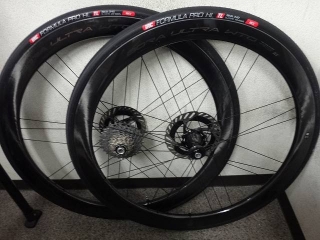
This is one we sold at the shop.
The image above is after the work.
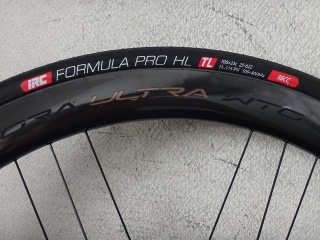
I often align the center of the tire label with the valve hole,
but with Campagnolo wheels, the text has gravity (→here) (→here)
pointing in one direction (downward), so this time I aligned
the tire label text and rim text on the opposite side of the valve hole.
The tire is a hookless rim-compatible model that just came out from IRC,
with "HL" added to the model name acronym.
With the hookless rim-compatible model now available, the conventional model is being discontinued.
Although this tire has the same nominal weight (it's not heavier),
the bead is stiffer and somewhat harder to fit onto the rim than the previous model.
By the way, this wheel is not a hookless rim, just so you know.
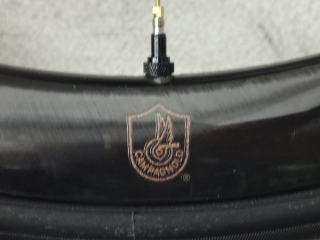
The rim marking on the valve side looks like this.
The image is slightly blurry because when shooting up close,
the camera and my hands get reflected in the rim, so I'm shooting
from a bit further away using zoom.
Starting with the rear wheel.
There was a centering offset, but at a nitpicking level.
"Nitpicking level" means
"pointing this out as a centering offset would be nitpicking."
In the direction where the centering offset decreases, I forcefully kept finding and truing
any minute lateral runout until the center came into true. It's more like truing until it's true
rather than truing to be true.
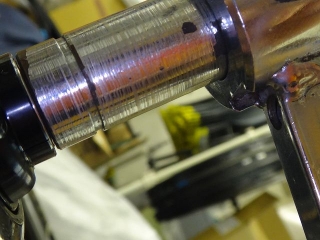
Now for the front wheel.
It appears to have almost no offset, but
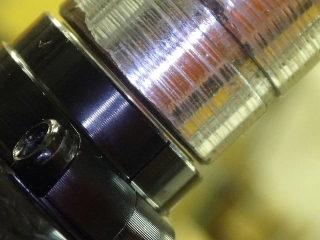
there is a barely detectable offset, right at the limit of observation.
This is the kind of level where some centering gauges would call it perfect.
At this degree, if the gauge happened to be placed at a point of runout,
perfect centering might be observed at other points, but
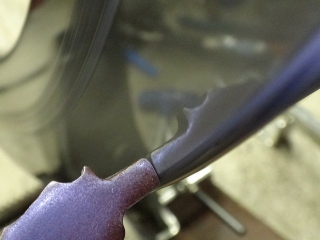
this front wheel was so runout-free you could almost call it perfect.
Even the rear wheel I worked on had runout at about 3 spots.
Just so you know, the wheel in that image is rotating.
At these intervals, there are no points where the gauge contacts the rim.
They're doing this work with pride.
At this level, there are probably plenty of shops that would mess around further with
centering corrections and end up making the accuracy worse than it was.
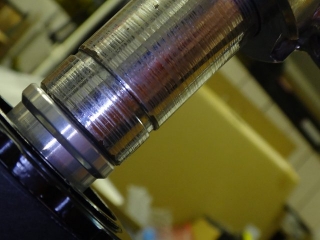

I got the center true.
When a wheel has no runout at all, the work actually becomes harder.
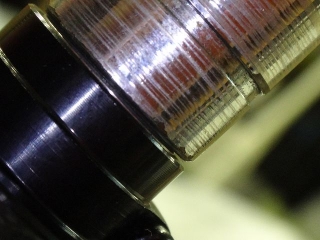
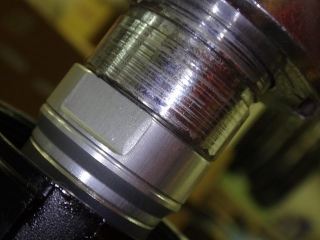
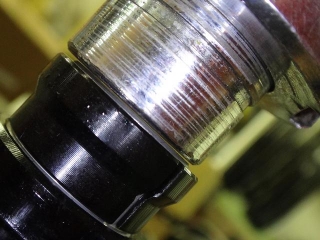
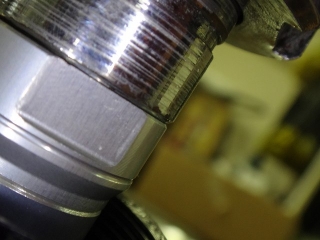
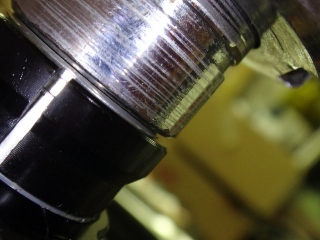
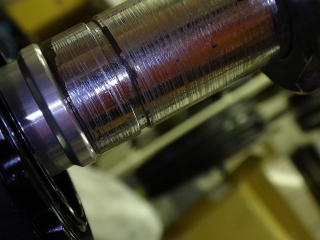
It looks like there's a gap, but
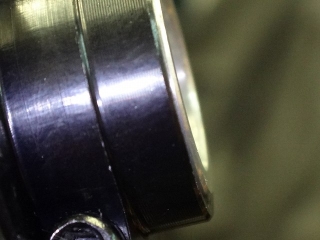
what's touching the fork is the silver part of the hub axle,
and the black part is the adjusting locknut for the bearing preload.
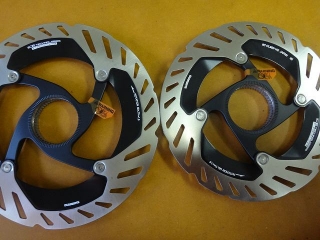
I went with the RT-CL900 disc rotor.
Shimano disc rotors followed the rule of "SM-RT followed by two digits,"
but when the R9100 series Dura-Ace came out,
there were SM-RT900 and SM-RT800 rotors.
The 900 was Dura-Ace grade, the 800 was Ultegra grade.
After that, in the higher grades of MTB,
instead of SM-RT, rotors came out with the part number RT-MT
with RT-MT900 and RT-MT800.
The 900 was XTR grade, the 800 was XT grade.
Yeah, it's confusing.
SM-RT900 and RT-MT900 — aside from calling them wrong,
I could easily make a wrong order.
Fortunately (?) the SM-RT900/800 had problems
like picking up crosswind and being prone to rub during standing efforts,
so riders started using MTB rotors as standard,
and Shimano officially said to use XTR and XT rotors
for Dura-Ace and Ultegra.
From that situation, newly released for road use are
the RT-CL900 and RT-CL800.
CL means better cooling effect, so COOL... no wait,
it's short for center lock. Probably.

This is one we sold at the shop.
The image above is after the work.

I often align the center of the tire label with the valve hole,
but with Campagnolo wheels, the text has gravity (→here) (→here)
pointing in one direction (downward), so this time I aligned
the tire label text and rim text on the opposite side of the valve hole.
The tire is a hookless rim-compatible model that just came out from IRC,
with "HL" added to the model name acronym.
With the hookless rim-compatible model now available, the conventional model is being discontinued.
Although this tire has the same nominal weight (it's not heavier),
the bead is stiffer and somewhat harder to fit onto the rim than the previous model.
By the way, this wheel is not a hookless rim, just so you know.

The rim marking on the valve side looks like this.
The image is slightly blurry because when shooting up close,
the camera and my hands get reflected in the rim, so I'm shooting
from a bit further away using zoom.


Starting with the rear wheel.
There was a centering offset, but at a nitpicking level.
"Nitpicking level" means
"pointing this out as a centering offset would be nitpicking."


In the direction where the centering offset decreases, I forcefully kept finding and truing
any minute lateral runout until the center came into true. It's more like truing until it's true
rather than truing to be true.


Now for the front wheel.
It appears to have almost no offset, but

there is a barely detectable offset, right at the limit of observation.
This is the kind of level where some centering gauges would call it perfect.
At this degree, if the gauge happened to be placed at a point of runout,
perfect centering might be observed at other points, but

this front wheel was so runout-free you could almost call it perfect.
Even the rear wheel I worked on had runout at about 3 spots.
Just so you know, the wheel in that image is rotating.
At these intervals, there are no points where the gauge contacts the rim.
They're doing this work with pride.
At this level, there are probably plenty of shops that would mess around further with
centering corrections and end up making the accuracy worse than it was.


I got the center true.
When a wheel has no runout at all, the work actually becomes harder.

It looks like there's a gap, but

what's touching the fork is the silver part of the hub axle,
and the black part is the adjusting locknut for the bearing preload.

I went with the RT-CL900 disc rotor.
Shimano disc rotors followed the rule of "SM-RT followed by two digits,"
but when the R9100 series Dura-Ace came out,
there were SM-RT900 and SM-RT800 rotors.
The 900 was Dura-Ace grade, the 800 was Ultegra grade.
After that, in the higher grades of MTB,
instead of SM-RT, rotors came out with the part number RT-MT
with RT-MT900 and RT-MT800.
The 900 was XTR grade, the 800 was XT grade.
Yeah, it's confusing.
SM-RT900 and RT-MT900 — aside from calling them wrong,
I could easily make a wrong order.
Fortunately (?) the SM-RT900/800 had problems
like picking up crosswind and being prone to rub during standing efforts,
so riders started using MTB rotors as standard,
and Shimano officially said to use XTR and XT rotors
for Dura-Ace and Ultegra.
From that situation, newly released for road use are
the RT-CL900 and RT-CL800.
CL means better cooling effect, so COOL... no wait,
it's short for center lock. Probably.