Another day of wheel building (and so on).
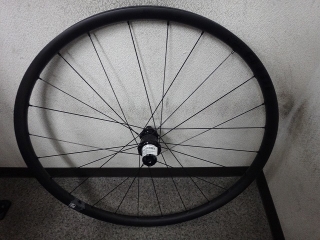
I built a rear wheel with a WTB carbon rim and Onyx hub.
This is for the same customer whose left-side front wheel we built here at the shop before (→here).
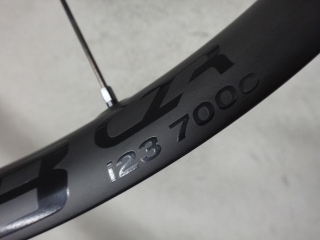
The rim is also a CZR i23 rim, same as the front wheel,
and since the Lefty front wheel was also 700C,
I wonder if it's going on a Topstone with front suspension.
I don't know if the frame for this rear wheel is a Cannondale,
but the customer asked me to build it with normal centering
rather than Cannondale's proprietary AI offset specification.
That said, given that the hub and rim aesthetics match,
it's hard to imagine it being anything other than the pair to that Lefty front wheel.
And since Cannondale apparently dropped AI offset starting with their 2023 models,
it might be going on one of those framesets.
In the future, if I ever need to mount a rear wheel that was built for AI offset
onto a non-AI offset frame,
re-centering it wouldn't be impossible, but
it's so tedious that it's basically impractical,
so it's faster to just build a separate rear wheel.
A realistic scenario where this becomes a real problem would be something like
having multiple race-ready cyclocross bikes prepared,
with some mixing in frames from the AI offset era of Cannondale.
During the transition period for cyclocross, there were front hubs
that didn't use the 100×12 standard
but instead used 100×15, the same as MTBs before the BOOST standard,
and I've actually seen examples like GIANT where
the front fork standard changed from 100×15 to 100×12
between one year's TCX and the next year's model,
making it impossible to share front wheels.
Being forced to have "a rear wheel specific to this frame" or "a front wheel specific to this fork" is inconvenient,
but this isn't limited to cyclocross—
nowadays manufacturers are effectively forcing riders to completely replace their bikes,
going from road bikes with quick-release-fixed 630mm rotors gripped by rubber shoes
to ones with through-axle 160mm or 140mm rotors gripped by resin pads,
and these wheels aren't compatible with each other either.

The hub is an ONYX Racing Vesper,
142×12mm through-axle.
I built it 24H with black semi-comp, 1-2-1 JIS lacing.
I'll tension the spokes later.
Since the CZR rim itself is an offset rim,
if I were asked to build this for AI offset,
the non-drive side would practically explode,
so I might have needed to detune something
in the asymmetrical lacing pattern.
Well, even for someone like me who will never escape the mindset of building rear wheels with symmetrical lacing,
AI offset is an annoying thing because wheels naturally end up with
less spoke tension difference between sides.
The hubs that Cannondale provides factory-built for AI offset specs
aren't actually wider flange compared to standard ones.
So I'm centering it normally.
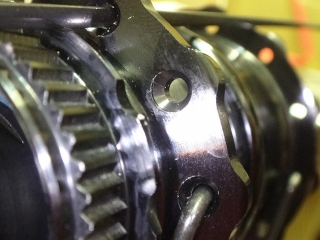
Going back in the timeline a bit,
the reason the center-lock collar on the hub has
a notch cut into it is
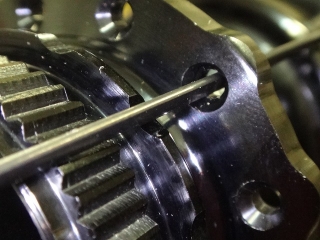
without it, threading the spokes becomes extremely difficult.
Compared to the rim-brake Vesper hub with quick-release,
the drive-side flange hole diameter was the same,
but the non-drive side was slightly larger flange.
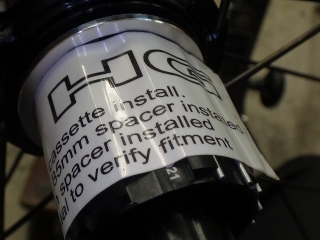
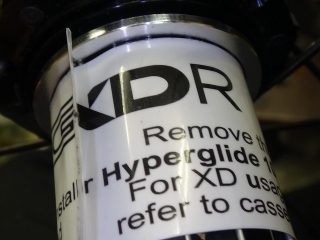
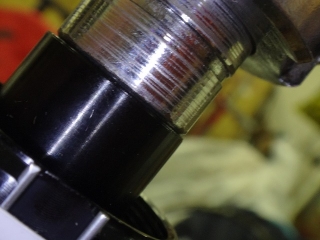
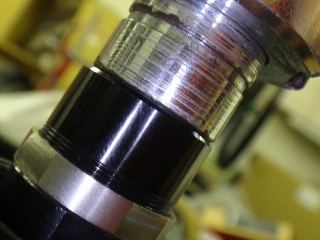
About this seal stuck on the freebody,
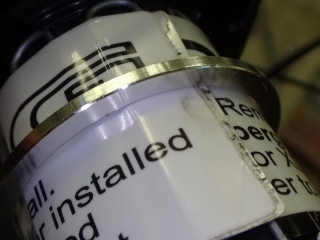
the 1.85mm spacer inside the freebody has a smooth round shape on its inner circumference
with no spline-matching protrusions,
so if you tilt the seal's seam just right,
you can remove it like pulling off a ring.
Actually, what the seal is really trying to hold in place isn't the spacer, but
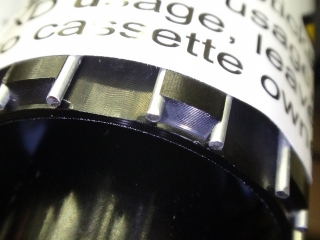
↑this pin.
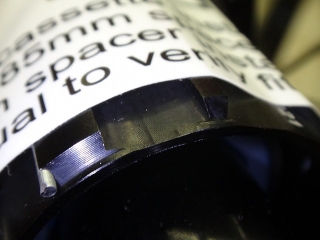
What got me was that
in this section of the spline where the gap is wider, there's no pin.
I hope I didn't drop it somewhere.
The hub arrived from the customer wrapped in bubble wrap, not in a box,
so I didn't see how it shipped.
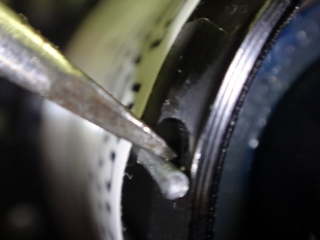
This pin would seem to come loose and fall out if you lifted the seal,
but looking closely, the side surface of the spline protrusion
is rounded because of the pin.
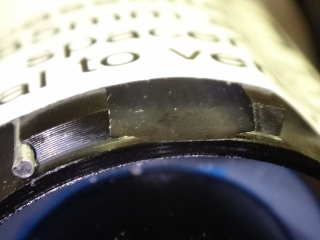
The spline protrusion without the pin didn't have that rounding,
so the pin was missing from the factory. Those jokers really scared me for nothing.

I built a rear wheel with a WTB carbon rim and Onyx hub.
This is for the same customer whose left-side front wheel we built here at the shop before (→here).

The rim is also a CZR i23 rim, same as the front wheel,
and since the Lefty front wheel was also 700C,
I wonder if it's going on a Topstone with front suspension.
I don't know if the frame for this rear wheel is a Cannondale,
but the customer asked me to build it with normal centering
rather than Cannondale's proprietary AI offset specification.
That said, given that the hub and rim aesthetics match,
it's hard to imagine it being anything other than the pair to that Lefty front wheel.
And since Cannondale apparently dropped AI offset starting with their 2023 models,
it might be going on one of those framesets.
In the future, if I ever need to mount a rear wheel that was built for AI offset
onto a non-AI offset frame,
re-centering it wouldn't be impossible, but
it's so tedious that it's basically impractical,
so it's faster to just build a separate rear wheel.
A realistic scenario where this becomes a real problem would be something like
having multiple race-ready cyclocross bikes prepared,
with some mixing in frames from the AI offset era of Cannondale.
During the transition period for cyclocross, there were front hubs
that didn't use the 100×12 standard
but instead used 100×15, the same as MTBs before the BOOST standard,
and I've actually seen examples like GIANT where
the front fork standard changed from 100×15 to 100×12
between one year's TCX and the next year's model,
making it impossible to share front wheels.
Being forced to have "a rear wheel specific to this frame" or "a front wheel specific to this fork" is inconvenient,
but this isn't limited to cyclocross—
nowadays manufacturers are effectively forcing riders to completely replace their bikes,
going from road bikes with quick-release-fixed 630mm rotors gripped by rubber shoes
to ones with through-axle 160mm or 140mm rotors gripped by resin pads,
and these wheels aren't compatible with each other either.

The hub is an ONYX Racing Vesper,
142×12mm through-axle.
I built it 24H with black semi-comp, 1-2-1 JIS lacing.
I'll tension the spokes later.
Since the CZR rim itself is an offset rim,
if I were asked to build this for AI offset,
the non-drive side would practically explode,
so I might have needed to detune something
in the asymmetrical lacing pattern.
Well, even for someone like me who will never escape the mindset of building rear wheels with symmetrical lacing,
AI offset is an annoying thing because wheels naturally end up with
less spoke tension difference between sides.
The hubs that Cannondale provides factory-built for AI offset specs
aren't actually wider flange compared to standard ones.


So I'm centering it normally.

Going back in the timeline a bit,
the reason the center-lock collar on the hub has
a notch cut into it is

without it, threading the spokes becomes extremely difficult.
Compared to the rim-brake Vesper hub with quick-release,
the drive-side flange hole diameter was the same,
but the non-drive side was slightly larger flange.


About this seal stuck on the freebody,

the 1.85mm spacer inside the freebody has a smooth round shape on its inner circumference
with no spline-matching protrusions,
so if you tilt the seal's seam just right,
you can remove it like pulling off a ring.
Actually, what the seal is really trying to hold in place isn't the spacer, but

↑this pin.

What got me was that
in this section of the spline where the gap is wider, there's no pin.
I hope I didn't drop it somewhere.
The hub arrived from the customer wrapped in bubble wrap, not in a box,
so I didn't see how it shipped.

This pin would seem to come loose and fall out if you lifted the seal,
but looking closely, the side surface of the spline protrusion
is rounded because of the pin.

The spline protrusion without the pin didn't have that rounding,
so the pin was missing from the factory. Those jokers really scared me for nothing.