Another wheel day (etc.).
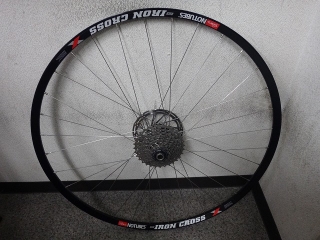
A customer brought in a rear wheel built with a Standup Iron Cross Rim (Standup アイアンクロスリム).
This is actually the very rear wheel I've been seeking for years.
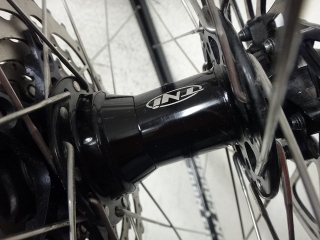
The reason is that this rear wheel has the Tni Evo Disc Hub II with Sapim Laser spokes (2.0–1.5–2.0mm) laced in a 4-cross (radial on the reverse side) pattern—basically the worst possible configuration built with a reverse high-low flange rear hub. Because the Iron Cross has a low tension tolerance, even when built with Laser or Revolution spokes, the spokes don't go into the "squirmy" zone, so you might say the rim and spoke matching is decent. That said, they weren't tensioned anywhere near the Iron Cross's limit.

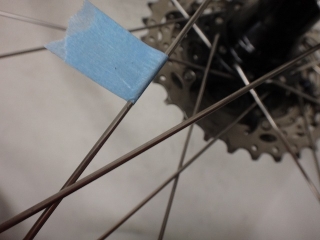
So the non-drive side is extremely loose. As I mentioned, the drive side was already loose to begin with, and the unfavorable hub dimensions are making it worse.
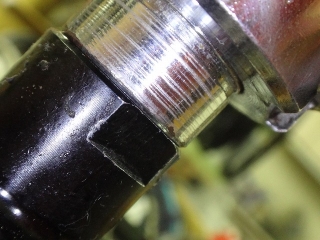
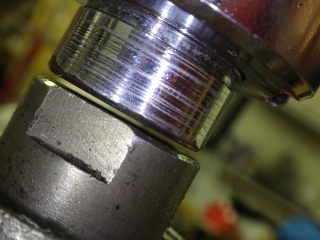
Along with some wear and drift from years of use, the rim had shifted toward the drive side. If I true this by tightening the non-drive side, the non-drive side will be tensioned a bit more, but it won't change drastically.
Wow, this is rare. I wouldn't bother building a wheel like this these days.
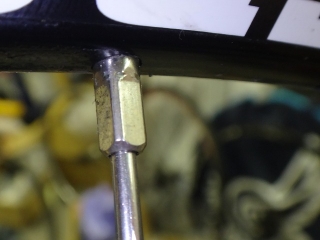
Also, I couldn't figure out why they used brass nipples when both the spokes and rim are light.
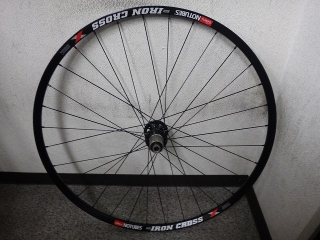
Built.
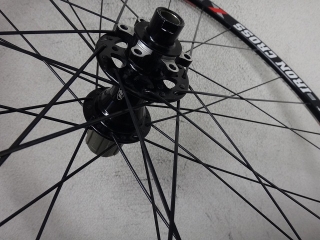
Evo Disc Hub II 32H black half-comp 4-cross JIS lacing with black aluminum nipples. I'll do the spoke dressing later. The original had silver spokes, but the rebuild has black spokes per the customer's request. The non-drive side is large flange and it's a 32H hub, so 8-cross (48-spoke) lacing would also be possible, but I went with 46-spoke this time.
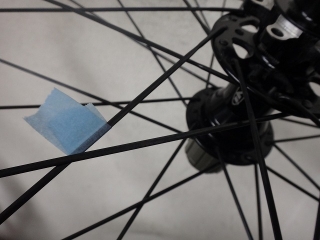
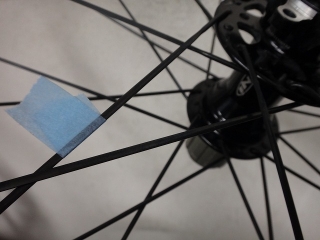
To be fair, I tensioned with more force than the original wheel (enough to leave spoke marks on my fingers immediately after), so I'd like to say the non-drive side deformation is reduced, but the original had straight-gauge spokes while the rebuild uses aero spokes. Aero spokes show favorable results regarding deformation from front-to-back compression during the final cross tensioning, so I can't make a direct comparison. It's true that tension is far higher and the difference in spoke deformation between left and right is greatly reduced. Still, I'm being very conservative and holding back to stay within the Iron Cross's limits, so if it were a rim like the Nomulab Wheel 8, I'd tension it a bit more. Also, I didn't photograph it, but the wheel is of course centered, just so you know.

A customer brought in a rear wheel built with a Standup Iron Cross Rim (Standup アイアンクロスリム).
This is actually the very rear wheel I've been seeking for years.

The reason is that this rear wheel has the Tni Evo Disc Hub II with Sapim Laser spokes (2.0–1.5–2.0mm) laced in a 4-cross (radial on the reverse side) pattern—basically the worst possible configuration built with a reverse high-low flange rear hub. Because the Iron Cross has a low tension tolerance, even when built with Laser or Revolution spokes, the spokes don't go into the "squirmy" zone, so you might say the rim and spoke matching is decent. That said, they weren't tensioned anywhere near the Iron Cross's limit.


So the non-drive side is extremely loose. As I mentioned, the drive side was already loose to begin with, and the unfavorable hub dimensions are making it worse.


Along with some wear and drift from years of use, the rim had shifted toward the drive side. If I true this by tightening the non-drive side, the non-drive side will be tensioned a bit more, but it won't change drastically.
Wow, this is rare. I wouldn't bother building a wheel like this these days.

Also, I couldn't figure out why they used brass nipples when both the spokes and rim are light.

Built.

Evo Disc Hub II 32H black half-comp 4-cross JIS lacing with black aluminum nipples. I'll do the spoke dressing later. The original had silver spokes, but the rebuild has black spokes per the customer's request. The non-drive side is large flange and it's a 32H hub, so 8-cross (48-spoke) lacing would also be possible, but I went with 46-spoke this time.


To be fair, I tensioned with more force than the original wheel (enough to leave spoke marks on my fingers immediately after), so I'd like to say the non-drive side deformation is reduced, but the original had straight-gauge spokes while the rebuild uses aero spokes. Aero spokes show favorable results regarding deformation from front-to-back compression during the final cross tensioning, so I can't make a direct comparison. It's true that tension is far higher and the difference in spoke deformation between left and right is greatly reduced. Still, I'm being very conservative and holding back to stay within the Iron Cross's limits, so if it were a rim like the Nomulab Wheel 8, I'd tension it a bit more. Also, I didn't photograph it, but the wheel is of course centered, just so you know.