A customer brought in a Roval CLX32
rim brake wheelset for service.
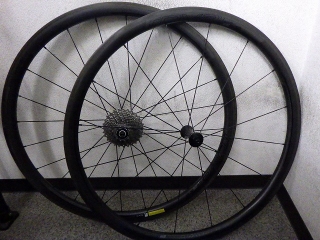
We determined that hub bearing replacement was necessary,
and the customer also requested rear wheel truing.
For the rear wheel, there's no need to rebuild it with reverse-spoked lacing before truing.
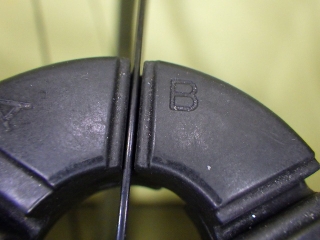
The drive side uses black Aero Lite spokes
with a thickness that fits all the way into the B-groove of the Campagnolo tool,
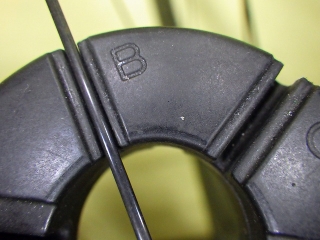
while the non-drive side uses black Aero Comp spokes
with a thickness that doesn't reach the bottom of the B-groove,
so it's already built with reverse-spoked lacing.

Before tensioning

During tensioning
Before tensioning
During tensioning
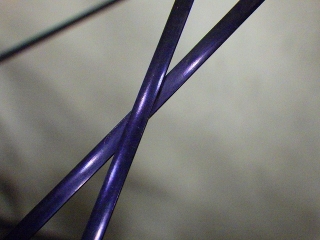
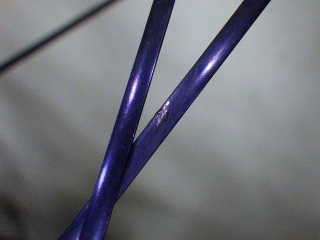
These show the final crossing point at the same location in the upper and lower images,
and you can see the paint is worn away at the contact points where the spokes cross.
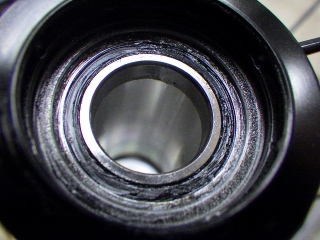
The freewheel body bearing didn't need replacement,
but all the left and right bearings on both the front and rear hub bodies
had a rough, grinding rotation,
so we determined replacement was necessary.
The bearing size is 6902 on the right side of the hub body only,
while the other three positions use 6802.
The 6902 is a larger bearing size and shouldn't deteriorate as easily,
but the rotation was heavy enough to warrant replacement.
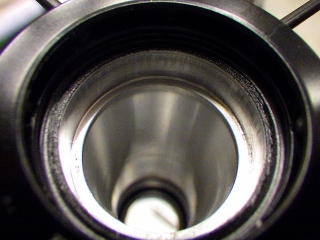
DT (the original manufacturer) uses larger bearings because they adopted skewers
that have a negative impact on bearings.
However, wheels like Roval and GIANT's SLR either fail to understand
why DT made that choice, or are too shortsighted in their weight-saving
and use undersized bearings for the hub body.
Steel ball bearings weigh about 7g for the 6802 and about 16g for the 6902,
so there's definitely more than double the weight difference there alone.
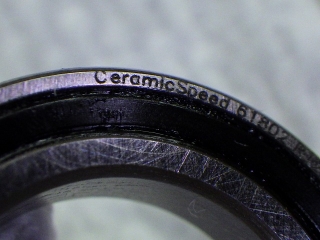
I removed the CeramicSpeed bearings.
The seal ring is black on the outside, and the manufacturer and size markings
are printed only on the side of the outer race.

The inner seal facing the hub is blue.
While not quite as bad as Mavic's Instant Drive 360,
CeramicSpeed's recommended maintenance frequency is so unrealistic
that probably nobody actually follows it,
and especially on Roval front wheels, you often see ones that have
much grittier rotation than a fresh steel ball bearing would have.
Since the customer said steel bearings were fine for the replacement,
I went ahead and replaced them with steel ball bearings.
The rotation is now much smoother than it was with the damaged ceramic ball bearing races.

The DT rear hub freewheel body bearing cannot be replaced without removing
the ratchet tooth component.
This one is a star ratchet, which requires a special tool with a gear-like spline
with square-toothed profile around the circumference.
The three-pawl spring ratchet hubs have a similar tool with a saw-tooth-like profile,
and since the threaded dimension on the hub body is the same,
it's theoretically possible to convert a three-pawl spring ratchet rear hub
to a star ratchet (though we've never done it at this shop).
The parts are prohibitively expensive, so I doubt anyone would try.
We do have the tool since we've replaced the right bearing on a three-pawl spring ratchet rear hub before.

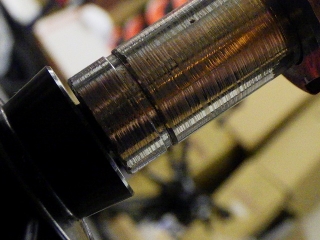
The front wheel had lateral runout.
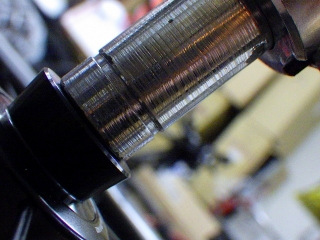
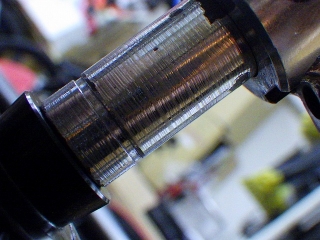
I trued the runout and centered it.
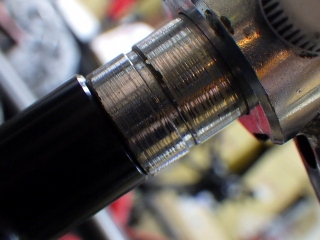
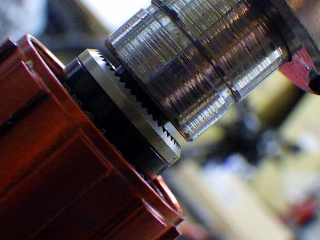
The rear wheel had lateral runout so severe it wouldn't pass manufacturer QC
(except for Mavic), and it also had significant radial runout that the front wheel didn't have.
This suggested there was a history of "going through the motions of just fixing lateral runout"
without addressing radial issues.
Fixing this took more time than the bearing replacement and respooking combined.
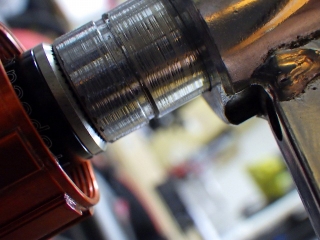
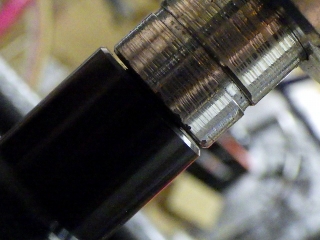
After chasing down both the radial and lateral runout,
the direction of the lateral offset reversed at that point.
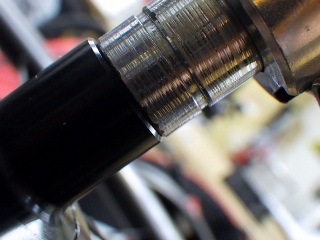

The centering is now corrected.
Now we can respoke it.
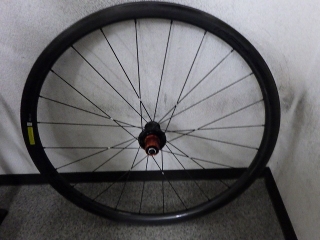
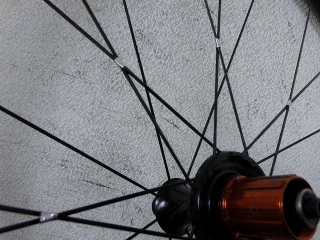
Done respooking.
rim brake wheelset for service.

We determined that hub bearing replacement was necessary,
and the customer also requested rear wheel truing.
For the rear wheel, there's no need to rebuild it with reverse-spoked lacing before truing.

The drive side uses black Aero Lite spokes
with a thickness that fits all the way into the B-groove of the Campagnolo tool,

while the non-drive side uses black Aero Comp spokes
with a thickness that doesn't reach the bottom of the B-groove,
so it's already built with reverse-spoked lacing.

Before tensioning

During tensioning

Before tensioning

During tensioning
These show the final crossing point at the same location in the upper and lower images,
and you can see the paint is worn away at the contact points where the spokes cross.

The freewheel body bearing didn't need replacement,
but all the left and right bearings on both the front and rear hub bodies
had a rough, grinding rotation,
so we determined replacement was necessary.
The bearing size is 6902 on the right side of the hub body only,
while the other three positions use 6802.
The 6902 is a larger bearing size and shouldn't deteriorate as easily,
but the rotation was heavy enough to warrant replacement.

DT (the original manufacturer) uses larger bearings because they adopted skewers
that have a negative impact on bearings.
However, wheels like Roval and GIANT's SLR either fail to understand
why DT made that choice, or are too shortsighted in their weight-saving
and use undersized bearings for the hub body.
Steel ball bearings weigh about 7g for the 6802 and about 16g for the 6902,
so there's definitely more than double the weight difference there alone.

I removed the CeramicSpeed bearings.
The seal ring is black on the outside, and the manufacturer and size markings
are printed only on the side of the outer race.

The inner seal facing the hub is blue.
While not quite as bad as Mavic's Instant Drive 360,
CeramicSpeed's recommended maintenance frequency is so unrealistic
that probably nobody actually follows it,
and especially on Roval front wheels, you often see ones that have
much grittier rotation than a fresh steel ball bearing would have.
Since the customer said steel bearings were fine for the replacement,
I went ahead and replaced them with steel ball bearings.
The rotation is now much smoother than it was with the damaged ceramic ball bearing races.

The DT rear hub freewheel body bearing cannot be replaced without removing
the ratchet tooth component.
This one is a star ratchet, which requires a special tool with a gear-like spline
with square-toothed profile around the circumference.
The three-pawl spring ratchet hubs have a similar tool with a saw-tooth-like profile,
and since the threaded dimension on the hub body is the same,
it's theoretically possible to convert a three-pawl spring ratchet rear hub
to a star ratchet (though we've never done it at this shop).
The parts are prohibitively expensive, so I doubt anyone would try.
We do have the tool since we've replaced the right bearing on a three-pawl spring ratchet rear hub before.


The front wheel had lateral runout.


I trued the runout and centered it.


The rear wheel had lateral runout so severe it wouldn't pass manufacturer QC
(except for Mavic), and it also had significant radial runout that the front wheel didn't have.
This suggested there was a history of "going through the motions of just fixing lateral runout"
without addressing radial issues.
Fixing this took more time than the bearing replacement and respooking combined.


After chasing down both the radial and lateral runout,
the direction of the lateral offset reversed at that point.


The centering is now corrected.
Now we can respoke it.


Done respooking.